

Global Trends and Policy Insights in Telemedicine: Analysis of 1,453 Regulations and Market Dynamics

Text. Deng Xueyuan
In recent years, the domestic telemedicine market has developed rapidly. In 2015, the market size of telemedicine had already reached3.6 billion yuan, with the proliferation of mobile medical terminals, the development of the Medical Internet of Things (IoMT), and increased participation from healthcare institutions, it is projected to reach by the end of 2018RMB 17.2 billion。
Telemedicine not only bears the mission of addressing the unequal distribution of medical resources, but also serves as a critical link connecting the vast industrial chain encompassing healthcare, insurance, and pharmaceuticals.Major enterprises such as Neusoft, Wonders Information, Winning Health, and Longma Information have actively entered the market, while startups continue to emerge., especially after 2011, showing an upward trend; in 2015, there were29 CompaniesNewly established companies. This is because the number of telemedicine policies issued in China has seen a leapfrog increase since 2011.
In fact, policy-driven initiatives have been a prominent feature throughout the development of the telemedicine industry. In this report, we have reviewed the period from 1997 to the present1,453 articlesAnalyze telemedicine-related policies to identify key development directions, strategic focus areas, and priority regions. Compare these with overseas policies from the United States, Europe, and Japan to gain insights into future trends in the field.
// VCBeat members can access the full report. The 1,453 policies mentioned in this report will be freely available to members next week. To become a VCBeat member, please long-press to scan the mini-program code below //

Below is a partial report.
Telemedicine refers to the provision of long-distance medical information and services to populations in areas with limited healthcare resources or in special environments, by leveraging computer technology, remote sensing, telemetry, and remote control technologies to fully utilize the medical expertise and equipment advantages of large hospitals or specialized medical centers. Telemedicine encompasses all medical activities, including remote diagnosis, remote consultation and nursing, tele-education, and remote medical information services. The aim of telemedicine is to enhance healthcare service capabilities, reduce medical expenditures, and meet the healthcare needs of a broader population.
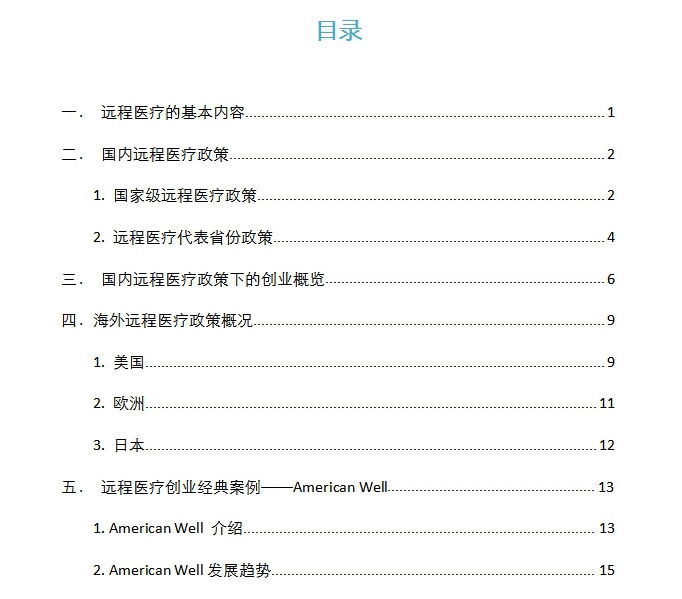
This report outlines the development of telemedicine both domestically and internationally by examining its fundamental concepts, China’s telemedicine policies, an overview of entrepreneurial ventures under these domestic policies, a summary of overseas telemedicine policies, and classic case studies of telemedicine startups.
Telemedicine refers to the provision of long-distance medical information and services to populations in areas with poor healthcare conditions or in special environments, by leveraging computer technology, remote sensing, telemetry, and remote control technologies to fully utilize the medical expertise and equipment advantages of large hospitals or specialized medical centers. Telemedicine encompasses all medical activities, including remote diagnosis, remote consultation and nursing, remote education, and remote medical information services. The aim of telemedicine is to enhance healthcare service capabilities, reduce medical expenditures, and meet the healthcare needs of a broader population.
In the late 1950s, American scholar Wittson first applied two-way television systems to medical care. In the same year, Jutra and colleagues established the field of teleradiology. Subsequently, researchers in the United States continued to leverage communication and electronic technologies for medical activities, leading to the emergence of the term “Telemedicine.”
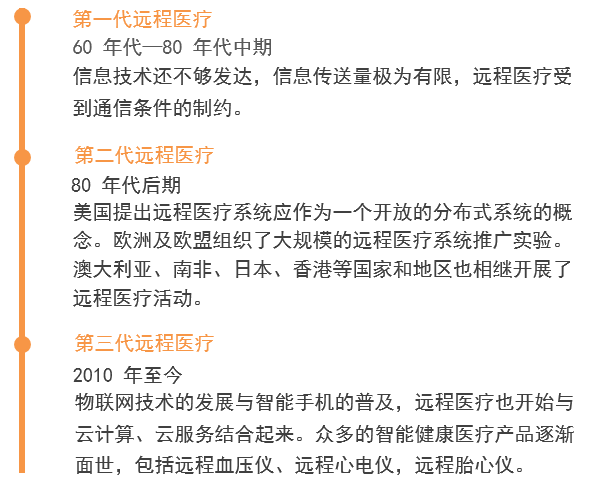
Schematic Diagram of the Development Path of Overseas Telemedicine
Overseas telemedicine has a 40-year history. Compared with foreign countries, China's telemedicine started slightly later, but since its launch, it has developed at a relatively rapid pace.
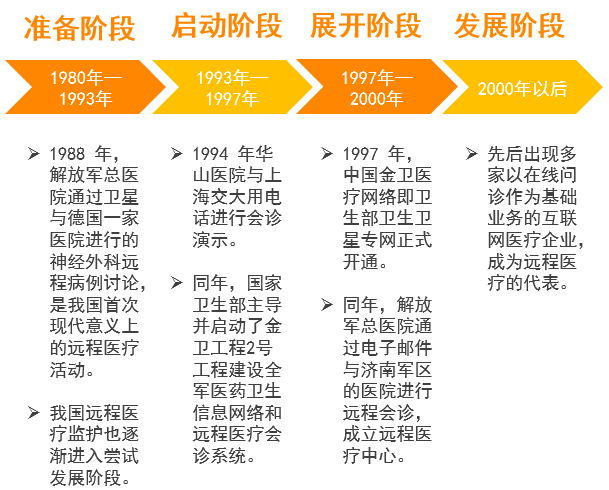
Timeline of the Development Stages of Telemedicine in China
China began exploratory research trials in investigative telemedicine in the late 1980s, and initiated the development and application of practical telemedicine systems in the mid-1990s.
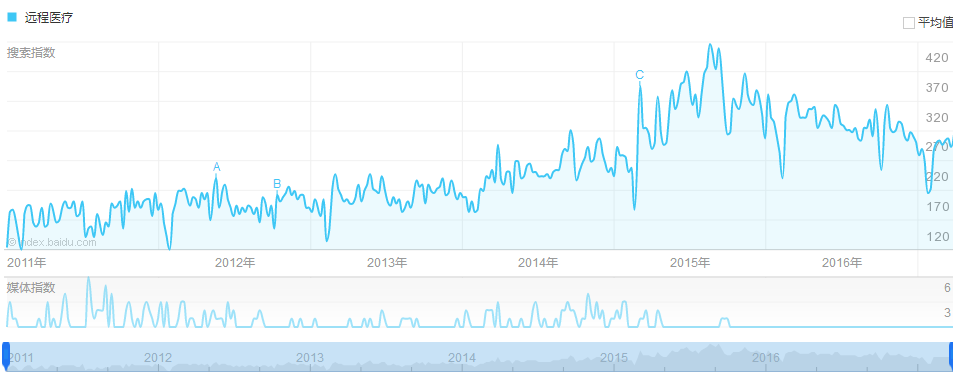
A search for "telemedicine" on the Baidu Index reveals that its corresponding trend line has been on a consistent upward trajectory since 2012.
ViaVCBeat Knowledge BaseSearch『Telemedicine』『Remote Consultation』Two keywords: The VCBeat Knowledge Base shows a total of 1,453 relevant policies. The earliest telemedicine policy dates back to 1997. In 2011, there was an explosive growth in the number of telemedicine policies released, after which the annual volume stabilized at between 140 and 200.
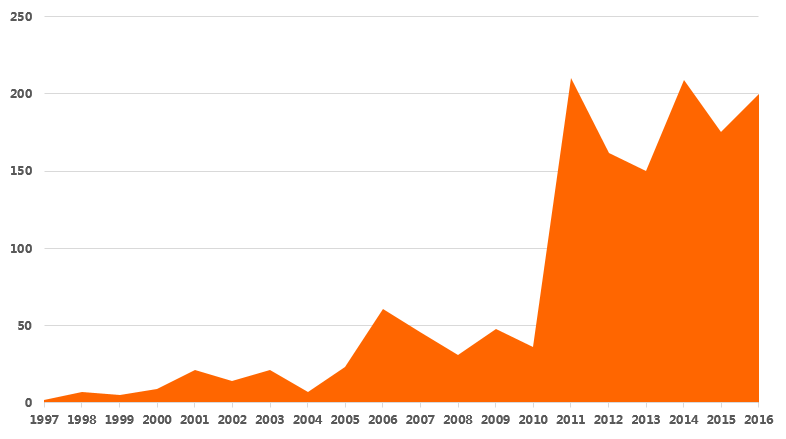
Figure. Number of Telemedicine Policies Issued Annually in China
Among the 1,453 policies, 1,298 are local policies and 155 are national-level policies. Based on data from the VCBeat knowledge base, VCBeat analyzed the number of telemedicine-related policies issued by each province. Guangdong Province had the highest number with 118 policies, followed by Zhejiang Province with 103. The top ten provinces are Guangdong, Zhejiang, Jiangsu, Hebei, Shandong, Sichuan, Fujian, Henan, Shanxi, and Inner Mongolia.
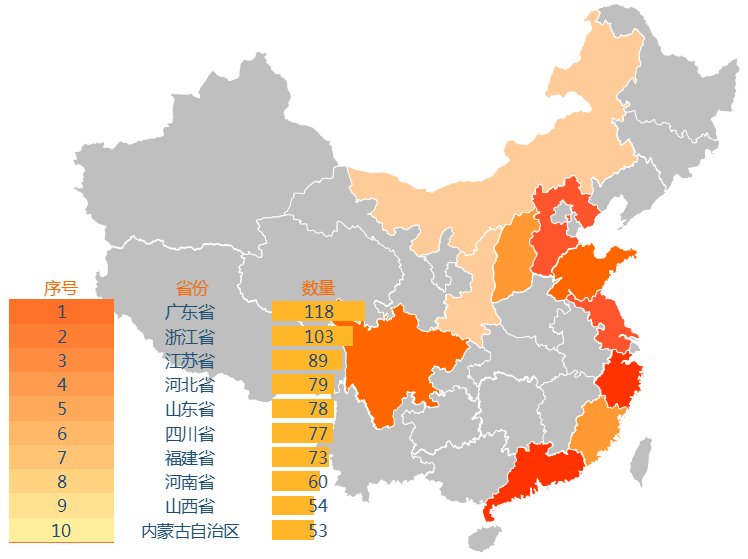
Figure. Distribution of Local Telemedicine Policies in China
The policy clarifies the development direction of telemedicine, outlines its core components, specifies requirements for service delivery models, and establishes development goals. Telemedicine primarily targets grassroots institutions, remote areas, and underdeveloped regions, aiming to facilitate the downward distribution of high-quality medical resources and improve resource utilization efficiency.
Among the 1,452 telemedicine-related policies, 155 are national-level policies. VCBeat has selected 14 of the most representative key policies from these.
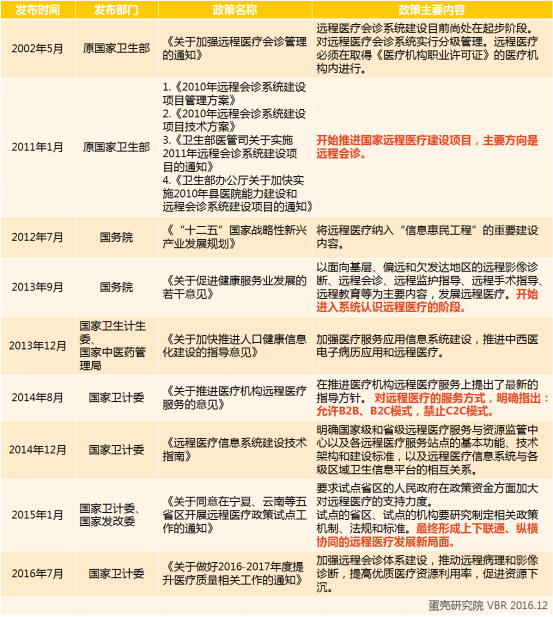
Overview of Key National Policies on Telemedicine
An analysis of key policies reveals that China’s telemedicine framework is primarily focused on three areas: remote consultations, remote monitoring and guidance, and remote imaging diagnosis.
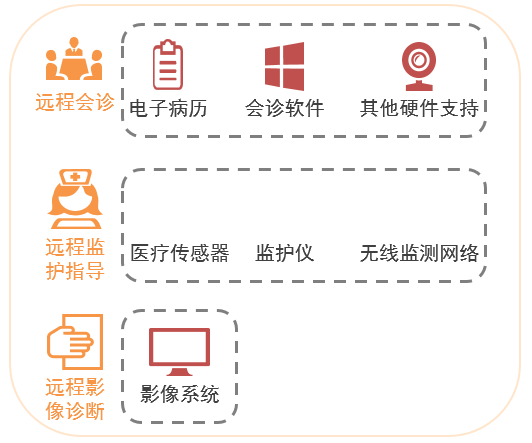
Key Focus Areas of China's Telemedicine Policy
One of the objectives of telemedicine is to help remote areas and regions with inadequate healthcare conditions gain access to high-quality medical resources. Provinces with relatively limited healthcare infrastructure deserve particular attention during the implementation of telemedicine initiatives. In January 2015, the General Office of the National Development and Reform Commission and the General Office of the National Health and Family Planning Commission approved pilot telemedicine policy programs in the Ningxia Hui Autonomous Region, Yunnan Province, Inner Mongolia Autonomous Region, Guizhou Province, and Tibet Autonomous Region. Specifically, Ningxia, Guizhou, and Tibet collaborated with the Chinese PLA General Hospital; Inner Mongolia partnered with Peking Union Medical College Hospital; and Yunnan worked with China-Japan Friendship Hospital to carry out these telemedicine policy pilots.
Guizhou Province, located in the hinterland of Southwest China, borders Chongqing, Sichuan, Hunan, Yunnan, and Guangxi, serving as a transportation hub for the southwestern region. Characterized predominantly by plateaus and mountains, Guizhou is home to numerous underdeveloped townships nestled within its mountainous areas. In these regions, the scarcity of medical resources, compounded by poor transportation accessibility, makes the implementation of telemedicine an urgent priority.
Since January 2015, when the General Office of the National Development and Reform Commission (NDRC) and the General Office of the National Health and Family Planning Commission (NHFPC) included Guizhou Province as one of the five pilot provinces for telemedicine policies, Guizhou Province successively issued eight policy regulations in July of the same year to standardize the provision of telemedicine services. These regulations covered aspects such as service-providing institutions, practitioners, operational standards, telemedicine under tiered diagnosis and treatment, two-way referral, protection of patients’ personal information, incentive mechanisms, and evaluation methods.
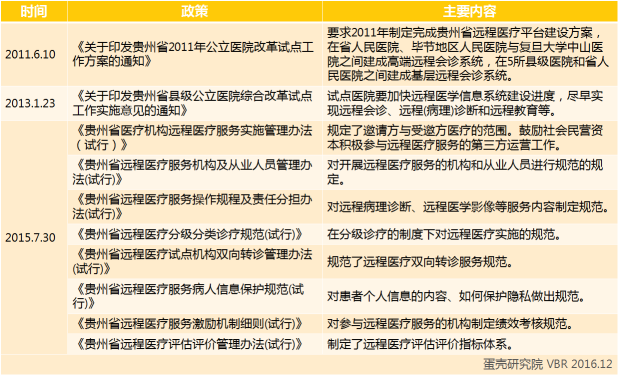
List of Representative Policies and Regulations on Telemedicine in Guizhou Province
Alongside the promulgation of policies, Guizhou has also been actively implementing telemedicine services. Since 2014, telemedicine in Guizhou has witnessed rapid development.
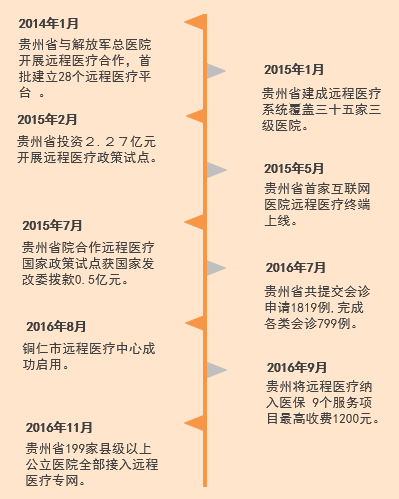
Overview of Key Measures Implemented by Guizhou Province to Advance Telemedicine
In July 2015, the National Development and Reform Commission (NDRC) allocated RMB 50 million to support Guizhou Province in establishing a national policy pilot for provincial-hospital collaborative telemedicine. Building on this foundation, an additional RMB 100 million was appropriated to support Guizhou Province’s implementation of the “Broadband Countryside” demonstration project, aimed at enhancing rural informatization and thereby indirectly providing technical support for rural telemedicine in the province.
China’s first telemedicine startup was founded in May 1998. As of December 2016, there were a total of 81 startups in the telemedicine sector.
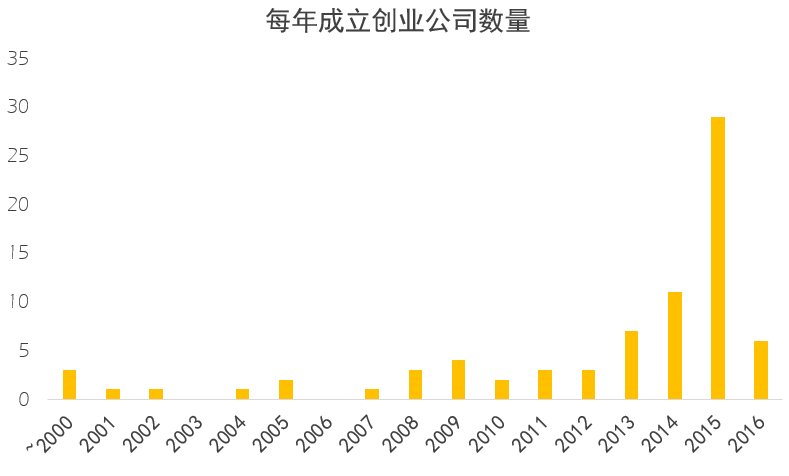
(Note:(Among the 81 companies, four did not disclose their founding dates and are therefore excluded from the above chart.)
Prior to 2007, China’s telemedicine startup sector was in its infancy, with an average of only one to two new companies established each year. Starting in 2008, entrepreneurial activity in telemedicine began to gain momentum, particularly after 2011, when it showed a marked upward trend. This growth was driven by a surge in the number of telemedicine-related policies issued in China after 2011, which spurred the emergence of a wave of startups under policy guidance. In 2015, the number of newly founded telemedicine companies peaked, with 29 new entrants establishing their presence in the field.
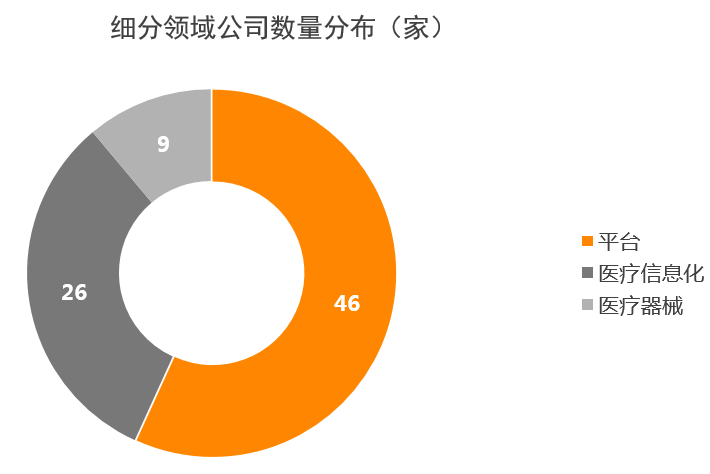
As of December 2016, among the 81 companies in China providing telemedicine services, more than half offered platform-based services. These platforms integrated domestic and international medical resources, enabling patients to remotely access these resources via websites and mobile apps, thereby facilitating telemedicine, while the companies charged a commission fee. Furthermore, the scope of platform services was diverse, specifically including overseas medical treatment, assisted reproductive technology, and dental care.
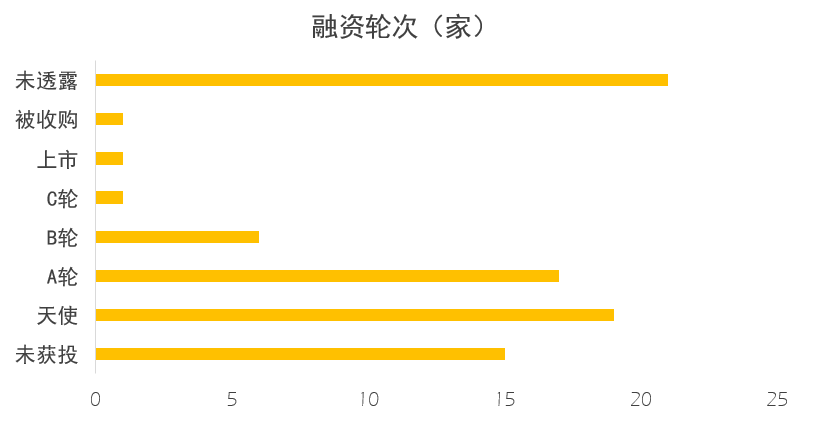
Investment and Financing Landscape of Telemedicine in ChinaOverview
Excluding companies with unknown financing status, most domestic telemedicine companies are currently in the early stages of fundraising, with a significant number yet to secure investment or having only completed angel or Series A rounds. This presents substantial opportunities for capital entry.
The development of telemedicine in the United States has evolved from Era 1.0 to Era 2.0. Telemedicine in Era 1.0 was primarily conducted between healthcare institutions and physicians. The hallmark of Era 2.0 telemedicine is its patient-centered approach, which leverages advanced communication networks to connect physicians with patients.
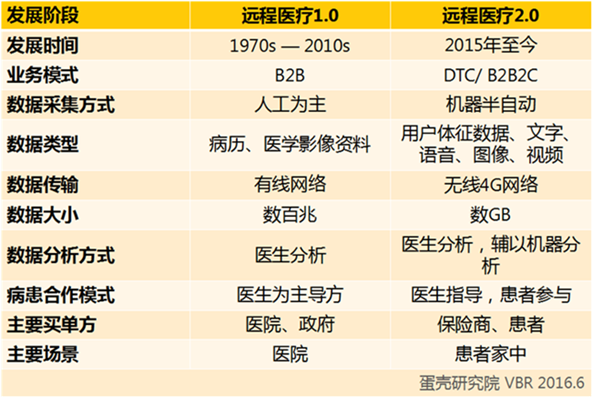
(Image source: VCBeat)June 24, 2016 “A Detailed Explanation of How the United States Moved into the Telemedicine 2.0 Era with the DTC Model”
Since 1997, a series of legislative acts with significant influence on the development of telemedicine in the United States have been enacted, primarily focusing on expanding the geographic coverage and scope of medical conditions eligible for telemedicine reimbursement.
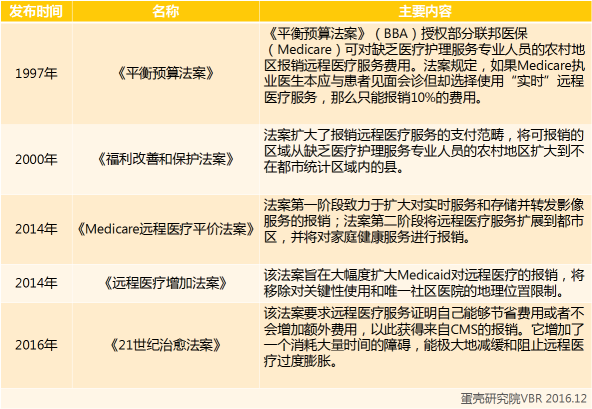
Overview of Key Policies in the Development of Telemedicine in the United States
In its “2016 U.S. Healthcare Consumer Survey Report,” Deloitte noted that consumers are open to telemedicine. Nearly half of the surveyed consumers, including those with and without chronic conditions, expressed willingness to use telemedicine services for post-acute care or chronic disease monitoring. Consumers appear less interested in using telemedicine for the diagnosis and treatment of acute conditions, such as sore throat, rash, or minor injuries. Regarding potential issues that may arise during telemedicine consultations, the surveyed consumers also shared their perspectives.
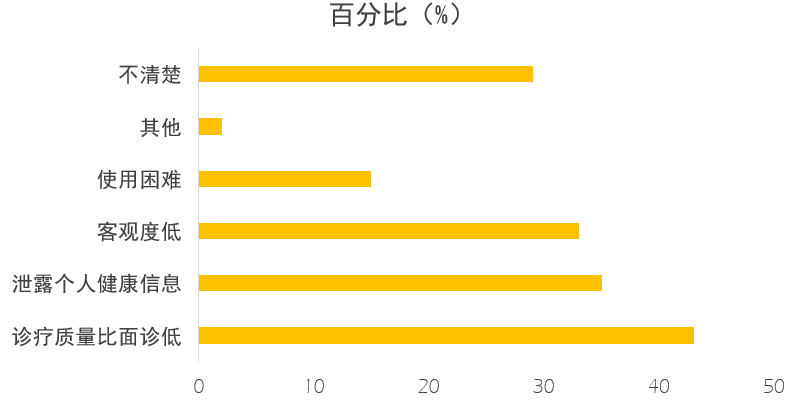
Note: Potential Issues with Telemedicine from the Perspective of U.S. Consumers
Beyond this, a critical aspect in the development of telemedicine in the United States has been determining which party bears the cost. Currently, insurance coverage for telemedicine lags slightly behind; Medicare covers only a limited number of telemedicine services and restricts eligibility to beneficiaries in rural areas. Bipartisan support has emerged in the U.S. Congress for legislation aimed at expanding telemedicine coverage. Opponents worry that such expansion could increase costs for taxpayers, while proponents argue that, in the long run, these measures will reduce taxpayer burdens.
Regarding the release of new policies, the United States' new regulations in the field of telemedicine may need to balance the relationships among potential service growth, increased costs, changes in payment methods, altered licensing conditions, and shifts in business models.
Europe’s healthcare standards have consistently ranked among the world’s best. Due to relatively abundant medical resources, Europe has been less proactive in developing telemedicine. Nevertheless, Europe has continued to focus on other benefits offered by telemedicine, such as improved diagnostic and treatment efficiency and telemedicine-based education. The United Kingdom, Germany, Italy, and Norway are representative countries in this regard.
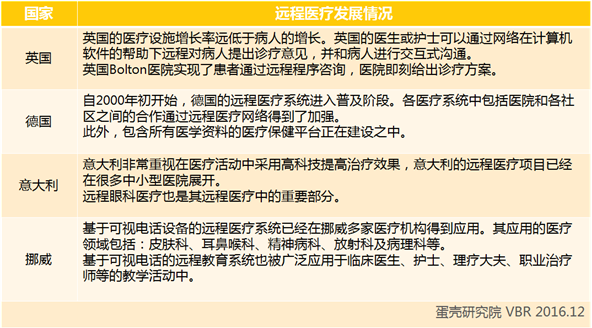
Overview of Telemedicine Development in Selected European Countries
The background for the development of telemedicine in Japan is the shortage of radiologists and pathologists, which fails to meet patients’ healthcare needs. The initial framework of telemedicine in Japan emerged around 1970, and by 1990, its application scope had begun to gradually expand. In 1997, film-based fax machines enabled large-scale remote imaging diagnosis. By 1999, the Department of Pathology at Asahikawa Medical University had established connections with 42 primary care hospitals. Alongside the development of telemedicine in Japan, its definition has continuously evolved.
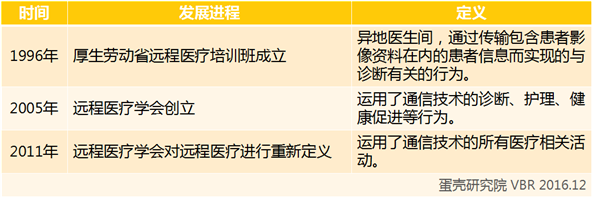
Overview of the Evolution of the Definition of Telemedicine in Japan
In 2012, the Kochi Medical Regeneration Institute in Japan began providing tele-radiology diagnostic assistance to areas with shortages of medical resources. This mechanism was first established at Aki Hospital in Kochi Prefecture, which lacked specialists capable of interpreting medical images. The newly introduced remote image diagnosis system by the Kochi Medical Regeneration Institute utilizes servers managed by Tokyo-based “Doctor Net” Co., Ltd., receiving images from hospitals in remote areas via a virtual private network (VPN).
[References]
Wen Xuebin, Cao Yanlin.Legal and Policy Analysis of Telemedicine Development[M].2015
Fan Jing, Jiang Tianyi.Interpretation of Telemedicine Policy[J].2015
Yu Yang. Policy Measures and Current Status of Digital Healthcare Development in the European Union[J].2012
Osaka University Hospital. Overview of Japan’s Official Telemedicine Business Model[R].2016
Gao Xing, Hu Hongpu.Development Experience and Implications of Telemedicine in the United States[J].2016
VCBeat: A Detailed Analysis of How the United States Embraced Telemedicine2.0EraDTCMode[N].2016

Author of this articleDeng Xueyuan, Wang Guanglong(WeChat ID: touchlife1). After purchasing a membership, add the author to obtain materials for this article. When adding, please specify: Name-Company-Position.