

Nokia Bets on Digital Health: Acquires Withings and Partners with IBM Watson to Rebuild Its Future
When Nokia announced that it would exit the mobile phone business, it did not mean that its ambitions in the hardware sector had come to an end: last year, Nokia acquired the French health hardware manufacturer Withings, using this €170 million acquisition to open the door to the healthcare industry.
The transaction was completed last June, when Nokia combined Withings’ hardware manufacturing capabilities with its own patient care and preventive healthcare teams. This integration forms the foundation of Nokia’s digital health business unit, which claims it will create “smarter objects that lead healthier lives.” Withings has now been integrated into Nokia Technologies, the division responsible for research and development and patents.
“We have a clear plan to accelerate our product roadmap and rapidly bring new health solutions to market—including devices and applications. At the same time, we will ensure that our team does not merely focus on technology in isolation, but also maintains close attention to the marketing and communications sectors,” Cédric Hutchings, CEO of Withings prior to its acquisition and now Nokia’s Vice President of Digital Health, told ZDNet.
Nokia’s leadership has provided Withings with a strong growth opportunity. Hutchings added that digital health is a key vertical within the Internet of Things (IoT) and aligns closely with Nokia’s strategic vision and brand equity. He noted that catering to the mass market is a critical capability, as is large-scale strategic collaboration between companies. He stated that the initial outcomes of the Nokia–Withings partnership will be reflected in this year’s product roadmap.
OEM Subsidiary’s Health Devices: “Light Medical” Concept Integrated Across the Entire Product Line
Withings’ health device products will alsoBranded with the Nokia name, but did not announce the exact timing of the rebranding. Coincidentally, Nokia launched at the 2017 Consumer Electronics Show (CES)Nokia 6 Smartphone,In fact, it also adopted the product OEM/white-labeling approach.—The mobile phones are manufactured by HMD Global Oy, a company founded by former Nokia employees, but they use the Nokia brand logo.
Nokia envisions evolving into a health information platform, where connected hardware devices will contribute users’ health status and activity data. This concept bears some resemblance to Apple’s HealthKit; however, further observation is needed to determine how Nokia will specifically deploy this platform.
Withings offers a diverse range of hardware devices and app-based products. These include widely recognized consumer items such as smartwatches, as well as more niche offerings like the upcoming “connected hairbrush,” which purportedly analyzes hair health while you comb your hair.
A core philosophy running through Withings’ product line is to infuse everyday lifestyle items with more medical-grade functionalities. For instance, its recently launched Body Cardio scale not only measures and wirelessly uploads data on weight, body fat, and heart rate, but also assesses pulse wave velocity—a metric unfamiliar to most consumers, as it is predominantly used in clinical settings.
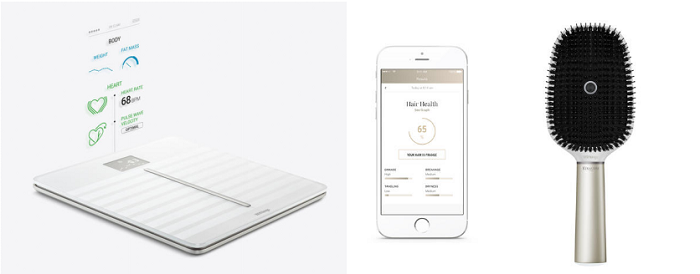
Withings Body Cardio Scale and Connected Hairbrush (Image source: ZDNet)
Nokia has partnered with the University of Helsinki and its affiliated hospitals to develop a remote monitoring product for neurology outpatient clinics, stating that this move reflects its determination to “enter the regulated healthcare sector.” This sends a signal to the outside world: while Nokia is developing consumer health products, it will alsoEqually Prioritizing Vertical Healthcare Businesses。
Hutchings also stated that Nokia’s digital health business aims to “make patients’ medical experiences as excellent as products in the consumer market.” This is precisely the point on which Withings and Nokia have reached a consensus: both believe that there should be no significant divide between the healthcare market and the consumer market, and that the quality of serious medical products and services deserves attention and refinement.
Through these home-friendly “light medical” devices, physicians can also monitor patients’ long-term adherence to medical advice based on the data collected. In the future, products that do not resemble traditional medical equipment yet offer therapeutic benefits will become increasingly prevalent, evolving to the point where everyday tools incorporate medical recording capabilities, subtly capturing every detail of individuals’ health status.
Leveraging IBM’s Momentum, AI Analysis Penetrates into the Nuances of Healthcare
In addition, Nokia has reached an agreement with IBM Watson to leverage the analytical capabilities of its cognitive computing system to enhance Nokia’s own IoT platform and devices for the healthcare of the elderly and frail populations.
Ultimately, Nokia will be capable of “deploying devices that collect various types of data and information.” Hutchings stated that they believe integrating analytical tools and artificial intelligence will unlock greater opportunities to derive more critical insights from the data.
This technology willUnderstand individual health status from subtle details and provide timely assistance.. For instance, if an individual has not left home for an extended period or has ceased communicating with others, the platform can promptly alert their family members to visit, or dispatch health professionals to engage with the individual to assess whether medical assistance is needed.
Hutchings stated that developing medical products for elderly users has long been a weakness of modern tech companies. However, in an increasingly aging world, the market share for technology devices tailored to seniors is gradually expanding.
“We believe that truly forward-looking digital health solutions are not aimed at tech-savvy science geeks who love cutting-edge products, nor at those obsessed with health and wellness, but rather at the majority of ordinary people who often overlook their health status. The market for gerontechnology, which is currently poorly served, holds tremendous opportunities. For those seeking to capitalize on this opportunity, the key focus should be on designing simple and convenient services tailored to the usage habits of the elderly population.”
Health-Focused Environmental Monitoring Products
While expanding into the vertical healthcare sector, Nokia Withings is also developing technologies akin to “environmental monitoring” and launched a home environment monitoring product at this year’s CES. Named Home Camera, the device integrates with Apple’s newly released HomeKit smart home platform, enabling remote tracking of home conditions while recording indoor air quality.
Similar to Withings’ positioning in the light medical device sector, the Home Camera targets the general consumer market, though it also holds potential for business-to-business (B2B) sales. For instance, some real estate developers may choose to pre-install Home Cameras in newly constructed homes in the future. Hutchings stated, “A healthy living environment is a crucial condition for healthcare; therefore, this device is essentially a health-oriented product.”
(Some information in this article is from http://www.zdnet.com/)