

WeDoctor's 'Pharmacy + Clinic' Model Is Reshaping Pharmaceutical Retail as It Files for IPO
The integration of healthcare and the Internet has given rise to initiatives such as online consultations, pharmaceutical e-commerce, internet hospitals, and health communities. However, the pharmaceutical retail sector, which is closest to consumers, has yet to reap the benefits of internet-based healthcare. Transactions and services remain offline, limited to basic medication purchases. What would happen if we infused retail pharmacies with internet-driven capabilities?
Micro Medical Group’s “Pharmacy-Clinic-Store” initiative is precisely such a project. It transforms traditional pharmacies by integrating the Wuzhen Internet Hospital, thereby expanding online appointment booking, remote consultations, and e-prescription services for in-store customers. This helps retail pharmacies evolve into “neighborhood hospitals,” supplementing primary healthcare resources while addressing challenges related to prescription sources and pharmaceutical care services in the retail pharmacy sector.
Recently, VCBeat (WeChat: vcbeeat) interviewed Lu Zigui, Vice President of WeDoctor, and Zhang Yong, Deputy General Manager of the Pharmaceutical Business Division, who provided a detailed introduction to the “Pharmacy-Clinic” project and its future plans.
Retail pharmacies are a crucial link in the pharmaceutical distribution chain and an important node in the closed-loop health management system. However, within the internet healthcare ecosystem, retail pharmacies have yet to fully reap the benefits of the transformation brought by the internet.
In fact, from an external perspective, the outflow of prescriptions, the separation of prescribing and dispensing, and the elimination of drug price differentials have brought opportunities to the development of retail pharmacies. According to relevant statistics, the market size of retail pharmacies continues to expand and is expected to reach RMB 400 billion. Meanwhile, the rapid expansion of internet hospitals has generated a significant volume of prescriptions that require effective fulfillment, which undoubtedly presents a major opportunity for retail pharmacies.
From the perspective of retail pharmacies themselves, the sector is entering a period of rapid consolidation. Industry concentration continues to rise, with industrial and financial capital increasingly investing in pharmacy mergers and acquisitions, thereby accelerating transformation in the retail pharmacy market.
A head of a chain pharmacy told reporters that the pharmaceutical retail market only considers two issues: one is gross profit margin, and the other is customer traffic. He said, “High labor costs, management costs, and site costs have put enormous pressure on the retail pharmacy business, prompting retail pharmacies to explore new ways of acquiring customers and identifying new profit growth points.”
He believes that the pharmaceutical terminal industry should transition from single-product sales to diversified services, expanding into areas such as consultations, chronic disease management, and health management beyond mere drug dispensing. By leveraging accessible entry points, it aims to become a health management service hub for urban communities and residents.
For internet healthcare platforms, there is also an urgent need to find offline entry points. Building self-owned clinics is too expensive, and medical staff resources are difficult to obtain. Therefore, it is only natural for pharmacies to cooperate with internet healthcare platforms like WeDoctor.
In March last year, WeDoctor launched the “Internet Hospital + Pharmacy Cooperation Plan,” aiming to establish 1 million consultation points for the Wuzhen Internet Hospital across China, covering 900,000 primary healthcare institutions, 460,000 retail pharmacies, and 100,000 community health service centers nationwide.
WeDoctor’s vision is to leverage the Wuzhen Internet Hospital to help pharmacies upgrade into “pharmacy-clinics,” addressing their shortcomings in medical services and enabling rational, symptom-based medication use, thereby increasing customer referral rates and stickiness. Through these pharmacy-clinics, high-quality medical resources will be decentralized to create an O2O service closed loop, accelerating the outflow of prescriptions and driving the upgrading and transformation of pharmacy business models.
Micro Medical Group stated that by logging into the Wuzhen Internet Hospital Pharmacy System, partner pharmacies can provide members with services such as precise appointment scheduling, remote diagnosis and treatment, and electronic prescriptions. This allows them to be upgraded free of charge to virtual clinics, establishing a new internet-based “pharmacy-clinic” business model. Consequently, these pharmacies are evolving from mere drug retailers into integrated hubs for appointment registration, remote consultations, diagnostic testing, and electronic prescription issuance.
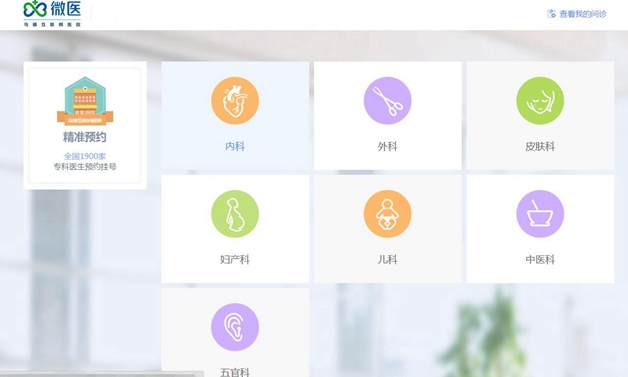
Wuzhen Internet Hospital Consultation Departments
“Pharmacy-Clinic” products center on rapid consultations. When pharmacies attend to customers, patients can quickly connect with physicians via the Wuzhen Internet Hospital platform for professional guidance. Medication recommendations derived from these consultations enjoy greater patient acceptance, thereby facilitating effective adherence management.
From a systemic perspective, the “pharmacy-clinic” model has brought incremental growth to retail chain stores in terms of diagnostic and treatment services, prescription volume, and customer stickiness, making it highly popular among retail pharmacies.
Zhang Yong, Deputy General Manager of the Pharmaceutical Division at WeDoctor, told reporters, “The ‘Pharmacy-Clinic’ project was launched in March last year, entered trial operation in April and May, and was officially rolled out to the market in the second half of the year. Based on current actual store coverage and consultation volumes, Wuzhen Internet Hospital’s Pharmacy-Clinic has become China’s largest pharmacy-plus-clinic platform. The number of pharmacies actually integrated into the Pharmacy-Clinic network exceeds 10,000, with daily consultation volumes surpassing 20,000. Both the number of stores and consultation volumes have achieved a month-on-month growth rate of 20%.”
Zhang Yong introduced that well-known enterprises, including Laobaixing Pharmacy, Yixintang, Shandong Shuyu Pingmin, Gansu Zhongyou, Xi’an Yikang, and Guoda Pharmacy, have all become partners of the Wuzhen Internet Hospital. Taking Shuyu Pingmin as an example, in late July last year, Shuyu Pingmin officially partnered with Weiyi to launch the “Wuzhen Internet Hospital Pharmacy-Clinic-Store” model. By mid-December, the number of cooperative stores between the two parties had exceeded 600, with more than 1,000 prescriptions being issued to stores daily.
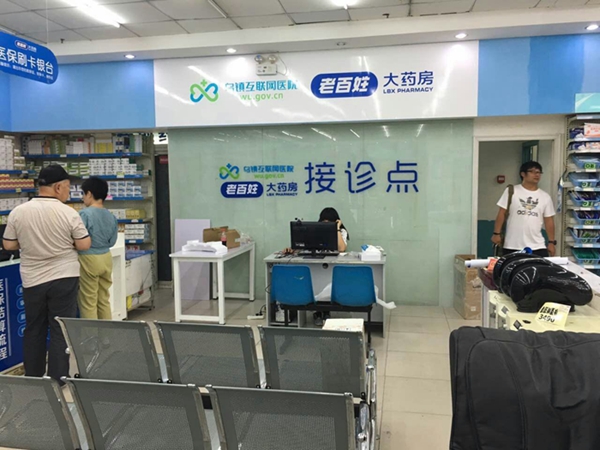
Laobaixing Pharmacy Consultation Point
Li Wenjie, Chairman of Shuyu Pingmin Pharmacy Chain, stated that the collaboration with Weiyi has primarily addressed the issue of prescriptions. In the past, many pharmacies lacked access to prescriptions; now, customers can consult physicians via the Wuzhen Internet Hospital to obtain legitimate prescriptions for purchasing prescription medications. Secondly, this arrangement saves patients the time spent queuing at hospitals for consultations, meets their follow-up visit needs, and helps attract greater customer traffic.
Zhang Yong stated that after leveraging internet hospitals for promotion, pharmacy foot traffic increased by 2–3 times, with new customers accounting for over 40% and a follow-up visit rate exceeding 80%. The conversion rate from direct mail (DM) flyers reached 15%, significantly higher than the industry average of 3%. Physicians at these pharmacy-clinics are all recruited from public hospitals, ensuring professionalism, safety, and reliability. They operate on unified schedules with standardized services, guaranteeing a rapid response within one minute. Consultations are free of charge, with patients able to choose from text, video, or telephone options.
However, the pharmacy-clinic model is not merely about expanding traffic; both WeDoctor and chain pharmacies have higher aspirations.
According to reports, the application scenarios of "Pharmacy-Clinic" models are concentrated in four key areas. The first is professional guidance: since pharmacy staff are not physicians and may struggle to assess many conditions, the "Pharmacy-Clinic" model enables precise diagnosis and targeted medication for customers, thereby compensating for gaps in staff expertise. The second is chronic disease management: by providing one-stop services in pharmacies for elderly patients with chronic conditions—including repeat medication purchases, regular follow-up visits, and medication management—the model enhances medication adherence and customer satisfaction. The third is prescription compliance: obtaining legitimate prescriptions through consultations ensures the safe and lawful sale of prescription drugs in pharmacies, reducing operational risks related to regulatory compliance and medication safety. The fourth is a powerful tool for customer acquisition: this approach transforms traditional pharmacy marketing strategies, such as price cuts and gift-with-purchase promotions, by integrating consultation services into marketing efforts. Combined with general and membership-based marketing, it creates differentiation and distinctive features that attract foot traffic and increase customer stickiness.
In simple terms, the "pharmacy-clinic" model aims to create an online-to-offline closed loop through the integration of medical services and pharmaceuticals. For internet platforms, this provides access to offline entry points; for chain pharmacies, it generates incremental growth driven by deepened service offerings.
Zhang Yong stated that the Wuzhen Internet Pharmacy Clinic is positioned as a service-oriented entity. Compared with traffic-driven O2O models, service-oriented O2O exhibits greater user stickiness and fosters more stable relationships with pharmacies.
Furthermore, with the advancement of tiered diagnosis and treatment and the expansion of residents’ proactive health needs, pharmacy-clinics will play an even greater role. “Initial consultations for minor illnesses take place at ‘pharmacy-clinics,’ serious conditions are referred to hospitals, and follow-up visits return to pharmacies. In the future, leveraging WeDoctor’s family health service platform, pharmacy-clinics will transform from passive sales to proactive services, gradually evolving into family health service centers,” stated Zhang Yong.
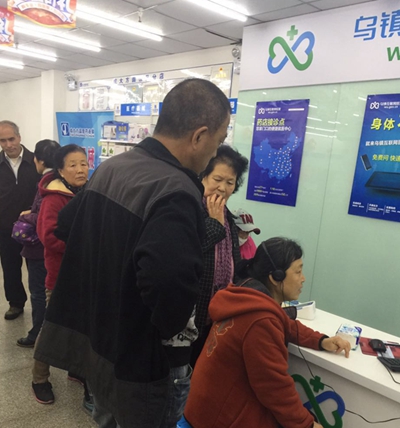
Residents Consult at the Clinic
In fact, in addition to WeDoctor, numerous other internet healthcare platforms are driving the transformation of pharmacies. For instance, Dingdang Kuaiyao’s “Smart Pharmacy” initiative enables the creation of electronic health records for users and the collection of health data to meet their health management needs. Similarly, Haoyaoshi is promoting its “Health Service Point” model to uncover user demands in health management and long-term medication services, thereby expanding beyond traditional pharmaceutical sales and procurement.
In response, industry insiders predict that previously fragmented healthcare segments will be integrated through internet medical platforms. In the future, refined and personalized healthcare will become the mainstream trend. Internet medical platforms—whether offering online consultations, pharmaceutical e-commerce, or O2O pharmacy services—will evolve toward functional diversification. Those providing the most comprehensive services will be best positioned to sustain user retention in the long run. Models that integrate diagnosis and treatment, medication management, and health services are likely to become industry standards, at least achieving significant market penetration within certain segments.
According to Lu Zigui, Vice President of WeDoctor, the company has continuously recognized the growing demand for prescription outflow from hospitals during the development of its internet hospital. Driven by policy guidance, hospital revenue considerations, and pressure to control pharmaceutical expenditures, the trend toward prescription outflow is steadily intensifying.
Previously, the simple outflow of prescriptions referred to the transfer of paper prescriptions from hospitals to pharmacies. However, in Lu Zigui’s view, with the widespread adoption of smartphones and the continuous deep integration between internet hospitals and pharmacies, the future outflow of electronic prescriptions will inevitably be combined with internet-based products.
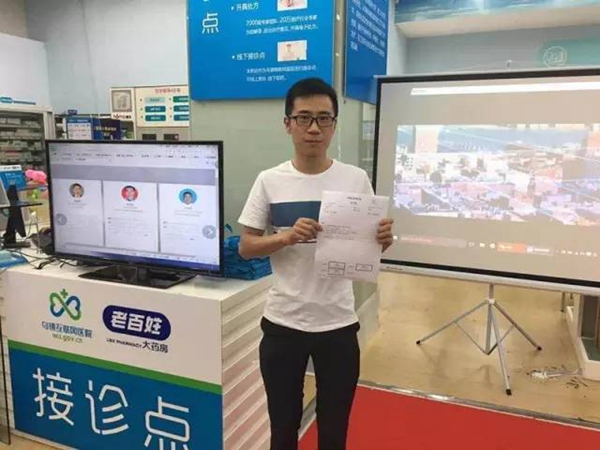
Electronic Prescription Obtained by the Patient via Wuzhen Internet Hospital
Currently, WeDoctor is integrating a series of medical service chains to ultimately enable patients at “Medication-Diagnosis-Pharmacy” centers to access comprehensive, one-stop, closed-loop services. Through the Wuzhen Internet Hospital, it establishes connections among patients, hospitals, doctors, and pharmacies, with service delivery supported by a cloud platform.
Lu Zigui believes that in the future, patients can select and bind with a specific doctor (or department) on the WeDoctor app under the guidance of doctors from the Wuzhen Internet Hospital platform. The system will then recommend nearby partner pharmacies based on the patient’s address for binding. Patients can also access the operating system by scanning and following the hospital’s QR code. After completing the initial selection, patients can conduct follow-up consultations and obtain prescriptions from home. They can then present a verification code at the pharmacy to retrieve their prescription and collect their medication. This process facilitates the outflow of prescriptions while also driving new growth for pharmacies.
“The profit centers of the ‘pharmacy-clinic’ model also stem from pharmaceuticals. ‘Project profitability will be derived from “pharmaceuticals,” including B2B revenue, pharmaceutical marketing revenue, information service revenue, and traffic monetization, among others. The cornerstone of these profit centers lies in the network scale and project value of the “pharmacy-clinic” model,’ stated Lu Zigui.”
It is worth noting that profitability remains one of the key pain points in internet healthcare. Qiu Zhongxun, CEO of Yaodou.com, stated bluntly: “Pharmaceutical e-commerce may serve as a positive catalyst for mobile healthcare. Only after pharmaceutical e-commerce gains user acceptance will mobile healthcare be able to identify viable profit models, thereby feeding back into and strengthening pharmaceutical e-commerce, ultimately forming a stable industrial ecosystem.”
Extending his logic to offline channels, retail pharmacies are also a key profit driver for internet healthcare, especially given that the sector has yet to resolve health insurance integration and lacks a clear business model.
Before and after the emergence of Weiyi, numerous internet healthcare platforms began to enter the pharmaceutical distribution sector, while some pharmaceutical e-commerce companies expanded into diagnostic and treatment services. For instance, mobile healthcare providers added medication shopping guides, and companies such as 1YaoWang and Jianke established internet hospitals. The internet healthcare industry is thus shifting from disorderly competition driven by capital injection to strategic expansion.
Taking WeDoctor as an example, it entered the market in 2010 through appointment registration services and gradually grew into one of China’s largest internet healthcare platforms, with its business undergoing continuous adjustments. It has ultimately consolidated into three core segments: “Healthcare–Pharmaceuticals–Insurance,” encompassing operations such as internet hospitals, online medical consultations, offline outpatient clinics, and pharmacy-clinics, thereby achieving integration across the entire pharmaceutical and healthcare industry chain.
“Medicine-Consultation-Pharmacy” serves as the flagship product of WeDoctor’s pharmaceutical segment within its “Medical Care–Pharmaceuticals–Insurance” strategic triangle. It plays a pivotal role in establishing an entry point for the drug retail platform by integrating WeDoctor’s resources and leveraging the marketing and service capabilities of pharmaceutical manufacturers, thereby gradually helping pharmacies develop service-oriented business models and evolve into a service-driven ecosystem platform for drug retail.
From the perspective of the overall internet healthcare market, after a period of rapid growth, several companies have solidified their positions in each sub-sector. Whether in online medical consultation, virtual hospitals, or pharmaceutical e-commerce, under the prevailing "winner-takes-all" dynamic, industry players are actively seeking new business growth drivers. Offline pharmaceutical retail initiatives, such as the "pharmacy-clinic" model, represent precisely such an opportunity.
It is expected that 2017 will be a pivotal year for WeDoctor’s online-to-offline (O2O) pharmacy project, leveraging its current market share in the internet healthcare sector as endorsement and nearly one year of project experience in collaboration with major pharmacies. Key performance indicators will focus on expanding the number of stores, deepening service offerings, and enhancing online-offline integration.