

Renhe Future: Leveraging Data Interpretation to Advance Precision Medicine After Setting Two World Records
In 2014, the cost of human whole-genome sequencing dropped to $1,000, ushering in the first boom for the global genetic testing industry, with China’s market experiencing explosive growth. In 2017, Illumina further reduced the cost of whole-genome sequencing to $800. As sequencing costs declined, genomic data worldwide surged at a rate exceeding Moore’s Law. Computational analysis and interpretation of genetic data have always been critical components of genetic testing. Amid this data explosion, how to achieve faster and more accurate data analysis and interpretation will be the next key challenge facing the genetic testing sector. Seizing this opportunity, VCBeat is launching its “Genes & Data” series; stay tuned for further details.
The first time I heard about Renhe Future was atAt the awards ceremony for the GCTA Challenge at the 2016 ICG Conference, Renhe Future emerged as the biggest dark horse by breaking two world records. Song Zhuo, CTO of Renhe Future, represented the company on stage to accept the award.. During the interview with Song Zhuo, topics such as genomic analysis, bioinformatics, and data mining,DNA sequencing, molecular diagnostics... These buzzwords repeatedly appeared in his professional background. At first, the reporter imagined him to be an extremely serious, even rigid, tech enthusiast. However, after an hour-long conversation, what emerged was a smiling millennial born in the 1980s.

Song Zhuo, CTO of Renhe Future
In 2006, when 23andMe, the first consumer-grade genetic testing service provider, was just established, Song Zhuo was pursuing his doctoral degree in the United States. The success of 23andMe allowed Song Zhuo to recognize the market potential of genetics; if such technology could be popularized in China, the market potential would be limitless. In 2009, Song Zhuo led the founding team of Renhe Future back to China for field research to explore the landscape.
However, the findings did not align with initial expectations. In China, the concept of genetic testing was largely unfamiliar, and both available testing panels and post-test intervention options were limited. Given the circumstances at the time, the Chinese market was immature, and the timing was not yet right. Ultimately, the Renhe Future team made a “rational choice” by refraining from rushing back to China to start a business; instead, they returned to the United States to continue technological development and scientific research.
2014,CFDA and NHFPC Issue Notice to Halt Clinical Gene Sequencing“State intervention and the initiation of regulatory oversight over genetic testing signify that the genetic testing market is gradually maturing.” Song Zhuo believes that the inclusion of genetic testing under the administration of national ministries indicates a sea change in market perception of genetic testing. Not only has market awareness and acceptance increased by several orders of magnitude, but also withCompared with 2009, the cost of gene sequencing has also dropped significantly. The reduction in costs will inevitably benefit all gene sequencing applications, which will certainly usher in an explosion of genetic data.
With the maturation of policies and markets, declining sequencing costs, and the team’s accumulated technical advantages in genetic data processing and analysis, “the time is right,” making the establishment of Renhe Future a logical next step.
Management and Technology, BT and IT: Intersection and Complementarity
Among the core members of the team and its future leadership, in addition to technical experts like Song Zhuo, there are also many individuals with Wall Street investment backgrounds and Cornell“Financial and operational management professionals with business backgrounds, such as MBAs. ‘A cross-disciplinary, complementary team combining business and technical expertise,’ summarized Song Zhuo, describing the company’s team.”
“Cross-complementarity” is a high-frequency term throughout the interview and serves as a defining label for Renhe Future. The core team of “cross-complementarity” integrates a business framework that provides strategic direction with a technology-driven engineering team. By combining “business + technology,” Renhe Future has become one of the few genetic companies to achieve profitability from its first year of operation.
The year the company was founded coincided with the cost of whole-genome sequencing dropping to$1000,“The lower the sequencing costs, the faster genomic big data grows; genomic data worldwide is expanding at a pace surpassing Moore’s Law.”When the conversation turned to topics related to genomic data, Song Zhuo appeared slightly excited.
Anticipating that data processing and analysis would become a bottleneck for the entire industry in the near future, Renhe Future strategically positioned itself at its inception, continuously accumulating expertise and making sustained efforts in computational capabilities. “It was quite fortuitous that the GCTA challenge aligned perfectly with our long-term preparations in this area.” In light of this, Renhe Future’s achievements in the competition were by no means accidental.
BT+IT: Where Lies the Value?
During his doctoral studies at Vanderbilt University, Song Zhuo’s research focused on human genetics and bioinformatics, which was inherentlyBTandIT “Cross-Complementary” Disciplines.
“BT has, in fact, brought a vast amount of new types of data to IT.” The massive volumes of data generated by the entire genomics industry, including the healthcare sector, are essentially BT data. From an IT perspective, BT serves as a complex and polymorphic data source; conversely, IT acts as the precise analytical tool for BT. Since data only generates value after being analyzed, IT plays a crucial role in BT.
When the data scale is still relatively small,What IT does is to develop various specialized analytical tools for different problems, thereby helping BT obtain the desired results. Technologies in this stage have advanced significantly since the completion of the first human whole-genome sequencing in 2000 and are now relatively mature. However, the current scale of data is gradually exceeding the processing limits of these analytical tools, necessitating the use ofHighly Parallel Tools Such as Cloud Computing, andHardware acceleration solutions, such as GPU and FPGA chips, enhance computational efficiency. “Previously, the challenge was how to perform calculations; now, it is how to perform them faster.” Regardless of the massive volume of data generated by BT (Biotechnology), IT methods are ultimately required to achieve faster and more efficient processing.
BT + IT = Higher-Quality, More Comprehensive Services
In the field of genetic testing, the most intuitive manifestation is the improvement in analysis speed. Taking whole-genome sequencing as an example, it previously took at least three to five days after sequencing data generation to obtain analytical results, whereas now it can be completed within a single day. For the average person, thisThe integration of IT and BT is not immediately apparent, yet for ICU patients in urgent need of treatment, every second counts.
For physicians and related scientific researchers, IT technology not only helps researchers obtain analytical data more quickly to gain a time advantage in fierce competition, but also assists them in organizing their research ideas more rapidly and comprehensively to identify high-value targets. The text mining engine developed by Renhe Future leverages IT technology to extract and reconstruct vast amounts of biomedical literature information. By automating processing workflows, it liberates researchers from the critical yet tedious tasks of literature retrieval and database queries. These precisely extracted existing research findings significantly enhance the efficiency of research collaborators.
The U.S. National Center for Biotechnology Information (NCBI) hosts one of the world’s most comprehensive literature databases, aggregating biomedical publications from around the globe. Leveraging NCBI and select high-quality domestic Chinese literature as information sources, Renhe Future has launched the CNVision search engine using advanced IT technologies. By employing text mining algorithms, the platform enables rapid extraction of associations between genetic variants and diseases, constructs a knowledge base linking diseases with chromosomal copy number variations (CNVs), supports bidirectional search for diseases and genetic variants, and provides an overarching, god’s-eye view of the knowledge graph.
“Currently, in many gene interpretation efforts,”IT"...technologies have all played a significant role, leveraging information obtained through text mining to be more comprehensive and complete.” Compared to the obvious value of cost reduction,"The additional value brought by the application of IT in BT is not yet particularly evident. However, Song Zhuo emphasizes that “BT+IT is a massive information engineering project hidden beneath the tip of the iceberg,” and its implementation will significantly enhance the service quality of genetic testing products. “The role that Renhe Weilai aims to play in the future” is to facilitate faster, more accurate, and lower-cost analysis and mining of BT data through collaborative innovation across the entire industry.
Product Dimension: Health Is a Multidimensional Term
In Song Zhuo’s view, “health is a multidimensional concept.” This philosophy has naturally been extended to the company’s products. Disease risk may stem from innate genetic factors, accumulate gradually during growth and development, or even be closely linked to the internal environment of the human gut. “What Renhe Future provides is a multidimensional health management service,” capable of delivering comprehensive, precise monitoring and intervention solutions for clients.
Renhe Future positions itself with gene technology at its core, leveraging biotechnology (BT) and information technology (IT) to provide customers with solutions for precision health and precision medicine. In the health sector, it serves commercial clients through high-quality genetic testing services across its full product line. Beyond clinical hospitals, Renhe Future has expanded its testing services into channels such as insurance, physical examinations, and health management. Song Zhuo pointed out, “Testing is only the first step; it should be followed by corresponding interventions, widespread education, and management measures.” Therefore, in addition to testing, Renhe Future also provides users with intelligent health interpretation and management based on its understanding of BT and its advantages in the IT field. Song Zhuo hopes to establish a comprehensive management model for precision health, using genetic testing as the entry point. When asked how this model should be specifically constructed, Song Zhuo gave a forceful answer: “It should at least include three-dimensional dynamic monitoring, data analysis and interpretation, and precise intervention guidance.”
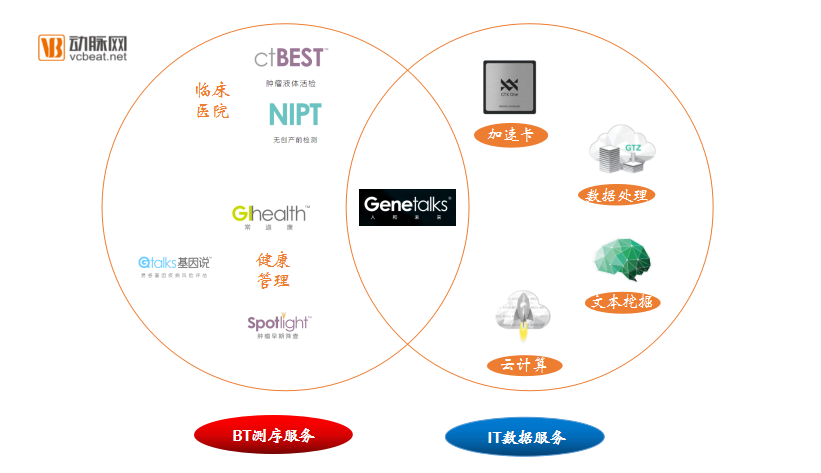
Seize today’s market opportunities while strategically positioning for tomorrow’s market landscape
Song Zhuo revealed that the company will further explore smart health in its next steps, aiming to create a closed-loop service for monitoring and intervention. In addition to genetic testing and intervention, the company will enhance data interpretation and interactive health education, truly approaching issues from the perspective of long-term management, and providing solutions for the “precision” upgrade of the health industry.
Meanwhile, the company will continue to leverage its strengths in data processing and interpretation, prioritize collaborations with upstream and downstream enterprises, harness the significant potential of high-performance computing and text mining in data processing, and pursue the productization of technical services.
The company secured tens of millions of RMB at its inception, with its Series A funding round expected to launch this year. Despite smooth fundraising progress, Renhe Future has never engaged in “cash-burning,” instead prioritizing sustainable growth through self-generated revenue and maintaining consistent profitability. When asked about the company’s secret to balancing profitability with expansion, Song Zhuo replied, “Seize today’s market opportunities with one hand, while strategically positioning for tomorrow’s market landscape with the other.”
Since its establishment, the company has consistently adhered toThe integration of BT and IT leverages our robust technical capabilities to provide solutions for the healthcare industry, particularly for the newly upgraded “precision health” sector. “This is our core strategy.” Song Zhuo’s summary is concise, yet the journey has been far from easy. The challenges extend beyond engineering and scientific issues to encompass the complex task of integrating diverse technologies. Addressing these challenges requires incubation and rigorous testing over time. In development and optimization, how can we overcome bottlenecks? “When facing such bottlenecks, there are no shortcuts.”
From an industry perspective, the integration of BT (Biotechnology) and IT appears to be Song Zhuo’s underlying mindset in everything he does. Perhaps it is precisely this DNA that has enabled Renhe Weilai to grow from a small team into a startup with nearly 300 employees over the past two years, gradually gaining prominence within the industry. “Broaden your horizons while being selective in what you adopt; accumulate substantially before releasing your potential.” Success is never accidental. It will be intriguing to see what topics this ACG-styled BT company will lead in the future.