

My View on WeDoctor: Achieving the 'Medical Care-Pharmacy-Insurance' Closed Loop at Internet Speed | Review and Outlook
As the new year begins, everything takes on a fresh look. The end of the Spring Festival holiday marks our official entry into the busy rhythm of 2017. Looking back on 2016, we witnessed frequent turbulence in the internet healthcare industry, the sustained boom in artificial intelligence, a surge of capital into the genomics sector, and tighter regulatory policies for pharmaceutical e-commerce……
Although the market we can observe is merely the tip of the iceberg of the entire healthcare and wellness industry, small signs can reveal major trends. VCBeat will identify benchmarks and leaders from these dynamic sectors, review their development over the past year, and offer reflections and forecasts on their 2017 strategies, with the hope of providing valuable insights for investors, observers, thinkers, and practitioners in the industry.
On December 23, 2016, braving the severe cold and smog, VCBeat (WeChat ID: vcbeat) successfully held its long-planned Future Healthcare Top 100 Forum. The next day, we immediately headed to our next destination to attend the 2016 China’s First Family Health Forum. After WeDoctor unveiled its health initiatives and internet-based general practice health services at the conference, the challenging year of 2016 for internet healthcare quietly came to a close.
At the very beginning of 2017, colleagues from WeDoctor’s marketing department promptly reached out on New Year’s Day, inviting VCBeat to witness WeDoctor’s final major push before the Lunar New Year. Consequently, on January 6, 7, and 8, we personally attended the launches of the Qingdao Ophthalmology Internet Hospital, Guangzhou Internet Hospital, and Shenzhen WeDoctor Internet Hospital. Shortly thereafter, WeDoctor announced another internet hospital in Hainan. With this addition, WeDoctor’s network of 17 internet hospitals was officially complete. The intensive rollout of these internet hospitals prior to the holiday season brought a fitting close to WeDoctor’s 2016.
WeDoctor's Growth: Internet Speed
Micro Medical Group’s 2016: Many Key Terms—Internet Hospital, General Practice Center, Health Plan, ACO, Internet-Based General Practice Health Services—and Many Key Data Points:Valued at over $3 billion, connecting 2,400 key hospitals across 27 provinces, serving more than 260,000 doctors, with 150 million real-name registered users, a cumulative service volume of 850 million visits, 10,000 family health service centers, and 17 WeDoctor internet hospitalsetc. By the end of 2016, the proliferation of business initiatives and concepts had left many people unable to understand WeDoctor or keep pace with its rhythm.
Micro Medical Group’s growth has been remarkably rapid, embodying what can truly be described as “Internet speed” among digital health companies.
Guahao.com, which launched in Shanghai in 2010 and has been operating ever since, laid a solid foundation for WeDoctor. It now connects more than 2,400 hospitals across China and has deployed over 1,700 front-end servers. After Guahao.com was upgraded to WeDoctor in September 2015, a series of business models, commercial activities, and operational systems built upon this information service platform enabled WeDoctor to truly flourish and expand.
WeDoctor has established a comprehensive layout across the entire industry chain encompassing “healthcare, pharmaceuticals, and insurance.” Its core business spans internet hospitals, general practice centers, health consumption, health finance, membership services, and family doctors. A thorough review of WeDoctor’s 2016 operations entails a detailed analysis of each of its business segments.
Internet Hospitals Launched in 17 Provinces and Cities
In the landscape of internet hospitals in 2016, WeDoctor was unquestionably the leader, as well as the founder and pioneer. In November 2016, Tencent Research Institute and VCBeat Eggshell Research Institute jointly released the "2016 China Internet Hospital White Paper." Among the 36 publicly announced internet hospitals under construction, WeDoctor’s internet hospitals accounted for half of the total with 18 institutions. Notably, Wuzhen Internet Hospital, Sichuan WeDoctor Internet Hospital, Gansu Provincial Internet Hospital, and Guangxi Zhuang Autonomous Region Internet Hospital ranked among the top four in terms of maturity.
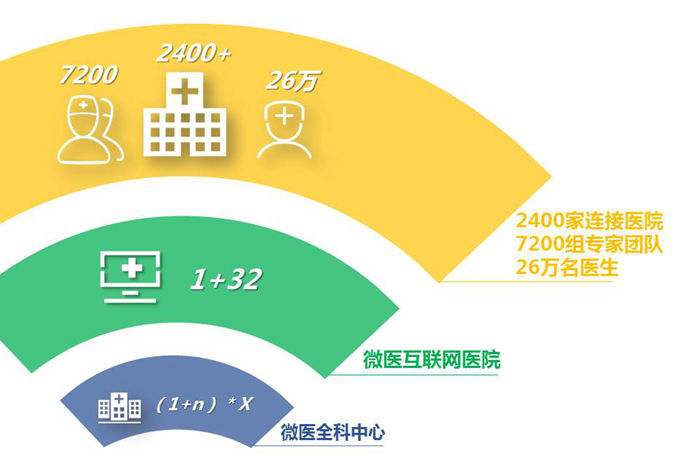
2016 was dubbed the inaugural year of internet hospitals, a concept that originated with the opening of WeDoctor’s first internet hospital—the Wuzhen Internet Hospital—on December 7, 2015.Wuzhen Internet Hospital connects more than 2,400 hospitals, over 260,000 experts, and 7,200 expert teams across China., offering services such as online triage, appointment registration, online follow-up consultations, remote consultations, remote ward rounds, electronic prescriptions, home medication delivery, and medical payments. It facilitates online diagnosis and treatment between doctors and patients, as well as remote consultations among medical professionals, while extending high-quality medical resources to grassroots levels to enhance the overall healthcare service capacity at the primary care level. As of October 2016, the Wuzhen Internet Hospital had achieved a daily online consultation volume of 31,000, nearly twice the daily patient volume of a large tertiary Grade-A hospital.
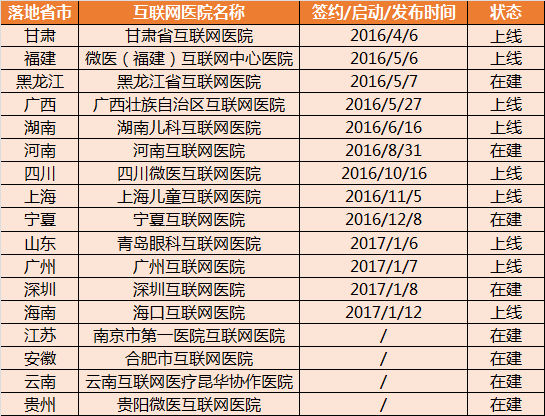
Since 2016, starting with the Wuzhen Internet Hospital, WeDoctor Internet Hospitals have been established in 17 provinces and municipalities, including Guangdong, Hainan, Jiangsu, Beijing, Shanghai, Guangxi, Gansu, Yunnan, Henan, Anhui, Shandong, Tianjin, Sichuan, Heilongjiang, Guizhou, Shaanxi, and Ningxia.
WeDoctor’s internet hospitals across various provinces and municipalities offer medical services such as appointment scheduling, online follow-up consultations, remote consultations, home medication delivery, and one-stop payment solutions. They also serve as key platforms for issuing cloud-based health cards and implementing family doctor contract services. The establishment of provincial and municipal internet hospital platforms generally follows the “Three Ones” model, comprising one center, one network, and one system.
One Core: The development of internet hospitals is anchored by offline physical hospitals as the central support, connecting upward with high-quality medical resources both domestically and internationally, and serving downward the provinces and cities where they are located, to provide integrated online-and-offline full-process services;
One Network: Provincial and municipal internet hospitals must connect medical institutions at all levels within their respective regions via the internet, break down data silos, and achieve standardized collection, interoperability, and information sharing of medical data;
One System: A family doctor service system established on the basis of interconnectivity and information sharing of medical and health data, providing personalized, continuous, one-stop home health maintenance and medical services.
10 Teleconsultation Centers Established Nationwide Throughout the Year
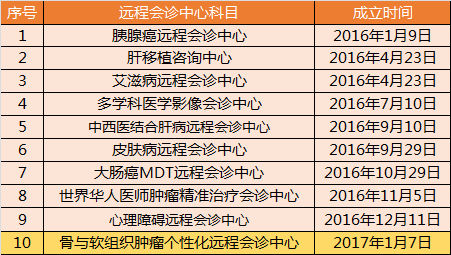
Building on its provincial and municipal internet hospital infrastructure, Wuzhen Internet Hospital established nine remote consultation centers in 2016, including: the Pancreatic Cancer Remote Consultation Center, the Liver Transplantation Consultation Center, the HIV/AIDS Remote Consultation Center, the Multidisciplinary Medical Imaging Consultation Center, the Integrated Traditional Chinese and Western Medicine Liver Disease Remote Consultation Center, the Dermatology Remote Consultation Center, the Colorectal Cancer MDT Remote Consultation Center, the World Chinese Physicians’ Precision Oncology Consultation Center, and the Psychological Disorders Remote Consultation Center. With the addition of the Personalized Bone and Soft Tissue Tumor Remote Consultation Center established in early 2017, it now operates a total of ten specialized disease-specific consultation centers.
Leveraging the Wuzhen Internet Hospital’s Specialized Disease and Specialty Consultation Center, WeDoctor integrates medical resources—including expert personnel, medical equipment, platform technology, and operational capabilities—and deploys them comprehensively to primary care hospitals. This initiative helps strengthen supply chain development at the grassroots level, enhances disciplinary service capabilities, facilitates the downward distribution of medical resources for specialized disciplines and specific diseases, and improves patients’ access to high-quality healthcare services.
First General Practice Center Established
As initial consultations represent the most challenging aspect of all medical services and impose high requirements on physicians, WeDoctor’s Internet Hospital does not provide initial consultation services. The establishment of the General Practice Center effectively addresses this limitation by enabling the continuous provision of comprehensive medical care, serving as a critical component in WeDoctor’s closed-loop internet healthcare ecosystem.
The General Practice Center is a vital component of WeDoctor’s online diagnosis and treatment, remote consultations, and offline medical closed-loop operations. Leveraging information technology platforms and mobile health technologies, it provides local residents with proactive, continuous, one-stop family health maintenance and medical services that integrate online and offline care, actively promoting a shift in residents’ health approaches from “passive health” to “proactive health.”
On December 17, 2016, WeDoctor’s first General Practice Center was finally established in Hangzhou. The basic investment amounted to RMB 10 million, with an additional RMB 10 million allocated for renovation and software, bringing the total investment to RMB 20 million, excluding personnel costs. The physical hospital facility covers an area of 2,400 square meters.
WeDoctor (Hangzhou) General Practice Center primarily provides online consultations, remote second opinions, and offline medical services. It comprises departments including General Practice, Obstetrics and Gynecology, Pediatrics, Dentistry, Traditional Chinese Medicine, Dermatology, Psychology, Clinical Laboratory, and Medical Imaging, delivering comprehensive, continuous, and family-oriented healthcare and health maintenance services.
WeDoctor plans to initially open one center and prepare two to three others, with the goal of establishing 100 general practice centers within three years. In the future, various operational models will be considered, such as partnerships and trusteeships (with franchising not ruled out). Not all future general practice centers will be fully funded by WeDoctor; meanwhile, corresponding flagship stores will be established to guide development in other regions.
Pharmacy-Clinic Model Achieves Initial Success
The internet hospitals and general practice clinics mentioned earlier represent WeDoctor’s strategic layout on the “medical care” front; next, we will discuss its layout on the “pharmaceutical” front.
In March 2016, WeDoctor launched the “Internet Hospital + Pharmacy Cooperation Plan,” aiming to establish one million consultation points for the Wuzhen Internet Hospital across China, covering 900,000 primary healthcare institutions, 460,000 retail pharmacies, and 100,000 community health service centers.
Leveraging Wuzhen Internet Hospital to help pharmacies upgrade into "pharmacy-clinics," addressing their shortcomings in medical services, enabling rational and symptom-based medication use, thereby increasing customer referral rates and loyalty; facilitating the decentralization of high-quality medical resources through pharmacy-clinics to create an O2O service closed loop; accelerating the outflow of prescriptions to drive the upgrading and transformation of pharmacy business models.
By logging into the Wuzhen Internet Hospital Pharmacy System, partner pharmacies can provide members with services such as precise appointment scheduling, remote diagnosis and treatment, and electronic prescriptions. They can be upgraded free of charge to virtual clinics, establishing a new internet-based “pharmacy-clinic” business model. This transforms them from mere drug retailers into integrated hubs for appointment registration, remote consultations, diagnostic testing, and electronic prescription management.
Since its launch in March, with trial operations in April and May, the Pharmacy-Clinic Project has been officially marketed since the second half of 2016. Currently, well-known enterprises such as Laobaixing Pharmacy, Yixintang, Shandong Shuyu Pingmin, Gansu Zhongyou, Xi'an Yikang, and Guoda Pharmacy have become its partners. The Wuzhen Internet Hospital’s Pharmacy-Clinic has become China’s largest pharmacy-plus-clinic platform.The number of pharmacies actually integrated into the “Medication and Consultation Pharmacy” network has exceeded 10,000, with daily online consultations surpassing 20,000. Both the number of partner pharmacies and consultation volume have achieved a month-on-month growth rate of 20%.
“Pharmacy-Clinic” is the flagship product of WeDoctor’s pharmaceutical segment within its “Healthcare, Pharmaceuticals, and Insurance” ecosystem. It serves a strategic role as the entry point to WeDoctor’s pharmaceutical retail platform. By integrating WeDoctor’s resources and leveraging the marketing and service capabilities of pharmaceutical manufacturers, it gradually helps pharmacies develop service-oriented business models, transforming them into a service-driven ecosystem for pharmaceutical retail.
Achieving a Closed-Loop Value Proposition in Internet Healthcare Through HMO and ACO Models
At the China Family Health Forum held at the end of 2016, Liao Jieyuan, Chairman and CEO of WeDoctor, officially unveiled the “WeDoctor Health Plan.” With the implementation of the first Chinese-style Accountable Care Organization (ACO) model, WeDoctor has completed its closed-loop value proposition for internet-based healthcare.
The Three-Tier Service Assurance System Established by WeDoctor:
I. Connected with 2,400 key partner hospitals across China, aggregating over 260,000 expert physicians and 7,200 online specialist teams;
II. Internet hospitals co-established with offline physical medical institutions have been launched in 17 provinces and municipalities;
III. The General Practice Center has been established in Hangzhou, with a plan to build 100 regional general practice centers within three years.
The WeDoctor Health Plan provides three types of services—Health Accounts, HMO, and ACO—to individual, family, and corporate members. The Health Savings Account, jointly developed by WeDoctor and several leading domestic banks, offers users integrated payment, medical care, and financial services. Together, these components form the “3+3+3” accountable care service system advocated by WeDoctor.
Upon enrollment in the health plan, WeDoctor will establish exclusive health records and health promotion plans for members based on genetic testing and personalized physical examinations. The assigned physician team will provide members with 24/7 health consultations and medical guidance. For members requiring offline medical care, the assigned physicians will also offer comprehensive medical services, including appointment scheduling, consultation, referral, and multidisciplinary consultation.
In Micro Medical Group’s strategic layout, HMOs and ACOs represent the final link in monetizing the value of internet healthcare, offering significant appeal in terms of corresponding services and pricing. Since its launch on December 12, 2016, the health plan attracted over 1 million enrolled users within just 12 days.
WeDoctor’s HMO offers targeted healthcare service plans tailored to different population groups, helping them mitigate disease risks and reduce medical expenses. The annual fee is RMB 365, averaging just RMB 1 per day. WeDoctor’s ACO charges a monthly base fee of RMB 500. Building upon the HMO model, it adds comprehensive full-coverage health insurance, enabling full reimbursement of medical costs beyond those covered by social security, with maximum coverage for over 60 critical illnesses reaching up to RMB 1 million. In comparison, Kaiser Permanente, the most efficient ACO provider in the United States, charges USD 500 per month for its ACO services.
Six Years of Accumulation Lead to Explosive Growth
In December 2016, Liao Jieyuan, Chairman and CEO of WeDoctor, disclosed to a reporter from VCBeat (WeChat ID: vcbeat) the company’s full-year revenue performance for 2016. WeDoctor generated RMB 1.2 billion in revenue for the year, with profits amounting to approximately RMB 280 million. Medical service revenue accounted for about 45%, medical insurance service revenue for about 35%, and pharmaceutical e-commerce revenue for about 20%. WeDoctor’s traffic primarily originated from its online platform, transaction volume from offline channels, and profits from insurance.
In addition, WeDoctor invested in projects such as Beilian Technology, Borui Health, Tangqiao Technology, Tai Kun Tang, Kangjiu Medical, and Yuesheng Pharmaceutical in 2016, with a portion of its revenue derived from investment returns.
Through rapid development in 2016, WeDoctor has gradually established a viable business model, with a clearly defined business structure and a self-sustaining value loop.
While other internet healthcare companies were still adjusting, hesitating, and struggling, WeDoctor was accelerating its progress toward achieving a closed-loop internet healthcare ecosystem. At a time when the internet healthcare sector was regarded by traditional medical professionals as operating in a regulatory gray area, WeDoctor began establishing its presence in China’s premier medical hubs, taking root and flourishing within the core domains of healthcare.
Looking back at 2016, Weiyi’s greatest achievement lay in leveraging medical resources through government partnerships. Drawing on six years of accumulated experience, it provided medical service support for health plans, thereby achieving a closed-loop value chain.
It is foreseeable that 2017 will also be a crucial year for WeDoctor.In 2017, WeDoctor will implement its health plan and vigorously promote insurance services based on the HMO and ACO models. This will be a crucial step in realizing value monetization, and WeDoctor’s performance in 2017 will largely depend on it.
In addition, the frequent launch of internet hospitals over the past year represents another key strategic move for WeDoctor. The planned “1+32” internet hospital network is only half complete to date, with the remainder likely to be deployed within this year. Meanwhile, the General Practice Center led by Dean He Chao is an indispensable component of WeDoctor’s development. Although the three-year plan aims to establish 100 such centers, only one has been completed in Xiaoshan so far, leaving a substantial task ahead.Providing primary care services to meet patients’ needs for initial and follow-up consultations, as well as the numerous ancillary services built upon this foundation, must rely on general practice centers; therefore, their development is imperative.
Review of Key Events at WeDoctor in 2016
On January 9–10, 2016, the Pancreatic Cancer Remote Consultation Center of Wuzhen Internet Hospital was established.
On January 16, 2016, the National Gastroenterology Tiered Diagnosis and Treatment Platform was launched, dedicated to improving the efficiency of China’s gastroenterology diagnosis and treatment system.
On February 19, 2016, the National Internet-based Maternal and Child Health Hospital Platform was launched at the Great Hall of the People.
On March 3, 2016, Wuzhen Internet Hospital launched the “Million Consultation Points Extension Plan” at the “Internet Healthcare + Pharmacy” Summit, bringing about a disruptive upgrade to the pharmacy industry.
On April 6, 2016, Gansu Internet Hospital was officially launched, providing high-quality and convenient medical services to residents in northwestern provinces, particularly those in Tibetan areas.
On April 23, 2016, the Wuzhen Internet Hospital AIDS Telemedicine Service Center was established.
On April 23, 2016, the Liver Transplantation Consultation Center of Wuzhen Internet Hospital was established.
On April 23, 2016, Wuzhen Internet Hospital launched the “‘Internet + County-Level Medical Consortium’ Empowering Tiered Diagnosis and Treatment: Thousand-County Action” initiative.
On May 6, 2016, WeDoctor (Fujian) Internet Central Hospital was established in Longyan, a revolutionary base area.
On May 7, 2016, Heilongjiang Province’s “Internet + Healthcare” platform was fully launched.
On June 24–25, 2016, Wuzhen Internet Hospital hosted the First International Internet Healthcare Conference and launched the “China Family Health Service Platform.”
On July 10, 2016, the Wuzhen Internet Hospital Multidisciplinary Medical Imaging Consultation Center was established.
On August 31, 2016, Henan Internet Hospital was established through a signing ceremony, leveraging “Internet+” to advance the realization of the “Healthy Central Plains” initiative.
On September 10, 2016, the Wuzhen Internet Hospital Remote Consultation Center for Liver Diseases with Integrated Traditional Chinese and Western Medicine was established.
On September 29, 2016, the Wuzhen Internet Hospital Dermatology Teleconsultation Center was established.
On October 16, 2016, Sichuan WeDoctor Internet Hospital was launched to support health-focused poverty alleviation efforts in Sichuan.
On December 8, 2016, the Ningxia Internet Hospital was launched.
On December 24, 2016, WeDoctor released its health plan.
On January 6, 2017, the Qingdao Ophthalmology Internet Hospital was launched.
On January 7, 2017, the Guangzhou Internet Hospital was launched.
On January 8, 2017, Shenzhen WeDoctor Internet Hospital was launched.
On January 12, 2017, Haikou Internet Hospital was launched.