

IBM Watson's Oncology-Centric Breakthroughs Across Nine Healthcare Domains: A 2016 Review and 2017 Outlook
As the new year begins, everything takes on a fresh look. The end of the Spring Festival holiday marks our official entry into the busy schedule of 2017. Looking back on 2016, we witnessed frequent turbulence in the internet healthcare industry, the sustained boom in artificial intelligence, a surge of capital into the genomics sector, and tightening policies for pharmaceutical e-commerce...
Although the market we can observe is merely the tip of the iceberg of the entire healthcare and wellness industry, these small signs reveal broader trends. VCBeat will identify benchmarks and leaders from these dynamic sectors, review their development over the past year, and analyze and forecast their strategies for 2017, hoping to provide valuable insights for investors, observers, thinkers, and practitioners in the industry.
In 2012,Watson decisively defeated two human contestants to win the *Jeopardy!* Challenge, showcasing its superior natural language processing capabilities and effectively becoming the face of artificial intelligence at the time. Since then,Artificial Intelligence Enters the Public Eye.
In 2016, AlphaGo defeated Lee Sedol to become the Go champion, sparking an AI frenzy in society. Subsequently, people realized that Microsoft, Amazon, Facebook, and IBM had already been strategically positioning themselves in the field of artificial intelligence for many years.The Partnership on AI was also established to ensure that AI develops safely, transparently, and responsibly in the future. Additionally,China's IT giants—Baidu, Alibaba, and Tencent—are also striving to catch up.
This series of developments propelled artificial intelligence into its second wave of hype. However, as the initial excitement subsided, people began to question what AI had accomplished beyond playing chess. In 2016, IBM Watson was arguably the most active player in the AI field. While most companies’ AI products in the healthcare sector were still in the research and development or pilot stages, only IBM Watson had alreadyHousehold RegistrationChina, and implement its own oncology solutions in hospitals to begin serving patients.。
Not only that, but IBM Watson, as a leader in the field, began to expand its scope in 2016 as artificial intelligence technology matured. With oncology as its core focus, it achieved breakthroughs across nine major healthcare domains, including chronic disease management, precision medicine, and in vitro diagnostics, thereby progressively realizing the value of AI as a novel tool.
Let’s first review IBM Watson Health in 2016 from a chronological perspective.
2016.1 IBM and Medtronic Collaborated to Launch a Diabetes Monitoring App
Jan. 2016 IBM partnered with Under Armour to leverage Watson’s cognitive computing technology to create and provide data-supported health monitoring
Feb. 2016: IBM Plans to Acquire Healthcare Data Company Truven for $2.6 Billion
March 2016 IBM Brings Watson AI to Apple Watch Sleep Health App
May 2016: IBM and Apple Partner to Develop Cataract Surgery App for Bausch + Lomb
June 2016: Partnering with the American Diabetes Association, IBM to Transform the Future of Diabetes with Big Data
July 2016: IBM Announces the Establishment of the IBM Watson Health Medical Imaging Collaboration Initiative
Aug. 2016 IBM Makes a Strong Entry into Liquid Biopsy with Exosomes
August 2016: IBM Watson Comes to China to Help Doctors Develop Personalized, Evidence-Based Cancer Diagnosis and Treatment Plans
Aug. 2016 IBM announced that it had completed training for adjuvant therapy of gastric cancer and officially launched its use
September 2016: Five Major U.S. Tech Giants Establish AI Partnership Organization
2016.10 Quest and IBM Launch Oncology Genomic Sequencing Services
October 2016: IBM and Siemens Sign “Five-Year Global Strategic Cooperation Plan” to Expand Watson’s Applications in Healthcare
Oct. 2016 Teva partners with IBM Watson to leverage big data in researching new drug indications and exploring new possibilities for chronic disease management
November 2016: Watson Makes a New Move, Partnering with MIT and Harvard to Explore Why Cancer Develops Drug Resistance?
Dec. 2016 IBM and Rice University Unveil Watson-Powered Caregiving Robot
Dec. 2016 IBM Watson partners with Pfizer to apply machine learning to cancer drug discovery
December 2016: IBM Watson Participates in ALS Research
December 2016: IBM “Watson Joint Consultation Center” Established at Zhejiang Provincial Hospital of Traditional Chinese Medicine
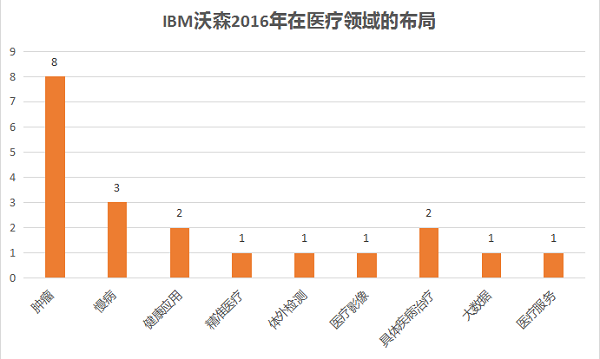
We can see that inOf the 20 major events, eight were related to oncology. IBM Watson’s healthcare applications have primarily focused on cancer diagnosis and treatment. In 2016, IBM Watson Health also expanded into many other areas:Chronic diseases such as diabetes, general health and wellness, medical imaging, in vitro diagnostics, precision medicine, robotics, and disease research and treatment.
>>>>
Watson's applications in healthcare are primarily focused on the diagnosis and treatment of cancer.
Watson’s first commercialization step was achieved through a collaboration with Memorial Sloan Kettering Cancer Center to jointly train IBM Watson for Oncology. Oncology experts inputted extensive case studies and medical records from Memorial Sloan Kettering Cancer Center into Watson for training purposes.
During this period, the system accumulated a total of 15,000 hours of login time. A team comprising physicians and researchers collectively uploaded thousands of patient medical records, nearly 500 medical journals and textbooks, and 15 million pages of medical literature, training Watson to become an outstanding “oncology specialist.” Subsequently, Watson Health deployed the system to many leading medical institutions, such as the Cleveland Clinic and the MD Anderson Cancer Center, to provide an evidence-based medical decision-support system.
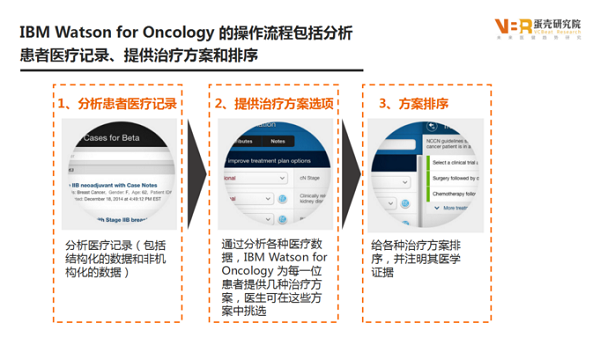
Watson's Process for Cancer Treatment Is as Follows
Source: VCBeat
1. IBM Watson Enters China
On August 12, 2016, IBM and Hangzhou Cognitive Network Technology Co., Ltd. (hereinafter referred to as “Hangzhou Cognitive”) jointly announced that 21 hospitals in China had planned to adopt the IBM Watson for Oncology solution trained by Memorial Sloan Kettering Cancer Center. This collaboration aims to leverage cognitive computing platforms to assist Chinese physicians in delivering personalized, evidence-based cancer treatment plans.
AsA key component of the collaboration between IBM and Hangzhou Cognitive Deep, the initial 21 hospitals participating in the program will serve as industry benchmarks.Promote the Watson for Oncology solution more effectively in hospitals across China.This is also Watson Health’s first partner project in China.
2017 Hangzhou Cognition will be localized into Chinese.Interface,Recommended PlanMedication Regimen Included. Additionally, current recommendations are all foreign protocols; this year, we aim to highlight domestically developed protocols and plan to implement them in over 50,000 cases across China.
2. IBM “Watson Joint Consultation Center” Launched at Zhejiang Provincial Hospital of Traditional Chinese Medicine
On December 26, Zhejiang Provincial Hospital of Traditional Chinese Medicine, together with Thinkive Medical and Hangzhou Cognitive, jointly announced the establishment of the Watson Multidisciplinary Consultation Center. The three parties will engage in long-term cooperation to deliver IBM Watson for Oncology services.This is sinceThe First Watson Multidisciplinary Consultation Center to Officially Announce External Services Since the Introduction of IBM Watson for Oncology to China, marking the beginning of a new era of AI-assisted diagnosis and treatment in China's healthcare industry.
Watson can provide consultation services for six types of cancer: lung cancer, breast cancer, rectal cancer, colon cancer, gastric cancer, and cervical cancer.In 2017, it will expand to cover 8–12 cancer types.. After the physician inputs information such as cancer type, patient age, sex, weight, disease characteristics, and treatment history, Watson can provide multiple treatment recommendations within seconds, relying entirely on its robust data repository and learning capabilities.
3. IBM Announces Completion of Training for Adjuvant Therapy in Gastric and Cervical Cancers, Officially Launching Its Use
After successively tackling lung cancer, breast cancer, colon cancer, and rectal cancer, IBM Watson for Oncology became one of the first commercial projects under IBM Watson Health in July 2015, officially launching its oncology solutions for these four cancer types for commercial use. In August 2016, IBM announced that it had completed training for adjuvant therapy in gastric cancer and formally launched its clinical application.
IBM Watson leverages cognitive computing to create a novel approach for uncovering answers and insights hidden within vast amounts of data. Cognitive computing is not designed to produce machines that think in place of humans, but rather to augment human intelligence and help people think more effectively. It does not make decisions; instead, it provides reference answers. For every question, it offers a set of potential answers accompanied by relevant evidence. Watson can comprehend questions posed in natural language and employ thousands of algorithms to provide alternative answers.
Additionally, according to Hangzhou Cognitive, Watson is stillIn November 2016, the cervical cancer service was launched after training.
4. Quest and IBM Launch Oncology Genomic Sequencing Services
In October 2016, Quest Diagnostics and IBM Watson Health announced the launch of a service to provide U.S. physicians with tumor genomic sequencing and analysis, as well as cancer treatment recommendations. This service represents IBM’s advanced genomics intelligent computing platform.Watson for Genomics now serves not only patients and oncologists but also community oncologists who provide the majority of cancer treatments.
As part of the collaboration, Memorial Sloan- Memorial Sloan Kettering Cancer Center’s precision oncology knowledge base, OncoKB, will supplement Watson with scientific data. The Broad Institute will provide genomic sequencing services as a complement to Quest Diagnostics’ sequencing offerings.Through this service, clinicians can send tumor tissue toQuest performs sequencing, and the sequencing data will then be transferred to Watson for analysis.。
After reviewing Watson’s report, the pathologist at Quest Diagnostics forwarded it to the clinical oncologist.Quest stated that the key to this initiative lies in its broad applicability. The company serves clients in approximately half of all physician offices and hospitals across the United States, including community oncologists who provide 70% of cancer treatments.
5. Watson Joins Forces with MIT and Harvard to Explore Drug Resistance in Cancer
Although an increasing number of therapies can suppress cancer for months or even years, unfortunately, most cancers eventually recur. Part of the reason lies in the fact that tumors undergo genetic mutations, leading to drug resistance.
IBM’s Watson AI platform will collaborate with the Massachusetts Institute of Technology (MIT) and the Broad Institute of Harvard University and MIT to study cases of resistance to cancer drugs, aiming to elucidate the mechanisms underlying drug resistance and to develop next-generation anticancer drugs and therapies.
Researchers state that fighting cancer is akin to playing chess: when we make a move with a therapy, cancer discovers new ways to resist the drug and counterattack. Therefore, the key to solving this problem may lie in leveraging clinical experience to anticipate cancer’s next move, thereby allowing us to strategize in advance and cut off its escape routes.
6. Watson Partners with Pfizer to Apply Machine Learning in Cancer Drug Discovery
IBM Watson and Pfizer have reached a new agreement to leverage the former’s supercomputing capabilities for cancer drug research and development.
Pfizer will useWatson for Drug Discovery leverages machine learning, natural language processing, and other cognitive reasoning capabilities to facilitate novel drug identification, combination therapy development, and patient selection strategies in immuno-oncology.
According to Pfizer, many researchers believe that the future of immuno-oncology lies in combinations targeting unique tumor characteristics, which will transform the way cancer is treated.. And in drug development, leveragingWatson’s cognitive capabilities can accelerate the delivery of potential new immuno-oncology therapies to patients.
>>>>
Chronic Disease Management Remains in the Data Collection Phase
1. IBM and Medtronic Collaborate to Launch a Diabetes Monitoring App
In January 2016, IBM and Medtronic collaborated to launch a diabetes monitoring app. Medtronic CEO Omar Ishrak and IBM CEO Ginni Rometty jointly introduced the app at the 2016 CES.
Previously, Medtronic and IBM conducted a pilot project involving 600 anonymous patients to identify predictive factors for hypoglycemia by analyzing data from Medtronic’s diabetes monitoring devices (insulin pumps and blood glucose monitors). Through this analysis, IBM’s Watson system was able to predict hypoglycemic events up to three hours before their occurrence.
2. Partnering with the American Diabetes Association to Leverage Big Data for Advancing Diabetes Care Applications
In June 2016, IBM’s medical data analytics division, Watson Health, recently entered into a partnership with the American Diabetes Association (ADA). Together, they will develop a suite of digital tools to help prevent, identify, and treat diabetes.
The ADA holds 66 years of valuable data, encompassing clinical studies, self-management capabilities, support groups, and diabetes education. Furthermore, this data is made accessible to third-party developers to facilitate the creation of patient-focused applications. However, as application development is not their core competency, this has been a primary driver for their collaboration with IBM.
3. Teva Partners with IBM Watson to Leverage Big Data in Exploring New Drug Indications and Novel Possibilities for Chronic Disease Management
In October 2016, global pharmaceutical company Teva and IBM jointly launched a three-year research collaboration, with plans to integrate with the Watson Health Cloud in the future. This project builds upon the existing alliance between the two companies,It will focus on two key areas in healthcare: developing systematic approaches to discover new uses for existing drugs, and improving the management of chronic diseases.
This collaboration in chronic disease management stems from the Foundation Life Sciences Partner Alliance, previously established through the partnership between Teva and IBM Watson Health Cloud. By leveraging Teva’s therapeutic technologies and Watson’s cognitive computing capabilities, the company is striving to help physicians, patients, and payers better manage chronic conditions such as asthma and more effectively track long-term treatment outcomes.
>>>>
Health Apps
1. Collaborate with Under Armour to leverage Watson’s cognitive computing technology for data-supported health monitoring
On January 6, 2016, at the CES exhibition, IBM and Under Armour announced a strategic partnership to leverage Watson’s cognitive computing technology to create and deliver data-driven health monitoring solutions.Under Armour’s latest UA Record, combined with its cognitive coaching system, will serve as athletes’ personal health advisor, fitness coach, and assistant.
With Watson’s data support, UA Record can acquire and synthesize various health-influencing factors, including personal data, physiological data, behavioral data, and environmental factors. Furthermore, Watson’s advanced technology enables the provision of reference data from age-matched peer groups. By delivering this evidence-based data to athletes, UA Record can guide their sleep, overall health, physical activity, and nutrition.
2. IBM Brings Watson AI to Apple Watch Sleep Health App
In March 2016, IBM announced the launch of a SleepHealth application for iPhone and Apple devices, aimed at collecting data on the relationship between sleep habits and overall health. Unlike other sleep-tracking apps that monitor the number of times users wake up during the night, this application is built on the IBM Watson Health Cloud. It was developed through a collaboration between IBM, Apple, and Johnson & Johnson, and integrates with Apple’s open-source ResearchKit framework.
SleepHealth is actually part of a study conducted by IBM in collaboration with the American Sleep Apnea Association. Its purpose is to leverage the many advanced sensors in the iPhone and Apple Watch to analyze how sleep quality affects daily life metrics, including daytime activity, alertness, productivity, general health status, and medical conditions.
The application was designed with several features specifically for the Apple Watch. IBM stated that it utilizes the Apple Watch’s heart rate monitor to detect users’ heartbeats during sleep, and also employs motion sensors, such as accelerometers and gyroscopes, to collect movement data, including information on position changes while users are sleeping at night.
>>>>
Robot
1、IBM and Rice University Unveil Watson-Powered Caregiving Robot
On December 8, IBM Research unveiled the IBM MERA, a multi-purpose elderly care robot jointly developed with Rice University. Powered by IBM Watson applications, IBM MERA is primarily designed to assist older adults and their caregivers.
The IBM MERA prototype was designed through the collaborative efforts of faculty and students from Rice University’s Department of Electrical and Computer Engineering and Department of Psychology. It primarily serves three functions: facilitating research into innovative methods for measuring vital signs such as heart rate, heart rate variability, and respiratory rate; answering basic health-related questions; and detecting falls in the elderly by analyzing accelerometer data.
IBM Research also plans to collaborate with Sole Cooperativa, a third-party healthcare service provider in Italy, to equip senior living facilities with sensors for monitoring residents’ daily activities and collecting data on their routine behaviors.
>>>>
In Vitro Diagnostics
1. IBM Makes a Strong Entry into Liquid Biopsy with Exosomes
In August 2016, IBM began to venture into liquid biopsy, aiming to establish a chip-based technology capable of separating and detecting particles at the nanoscale, with the expectation of enabling clinicians to detect tumors earlier.
This chip marks IBM’s first step into liquid biopsy, with exosomes being the most noteworthy component. Exosomes are disc-shaped vesicles with a diameter of 30–300 nm, closely involved in cell signaling, waste disposal, and other functions. They encapsulate molecules such as DNA, RNA, and cell surface proteins, reflecting the health status of cells.
This technology, capable of early tumor detection and real-time monitoring of therapeutic efficacy to accelerate new drug development, is IBM’s trump card for entering the rapidly growing liquid biopsy market. Liquid biopsy represents a trillion-dollar market, and in recent years, numerous companies have entered this space, including sequencing giant Illumina.
>>>>
Medical Imaging
1. IBM Announces the Launch of the IBM Watson Health Medical Imaging Collaboration Initiative
This is a global initiative comprising more than 15 renowned health organizations, academic medical centers, imaging diagnostic providers, and medical imaging technology companies. It aims to integrate cognitive imaging into the daily operations of healthcare institutions, assisting physicians in diagnosing breast cancer, lung cancer, and other cancers, as well as diabetes, eye diseases, brain disorders, heart disease, and related conditions such as stroke.
Members of the collaborative initiative leverage IBM Watson to extract insights from previously “invisible” unstructured imaging data and integrate them with vast datasets from other sources. This approach assists physicians in making personalized treatment decisions for individual patients while building a knowledge base to benefit a broader patient population. Such information may include data extracted by IBM Watson from electronic health records, radiology and pathology reports, laboratory results, clinical progress notes, medical literature, clinical practice guidelines, and publicly available conclusive reports.
>>>>
Medical Services
Leveraging Siemens’ Global Network to Transition Toward Value-Based Healthcare
Currently, the application of Siemens’ medical equipment and clinical testing technologies in healthcare institutions accounts for approximately 70% of the “critical decision-making” processes in hospital medical services, directly influencing development trends in the healthcare and broader health sectors, as well as the research and development and market adoption of next-generation Siemens medical devices.
Approximately 70% of medical services and clinical testing technologies in any large or moderately modernized hospital rely on Siemens’ medical equipment and technical support. These already advanced medical devices and decision-making solutions will, in the future, undergo an iterative transformation from quantitative accumulation to qualitative leaps, powered by the intelligent decision-making capabilities of the IBM Watson supercomputer. For instance, Siemens healthcare providers can access IBM Watson Care Manager, a new solution from IBM that integrates diverse types of clinical data and applies cognitive analytics to provide nurses and related care management personnel with actionable insights, enabling them to closely monitor patients with chronic conditions.
Under the “Five-Year Global Strategic Development Plan,” Siemens Healthineers will leverage its global medical device sales network and channels to introduce technology-driven innovations and provide consulting services to suppliers, supporting their transition toward value-based healthcare delivery.
>>>>
Big Data Collection
IBM to Acquire Healthcare Data Company Truven for $2.6 Billion
In February 2016, IBM announced plans to acquire healthcare data and analytics provider Truven Health Analytics for $2.6 billion.
Notably, this acquisition marks the fourth health data-related company IBM has acquired in the past two years. Meanwhile, it brings IBM’s total investment in healthcare to over $4 billion.
Deborah DiSanzo, General Manager of IBM Watson Health, stated, “In the healthcare industry, most data is distributed across disparate databases. IBM’s strategy is to consolidate this data and make it accessible, enabling both IBM and our partner ecosystem to develop healthcare solutions based on this foundation.”
According to available data, Truven is a privately held company whose primary business is providing cloud-based data management and analytics services to more than 8,500 healthcare clients, including hospitals, insurance companies, and government agencies.
>>>>
Specific Disease Applications
1. IBM and Apple Partner to Develop Cataract Surgery App for Bausch + Lomb
In May 2016, IBM will leverage its corporate partnership with Apple to develop a clinical computing app for cataract surgeons at Bausch + Lomb, a global eye health company. Initially, the app will focus on integrating all computational data, patient data, and prior surgical records to enhance the efficiency of surgeons’ workflows. The app was designed with future integration of IBM’s cognitive computing capabilities in mind.
2. IBM Watson Participates in ALS Research
In February 2016, amyotrophic lateral sclerosis (ALS) was fully named as such. ALS is a fatal neurological disease that causes muscle weakness, twitching, trembling, degeneration, and atrophy. In severe cases, it leads to difficulty swallowing, coughing, and respiratory function decline, resulting in the loss of mobility and self-care abilities. Currently, there is only one FDA-approved drug that shows limited efficacy. Much of the public's understanding of ALS may stem from the Ice Bucket Challenge, which gained widespread attention two years ago.Participants in the Ice Bucket Challenge pour a bucket of ice water over their heads, film the process and upload it to social media, and make donations to support the cause.Research on ALS.
IBM Watson has also achieved remarkable results in research on amyotrophic lateral sclerosis (ALS). Through collaboration with the Barrow Neurological Institute in Arizona, USA, Watson has identified five genes associated with ALS. This marks the first application of IBM Watson in neuroscience, suggesting its potential for use in research on other neurological disorders.
>>>>
U.S. Tech Giants Form AI Collaboration Organization
On the afternoon of September 28 (U.S. time), Google, Facebook, Amazon, IBM, and Microsoft officially announced the establishment of a new AI organization—the Partnership on AI—with the goal of ensuring that AI develops safely, transparently, and responsibly in the future.
The organization’s full name is the Partnership on Artificial Intelligence to Benefit People and Society, abbreviated as the Partnership on AI. It was established to focus on researching and addressing the various challenges that AI poses to human society, and to explore how humanity can most effectively leverage rapidly advancing technology.
This collaboration will further advance research in the field of artificial intelligence (AI) and provide reference information for other stakeholders in the AI sector, helping them better develop their own systems.
>>>>
Cognitive Computing Will Become IBM’s Future Growth Engine
According to IBM’s reported financial results, the company’s fourth-quarter revenue was $21.77 billion, lower than $22.059 billion in the same period last year; net income was $4.501 billion, a 1% increase from $4.463 billion in the same period last year; operating profit from continuing operations was $4.776 billion, a 1% increase from $4.707 billion in the same period last year.
Among them, the Cognitive Solutions segment (including solution software and transaction processing software businesses) reported fourth-quarter revenue of $5.297 billion, a 1.4% increase from $5.225 billion in the same period last year, or a 2.2% year-over-year growth excluding the impact of foreign exchange rate fluctuations; the gross profit margin was 82.7%, down from 85.7% in the same period last year.
Since Ginni Rometty took the helm at IBM in 2012, the company has been undergoing fundamental adjustments to its strategic direction and business architecture. The prominence of its traditional hardware and system software businesses has steadily declined, while cloud computing, cybersecurity, data analytics, and artificial intelligence have become the core areas for the company’s cash flow investment. Chen Liming, Chairman of IBM Greater China, once stated, “IBM is transforming into a company focused on cognitive computing and cloud platforms. There is no doubt that cognitive computing will become IBM’s growth engine in the future.”
While some AI companies are still struggling day and night with data collection and algorithm research, Watson, as a foundational technological tool, has already begun its strategic deployment and application in healthcare. It has been implemented in select major hospitals worldwide, particularly in the field of oncology, to serve patients. Although IBM’s financial statements appeared somewhat lackluster during its 2015–2017 restructuring period, the company is poised to enter a harvest phase soon as AI technology matures and its strategic initiatives unfold.
Furthermore, as the technology matures, Watson will not be content to limit itself to areas such as diabetes and other chronic diseases, general health, medical imaging, in vitro diagnostics, precision medicine, robotics, and disease research and treatment. In 2017, Watson’s reach will extend into other sectors of healthcare, serving the entire medical industry.