

Mobile Microscope Paired with Smartphone Enables Low-Cost, Point-of-Care DNA Sequencing
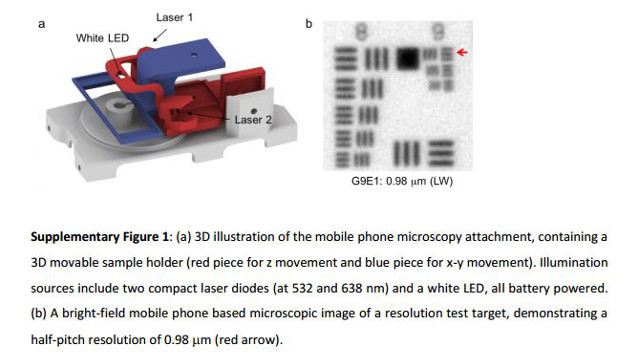
Recently, researchers published a paper in *Nature Communications* describing an add-on microscope for smartphones that enables the phone’s camera to detect fluorescent products from DNA sequencing reactions in cells and tissues. This mobile microscope can identify a mutation in the KRAS gene associated with colorectal cancer, which is present in more than 30% of patients with this disease.
“This study demonstrates that specific DNA target sequences can be analyzed using a very simple imaging device, such as a mobile phone,” said Nilsson, one of the authors of the paper and a researcher at Stockholm University in Sweden.
This microscope incorporates two battery-powered lasers for detecting different fluorophores, as well as a white LED light for bright-field imaging. The combination of the smartphone lens and an external lens provides 2.6× magnification. The 3D-printed microscope stage allows manipulation of the sample slide from three directions.
Researchers utilized this sequencing technology to amplify and fluorescently label target DNA sequences in colorectal cancer cells and human tumor samples, enabling the detection of mutant or wild-type KRAS. Subsequently, they employed this smartphone-based microscope for image processing of the sequencing results.
Gene mutation analysis and DNA sequencing are remarkable technological advances in recent years that have been introduced into clinical medicine. Professor Ozcan from the University of California stated, “However, they are confined to laboratories and clearly cannot be used in resource-poor or limited settings.” Ozcan believes that mobile microscopes can be used to analyze specific target sequences in more locations beyond medium-to-large hospitals or laboratories.
Tay from the University of Chicago was not involved in this study, but he considers it an attempt to democratize high-end molecular pathology measurements. Tay added, “DNA sequencing is currently the gold standard for detecting cancer types, but due to resource and cost constraints, it is difficult to perform routinely in daily practice. This mobile microscope can change this situation by reducing costs. The technology platform designed by the paper’s authors enables targeted sequencing of tumor samples at point-of-care testing (POCT) sites.”
Johan Lundin of the Institute for Molecular Medicine Finland, who was also not involved in the study, stated: “Another advantage of this combination of microscopy and sequencing strategies, compared with other gene mutation analysis techniques, is the preservation of cellular and tissue integrity. It allows you to create a map showing that mutations occur in specific cells.”
However, this technology still has room for improvement. Lundin noted that the platform has certain limitations, particularly in resource-limited settings. The use of mobile microscopy across diverse environments is constrained by the availability of additional laboratory equipment, which limits the feasibility of gene mutation analysis techniques. Meanwhile, Tay believes that there is significant scope for improving sample preparation, which currently requires a well-trained laboratory technician.
The authors point out that microfluidic chips can simplify sample preparation. Nilsson’s team of scientists has also begun working on solutions for sample preparation protocols.
Ozcan stated that the current goal of the scientific team in improving this product is to reduce the cost of the technology and make it easier for untrained individuals to use.Moreover, the platform will continue to expand its mutation analysis capabilities to other types of cancer.
Nilsson stated, “Such a remarkably simple device is well-suited for diagnosing infectious diseases, such as tuberculosis, in resource-limited settings. We can detect mutations in antibiotic resistance genes and then predict which antibiotics will be effective for tuberculosis patients through a straightforward test.”
He added that the platform can also be used for rapid diagnosis during viral outbreaks. Regardless of where the POCT site is located, analytical data can be transmitted remotely to experts, and results can be immediately fed back to users.
Source: www.the-scientist.com, AuthorAbby Olena