

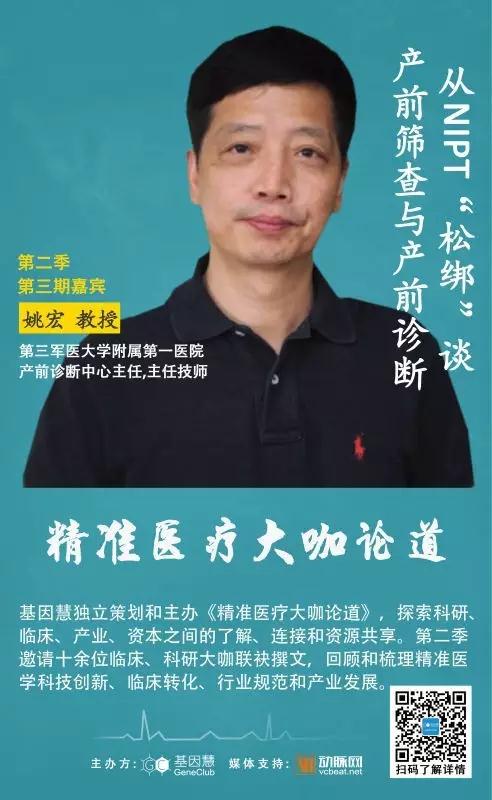
Professor Yao Hong from Southwest Hospital of Army Medical University Featured in 'Dialogues on Precision Medicine' Season 2 Episode 3
Source: GeneInsight PPT
[Review]
Precision Medicine: "Big Names Discuss" Season 1, Industry Series, Episode 12
Season 2, Episode 01: Professor Huang Shangzhi
Season 2, Episode 02: Dr. Gu Weihong
Guest of Season 2, Episode 3
[Editor's Note]
Precision medicine based on genetic testing technologies is gradually expanding its scope of clinical application. Among these, non-invasive prenatal testing (NIPT) stands out as the area with relatively mature technical assessment and market models. Local governments have begun to implement pricing standards, and some regions have already included NIPT in medical insurance coverage. In December 2016, the National Health and Family Planning Commission issued regulations that abolished the previous policy restricting NIPT to pilot institutions, allowing all qualified medical institutions to offer the service—a significant boost for the promotion of NIPT. The two companies with the highest coverage in NIPT services, BGI Genomics (approximately 1.7 million samples) and Berry Genomics (approximately 740,000 samples), are both on the verge of going public. Against the backdrop of national policies and corporate market model preparations, how do clinicians—the key stakeholders in this field—view the application of NIPT? GeneInsight invited Professor Yao Hong, Director of the Prenatal Diagnosis Center at Southwest Hospital of the Third Military Medical University, to share with readers the perspectives and outlooks of frontline clinicians on prenatal screening and prenatal diagnosis.

Prof. Hong Yao
The First Affiliated Hospital of the Third Military Medical University (Southwest Hospital)
Director, Prenatal Diagnosis Center; Chief Technician

Director of the Prenatal Diagnosis Center and Chief Technologist at the First Affiliated Hospital of Army Medical University (Southwest Hospital). Council Member of the Cross-Strait Medical and Health Exchange Association; Vice Chairperson of the Genetics and Reproduction Professional Committee; Committee Member of the Medical Genetics Professional Committee of the China Association for Healthy Birth and Science; Council Member of the Chongqing Genetics Society; Committee Member of the Reproductive Medicine Professional Committee of the Chongqing Reproductive Health Society; Deputy Leader of the Prenatal Diagnosis Group under the Obstetrics and Gynecology Professional Committee of the Chongqing Medical Association; Member of the Chongqing Prenatal Diagnosis Expert Group; Member of the Chongqing Thalassemia Project Expert Group; Deputy Leader of the Expert Group for the Chongqing Free Prenatal Down Syndrome Screening Project; and Committee Member of the Reproductive Health Committee under the PLA Professional Committee for Eugenics, Family Planning, and Childcare.With 34 years of experience in medical genetics, prenatal diagnosis, and assisted reproductive technology, he has helped establish comprehensive technical platforms and work systems at the Prenatal Diagnosis Center, covering all fetal sampling procedures, cytogenetics, molecular genetics, whole-genome and next-generation sequencing, preimplantation genetic diagnosis (PGD) and screening (PGS), newborn screening for inherited metabolic disorders, fetoscopy, fetal imaging, fetal pathological diagnosis, and a biobank for birth defect samples. He possesses extensive clinical and laboratory expertise in medical genetics and prenatal diagnosis. He has received one Third Prize for Military Scientific and Technological Progress and one Second Prize for Chongqing Municipal Scientific and Technological Progress. He has authored or co-authored more than 80 academic papers (including 10 SCI-indexed papers) and served as editor-in-chief or contributing editor for five monographs.
Author: Yao Hong
The First Affiliated Hospital of the Third Military Medical University (Southwest Hospital)
Director, Prenatal Diagnosis Center; Chief Technologist
Prenatal diagnosis and prenatal screening in China began with cytogenetics in the 1970s, followed by serological screening and ultrasonography in the 1980s. After nearly half a century of development, significant progress has been made in establishing theoretical frameworks, enhancing government and industry awareness, and innovating technical methods. Among these advances, non-invasive prenatal testing (NIPT) undoubtedly represents a revolutionary technological breakthrough.
After non-invasive prenatal testing (NIPT) entered clinical practice in 2010, it attracted the participation of related technical professionals and clinicians. Due to differing interpretations of testing models and the high clinical detection rates, there was a lack of uniformity and standardization in technical implementation and result evaluation. Consequently, the National Health and Family Planning Commission temporarily suspended the program in early 2014. From late 2014 to early 2015, it successively announced the list of testing institutions and clinical trial medical institutions permitted to conduct NIPT. In November 2016, guidelines were issued to regulate prenatal screening and diagnosis using cell-free fetal DNA from maternal peripheral blood, relaxing access requirements for testing institutions and abolishing the approval process for clinical pilot institutions, a move referred to within the industry as the “deregulation” of NIPT.
This has brought new challenges to the fundamental theories, operational models, and technical applications of existing prenatal screening and prenatal diagnosis under the conditions of new technologies.
No genetic disorder is as suitable for population-based screening as Down syndrome. Its high prevalence in the general population, the severity of its pathological consequences, and its distinct characteristics and patterns—arising from germ cells, the fertilization process, and early embryonic cleavage—underscore the importance of screening. Over the past three decades, serological screening for Down syndrome has evolved from second-trimester screening to combined first- and second-trimester screening incorporating ultrasound markers, making significant contributions to the prenatal definitive diagnosis of fetuses with Down syndrome. Non-invasive prenatal testing (NIPT) demonstrates irreplaceable technical advantages due to its extremely high detection rates for trisomies 21, 18, and 13, as well as its ability to flag other chromosomal abnormalities. However, clinical practice has faced challenges and confusion, ranging from the initial disarray during early adoption to current issues regarding the management of late-pregnancy testing windows, appropriate indications for cautious-use populations, and the handling of results, despite the establishment of clinical guidelines in 2015 that standardized timing, indications, precautions, and contraindications. How should these two technologies coexist? This issue will be readily resolved as physicians and pregnant women gain a more comprehensive understanding of the testing technologies, as NIPT is implemented in strict accordance with relevant regulatory standards, and as a rational clinical pricing system is established. This is not merely a choice between technologies, but rather a testament to scientific progress.
In the early stages of the clinical application of NIPT, many practitioners not only compared it with serological screening techniques but also considered whether it could, to some extent, replace invasive prenatal diagnosis. During this period, there were cases of pregnancy termination due to high-risk NIPT results. Fortunately, experts in prenatal diagnosis promptly responded by clarifying that these are two distinct platforms: NIPT is a screening tool, whereas invasive prenatal diagnosis is a diagnostic procedure. Therefore, pregnant women with high-risk NIPT results must undergo invasive prenatal diagnosis. However, invasive prenatal diagnosis does carry certain clinical risks, such as fetal loss, and compliance among pregnant women and their families remains suboptimal. Chromosomal disorders have specific inheritance patterns and occurrence rules, which differ from those of common diseases.
Even frontline clinicians have certain knowledge gaps. Non-invasive prenatal testing (NIPT) is a non-invasive screening method with a high level of detection accuracy, while invasive prenatal diagnosis carries a relatively low risk to both mother and fetus. For pregnant women who already have indications for prenatal diagnosis and for frontline clinicians, is it not inevitable to face dilemmas? Regarding how to make choices, I believe there is no fixed model. However, we should at least accomplish the following tasks: First, strengthen reproductive health education and popular science outreach for couples of childbearing age; Second, advocate for preconception genetic disease screening, such as testing for common monogenic disorders and karyotyping of both partners; Third, enhance frontline clinicians’ understanding of screening and diagnostic techniques for chromosomal abnormalities through training; Fourth, ensure that prenatal counseling comprehensively assesses corresponding high-risk factors. Comprehensive testing should be conducted by integrating individual maternal risk factors with considerations of the advantages and disadvantages of technologies, testing methods, turnaround times, and the clinical significance of results.
The advancement of fetal imaging has unveiled an increasing amount of phenotypic information about the fetus. Apart from major organ malformations, numerous phenotypic findings do not allow for a straightforward prediction of postnatal growth, development, or disease outcomes; nevertheless, they often induce panic and helplessness in pregnant women and their families. Currently, our understanding of the specific causes underlying abnormal fetal phenotypic development remains limited, and the technical means available to detect potential diseases are constrained. With the exception of approximately 10% of fetuses that can receive a definitive diagnosis through chromosomal analysis and testing for a limited number of monogenic disorders, we can only continue to monitor the remaining cases. Under existing technological conditions, no matter how endearing the images captured by “four-dimensional” ultrasound may appear, we essentially remain unable to clearly discern the fetus’s true “countenance.” We cannot remain indifferent; at the very least, we can:
1. Respect for life, maintain effective communication with pregnant women and their families, and face challenges together;
2. Establish a scientific and effective follow-up system to gradually summarize the relationship between different phenotypic characteristics and growth, development, or disease;
3. Rational application of prenatal diagnostic techniques;
4. Establish a multidisciplinary fetal medicine outpatient clinic (such services are already offered by certain institutions in China);
5. Conduct intrauterine fetal therapy under the conditions of ethical and technical safeguards;
6. Conduct scientific research related to abnormal fetal development,
..........................................
With our hearts as mirrors, we can surely see the fetus’s radiant smile.
Having practiced prenatal diagnosis for 34 years, I have never before had access to such an abundance of technical tools. While advanced detection technologies have expanded our diagnostic capabilities, they have also introduced challenges in interpreting results. Setting aside the professional recognition I have earned through 34 years of practice with zero complaints, one need only look at the uncertain reports regarding copy number variations (CNVs) to appreciate the difficulties faced by my peers. Despite the availability of comprehensive guidelines for chromosomal microarray analysis (CMA), interpreting specific individual cases remains far from easy. I call on relevant national authorities or industry associations to establish a Chinese population database at the national level. Committed to advancing alongside science, I will continue on this journey.
In 2017, we will still face the aforementioned challenges. However, as practitioners enhance their understanding of technology through training, as testing technologies continue to improve, and as clinical application experience is accumulated and shared, we believe that prenatal screening and prenatal diagnosis will be conducted in a more rational, scientific, and humanistic manner in an orderly fashion.
It is the shared goal of practitioners to establish a comprehensive medical system for prenatal screening and diagnosis under new technological conditions, integrating policy and regulatory guidance, research and development of new technologies, formulation of clinical application standards, implementation of multi-technology combined testing, as well as technical management and ethical norms. Only in this way will we be equipped to embrace the advent of PGD and PGS with more rationality and higher detection capabilities, non-invasive prenatal diagnostic technologies, genomics, and related gene testing technologies—representing novel approaches to the detection and intervention of birth defects and genetic disorders.
Effective Prenatal Screening and Diagnosis in the Era of New Technologies Depend on Our Continuous Knowledge Updating, Lifelong Learning, and Rigorous, Responsible Competence and Attitude.
Let us give thanks to the pregnant women and fetuses we serve! They bring joy to families, advance science, hone our skills, and enrich humanity!
[Postscript]
We extend our gratitude to Professor Yao Hong for participating in the clinical research series of Season 2 of “Dialogues with Precision Medicine Leaders” and sharing his professional insights.
“Health is our commitment; lives are entrusted to us.” Clinicians on the front lines, particularly those specializing in prenatal screening and diagnosis, hold a unique reverence for life. The early clinical application of genetic diagnosis (in the 1980s and 1990s) also took place in obstetrics and prenatal care. Professor Yao Hong has been engaged in prenatal diagnosis for over 34 years. He is deeply aware that clinical advancements have benefited from societal progress and technological innovation. While dedicating himself to clinical practice, he actively embraces new technologies and maintains close collaboration with the genetics industry. GeneWisdom is honored to have collaborated on the event hosted by the Cross-Strait Medical and Health Exchange Association and the PLA Obstetrics and Gynecology Professional Committee of Southwest Hospital."The 10th National Academic Exchange Conference on Genetic Disease Diagnosis and Prenatal Diagnosis"Throughout our exchanges and collaboration with Professor Yao Hong, we are grateful for his enthusiastic assistance and open-mindedness. He possesses profound insights into technology and its applications, drawing from a clinical background while transcending its boundaries. We look forward to new technologies such as NIPT better serving clinical practice and the general public. As sample sizes accumulate and big data technologies integrate with clinical care, realizing their value in advancing both research and clinical applications of precision medicine will require multi-party connectivity, collective effort, and shared development.