

DHC Software's Strategic Bet on DRGs: Progress and Product Portfolio in China's Healthcare Payment Reform

Recently, to accelerate the pace of national healthcare reform, the National Development and Reform Commission (NDRC) issued the “Notice on Promoting Diagnosis-Related Group (DRG) Payment,” requiring all public hospitals at Level II and above across China to select a certain number of medical conditions for implementation of diagnosis-related payment. In pilot regions for comprehensive urban public hospital reform, no fewer than 100 such conditions were to be implemented by the end of 2017. Meanwhile, the Notice released a catalog of 320 medical conditions for localities to choose from when advancing diagnosis-related payment.
As early as last June, the Ministry of Human Resources and Social Security issued the “Guiding Opinions on Actively Promoting the Linked Reform of Healthcare Services, Medical Insurance, and Pharmaceuticals,” proposing to prioritize payment method reform within the broader healthcare system reform. In conjunction with budgetary management of medical insurance funds, it called for comprehensive implementation of global budget caps, accelerated adoption of case-based and capitation payment models, active promotion of Diagnosis-Related Groups (DRGs) payment systems, exploration of combined applications of global budgets and point-value methods, and establishment of a composite payment mechanism.
The introduction of various policies has been a clear boon for Diagnosis-Related Groups (DRGs). As a technological benchmark in China’s DRG sector and a leading domestic healthcare IT enterprise, Donghua Software began strategically positioning itself in the DRG space as early as May 2015. Driven by these policy initiatives, DRG adoption is becoming the industry mainstream, with DRG data poised to serve as a critical resource for health insurance cost containment and medical big data analytics.
How is DHC Software's DRG development progressing?
In May 2015, Donghua Software signed the "Equity Transfer Agreement of Beijing Wanxing Xinrui Technology Development Co., Ltd." with Lhasa Jinquan Investment Management Co., Ltd., acquiring a 51% equity stake in Beijing Wanxing Xinrui Technology Development Co., Ltd. held by Lhasa Jinquan Investment Management Co., Ltd. for a transfer price of RMB 153 million.

Data Source: Internet
Wanxing Xinrui’s product portfolio mainly comprises four categories: (1) the HITB Industry Application Platform (primarily applied in Beijing’s health informatization projects); (2) DRGs Hospital-Side Applications (including performance analysis, quality control, and process control); (3) Electronic Medical Records (EMR); and (4) a health management platform centered on chronic disease management.
As the sole technical partner for the Beijing version of DRGs, a national pilot program, Wanxing Xinrui holds exclusive authorization from the National Quality Control Center for Disease Diagnosis Related Groups and is responsible for developing and maintaining the national and provincial versions of the Inpatient Performance Service Evaluation Platform software, as well as the DRG grouper software.
Meanwhile, Wanxing Xinrui is the designated technical partner of the Beijing DRGs Research Group in the field of information system development. By aggregating tens of millions of medical records, it has built the “Beijing DRGs Grouper Software” and the “Inpatient Medical Service Performance Evaluation Platform.” It has also collaborated with nationally renowned Grade III Class A hospitals, such as Peking Union Medical College Hospital and the 301 Hospital (Chinese PLA General Hospital), to support the Beijing DRGs Research Group in further promoting these solutions to health commissions across all provinces in China.
At that time, Wanxing Xinrui had once fallen into significant losses, with its assets at the end of May totaling only RMB 2.05 million and equity standing at merely RMB 1.6 million. Upon completion of the acquisition, the fair value of identifiable net assets on the acquisition date was RMB 2,730,400.87, of which the share attributable to Donghua Software was RMB 1,392,504.44. The difference between the two amounts, totaling RMB 151,607,495.56, was entirely recognized as goodwill.
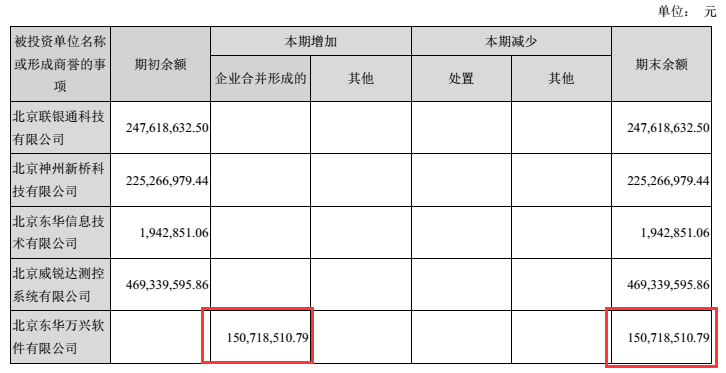 Data Source: DHC Software 2015 Semi-Annual Report
It is evident that the nearly 180-fold premium paid by Donghua to Wanxing Xinrui was remarkably high. Following the acquisition, several individuals, including Donghua’s directors and senior executives, increased their holdings by a total of 366,800 shares (representing 0.024% of the company’s total share capital), at an average transaction price of RMB 20.57 per share. Han Shibin, General Manager of Donghua’s Healthcare Division and the new legal representative of Donghua Wanxing (Wanxing Xinrui), increased his holdings by nearly 30,000 shares. Even if this were merely a case of capitalizing on market concepts, Donghua’s preparations were sufficiently thorough.
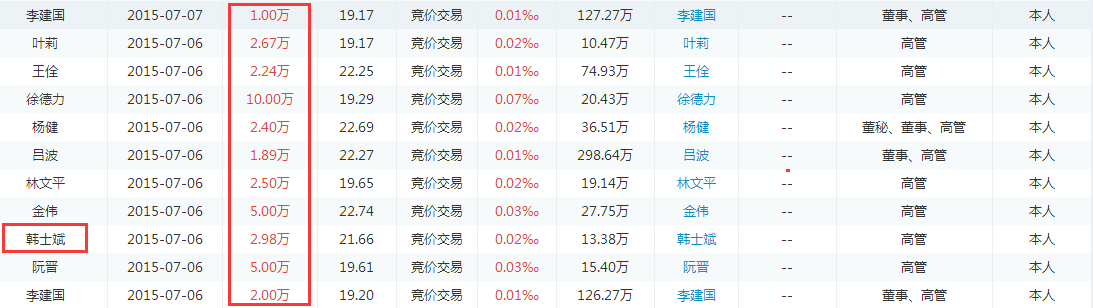
Changes in Shareholdings by DHC Software Executives in July 2015 Data Source: Internet
Key financial data derived from the subsidiary’s reports show that, in the first half of 2016 compared with the same period in 2015, Donghua Wanxing’s operating revenue increased by RMB 49,329, net assets rose by RMB 5,133,758, operating profit grew by RMB 12,266,532, and net profit increased by RMB 12,494,296. Undoubtedly, Donghua Wanxing’s profit growth rate is quite remarkable.

Financial Performance of Donghua Wanxing (Wanxin Xinrui) in the First Half of 2015 Data Source: Donghua Software’s 2015 Semi-Annual Report

Financial Performance of Donghua Wanxing (Wanxing Xinrui) in the First Half of 2016 Data Source: Donghua Software’s 2016 Semi-Annual Report
Our analysis reveals that although Donghua Wanxing’s revenue growth was modest, amounting to only RMB 49,329, this figure does not accurately reflect the actual growth of its business operations. According to Donghua Software’s 2016 semi-annual report, within one year, Donghua Wanxing’s DRGs-based regional healthcare performance evaluation system and DRGs-based regional medical insurance cost-control system were successively launched or entered trial operation in several regions, including the Chinese Academy of Chinese Medical Sciences region, Shanghai Jiading District, Shenzhen City, Shenzhen Nanshan District, and Beijing’s New Rural Cooperative Medical Scheme projects. In terms of geographic coverage, these products have expanded significantly compared to the period immediately following the acquisition in 2015.
As DRG projects are government-led initiatives with immature operational models and frequent pilot implementations, it is highly likely that Donghua Software operates them under a Public-Private Partnership (PPP) model. PPP payment mechanisms primarily fall into three categories: user fees, viability gap funding (VGF), and government payments. Clearly, at this stage, it is difficult for third-party social entities to bear the costs of DRGs. If non-recurring gains and losses are taken into account, viability gap funding aligns more closely with the aforementioned circumstances. This also explains why the company’s profit growth rate significantly outpaces its revenue growth.
Leverage DRGs to Dominate the Upstream and Extend Downstream
On one hand, clinical pathway management and diagnosis-related group (DRG) payment have gradually become essential requirements for healthcare institutions. On the other hand, leveraging precision medicine to enhance healthcare quality and efficiency represents the future trend of medical development.
From the logic of national healthcare reform, cost containment is the objective, payment method reform is the core, and DRGs serve as the methodology. Consequently, DRGs occupy a pivotal position in the upstream of healthcare reform.
In November last year, Donghua Software entered into a strategic partnership with Lanhai Group. Shanghai Life Insurance, in which the actual controller of Lanhai Group holds equity stakes, possesses a life insurance license. This enables industrial synergy with Donghua Software’s information technology systems and DRG (Diagnosis-Related Groups) services, thereby establishing a closed-loop payment system for medical insurance cost containment.
Whether it is commercial insurance or social security insurance, the most challenging issue remains cost control. The difficulty in cost control lies in the inability to quantitatively distinguish between reasonable and unreasonable expenses. In the absence of such differentiation, it is naturally impossible to standardize reasonable costs for medical services provided by hospitals and patients. To address this challenge, it is essential to analyze both structured and unstructured data through healthcare big data.
Pain Points in the Application of Medical Big Data: On one hand, there is inconsistency in the terminology used for medical specialized terms across China; on the other hand, data systems from healthcare institutions (such as electronic medical records, imaging, radiology, and genomics), pharmacies, pharmaceutical R&D, and commercial insurance have not been integrated through interoperable interfaces. This lack of integration prevents the formation of a closed-loop data ecosystem, thereby compromising the authenticity and accuracy of medical big data.
In December last year, the National Health and Family Planning Commission (NHFPC) issued the "Notice of the General Office of the National Health and Family Planning Commission on the Implementation of Clinical Pathways for Certain Diseases," entrusting the Chinese Medical Association to organize experts to formulate (revise) and announce a total of 1,010 clinical pathways. It proposed promoting the integration of clinical pathway management with medical quality control and performance assessment, adjustments to medical service fees, reforms in payment methods, and the development of information systems in healthcare institutions. Against the backdrop of controlling medical insurance costs, this initiative aims to lay the groundwork for further advancing payment method reforms and even reducing medical expenses.
The standardization of clinical pathways will resolve discrepancies in medical terminology across different healthcare institutions and between traditional Chinese medicine and Western medicine. The practical application of Diagnosis-Related Groups (DRGs) enables the optimal grouping and consolidation of clinical case data. With continued investment in healthcare informatization, the establishment of unified interface standards among healthcare institutions, pharmacies, and health insurance systems will allow medical big data to address the pain point of information silos.
However, medical big data alone is far from sufficient. The ultimate application of data lies in artificial intelligence (AI). Only by integrating big data with AI to assist physicians in diagnosis and treatment can we realize the future direction of precision medicine. In summary, Diagnosis-Related Groups (DRGs) can effectively control the source of medical data, thereby enabling medical big data and AI to truly deliver value. The former serves as the cause, while the latter represents the effect.
In October 2016, DHC Software established a long-term strategic partnership with IBM. The two parties agreed to leverage cognitive analytics technologies to accelerate the discovery of insights in clinical research, and to further translate these research insights and findings into clinical practice, thereby enabling personalized diagnosis and treatment. Starting with three disease types within the field of oncology-related conditions, they will build a reusable analytics platform that will support analytical work for other disease types.
Market Prospects of DHC Software's DRGs
Currently, there are numerous constraints hindering the development of Diagnosis-Related Groups (DRGs). Key challenges requiring urgent resolution include cost accounting for hospital disease groups, standardization of clinical pathways, enhancement of hospital operational management, and coordination among multiple departments—such as finance, medical affairs, information technology, and logistics—as well as with health IT vendors.
For Donghua Software, its mature traditional healthcare IT business and strong brand can effectively support the promotion and application of DRG-based services. The complete closed-loop ecosystem it has built—integrating Hospital Information Systems (HIS), Diagnosis-Related Groups (DRGs), big data, artificial intelligence, and commercial insurance—represents a distinctive industry advantage that currently sets the company apart. As new policy-driven opportunities emerge, whether Donghua Software can capitalize on this momentum and rise to the occasion will depend on its strategic moves and layout in the near future.