

11160: Expanding from Medical Services into the Greater Health Industry with a Strategic Focus on Online Hospitals

Shenzhen Ningyuan Technology
Integrated Internet Healthcare Service Platform
As the new year begins, everything takes on a fresh look. The end of the Spring Festival holiday marks our official entry into the busy schedule of 2017. Looking back on 2016, we witnessed frequent upheavals in the internet healthcare industry, the sustained boom in artificial intelligence, a surge of capital into the genomics sector, and tighter regulatory policies for pharmaceutical e-commerce...
Although the market we witness is merely the tip of the iceberg of the entire healthcare and wellness industry, a single leaf can herald the coming of autumn. VCBeat will identify benchmarks and leaders from these dynamic sectors, review their development trajectories over the past year, and reflect on and forecast their strategies for 2017, with the hope of providing valuable insights to investors, observers, thinkers, and practitioners in the industry.
Throughout 2016, all mobile health companies faced a make-or-break test. Amidst the harsh trials of market competition and profitability, many enterprises hit a bottleneck.. As one of the most representative companies, Shenzhen Ningyuan Technology (Jiankang 160) has also undergoneThe Long Metamorphosis Before Breaking the Cocoon.On November 18, after successfully completing a C1 round of private placement worth RMB 56.5 million and reaching a valuation of RMB 1.5 billion, external parties’ views onHealth 160The suspicion and unease finally came to an abrupt halt.
Top 10 Events of Health 160 in 2016
In March 2016, the international medical services platform of 91yiyao (Jiuyi 160) was launched. To date, Jiuyi 160 has partnered with dozens of renowned hospitals in South Korea, Japan, the United States, and Thailand, primarily offering three categories of services: cosmetic and plastic surgery in South Korea, precision health screenings in Japan, and critical care treatment in the United States. Subsequently, it also expanded its network to include healthcare providers from Thailand, Germany, and other countries and regions.Assisted Reproductive Technology and Other Medical Services。
In April 2016, Jiuyi 160 pioneered the entry of personalized insurance into the mobile healthcare sector by launching the first-ever "Appointment Cancellation Insurance." During the coverage period, if an insured patient successfully books an appointment with a public hospital in Shenzhen or Dongguan through the Jiuyi 160 platform, and the scheduled doctor temporarily cancels consultations due to uncontrollable factors, the patient will receive a compensation of RMB 50 per incident, with a premium of only RMB 1.
In May 2016, the transaction volume for in-consultation payments on Jiuyi 160’s full-process online hospital platform exceeded RMB 100 million, setting a record for hospitals conducting online transactions via internet healthcare platforms. As of September 2016, Jiuyi 160 had connected with more than 3,000 large hospitals across China, covering over 200 cities. The platform boasted 470,000 affiliated physicians, served more than 1 million users daily, and had provided a cumulative total of 250 million online medical services to patients nationwide, with the number of real-name registered users surpassing 100 million.
In June 2016, JiuYi160 launched China’s first patient-centric internet-based tiered diagnosis and treatment system. Leveraging its massive user traffic, JiuYi160 promoted tiered diagnosis and treatment policies to patients and provided guidance, directing those with mild or chronic conditions to community health service centers, thereby alleviating the diagnostic and treatment burden on large hospitals. Meanwhile, patients can easily access health knowledge through the JiuYi160 platform, cultivate proper healthcare-seeking habits, and establish a “primary care at the grassroots level” model of medical consultation.
In June 2016, Jiuyi 160’s first mobile payment service integrated with medical insurance officially commenced operations at the Longgang District Hospital of Traditional Chinese Medicine. Through the Jiuyi 160 platform, patients can not only access a full spectrum of healthcare services on their mobile devices—including appointment registration, in-consultation payments, retrieval of laboratory and imaging reports, and post-consultation follow-ups—but also seamlessly achieve real-time reimbursement of medical insurance expenses. This initiative has fully streamlined the mobile healthcare payment process.
In June 2016, Jiuyi 160 entered Hainan Province to participate in the government-led construction of the Smart Hainan Public Healthcare Platform. As the operator of the “Smart Hainan” public healthcare platform, Jiuyi 160 leveraged its strong first-mover advantage in the internet healthcare sector to deliver health information services and smart medical services to the people of Hainan.
In August 2016, Health 160 partnered with Tencent to establish a strategic platform collaboration, building a complete ecosystem for mobile healthcare. Leveraging the “Internet Plus” strategy, Tencent launched a unified appointment registration platform, with Health 160 as one of the inaugural partners, sharing access to its vast user traffic. The platform consolidated previously fragmented appointment slots, enabling patients to complete registration and receive medical care more quickly, accurately, and efficiently.
In August 2016, Jiuyi 160 launched its genetic testing service. As a genetic testing program specifically designed for the general public, “Gene 160” allows users to purchase required genetic testing services online via the “Gene 160 Platform” WeChat official account or website. Sample collection can be completed at home, thereby truly bringing genetic testing into the lives of ordinary consumers.
In September 2016, Health 160 entered into a partnership with China Resources Phoenix Healthcare. Under the agreement, Health 160 would provide an online appointment registration technology platform for six of the latter’s affiliated hospitals, as well as implement the Blue Dragonfly real-time hospital infection monitoring system at one of these hospitals.
In November 2016, Jiuyi 160 issued an announcement on external investment, acquiring Shenzhen Jiankangyuan Pharmaceutical Co., Ltd. for RMB 2.928 million. The acquired company was registered and established in March 2013, operating 17 pharmacy stores. On July 22, 2016, it obtained the C Certificate for pharmaceutical e-commerce, qualifying it to operate an online pharmacy. Following the acquisition, “160 Grand Pharmacy” was officially launched in December.
Core Strategy: Internet + Healthcare Ecosystem
The above is a brief chronological overview of the events. Analyzing solely based on this timeline makes it difficult to discern the strategic logic of Health 160. However, the general outline can be clearly seen from the figure below:
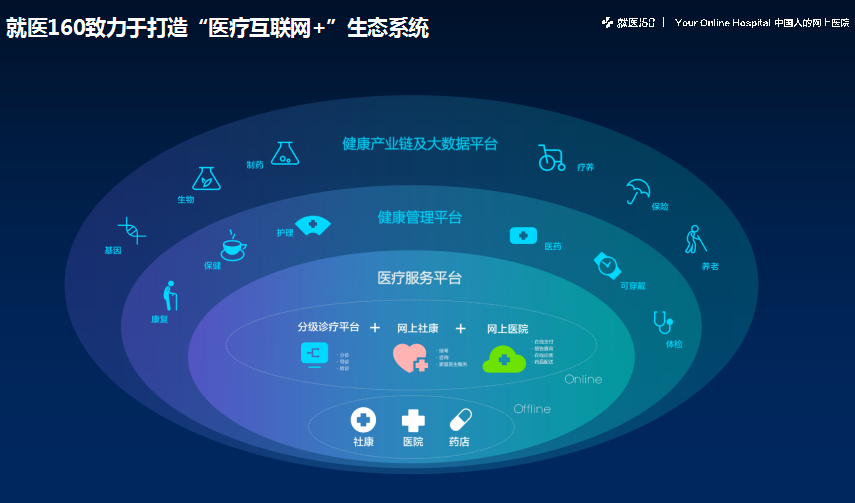
This chart is sourced from the keynote address delivered by Luo Ningzheng, CEO of Jiuyi 160, at VCBeat’s “Top 100 Future Healthcare Companies Forum.” Its implications can be understood from two dimensions: horizontal and vertical.
Within the overall strategic framework, community health centers, hospitals, and pharmacies constitute the core of the business. From a vertical perspective, Jianyi 160 will build three progressively layered and interconnected platforms around these three core business areas: a Medical Service Platform, a Health Management Platform, and a Health Industry Chain & Big Data Platform.
The vertical dimension clearly reflects the strategic hierarchy of Health 160, while a horizontal analysis reveals the specific responsibilities and significance of each level:
1. Medical Service Platform
The medical service platform primarily comprises three core business segments: first, online hospital services represented by full-process hospital operations; second, a tiered diagnosis and treatment platform; and third, online community health services. These three segments collectively constitute the primary revenue source for JiuYi160 at the current stage.
Jiuyi 160’s online hospital services encompass end-to-end solutions, including appointment registration and payment, for large public hospitals. Notable initiatives include the launch of the first mobile medical insurance payment service in collaboration with Shenzhen Longgang District Hospital of Traditional Chinese Medicine last June; the introduction of a China-wide unified appointment registration platform based on the “Internet Plus” strategy in partnership with Tencent last August; and the provision of an online appointment registration technology platform for six hospitals under China Resources Phoenix Healthcare following a collaboration established last September.
Regarding tiered diagnosis and treatment, in June last year, Health 160 officially launched China’s first patient-centric internet-based tiered diagnosis and treatment system. Leveraging the principle of “condition priority,” this platform utilizes the internet’s strength in connecting information to effectively link patients with physicians, mobilize the enthusiasm of specialist doctors, and rationally match medical resources through a model of free patient applications followed by physician review, thereby improving the efficiency of medical care for referred patients.
Meanwhile, the Jiuyi 160 tiered diagnosis and treatment platform fully supports contracted services with community general practitioners. Through the Jiuyi 160 platform, patients can easily access health information, cultivate proper healthcare-seeking habits, and establish a “primary care first” model of medical consultation.
In addition to patient guidance and triage, the "Jiuyi 160" platform leverages its extensive resources of physicians, patient base, and traffic to facilitate "two-way referrals" between hospitals and community health centers. By integrating with Hospital Information Systems (HIS), it supports online referrals and can serve as an operational platform for the existing tiered diagnosis and treatment system.
In addition to online hospitals and tiered diagnosis and treatment platforms, online community health centers are also a crucial component of the 160 Medical Service Platform, providing services such as appointment registration, consultations, and family doctor contract signing for communities. Building upon these free basic service modules, “160 Medical” connects with a large number of B-side clients, including county-level hospitals, community hospitals, and postpartum care centers. By directing user traffic to these institutions, it helps revitalize underutilized medical resources.
2. Health Management Platform
Health management platforms can be viewed as an extension of medical service platforms, belonging to the broader health industry. Within Shenzhen Ningyuan Technology’s strategic vision, its business scope encompasses rehabilitation, wellness, nursing care, pharmaceuticals, wearable devices, and physical examinations.
In March last year, 9160 International Medical Services was launched, and in November, Shenzhen Jiankangyuan Pharmaceutical Co., Ltd., a pharmaceutical e-commerce enterprise, was acquired. These developments indicate that 9160 is extending its reach from a stable medical service platform toward becoming a comprehensive health management platform.
3. Health Industry Chain and Big Data Platform
As the top-tier platform in Shenzhen Ningyuan Technology’s strategy, this segment is constrained by technical and professional barriers, making it the most difficult area for healthcare enterprises to penetrate. In this regard, Shenzhen Ningyuan Technology has only just begun.
In April last year, Juyi 160 launched its first personalized insurance product—Cancellation Insurance. In August, it introduced “Gene 160,” a genetic testing service tailored for the general public. Both initiatives can be viewed as strategic probes to test the waters for the platform.
What Will Health 160 Do in 2017?
“We will systematically enhance our capabilities in building an ‘Internet Plus Healthcare’ ecosystem. In 2017, our strategic focus will center on the three key principles: standardization, value, and responsibility.” This statement was made by Luo Ningzheng last December at VCBeat’s “Top 100 Future Healthcare Companies Forum.”
Standards and responsibilities require time to mature. For Health 160, what truly needs to be amplified at this stage is value—for doctors, hospitals, and patients alike.
In November last year, the completion of a C1 round private placement worth RMB 56.5 million helped the company weather the harsh capital winter. However, this does not mean that “spring has arrived”; it merely signifies that Health 160 has secured its ticket to enter the second half of the game.
Services such as appointment registration, subsidy distribution, and providing free payment solutions for hospitals are considered basic offerings. While they rarely generate significant profits, they have enabled Health 160 to accumulate a broad base of both B-end and C-end customers. As the industry enters its next phase of intense competition, profitability becomes an inevitable challenge; ultimately, cash flow determines which players will survive. With over 100 million registered users, Health 160 places paramount importance on its e-commerce operations.
According to the “2015 Statistical Analysis Report on the Operation of the Pharmaceutical Distribution Industry” released by the Ministry of Commerce in June, the total sales volume of pharmaceutical e-commerce reported through the Ministry’s direct reporting system reached RMB 47.6 billion last year. Based on this figure, the share of pharmaceutical e-commerce in the total sales of pharmaceutical products was less than 3%. This indicates that pharmaceutical e-commerce is still in its early stages, and B2C pharmaceutical e-commerce holds significant growth potential in the future.
With over 100 million registered users, the Jiuyi 160 platform remains the largest internet healthcare platform in China. Given this substantial user base, there is an urgent need for a viable monetization strategy. The timely nature of pharmaceutical e-commerce transactions can directly bolster Jiuyi 160’s cash flow. Although the 160 Health Mall has been online for only a short period, its monthly transaction volume has grown at a month-over-month rate exceeding 200%. The newly acquired pharmaceutical e-commerce platform also holds significant promise.
Over the past two years, national policies have progressively strengthened support for commercial insurance, the broader medical and health sector, and big data. This presents a timely opportunity for Shenzhen Ningyuan Technology (Health 160) to explore health management, the health industry chain, and big data applications. However, based on its current strategic layout, the company’s presence in these areas remains relatively shallow, with most initiatives still in the pilot phase.
On January 19, 2017, Health 160 and the medical O2O platform「Yi He Ni」, formally establishing a strategic partnership. The two parties have agreed to carry out in-depth cooperation focusing on multiple areas, including medical system product business, internet-based O2O healthcare services, the joint establishment of internet outpatient centers, and capital operations. In this regard,Luo Ningzheng, CEO of Health 160, stated: “In 2017, Health 160 will focus its efforts on online hospitals.”
In 2016, Shenzhen Ningyuan Technology (Jiuyi 160) basically achieved break-even and may realize profitability for the first time this year. For enterprises, retreating and playing it safe leads only to demise.Investment in the ecosystem requires a continuous outflow of cash flow.Securing further financing, focusing on online hospitals, and expanding into broader health services such as elderly care and rehabilitation, biogenetics, and insurance constitute the inevitable path for Jiuyi 160’s growth from a nascent stage to maturity. 2017, perhaps marking the harvest year of this transformation。