

VivaLnk Files IPO Prospectus: Pioneering Medical-Grade eSkin Technology to Unlock the Future of Digital Health

“You are sitting on a gold mine of data.”
It is difficult for anyone to remain unmoved by this statement. Joseph Johnson, Managing Director and Partner at the renowned consulting firm L.E.K. Consulting, highlights a prevailing consensus within the HealthTech industry: health data will become a critical asset in the era of digital healthcare.
Effective health data not only signifies personalized treatment plans for each patient, but also heralds transformation and disruption across the entire industry.
Data acquisition, analysis, and processing will become a key direction driving the development of digital health. In fact, genomic sequencing, which has attracted fervent capital investment in recent years, is also a form of medical data collection from the human body. According to the latest statistics from Global Market Insights, the market size of digital health will surge from $51.3 billion to $379 billion within ten years.
Currently, this future market worth hundreds of billions of dollars, along with the digital transformation of the healthcare industry, is becoming a reality thanks to the efforts of many high-tech healthcare companies. In this transformation, cutting-edge healthcare companies in Silicon Valley have once again taken the lead, attracting significant capital interest while using technology to reshape traditional industries. Recently, our reporter interviewed Dr. Li Jiang, CEO of VivaLnk, a digital health company based in Silicon Valley, to discuss the tremendous opportunities and underlying challenges people face in the era of digital healthcare.
Digital health has begun to gain popularity in the United States.
“Nadia suffers from severe asthma, and data collected by smart wearable devices indicate that her condition has deteriorated. Prior to the consultation, the specialist compared her health data and genetic sequencing results with those of patients sharing similar biomarkers and risk stratifications, identifying successful treatment cases...”
Several years ago, Deloitte, one of the Big Four accounting firms, outlined its expectations for digital health in the “2020 Life Sciences and Health Care Trends Report.” The landscape depicted in that report is no longer unfamiliar to healthcare practitioners in the United States today.
This country, which has a massive and bloated healthcare system, urgently needs to introduce high technology into this traditional yet critical industry and has already made significant progress in many areas.
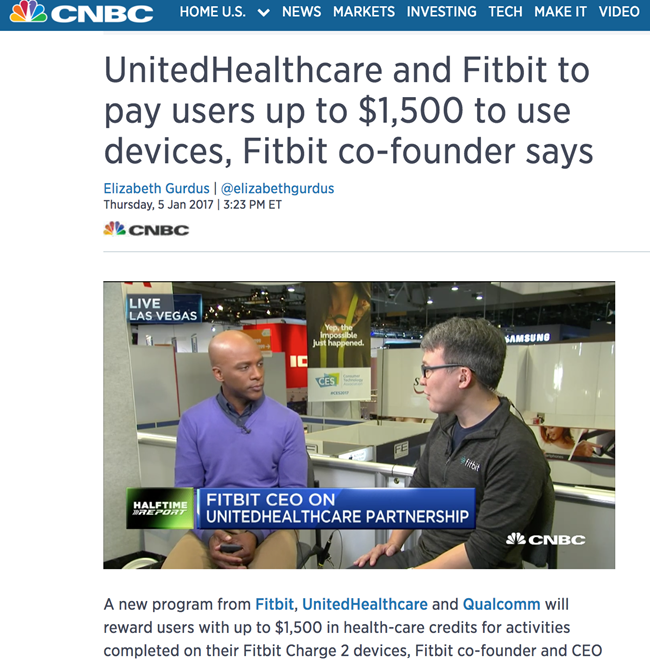
CNBC Reports on Fitbit’s Partnerships with UnitedHealthcare and Qualcomm
A month ago, Stanford University in the United States announced the establishment of a Digital Health Center. As its first step, the center will distribute 1,000 Apple Watches free of charge to faculty and staff to support the research and development of smart medical technologies. At the end of last year, UnitedHealthcare, one of the largest health insurance companies in the United States, announced that it would offer discounts of up to $1,500 per year to consumers willing to use Fitbit devices to monitor their physiological data. Last October, iRhythm Technologies, a U.S.-based cardiac monitoring company, went public on the NASDAQ, reaching a market capitalization of $700 million. Several major medical device companies have also begun launching digital health products. Since 2011, venture capital transaction volume in the digital health sector has continued to grow.
“It is evident that there is a strong market demand for more extensive and accurate health data, as well as enhanced capabilities in data management and analysis,” Li Jiang explained to the reporter. After all, possessing these capabilities often signifies rapid advancements in telemedicine, preventive medicine, and health management. This, in turn, is likely to exert three major impacts on the traditional healthcare industry.
First, for traditional healthcare providers, data-driven digital health can reduce medical costs and improve the quality of care. This will not only affect healthcare institutions but also other key players in related industries, such as health insurance.
Secondly, correspondingly, patients' medical expenses will also decrease. Whether they are ordinary individuals, patients with chronic diseases, or elderly and frail patients, all can benefit from technology-driven, improved treatment plans.
Finally, this also means more business models—for example, as people gain greater access to their own health data, they will have a natural demand for tools that analyze such data.
Future Leaders in Digital Healthcare: Data-Driven
However, for frontline healthcare workers, the data collected by these seemingly advanced technologies is difficult to transform into “actionable information”—that is, effective data that they can understand and utilize.
In 2015, Managed Healthcare Executive released a survey on the state of the industry, involving more than 600 executives from the U.S. healthcare sector. The top challenge they identified in the digital health era was precisely this issue.
To understand this issue, we may need to delve deeper into the topic of “medical data.”
As mentioned above, the demand for medical data in the digital health era encompasses three aspects: medical-grade data acquisition, data storage and management, and data analysis. These three areas also represent the key focus of many high-tech healthcare companies.
In the new era, data collection must not only capture timely, clinically valuable human physiological and health information but also align as closely as possible with users’ habits. “Manufacturers need to strive to find an ‘optimal path’—one that minimizes disruption to users’ daily lives while achieving medical-grade precision in data collection,” said Dr. Li Jiang.
It is worth noting that the “optimal pathway” represents a critical future entry point for human physiological data, which is precisely why many traditional manufacturers are beginning to focus on medical-grade smart wearable devices.
Data storage and management are also all-encompassing, including the storage and management of various sensor data, personal medication habits, Electronic Health Records (EHR), and Electronic Medical Records (EMR), among others. These systems can record nearly all of an individual’s health, behavioral, and healthcare service utilization data. In the future, these personal electronic medical records, composed of such data, will be stored in the cloud, enabling healthcare institutions to access them at any time.
In data analysis, ranging from monitoring body temperature to determine whether a patient has a fever and predict recovery outcomes, to leveraging artificial intelligence to analyze X-ray images and assessing cancer risk through DNA data analysis, analytical tools are essential for extracting meaningful insights from data.
Among these three segments, U.S. medtech companies, represented by VivaLnk, have already achieved earlier breakthroughs in both medical-grade data acquisition and analysis.
For instance, VivaLnk’s eSkin® electronic skin technology can continuously collect medical-grade precise data through a thin patch. In addition to body temperature and heart rate, this technology will be able to gather more vital physiological information in the future, including blood oxygen levels, blood pressure, and more.
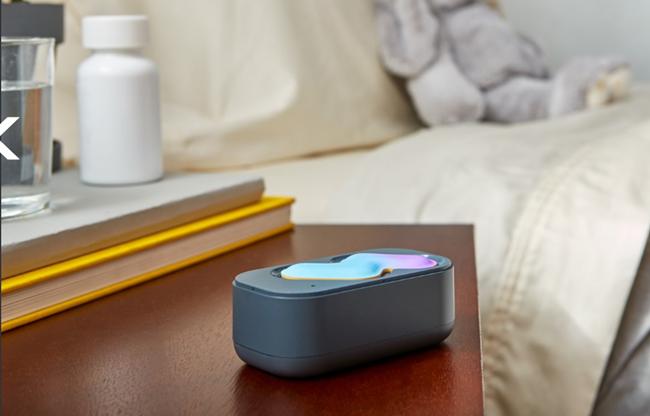
VivaLnk's First-Generation Product: Fever Scout
Additionally, through a smartphone app paired with the patch, collected physiological data will be transmitted in real time to physicians and uploaded to a cloud platform for patient management and analysis.
It is conceivable that the vast amount of human data generated by a high-quality data acquisition system, when combined with analytical techniques, will have extensive expanded applications in the era of digital health.
More importantly, VivaLnk offers a representative approach to resolving the conflict between advanced technology and traditional knowledge systems in today’s healthcare industry—its technology can collect precise human physiological data that still falls within doctors’ existing knowledge frameworks.
In this way, VivaLnk addresses the challenge of “having data but not knowing how to use it,” enabling healthcare providers to seamlessly integrate into the era of digital medicine and thereby gain a first-mover advantage in the market. After all, it is currently unrealistic to expect ordinary physicians to interpret genomic data and apply it in clinical practice.
It is reported that VivaLnk has signed a multi-million-dollar strategic partnership this year with a Fortune 500 company in the European healthcare sector, bringing its eSkin® medical solutions to tens of thousands of households across Europe.
Chinese Founder Transforms U.S. Healthcare
Rather than eSkin®Rather than merely helping VivaLnk secure a critical entry point for human physiological data, it is more accurate to describe this achievement as the successful first step in Dr. Jiang Li, founder of VivaLnk’s, grand vision for digital health.
Several years ago, Li Jiang was misdiagnosed with sudden cardiac arrest and spent an entire day in a U.S. emergency room before it was concluded that his electrocardiogram (ECG) naturally exhibited minor deviations from the norm. The hospital lacked his baseline ECG data, making accurate assessment difficult.
“The IT industry has developed at an astonishing pace over the past few decades, yet the healthcare sector has been slow to reap the benefits of technological advancements,” remarked Li Jiang. This is precisely why he chose to dedicate himself to the digital health industry.

Li Jiang Speaks at the BabyTech Summit of CES 2017
He formerly served as Vice President at AMD, a leading U.S. semiconductor company, and as Vice President at Kovio, a flexible electronics firm, and holds more than 20 U.S. patents. His industry background significantly enabled VivaLnk to pioneer the development of eSkin® technology. The VivaLnk team also includes the Chief of Cardiology at UCSF, holders of U.S. Doctor of Medical Engineering degrees, and a Japanese Ph.D. in Mechanical Engineering, among others, demonstrating profound expertise in the medical field. To date, VivaLnk has secured seven proprietary technology patents, and eSkin® is regarded as a key solution for balancing user comfort with measurement accuracy.
In 2015, VivaLnk launched the first-generation product of its eSkin® medical solution—Fever Scout. This flexible patch can monitor body temperature in real time and transmit the data remotely. A reporter conducted a brief trial: within minutes of application, the device became virtually unnoticeable, and even during an animated interview involving vigorous gesturing, it remained securely adhered without any sign of detachment.
This summer, VivaLnk will launch its second-generation product—Vital Scout. Functionally, Vital Scout can monitor vital physiological parameters such as respiratory rate, sleep quality, stress levels, heart rate, and blood oxygen saturation.
Their progress has also been significantly faster than that of their peers. In August last year, the University of Tokyo announced the development of similar flexible electronic technology, while VivaLnk’s medical solutions have already obtained medical certifications in more than 30 countries and regions, including approval from the U.S. FDA, as well as in Australia, New Zealand, and the European Union. In fact, many research institutions are striving to make breakthroughs in this field, and VivaLnk is the first company globally capable of mass-producing such products.
Beyond its multi-year lead over the industry and the technological barriers afforded by its patents, VivaLnk has another promising growth avenue: China.
If the U.S. healthcare system is characterized as bloated, oversized, and inefficient, then China’s healthcare system can be described as facing supply shortages and urgently in need of “burden reduction.” With the introduction of digital health, China’s limited medical resources can be made available to a greater number of patients in need. Moreover, while alleviating the workload of physicians, it also helps improve healthcare outcomes.
“Our primary goal in 2017 is to expand into the Chinese market,” said Li Jiang. He noted that while there is substantial demand for digital healthcare in China, the quality of digital medical devices available on the market varies significantly. VivaLnk aims to redefine electronic skin products and software to better meet the needs of the Chinese market.
It is reported that VivaLnk has established an office in Hangzhou and participated in the China Maternal and Infant Summit. At the event, Fever Scout received the Most Promising Award. Additionally, the company has entered into strategic collaborations with Chinese smart healthcare institutions, hospitals, and research institutes.
“We hope that people in China will also receive flexible electronic skins, representing the latest technology in digital healthcare, from doctors or nurses this year,” said Li Jiang.