

Google Launches 'Health Cards' in Australia to Deliver Authoritative Medical Information, Files IPO Prospectus
What is the first thing that comes to mind when you inexplicably develop a red rash or experience diarrhea? For many people, the answer is to pick up their smartphones and enter their symptoms into a search engine. However, previous tragedies triggered by medical searches have warned us to exercise caution when looking up health information online, as false medical information on the internet can lead to irreversible and severe consequences.
Nowadays, internet giant Google is set to make precise medical search a reality. This refers to its recently launched “Google Health Card” feature in Australia, which provides expert interpretations of various diseases and medical-related information. No pharmaceutical companies or healthcare providers are permitted to participate in the creation of these health cards.
Each medical card serves as an “outline” for a specific disease—detailing prevention methods, symptoms, preliminary diagnosis, next steps for management, and the level of attention required. Most importantly, these results appear at the top of browser search results, enabling peopleImmediately recognized this as an official authoritative opinionIn certain disease classifications, you can also find high-quality illustrations created by professional medical illustrators. A large team of professional physicians, led by Kapil Parakh, Senior Project Manager at Google Health, along with medical experts from the Mayo Clinic, serve as editors and reviewers for various health cards. Currently, more than 900 of the most frequently searched diseases or health-related topics have health cards, such as cough, infectious diseases, rash, and snake bites.
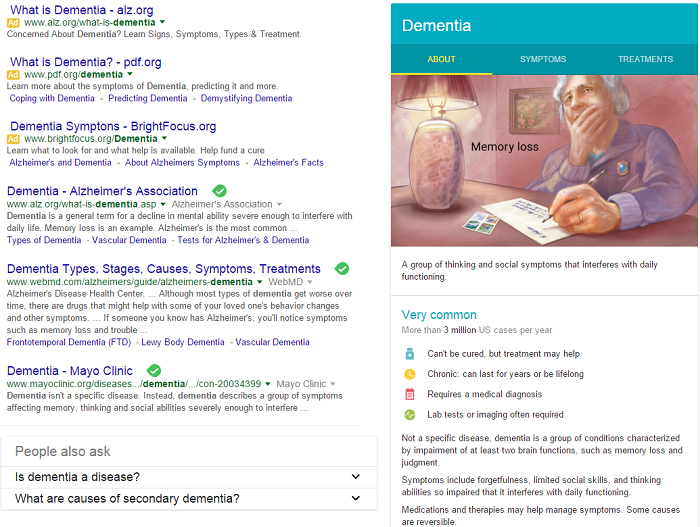
Google’s “Medical Cards” with Text and Images (Image Source: WebpageFX)
Isobel Solaqua, the project lead for Google’s Health Cards, stated that the initiative was created to address the growing volume of health-related searches. One in every 20 Google searches is related to healthcare, so Google aims to improve the quality of health search results by providing relatively authoritative answers to prevent misinformation. “Once the cards are launched, people will find it easier to access health and medical information.”
The Australian Medical Association (AMA) has expressed support for Google’s “Medical Cards” feature. AMA Vice President Tony Bartone stated that any initiative helping to enhance public understanding of diseases is worth promoting. “Medical information found online varies widely in quality, which can lead to numerous issues. With the introduction of this feature by Google, people can now obtain more reliable and accurate results directly when quickly searching for medical information.”
At the same time, Bartone also issued a corresponding warning, statingMedical Cards Cannot Replace Physician Diagnosis“This is merely information, not medical advice; its purpose is to help people develop an understanding of a particular disease. Diagnosis, by contrast, is a far more complex process that takes into account medical history, medication history, and test results, with the final conclusion representing a synthesis of all these factors.” He argues that the best use of Google’s medical cards is to give people a preliminary understanding of their condition before consulting a doctor, thereby helping them focus their questions and avoid arriving at appointments “armed with 50 pages of Google search results.” Routine medical tests, and even the time-honored face-to-face diagnostic methods of inspection, auscultation, inquiry, and palpation, cannot be replaced by online search technologies.
Bartone also suggests that individuals may appropriately refer to their medical records to improve their health status; however, if there is no improvement, they should seek medical attention immediately. For those who already have a designated primary care physician, the doctor has a better understanding of their prior medical history and is better positioned to identify the core issues.
Google also stated that the project was never intended to provide “medical advice,” but rather to shield people from certain low-quality medical information circulating online.