

Who Are the Primary Customers of Future Elder Care Facilities? Three Insights from U.S.-Based Masterpiece Living (MPL)
“Various surveys indicate that elderly people in China generally prefer aging in place, with institutional care primarily targeted at those who are disabled or of advanced age.”
——The above information is sourced from publicly available online materials.
Home-based elderly care is the predominant model of eldercare in China. Its inevitability, justified by traditional culture, living habits, and economic conditions, has become a consensus within the eldercare industry. China’s “12th Five-Year Plan for the Development of the Social Elderly Care Service System,” issued in 2011, also proposed establishing a “9073” elderly care service system, with home-based care as the foundation, community services as the support, and institutional care as the supplement. This refers to a distribution where 90% of seniors receive home-based care, 7% rely on community services, and 3% reside in institutions.
However, in practice, the choice of elderly care models tends to change with advancing age and changes in physical condition. The proportion of older adults, particularly those of advanced age or with disabilities, who opt for institutional care often increases significantly. Consequently, industry experts have proposed that the distribution of elderly care choices should be analyzed by stratifying the elderly population according to age groups:
Before age 75: Home : Community : Institution = 90:6:4
Aged 75–85: Home : Community : Institution = 60 : 20 : 20
Post-85: Home : Community : Institution = 20:20:60
According to this classification, the customer base for elderly care institutions comprises 4% of seniors under the age of 75, 20% of those aged 75–85, and 60% of those over the age of 85.
Does this mean that the primary clientele of elderly care institutions are the very old and disabled seniors?
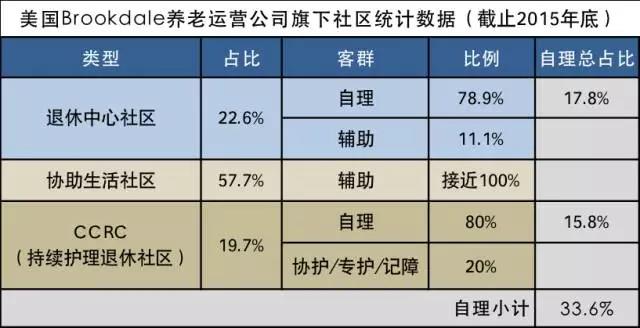
Let us first examine the United States, where the senior care industry is relatively mature. Brookdale, the largest senior care services company in the U.S., operates more than 1,100 senior living communities across 46 states, covering 80% of the national population. Its portfolio comprises independent living communities, assisted living communities, and Continuing Care Retirement Communities (CCRCs). Residents requiring independent living account for 33.6% of the total occupancy across its communities, contributing approximately 40% of Brookdale’s annual revenue.
Emeritus, the second-largest senior care provider in the United States, manages 494 communities across 44 states. Its portfolio includes assisted living communities, memory care communities, independent living communities, and skilled nursing communities, with independent living units accounting for 32% of its total bed capacity.
Based on U.S. experience, self-care seniors account for over 30% of the resident population in elderly care facilities and contribute an even higher proportion of revenue. Moreover, as the gross profit margin for self-care residents is higher than that for assisted living or specialized nursing care, this segment constitutes a significant component of elderly care facilities’ profitability.
Numerous factors influence elderly individuals’ decisions to reside in long-term care facilities. From the perspective of demand-side individual characteristics, these factors include personal attitudes, health status, financial situation, educational attainment, marital status, and living arrangements. From the supply-side institutional perspective, they encompass physical infrastructure, service quality, and geographic location.
In China’s current landscape, older adults with care needs, particularly those living alone or in “empty-nest” households, demonstrate a strong willingness to move into elderly care institutions, whereas self-reliant seniors exhibit a much weaker inclination. This creates the impression that institutionalization is driven primarily by urgent care necessities. Since self-reliant older adults have low dependence on caregiving support, their personal attitudes become the decisive factor in whether they choose to reside in such facilities, provided their financial circumstances permit.
The attractiveness and cost-effectiveness of non-care services offered by elderly care institutions are critical. To change the perceptions of self-reliant seniors, service providers must take greater initiative; in short, they need to give self-reliant seniors a reason to move into these facilities.
Why Are Independent-Living Seniors in the U.S. Willing to Move into Senior Living Communities? Globally, the United States is among the countries where older adults have a high level of acceptance of institutional care facilities. This high satisfaction rate is closely tied to their comprehensive service systems and high-quality care. What are the secrets behind U.S. senior living communities’ success in attracting independent-living seniors? This article attempts to analyze this issue from the perspective of promoting active aging among older adults, for your reference.
For self-reliant elderly individuals, who currently have low care dependency, enhancing their engagement with senior care facilities has become a key issue. The promotion and application of the concept of active aging serve as an excellent example of how U.S. senior care facilities improve user retention.
Active Aging was proposed by Masterpiece Living (MPL), a U.S.-based provider of senior vitality services. Its theoretical foundation stems from the landmark findings of the MacArthur Foundation’s research on human aging in the United States, which revealed that 70% of physiological differences and 50% of cognitive differences associated with aging are attributable to lifestyle factors. In other words, the aging process is largely determined by an individual’s lifestyle habits.
The core objective of MPL’s advocacy for active aging is to extend healthy life expectancy as much as possible while shortening the period of partial or total disability among older adults. This approach is undoubtedly attractive to self-reliant seniors. Furthermore, as elderly individuals age, their long-term care costs gradually increase; therefore, extending the duration of independent living will ultimately reduce the overall cost of elder care.

As for how this is achieved, MPL has established a comprehensive service system and accumulated big data through practical implementation to provide robust support, thereby effectively increasing the occupancy rates of elderly care facilities and enhancing residents’ satisfaction.
Elderly care institutions, through collaboration with MPL, have introduced vitality services for seniors, guiding improvements in their lifestyles across four dimensions: physical, psychological, cognitive, and social. The effectiveness of these initiatives is reflected in indicators across three areas:
1. Health Outcomes:including improvements in indicators such as the incidence of falls among the elderly, the prevalence of hypertension and other risk factors, healthcare utilization, volunteer services, cognitive health, and emotional well-being;
Second, cultural achievements:Includes improvements in metrics such as satisfaction, resident- and staff-led activities, engagement, and purposeful activities;
3. Marketing Achievements:This includes increases in key metrics such as occupancy rates, customer retention, referrals, and participation in the “Happy Aging” series of activities. Moreover, data shows that elderly residents who move into MPL-affiliated senior living communities live an average of 8–10 years longer than their counterparts in the general elderly population.
In the Westminster community of Dover, USA, the occupancy rate increased from 83% to 94% within five months after the introduction of MPL. A survey conducted at the Rosewood senior living community in the USA, following the implementation of MPL vitality services, showed that approximately 80% of residents participated. Among them, 90% indicated that an active aging lifestyle was the primary factor in their choice of Rosewood and also the aspect of community life with which they were most satisfied.
Regardless of whether older adults choose aging in place, community-based care, or institutional care, the concept of active aging remains applicable. However, institutional care offers a distinct advantage: factors influencing lifestyle habits are more controllable, making it easier for care facilities to create an environment and atmosphere conducive to an active aging lifestyle. Furthermore, institutional care providers can establish a closed-loop service model of “assessment–intervention–reassessment,” quantifying practical outcomes to enhance persuasiveness.
Currently, China’s elderly care industry is in its nascent stages, and the development of service systems within elderly care institutions remains exploratory. In the process of refining the elderly care service system, drawing on advanced international concepts and experiences can help facilitate a qualitative leap in elderly care services, moving beyond mere quantitative expansion. The case of MPL offers three key insights:
I. Services Provided by Elderly Care Institutions Must Be Guided by Philosophy and Objectives
Active aging, as advocated by MPL, serves both as a philosophy and a goal. It is only when service programs are designed around this goal that they become logical and self-consistent. Currently, services provided by elderly care institutions in China cover daily living assistance, rehabilitation nursing, medical healthcare, cultural and sports entertainment, and universities for the elderly, among others. While the variety of service offerings is extensive, the interconnectivity and logical coherence among these services remain weak.
For self-reliant seniors in particular, it is difficult for them to understand or accept the rationale behind paying for residential care to access these services. By integrating these service offerings cohesively around a unified concept or goal, we can not only create a more logical and comprehensive service system but also make our objectives easier for seniors to comprehend.
II. Elderly Care Institutions Must Establish a Complete Closed Loop for Service Provision and Service Evaluation
A major core advantage of MPL is its comprehensive service tracking and evaluation system for the elderly vitality services it provides. Through service tracking and evaluation, timely feedback on seniors’ living conditions can be provided, offering a basis for effective improvements, with final service outcomes demonstrated through data.
Currently, the majority of elderly care services in China remain in an open-loop state, failing to form a complete closed loop with service evaluation; consequently, there is a lack of effective big data support for assessing service outcomes.
III. Collaboration Between Elderly Care Institutions and Third-Party Professional Service Providers Will Become a Key Trend
From an operational perspective, controlling labor costs is a critical factor for elderly care institutions. Taking the provision of vitality services for seniors as an example, achieving multidimensional guidance and intervention across physical, psychological, cognitive, and social domains requires a team composed of professionals with multidisciplinary backgrounds, which undoubtedly increases the operational costs for enterprises.
But how can one provide high-quality services while reducing costs and maximizing cost-effectiveness? U.S. chain nursing home operators have addressed this challenge by leveraging MPL, a third-party professional service provider.
For elderly care institutions, it is essential to provide services tailored to the varying age groups and physical conditions of older adults. Focusing exclusively on the very old and those with disabilities as the primary service recipients narrows the customer base and reduces institutional revenue.
The MPL case presented in this article serves only as a reference. For self-care elderly individuals in China, senior care institutions must actively explore new approaches and innovate their concepts and services to attract more self-care seniors to reside in their facilities.
Source: Meridian Elderly Care Author: Chen Mingming