

Ping An Good Doctor: What's the Next Move? | Review and Outlook
As the New Year begins, everything takes on a fresh look. The end of the Spring Festival holiday marks our official entry into the busy schedule of 2017. Looking back on 2016, we witnessed frequent turbulence in the internet healthcare industry, the continuous surge of artificial intelligence, a rush of capital into the genomics sector, and tightening policies for pharmaceutical e-commerce...
Although the market we witness is merely the tip of the iceberg of the entire healthcare and wellness industry, a single leaf can herald the coming of autumn. VCBeat will identify benchmarks and leaders from these dynamic sectors, review their development trajectories over the past year, and provide analysis and forecasts for their 2017 strategies, hoping to offer valuable insights to investors, observers, thinkers, and practitioners in the industry.
Last year, as competitive barriers and entry thresholds in the mobile health sector continued to rise, many mobile health companies found themselves mired in development challenges. For Ping An Good Doctor, however, backed by a prestigious parent company, the year unfolded like a grand “data spectacle.” Not only did its user base double from 50 million to surpass 100 million, but it also successfully completed a $500 million Series A financing round, reaching a valuation of $3 billion. This marks another addition to the roster of unicorns under China Ping An, following Lufax.
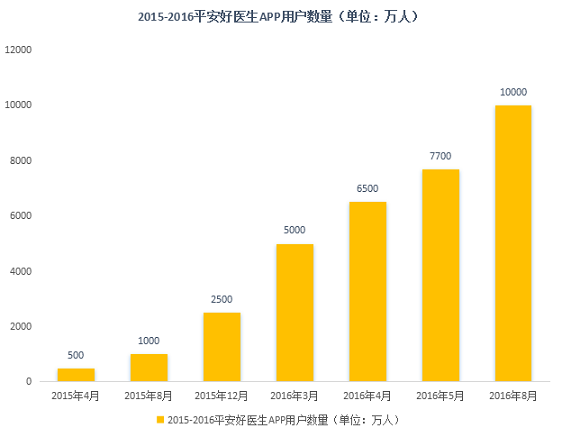
Compiled from publicly available data on Ping An Good Doctor
Several Eye-Catching Data Points
In March 2016, Ping An Good Doctor ranked 41st in daily active users (DAU) among all mobile applications in China. WeChat ranked first, and LeEco Video was ranked immediately ahead of Ping An Good Doctor.
In May 2016, Ping An Good Doctor successfully completed a $500 million Series A financing round, reaching a valuation of $3 billion and setting an industry record for the largest single funding round.
In June 2016, Ping An Good Doctor had over 80 million registered users and handled 250,000 daily consultations, ranking among China’s Top 50 most active apps. As of June 2016, its monthly active users (MAU) reached 27.74 million, representing a year-on-year growth rate of 1,052%, with an online consumption activity rate of 62%.
In July 2016, Ping An Good Doctor was listed among the top 100 apps in Quest Mobile’s Mid-Year App Strength Ranking, with nearly 30 million monthly active users. Data from the mid-year review showed that Ping An Good Doctor had become the mobile healthcare application with the highest coverage in China.
In August 2016, Ping An Good Doctor’s user base surpassed 100 million, comprehensively addressing user needs.
In November 2016, the number of registered users of Ping An Good Doctor exceeded 130 million.
This string of figures, which sparked envy among peers, was Ping An Good Doctor’s report card for 2016. While the results were impressive, the healthcare sector is simply too vast for any single company to fully contain, even one as formidable as Ping An.
Haodaifu, Juyi160, Ali Health, WeDoctor, and Ping An Good Doctor—these numerous competitors have jointly driven the development of mobile healthcare and consumer education. Low-barrier appointment registration and lightweight consultations are now things of the past; deeper and more grassroots-oriented medical resources have become the “standard requirement” for participants in the new round of elimination competitions.
Connection: Ping An Good Doctor's New Challenge
With massive financing, over 100 million members, and the backing of its insurance “parent” company, Ping An Good Doctor certainly started from a high vantage point. However, how to effectively leverage these advantages remains a significant challenge for the company.
In a previous interview with the media, Wang Tao, Chairman and CEO of Ping An Health, stated: “We aim to connect users, insurance companies, medical insurance providers, hospitals, clinics, testing and inspection institutions, emerging smart devices, and various health service providers through Ping An Good Doctor, thereby building an internet-based health management and medical ecosystem. This will integrate all stages of disease prevention, medical treatment, payment, and post-illness care, thus broadening revenue streams in the mobile healthcare sector.”
The term “connection” is not unfamiliar; as early as 2014,TencentIt has already made this its core strategy. Ant Financial, under Alibaba, also launched a similar open healthcare platform last November, determined to become the infrastructure of the internet healthcare sector. Among tech giants, there is no shortage of similarities on key issues. The era of platform-based mobile healthcare has arrived, with Tencent, Alibaba, and Ping An each commanding their own strongholds, leveraging their massive user bases and investment portfolios.
Looking back at 2016, it is evident that Ping An Good Doctor was shifting its service focus from online to offline, offering paid products that cater to multi-tiered and segmented needs. It has evolved into a comprehensive platform integrating a range of innovative healthcare services, including personalized medicine, overseas health check-ups, live-streamed consultations, internet hospitals, pharmaceutical e-commerce, and general practice clinics. Ping An Good Doctor has left no stone unturned in covering virtually all medical and consumer scenarios that patients may encounter.
For offline, asset-heavy medical institutions such as hospitals, clinics, and health check-up centers, Ping An Good Doctor has opted for strategic partnerships with strong players, including Hainan R&F, Southern Medical University Shenzhen Hospital, and overseas health examination providers. In contrast, online, asset-light services—such as personalized medicine, health management, live health streaming, and health e-commerce—are primarily self-developed by Ping An Good Doctor.
From a product perspective, if market entry is attempted by focusing solely on one or two isolated features, the utilization frequency of medical applications will inevitably remain low, making it difficult for enterprises to survive without external support. Without a viable business model, there is no capacity for self-sustaining revenue generation. It is for this reason that Ping An Good Doctor has chosen to collaborate with partners in specialized fields to provide diversified services that meet user needs. This strategy enables the company to acquire user data, integrate its products into users’ service ecosystems, and enhance user stickiness to the platform, thereby creating more opportunities for interaction.
In Wang Tao’s own words: “The traditional closed-loop service model may not be able to meet every user’s online healthcare needs. Connecting multiple stakeholders—including hospitals, users, insurance payers, and service providers—to create an open internet-based healthcare service ecosystem is what Ping An Good Doctor aims to achieve in its next phase.”
Offline Services
In March 2016, Ping An Good Doctor formed a strategic partnership with Hainan R&F to further deepen its medical O2O initiatives. By integrating Ping An Good Doctor into residential communities, the collaboration provides property owners and residents with one-stop health consultation and health management services.
In April 2016, Ping An Good Doctor expanded into overseas medical checkups, offering customized early cancer screening services. In addition to partnering with top-tier medical institutions, Ping An Good Doctor’s overseas checkup packages include exclusive, private itineraries that combine health examinations with sightseeing experiences. Clients enjoy five-star hotel accommodations throughout their trip, accompanied by a personal consultant during the checkup process, along with 24-hour local contact support at the destination.
In June 2016, Ping An Good Doctor announced the establishment of the “Ping An Good Doctor Anti-Cancer Alliance” in collaboration with medical experts in oncology prevention and treatment, genetic testing institutions, physician groups, and other organizations. Ping An Good Doctor committed an investment of RMB 100 million to the alliance. Following its inception, Ping An Good Doctor successively partnered with renowned oncology specialists across various subspecialties throughout China, launching multiple online free consultation initiatives to directly connect patients with the country’s top-tier oncology expertise.
In August 2016, Ping An Good Doctor piloted its “Health at Home” community-based service in Guangzhou. Users could consult with doctors on the Ping An Good Doctor platform; if further diagnosis was not feasible online, the doctor would recommend either registering for an in-person visit at a partner hospital or opting for Ping An Good Doctor’s one-hour home sample collection service.
In November 2016, Ping An Good Doctor signed a strategic agreement with Shenzhen Hospital of Southern Medical University. The two parties collaborated across the pre-hospital, in-hospital, and post-hospital stages, leveraging their respective advantageous resources to jointly create an innovative “Internet + Insurance + Hospital” model, and pioneered the launch of a direct billing system for commercial health insurance within the industry.
In December 2016, Ping An Good Doctor and Maxim Healthcare Group, a leading private integrated healthcare service operator in Hong Kong, jointly announced the establishment of a joint venture to open their first flagship clinic positioned for comprehensive medical services, the Shanghai Maxim Clinic, in Huangpu District, Shanghai.
Online Services
In February 2016, Ping An Good Doctor launched the Family Doctor Card. This product offers a comprehensive suite of services, including online consultations, appointment scheduling, consultations with renowned specialists, psychological counseling, health check-ups, and personalized health plans. Leveraging online consultations with family doctors and specialists as its entry point, and integrating big data mining, analysis, and application, the service combines online and offline resources to deliver diverse, content-rich, and personalized medical and health management solutions.
In July 2016, Ping An Good Doctor launched a health live-streaming project on its platform, enabling users to engage in scientifically guided fitness routines alongside influential streamers. Unlike other fitness video or live-streaming platforms, Ping An Good Doctor imposes strict qualification requirements on its streamers, and all live-streamed content is rigorously reviewed by the Ping An Good Doctor team.
In October 2016, Ping An Good Doctor partnered with Japan’s Kintetsu Group to launch a cross-border e-commerce pavilion focused on comprehensive health. Through this strategic collaboration, Ping An Good Doctor’s Health Mall will introduce nearly 1,000 high-quality Japanese products, including health supplements, maternal and infant care items, and beauty and household goods, while providing authenticity guarantees for all imported merchandise.
Revisiting HMOs
In the U.S. healthcare payment system, fee-for-service (FFS) was the earliest model and remains the predominant mode of healthcare reimbursement in China. Later, health maintenance organizations (HMOs) emerged in response to the heavy financial burden placed on the U.S. insurance system by healthcare providers’ excessive profit-seeking behavior.
HMOs, built upon insurance institutions, provide preventive health management to members through annual or monthly subscription models. Under this model, regardless of the treatment methods employed by physicians, the primary objective is to control healthcare costs and avoid waste and overtreatment.
Ping An Good Doctor’s ambition to build an HMO is hardly new. In 2015, Wang Tao, upon returning from a study trip to the United States, resolved to emulate Kaiser Permanente and develop a “Chinese-style HMO.” This led to the subsequent establishment of an in-house medical team of over 1,000 physicians and the contracting of nearly 50,000 community-based doctors.
For HMOs to develop in China, there are several major challenges, the most critical of which is the payer landscape. In the United States, commercial health insurance serves as the primary payer for HMOs, whereas in China, it is the basic medical insurance system. In recent years, cost containment within the basic medical insurance system has become the core of healthcare reform, while commercial health insurance has encountered new opportunities for growth.
According to the data from Ping An Insurance’s 2016 semi-annual report, the premium scale of health insurance still lags far behind that of life insurance. Calculated based on the insurance density development targets outlined in the “Ten New National Guidelines,” China’s health insurance market is projected to reach RMB 1.5 trillion by 2020, marking just the beginning of its growth phase.
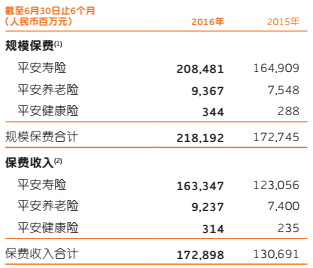
Specific Performance of Ping An Life Insurance Business (Data Source: Ping An 2016 Semi-Annual Report)
"As commercial health insurance has yet to achieve widespread adoption, the dominant position of basic medical insurance as the oligopolistic payer in healthcare remains difficult to challenge."Moreover, at present, the hospital's diagnosis certificate is the most critical factor in health insurance claims adjudication; whether cost-containment measures are involved is of little significance to insurers.
Under this overarching premise, it is difficult for domestic healthcare enterprises to penetrate deeply into the core of medical practice, let alone constrain the clinical behaviors of healthcare institutions from the payer’s perspective. To maximize the effectiveness of Health Maintenance Organizations (HMOs), concerted efforts from policymakers, enterprises, and healthcare institutions are required.
On one hand, the payer ecosystem has yet to fully take shape; on the other, companies such as Ping An Good Doctor, WeDoctor, and Haodaifu are striving to establish deeper collaborations with healthcare institutions. New healthcare models, including internet hospitals and cloud hospitals, have emerged during this phase. As the saying goes, “Rome was not built in a day.” Without incremental contributions from all stakeholders, achieving immediate success is far from easy.
At the 2016 Ping An Good Doctor financing conference, Wang Tao outlined the four strategic directions for Ping An Good Doctor in 2016:
Smart Hospitals: Leveraging Technology to Link Resources and Create Shared Value for Governments, Hospitals, and Patients;
Tiered Diagnosis and Treatment: Collaborating with emergency departments of major hospitals to build China’s largest tiered diagnosis and treatment system;
Medical Insurance Collaboration: Enhancing Insured Patients’ Service Experience and Controlling Medical Insurance Costs;
Insurance Collaboration: Combining Commercial Insurance, Family Doctors, and Health Management to Create a HMO Model with Chinese Characteristics.
Looking back at 2016, Ping An Good Doctor had already achieved substantial results in the first two areas, but still faced a long and arduous journey in the latter two. Today, the trend of healthcare reform is unstoppable, and the influx of policies has opened up more opportunities for enterprises. For Ping An Good Doctor and many other mobile health companies, 2017 may well be the true turning point. To succeed inOf the Starsstand out from the crowd; capital, strategic vision, and opportunities—each element is crucial.