

Prexton Therapeutics Secures $31 Million Series B Financing to Advance Novel mGluR4 PAM Foliglurax into Phase 2 Trials for Parkinson’s Disease

Today, Prexton Therapeutics announced the completion of a €29 million ($31 million) Series B financing round, co-led by Forbion Capital Partners and Seroba Life Sciences. Other participating investors included existing backers Merck Ventures, Ysios Capital, and Sunstone Capital. Additionally, Mr. Marco Boorsma from Forbion and Mr. Alan O’Connell from Seroba will join the company’s Board of Directors.
Prexton Therapeutics, an emerging biopharmaceutical company based in the Netherlands, is dedicated to developing novel small-molecule therapeutics for central nervous system (CNS) disorders. Founded in 2012 by its current Chief Executive Officer, Mr. Francois Conquet, and Merck Ventures, the company employs a pioneering scientific approach that fully integrates molecular biology, behavioral science, and chemistry to address Parkinson’s disease (PD) and other brain disorders.
Parkinson’s disease is a common neurodegenerative disorder, with an average age of onset around 60 years; juvenile-onset Parkinson’s disease (before age 40) is relatively rare. Parkinson’s disease can cause neurodegenerative symptoms such as resting tremor in the limbs and rigidity, and is also accompanied by non-motor symptoms such as depression. Although modern medical research has gradually clarified the pathological features of this disease, its etiology remains unknown, and there is currently no cure. The basal ganglia are the brain centers responsible for controlling movement and coordination. Parkinson’s disease is a neurodegenerative disorder caused by the loss of dopaminergic neurons in the basal ganglia.
Current Treatment Regimens Have Limitations
Current treatment regimens primarily involve the long-term administration of dopamine antagonists or the direct use of dopamine receptor agonists to replace endogenously produced dopamine or mimic its effects. The most commonly used medications are antipsychotics (phenothiazines and butyrophenones) for the treatment of psychiatric disorders.
These therapies provide good symptomatic relief in the early to middle stages of PD, but they lose efficacy as the disease progresses, and their long-term administration is associated with side effects (dyskinesia, motor fluctuations, behavioral disorders). Finally, none of the current PD drug compounds have demonstrated neuroprotective effects that can delay disease progression. Therefore, developing innovative treatment options targeting dopamine itself within the neurochemical system has been an unmet medical need worldwide.
Innovative Compound Advances into Phase II Clinical Trials for Parkinson’s Disease
Prexton’s target is the metabotropic glutamate receptor mGluR4, which has garnered significant attention from the scientific community. Several academic groups have demonstrated that novel positive allosteric modulators (PAMs) of mGluR4 hold promise for halting disease progression. Within the basal ganglia, mGluR4 receptors strategically counteract neurotransmitter imbalances in Parkinson’s disease (PD). Specifically, by reducing GABAergic and glutamatergic transmission in the indirect pathway, mGluR4 activation is expected to restore the balance between the direct and indirect pathways, thereby improving motor function in PD.
Building on this foundation, the company is developing a novel series of mGluR4 positive allosteric modulator (PAM) compounds, originally pioneered by Merck Serono (a subsidiary of Merck KGaA, Germany). Prexton believes these compounds represent a unique opportunity to establish a high-quality development pipeline for Parkinson’s disease (PD) therapeutics. The company is advancing PAMs designed to enhance mGluR4 activity while minimizing the potential for adverse effects. Several studies in animal models have demonstrated that this strategy holds promise for treating both motor and non-motor symptoms of PD.
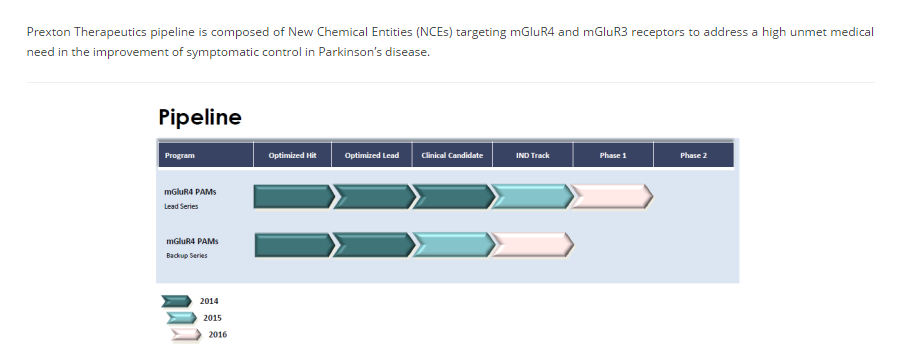
Prexton Therapeutics intends to use the proceeds from its Series B financing to fund two Phase 2 clinical trials of its lead product, Foliglurax (formerly known as PXT002331), for Parkinson’s disease. These Phase 2 trials are scheduled to commence in 2017 and will be conducted in Europe and the United States, respectively. The first trial, to be carried out in Europe, will have Parkinsonian symptoms as its primary endpoint; the second trial, to be conducted in the United States, will focus on levodopa-induced dyskinesia as its primary endpoint.
Mr. Francois Conquet stated in a press release, “We have generated a robust Phase I clinical data package for Foliglurax in non-human primates. We are now eager to initiate our Phase II efficacy trial and continue the development of Foliglurax as a potential innovative therapeutic for Parkinson’s disease.”
Source: WuXi AppTec