

China Launches National Medical Centers and Regional Medical Centers to Address Healthcare Disparities
Recently, the National Health and Family Planning Commission issued the "13th Five-Year Plan for the Establishment of National Medical Centers and National Regional Medical Centers" (hereinafter referred to as the "Plan"), making new arrangements for the regional layout of medical institutions in China and launching the planning and establishment of national medical centers and national regional medical centers.
Why Was the “Plan” Issued?
As healthcare reform continues to deepen, China’s medical service system has been continuously improved, and the level of medical services has achieved rapid enhancement. However, alongside socioeconomic transitions such as population aging and urbanization, residents’ basic health needs have grown rapidly and become increasingly diversified. Structural issues on the supply side of healthcare in China remain prominent, characterized by an uneven distribution of medical institutions and disparities in capabilities among institutions at different levels.
Current Status and Issues of China's Healthcare Service System
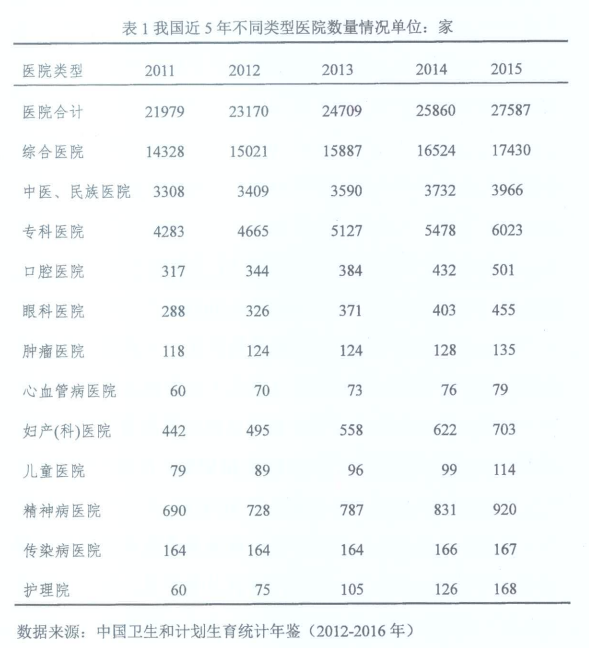
1. Number of Hospitals. According to the China Health and Family Planning Statistical Yearbook (2012–2016), there were a total of 27,587 hospitals in China in 2015. Among them, there were 6,023 specialized hospitals, accounting for 21.8%. The most common types of specialized hospitals were psychiatric hospitals (920), obstetrics and gynecology hospitals (703), stomatological hospitals (501), and ophthalmicHospitals (455), Oncology Hospitals (135), Cardiovascular Hospitals (79).
2. Number of hospital beds. In 2015, there were a total of 5.3306 million hospital beds in China.
3. Number of Hospital Physicians. In 2015, there were 3.2659 million licensed (assistant) physicians in hospitals across China, with 2.38 licensed (assistant) physicians per 1,000 population.
4. Hospital Diagnosis and Treatment Volume. In 2015, the number of outpatient and emergency visits in hospitals across China reached 3.017 billion, accounting for 40.95% of the total outpatient and emergency visits at all medical institutions nationwide; hospital discharges totaled 16.0139 million, representing 76.42% of the total discharges from all medical institutions.
During the 12th Five-Year Plan period, China's medical service system was gradually improved; however, internal structural issues constraining the reform and development of health and healthcare services persist.
First, there is an overall shortage of medical resources, with a scarcity of high-quality medical resources. China has more than 6 million medical personnel, and the number of doctors per 1,000 population is 2.38, but nearly half of the doctors have educational qualifications below a bachelor’s degree.
Second, the distribution of medical resources is uneven and concentrated in economically developed provinces and cities. The 11 eastern provinces have 998 tertiary hospitals, while the 21 central and western provinces have 1,125 tertiary hospitals.
Third, the healthcare service system is imperfect, and a scientific and orderly pattern of medical consultation has not yet been established. Primary healthcare institutions lack sufficient service capacity, and the functional positioning of medical institutions at different levels and categories remains unclear, leading to patient concentration in large hospitals and cross-regional medical visits.
Fourth, domestic hospitals still lag behind international top-tier standards in advanced medical fields such as scientific research, academia, and the translation of research findings into practical applications.
It is projected that by 2020, China’s population will exceed 1.4 billion, with a significant migration to urban areas. As demand for medical services continues to rise, shortages in healthcare provision have become increasingly severe in major cities, where high-quality medical resources are concentrated. Therefore, during the “13th Five-Year Plan” period, ChinaHigh-level hospitals must leverage the leading role of National Medical Centers to align domestic standards with international benchmarks. It is essential to establish National Regional Medical Centers, optimize the distribution of high-quality medical resources, address patients’ healthcare needs within their respective regions, and create favorable conditions for implementing a tiered diagnosis and treatment system.
Positioning of the Two Centers
National Medical Center
National Medical Centers are primarily positioned to represent the nation’s highest standards in the diagnosis and treatment of complex and critical conditions, training of high-level medical professionals, translation of advanced basic medical research and clinical findings, resolution of major public health issues, and hospital management. They aim to build international competitiveness, play a leading role in guiding the direction of medical technological development across China, provide support for national policy formulation, and collaborate with National Regional Medical Centers to drive improvements in healthcare, prevention, and health services nationwide.
National medical centers are established across China by specialty categories, including general medicine, oncology, cardiovascular diseases, obstetrics and gynecology, pediatrics, infectious diseases, stomatology, and psychiatry. Additionally, in response to the needs for prevention and control of major diseases, national medical centers specializing in respiratory diseases, cerebrovascular diseases, and geriatric medicine are also established.
National Regional Medical Center
National Regional Medical Centers are primarily positioned to represent the highest regional standards in the diagnosis and treatment of complex and critical conditions, medical talent development, clinical research, disease prevention and control, and hospital management. By collaborating with National Medical Centers, they drive improvements in regional medical, preventive, and healthcare services, striving to achieve homogenization of medical services across regions.
Each province (autonomous region, and municipality directly under the Central Government) shall select comprehensive hospitals with leading capabilities in medical care, education, research, disease prevention, and management to establish one national regional medical center of the comprehensive category. Based on coverage area and current population distribution, six regions—North China (Beijing, Tianjin, Hebei, Shanxi, Inner Mongolia), Northeast China (Liaoning, Jilin, Heilongjiang), East China (Shanghai, Jiangsu, Zhejiang, Anhui, Fujian, Jiangxi, Shandong), Central and South China (Henan, Hubei, Hunan, Guangdong, Guangxi, Hainan), Southwest China (Chongqing, Sichuan, Guizhou, Yunnan, Tibet), and Northwest China (Shaanxi, Gansu, Qinghai, Ningxia, Xinjiang)—shall each select hospitals with leading capabilities in medical care, education, research, disease prevention, and management. National regional medical centers of specialized categories shall be established for specialties including pediatrics, oncology, cardiovascular diseases, obstetrics and gynecology, infectious diseases, stomatology, and mental health.
Responsibilities and Functions of the Two Types of Centers
National Medical Centers primarily focus on the diagnosis and treatment of complex and critical cases nationwide, demonstrate and promote appropriate, effective, and high-level diagnostic and therapeutic technologies, and radiate influence to lead national medical development and enhance healthcare service capabilities. They train core clinical technical personnel and disciplinary leaders; integrate existing resources to establish a national database for major diseases, conduct annual case analyses, predict trends in disease incidence, mortality, and the prevalence and development of risk factors, and organize targeted, multicenter, large-sample clinical studies across China to promptly translate domestic and international clinical research achievements into clinical applications. They assist the National Health and Family Planning Commission in formulating diagnosis and treatment plans for complex and critical conditions, and in developing clinical practice guidelines, technical specifications, and relevant standards. By integrating resources, they promote preventive healthcare services, lead the construction of disease prevention and control networks, and foster exchanges and cooperation in disease prevention, control, and healthcare. They undertake emergency medical rescue responses to public health emergencies, diligently implement healthcare reform tasks, and actively participate in the comprehensive reform of public hospitals.
National Regional Medical Centers are primarily responsible for the diagnosis and treatment of complex and critical cases within their regions; demonstrating and promoting appropriate and effective diagnostic and therapeutic technologies; and radiating influence to lead medical development and enhance healthcare service capabilities across the region. They cultivate core professionals and disciplinary leaders; guide clinical research on major diseases within the region, ensuring timely translation of research findings into clinical applications; integrate existing resources to promote disease prevention and health services, taking the lead in establishing regional healthcare service and disease prevention and control networks. In coordination with National Medical Centers, they strengthen academic exchanges and regional collaboration to improve China’s healthcare service system and elevate regional healthcare standards. They undertake emergency medical rescue operations during public health emergencies, diligently implement healthcare reform tasks, and actively participate in the comprehensive reform of public hospitals.
Currently, regional medical centers are relatively mature in some countries, whereas China is still in the nascent stage. To further narrow the gap in medical technical standards across regions, promote the rational distribution and balanced development of medical resources, and advance the tiered diagnosis and treatment system, this “Plan” has been introduced.
The establishment of National Medical Centers and Regional Medical Centers facilitates the integration of limited healthcare resources. The government will prioritize investment in these two types of institutions to maximize the utility of medical resources and funding. Regional Medical Centers need to build a regional coordinated information-sharing platform among multiple hospitals at various levels within a geographic area, thereby achieving the sharing of medical information, services, and resources within the region. This ensures that patients receive systematic and standardized treatment across hospitals of different tiers, thus reducing medical costs.
Meanwhile, regional medical centers can integrate healthcare resources within the region to maximize benefits and efficiency. Currently, 80% of medical equipment and mid-to-senior-level healthcare professionals are concentrated in medical institutions at the county level and above, while community health service centers and rural clinics are small in scale, with suboptimal operational efficiency and outcomes. Regional medical centers can leverage their leadership in medical technology, specialized talent, and research capabilities to establish a positive, interactive collaboration mechanism with primary care hospitals, thereby enhancing the overall standard of healthcare in the region.