

UnitedHealthcare Outlines Five Key Healthcare Implementation Trends for 2017 in IPO Filing
Dave Allazetta is the CEO of UnitedHealthcare in Arizona. Not long ago, he published an article highlighting five key healthcare implementation directions for 2017, which are closely tied to the strategic judgments of UnitedHealth Group, the world’s largest health insurer and health information technology company by revenue. VCBeat (WeChat ID: vcbeat) has compiled his viewpoints to help readers gain a broader perspective on the industry through the lens of this healthcare giant.
Although the wearable market has underperformed, the momentum of wearable technology development has never stalled, and its prospects are significant: a recent report by market research firm MarketsandMarkets indicates that the overall valuation of the wearable industry will reach $31.2 billion by the end of 2020. For consumers, wearable fitness devices provide greater insight into their health status, such as daily step counts, heart rate, and sleep patterns, thereby encouraging healthier lifestyles.
UnitedHealth Group has recognized the health benefits of high-quality wearable devices, and thus partnered with Qualcomm Life (QualcommLife)We have partnered with the UnitedHealthcare Motion™ program, enabling employees of UnitedHealth’s client companies to earn rewards of up to $1,500 by achieving exercise goals. This initiative enhances participant health while simultaneously reducing long-term medical insurance claims costs, achieving a dual benefit. According to data from the technology consulting firm Endeavors Partners, more than 13 million wearable devices were projected to be deployed in the program by 2018. A recent study indicated that individuals’ self-reported weekly exercise duration exceeded actual levels by an average of 50 minutes, while self-reported sedentary time was underestimated by two hours. This discrepancy underscores the importance of precise wearable activity trackers in accurately assessing physical activity patterns.
In addition to wearable device projects, many companies also offer other health benefit policies, including medical service gift cards, health insurance subsidies, and gym membership discount cards. According to statistics from the Society for Human Resource Management (SHRM), 70% of U.S. companies already have corporate wellness programs, a figure expected to increase by another 8% in the coming year. A recent survey by the National Business Group on Health found that corporate health incentives for employees have risen from an average of $430 per person five years ago to $693 per person currently. However, fewer than half of employees receive the full incentive amount, resulting in millions of dollars going unclaimed each year.
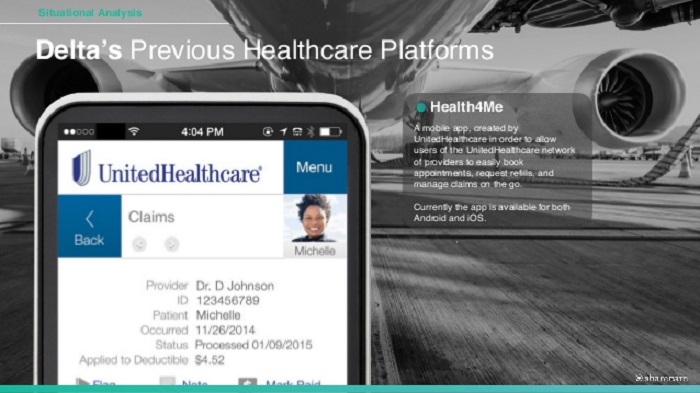
The Health4Me app launched by UnitedHealth Group (Image source:SlideShare)
The internet enables people to browse and compare products of interest without leaving home, and the same applies to medical products and services. New applications have emerged in the market that provide detailed ratings for hospitals, physicians, and medications, allowing consumers to make informed decisions based on price and review scores. UnitedHealth Group’s Health4Me app, for instance, allows users to locate nearby healthcare providers and offers information on more than 850 common medical services. As an increasing number of individuals enroll in consumer-directed health plans, more people are turning to publicly available online healthcare resources. A recent consumer sentiment survey by UnitedHealth Group indicates that a growing proportion of consumers (32%) now use websites or apps to compare healthcare services in advance, up from just 14% in 2012.

“Learn About United Healthcare Group’s Telemedicine Consultations”(Image source:YouTube)
Video-based virtual consultations have emerged in many new mobile applications, allowing users to connect with primary care physicians or medical specialists regardless of their location. In addition to enhancing the convenience of healthcare services, another major goal of telemedicine is to reduce medical costs. Virtual consultations that address similar needs cost less than $50, compared to an average of $80 for in-person visits. In certain urgent situations, they can even serve as alternatives to urgent care centers or emergency rooms. Recent advances in audio and video technologies have fully met the requirements for diagnosing and prescribing medications for some non-critical conditions, such as allergies, sinus infections, bladder infections, and bronchitis.
Value-based care models are gaining wider acceptance, while fee-for-service healthcare is gradually fading into the background. The practice of charging separately for each consultation, treatment, and laboratory test is being phased out, as the healthcare industry seeks the simplest and most effective approaches to optimize treatment. Under value-based care models, healthcare providers receive reimbursement only when they achieve measurable outcomes, deliver high-quality services, and demonstrate improvements in patients’ health status.
UnitedHealth Group’s new orthopedic care initiative is a value-based healthcare service delivered in partnership with medical institutions across China. Statistics show that participating companies save an average of over $10,000 per employee surgery, while employees’ out-of-pocket costs for these procedures are reduced by more than $1,000.