

350 Surgeries Demonstrate VR-Assisted Procedures Reduce Patient Pain by 24% and Cut Surgical Costs by ~25%
54-year-old Mexican surgeon José Luis Mosso Vazquez has incorporated VR technology to assist in over 350 surgical procedures, reducing patient pain by 24%. By decreasing the use of expensive sedatives such as fentanyl and midazolam, he has lowered surgical costs by 25% and reduced the incidence of complications.
VR as a Sedative
Let us understand how Mosso utilizes VR technology to assist in surgery through a brief case study: Ana Maria, a 61-year-old patient, had a lipoma on the left side of her thigh. The procedure took place in her private clinic. The lead surgeon disinfecting the lateral aspect of her left leg and administered anesthetic injection.
Throughout the entire surgical procedure, Ana remained awake. When the lead surgeon made the initial incision, her blood pressure was 183/93 mmHg, which was clearly elevated. Under normal circumstances, sedatives would be administered to the patient at this stage. However, Dr. Mosso fitted Ana Maria with VR glasses, immersing her in the breathtaking scenery of Machu Picchu—a sight she was experiencing for the first time in her life.

Meanwhile, the surgeon made the first incision, and the procedure proceeded smoothly. According to the monitoring instruments, Ana’s blood pressure decreased. During this 20-plus-minute surgery, she remained immersed in her own world, unaware that the operation had already been completed. Afterward, she expressed her gratitude to the medical team.
As a surgeon at the Universidad Panamericana in Mexico City, 54-year-old Mosso carefully observed Ana and prepared sedatives for immediate administration. His research aims to integrate virtual reality (VR) into surgical procedures to facilitate smooth operations. While such surgeries typically require potent analgesics and sedatives, they can now be performed under local anesthesia alone. This approach not only alleviates patients’ pain but also reduces surgical costs, thereby easing the financial burden on Mexico’s healthcare system.
Inspired by Gaming
In 2004, Mosso purchased a Spider-Man-themed VR game for his son, who became so immersed in the game that he could not even hear his father calling him for meals. Typically, the insertion of a tube into the stomach is extremely painful, and patients usually require sedation. This experience led Mosso to consider incorporating the game into surgical procedures to distract patients.
Mosso required patients to rate their pain and anxiety levels during surgical procedures and presented his findings at the 2006 California “Medicine Meets Virtual Reality” conference. The concept of using VR to divert patients’ attention during surgery was first proposed by researchers at universities in Seattle, Washington, where cognitive psychologist Hunter Hoffman and his colleagues had already developed a VR game called SnowWorld to help patients endure painful wound care for severe burns.
Researchers hope that immersing patients in computer-generated 3D scenes can divert their attention from the real world. This approach has proven effective: trials conducted by Hoffman’s team demonstrated that SnowWorld reduced pain perception in trauma care patients by 50% and also decreased activity in brain regions associated with pain processing.
However, at that time, VR applications were not widespread in other medical fields. At a conference in 2006, Mosso met Albert Rizzo, a psychology expert from the University of Southern California. Although Rizzo had performed approximately ten case surgeries, he showcased an advanced head-mounted display to Mosso, which left him deeply impressed. Rizzo also allowed Mosso to use certain virtual environments specifically developed by Brenda Wiederhold to help alleviate patients’ pain. This significantly advanced Mosso’s research progress.
After returning to his home country, Mosso attempted to apply VR to postpartum recovery and cardiac surgery. However, although surgery can distract patients, VR has only been used for minor procedures such as the removal of lipomas, cysts, and hernias.Finally, Mosso noted that when selecting virtual scenarios, it is important not only to distract patients but also to avoid games that may cause emotional agitation, thereby preventing a rise in blood pressure.
Dr. Zhang Qiang's Exploration
Not only in Mexico, but Chinese doctors are also exploring this field. In December 2016, Dr. Zhang Qiang announced via his personal Weibo and WeChat accounts that the Zhang Qiang Doctor Group had successfully performed varicose vein surgery under local anesthesia with VR assistance in Beijing.. During the surgery, the concentration of lidocaine (a commonly used local anesthetic in clinical practice) was reduced to 0.25%, which is one-fourth of the conventional concentration (1%), and the patient’s heart rate and blood pressure remained stable with no significant pain.
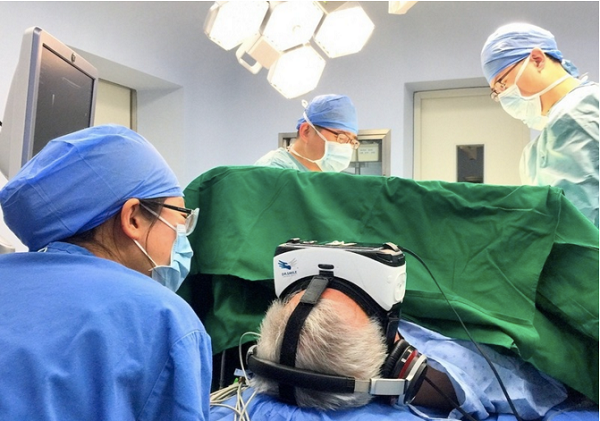
Dr. Zhang Qiang revealed that after the Zhang Qiang Doctor Group applied VR to patients undergoing varicose vein surgery, they were able to go home about one hour postoperatively.
The VR scenarios applied by Dr. Smile’s Doctor Group for patients are designed based on the dreams of Dr. Zhang Qiang, which he named “Smile’s Dream” (Smile is Dr. Zhang Qiang’s English name):
Drifting gently a few meters above the ground, one journeys from mist-shrouded wilderness into lush, verdant mountain forests. One witnesses the birdsong and floral fragrance of spring, feels the cool caress of summer breezes, sees autumn leaves return to their roots, and hears the tranquility sealed by winter snow. Thus, amidst the cyclical transitions of the four seasons, one experiences the serene comfort of merging with the beauty of nature.
These virtual scenes are fully 360° stereoscopic and dynamic. Every detail, from the falling leaves and fluttering butterflies to the integration of natural sounds with light music, has been specially crafted. Zhang Qiang’s team has also given considerable attention to addressing issues such as VR-induced dizziness in patients.
The virtual scenarios designed by Zhang Qiang are remarkably similar in effect to those used by Mosso; both aim to induce relaxation, prevent blood pressure elevation, and effectively alleviate patients' physical pain and psychological anxiety.
Dr. Zhang Qiang stated that he would continue to explore the application of new technologies in clinical medicine. For instance, beyond the “Smile Dream” experience, different scenarios such as an underwater world or space travel could be developed based on user feedback and preferences. In addition to treating varicose veins, these technologies could be applied to other therapeutic areas, including depression, rehabilitation therapy, and emergency care. Furthermore, beyond VR, AR products could be developed to replace 3D printing in facial contouring surgery, thereby eliminating the model fabrication process and reducing both surgical time and economic costs.
The use of VR-assisted devices halves the dosage of sedatives required by patients and, in many cases, completely eliminates the need for sedation.This represents a significant cost saving for Mosso’s clinic: sedatives such as fentanyl and midazolam are extremely expensive. He predicts that this approach could reduce surgical costs by approximately 25%.
Meanwhile, reducing the drug dosage can also lower the risk of complications and shorten recovery time. Mosso also plans to conduct further research. He stated that if patients receive only local anesthesia, they can be discharged one hour after surgery; however, general anesthesia requires a full day for recovery.
Source: https://www.theatlantic.com/health/archive/2017/01/virtual-reality-pain/515103/, and online resources.