

Precision Medicine Insights: Professor Zhao Haitao of Peking Union Medical College Hospital on Advancing Hepatobiliary Cancer Management
Source: GeneInsight PPT
Introduction
Precision medicine has become a national strategy, with upstream gene sequencing costs dropping to the $100 range; large-scale population cohort initiatives involving nearly one million participants are being launched successively. At the application level, precision medicine is gradually transitioning from scientific research to clinical diagnosis and treatment. The era of digital life, characterized by microbiome research, cloud platforms, multi-omics integration, and artificial intelligence, has begun. Meanwhile, application scenarios for genetic testing remain unclear, and technical standards and industry regulations urgently need improvement. Concurrently, cross-industry giants have started to enter the market through mergers and acquisitions.
During this period of industry transformation, GeneHui conceived and hosted “Dialogues with Precision Medicine Leaders.” For Season 1, twelve representatives from the precision medicine industry were invited to contribute joint articles. For Season 2, more than ten experts were invited to engage in online discussions on the clinical and research applications of genetic testing, systematically reviewing and forecasting its use in these fields. Through neutral planning and the philosophy of “creating value through connection,” we aim to support the orderly development of the industry. Special thanks to VCBeat for their media support.
[Review]
Precision Medicine: "Expert Insights" Season 1, Industry Series, Episode 12
Season 2, Episode 1: Professor Huang Shangzhi
Season 2, Episode 02: Dr. Gu Weihong
Season 3, Episode 03: Professor Yao Hong
[Editor's Note]
In early 2016, Chen Wanqing and colleagues analyzed the 2012 malignant tumor registration data reported by various registries nationwide and collected by the National Cancer Registration Center in 2015. The analysis revealed that there were approximately 3.586 million new cases of malignant tumors and 2.187 million deaths in China in 2012. Among these, lung cancer, gastric cancer, and liver cancer were the predominant malignant tumors in China, accounting for approximately 75% of all new cases. Given current environmental challenges and the growing emphasis on oncology health management, implementing primary prevention and transitioning cancer care toward chronic disease management have become significant public needs. With the development and gradual expansion of precision medicine, precise cancer management based on molecular subtyping and targeted therapy has garnered attention from frontline clinicians and researchers. In this issue, GeneInsight specially invites Professor Zhao Haitao to share insights on the development and prospects of precision medicine in malignant tumors, using hepatobiliary cancers as an example.

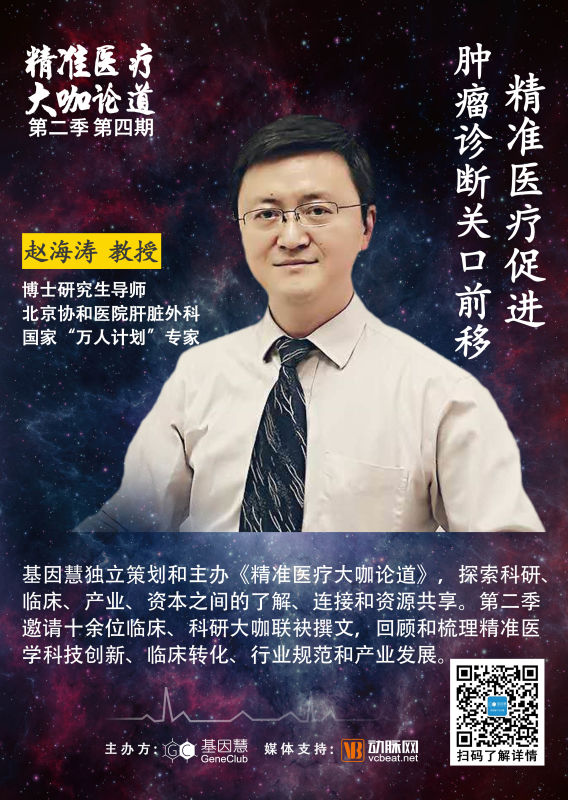
Prof. Zhao Haitao
Department of Liver Surgery, Peking Union Medical College Hospital
Ph.D. Supervisor

Author: Zhao Haitao
Department of Hepatic Surgery, Peking Union Medical College Hospital
Doctoral Supervisor
As exploration of the human genome and disease-related genes deepens, preventing, diagnosing, and treating diseases at the genetic and molecular levels has become a reality. Over the past decade, human capabilities in genomic detection and interpretation have reached unprecedented heights. Driven by advances in related technologies and disciplines, precision medicine has become the mainstream direction of medical development. Broadly speaking, precision medicine is an emerging approach to disease prevention and management that takes into account individual differences in genetics, environment, and lifestyle, with the goal of achieving personalized disease prevention and treatment. It encompasses a wide range of conditions, including common diseases, cancer, infectious diseases, genetic disorders, rare diseases, and region-specific illnesses. Specifically, precision medicine delivers personalized treatment based on individual gene expression profiles combined with molecular-level diagnostics. Meanwhile, it aims to build population-wide genomic databases and collect data on inter-individual genetic variations associated with diseases, leveraging big data analytics to propose new solutions for disease prevention, monitoring, and treatment. Furthermore, current precision medicine integrates multi-omics analysis—spanning genomics, proteomics, metabolomics, and epigenetic regulation—to achieve a deeper understanding of the overall mechanisms underlying diseases.
Although precision medicine has been formally implemented for only two to three years, it has already achieved significant progress. In the fields of infectious diseases, common conditions, and rare disorders, the application of precision medicine methodologies and research frameworks to establish large-scale disease research cohorts has yielded clear breakthroughs. Advances in molecular diagnostics, molecular pathology, and genomic subtyping have led to new definitions and classifications for both common diseases (such as cardiovascular diseases and chronic respiratory diseases) and rare genetic disorders. These developments have deepened our understanding of disease mechanisms and improved existing clinical diagnosis and treatment practices.
Cancer research, prevention, and treatment are central themes in precision medicine. Driven by the rapid advancement of next-generation sequencing (NGS) technologies and the continuous refinement of genomic data interpretation, both basic and clinical cancer research have witnessed unprecedented progress under the impetus of precision medicine. Thanks to these advances in oncology, molecular targeted therapies, immune checkpoint inhibitors, and cellular immunotherapies have emerged as new hopes in the field of cancer treatment. Below, I will share several key updates on the progress of precision medicine in oncology, with a particular focus on hepatobiliary malignancies.

China bears a substantial burden of liver cancer, accounting for half of the global cases. Consequently, the prevention and treatment of liver cancer have remained a key focus and a significant challenge in clinical practice. Despite decades of effort that have yielded marked progress in liver cancer prevention and treatment in China, its incidence and mortality rates remain persistently high. Particularly for patients with advanced hepatobiliary malignancies, existing clinical therapies often fail to effectively control tumor progression, resulting in severely compromised quality of life. In the era of precision medicine, recent years have witnessed substantial advances in understanding the genomics and related pathogenic mechanisms of hepatobiliary tumors. Large-scale deep sequencing studies conducted by Chinese and international scholars on hepatobiliary malignancies, particularly hepatocellular carcinoma, have identified several high-frequency mutated genes closely associated with hepatobiliary neoplasms. This has led to a more comprehensive understanding of the molecular regulatory networks formed by genes critically involved in tumorigenesis and progression.
In this regard, our research team has also conducted extensive work. By integrating existing data with our research findings, we have compiled a profile of the proportions of gene mutation expression in liver cancer and cholangiocarcinoma. We found that gene mutations in hepatobiliary tumors are highly heterogeneous within the population. Unlike lung cancer and breast cancer, it is difficult to identify truly significant high-frequency mutations in hepatobiliary tumors. This complexity is particularly pronounced in biliary tract malignancies, where the mutational spectrum is more intricate and inter-individual variability in mutation types is substantial. However, this also suggests from another perspective that a large population stands to potentially benefit from precision medicine in hepatobiliary tumors. The significant inter-individual differences make personalized treatment guided by precision sequencing more necessary and clinically meaningful. If combined with drugs targeting specific genes, this approach could lead to substantial breakthroughs in the diagnosis and treatment of hepatobiliary tumors. Consistent with our previous clinical experience, targeted therapy guided by precision sequencing has significantly controlled tumor progression in some patients with advanced-stage disease.
Under the paradigm of precision medicine, which emphasizes the integration of various factors and accounts for inter-individual heterogeneity, current models of oncology research and development have matured. In the field of liver cancer, clinicians and researchers are collaborating to investigate all aspects of the disease, including etiology, pathogenesis, treatment modalities, rehabilitation techniques, and prevention. Hepatitis B or C viral infection remains the primary etiologic factor. The Chinese government has invested significantly in hepatitis-related research, establishing numerous cohort studies. With the widespread use of the hepatitis B vaccine over recent decades, the incidence of hepatitis B in China has declined markedly. Current cases primarily involve individuals with established or prior disease onset. Furthermore, rapid advancements in hepatitis B therapy suggest that hepatitis B may cease to be a major public health issue in China within a few decades, leading to a corresponding decline in liver cancer prevalence. Regarding liver cancer treatment, surgery remains the most critical and effective intervention; therefore, early detection and diagnosis are paramount. For unresectable liver cancer, traditional therapies are often ineffective. Fortunately, the era of precision medicine is continuously yielding novel therapeutic approaches.
According to data from domestic and international clinical trials, current targeted therapies can extend the overall survival of patients with liver cancer by nearly one year. The disease control rate (DCR) of immune checkpoint inhibitors can reach 68%, and numerous new drugs targeting key genetic loci have been developed in recent years. For instance, TP53 mutations occur in nearly 50% of patients with hepatocellular carcinoma (HCC), and AZD1775, a recently reported agent targeting TP53, has demonstrated an objective response rate of 43% in solid tumors. Furthermore, for HCC, in addition to the currently widely used sorafenib (Nexavar), regorafenib and lenvatinib (E7080), whose clinical trial data were recently released, have both shown high efficacy and disease control rates in liver cancer. However, for individual patients, this does not guarantee that these drugs will effectively control tumors in clinical practice. The therapeutic effects of the same targeted drug often vary significantly among different patients. On one hand, this is because the mechanisms of action and specific therapeutic targets of current targeted drugs are not yet fully elucidated, and their clinical application is largely not guided by definitive genetic testing results; therefore, targeted therapy for liver cancer remains predominantly empirical. On the other hand, there is currently a lack of methods to effectively integrate outcomes from personalized treatment plans with population-level treatment results. Consequently, there is an urgent need to design scientific and rigorous experimental protocols to demonstrate their actual clinical benefits.
Notably, at the end of 2016, The New England Journal of Medicine (the most prestigious medical journal) emphasized the methodology of real-world studies. By constructing large-scale, rigorously designed study cohorts, these studies highlight the use of treatment regimens in real-life settings to demonstrate the benefits of a given therapy under practical conditions. Compared with traditional randomized controlled trials, this clinical research approach better reflects the actual effectiveness of drugs. It can be said that precision medicine has fostered the maturation of oncology R&D models, making cancer research more targeted and shifting the focus of disease diagnosis and treatment to an earlier stage.
It is imperative to recognize with clarity that the clinical translation of precision medicine and its therapeutic benefits in the general population are far from satisfactory. The so-called "precision" in prevention and treatment has not yet been fully realized, and the establishment of large-scale biobanks and databases faces numerous challenges. Many difficult issues continue to emerge. For instance, it remains to be further studied and determined whether targeted therapy regimens based on precise gene sequencing are truly superior to conventional treatments. Furthermore, it requires further verification to ascertain whether the low efficacy or ineffectiveness of precision therapy in some patients is attributable to the drugs themselves, imprecise therapeutic targets, insufficient interpretation and understanding of disease genomics, or inherent methodological issues within precision medicine. Therefore, to ensure that scientific progress and the development of precision medicine truly benefit patients and the public, and to clarify their genuine application value, it is essential to accelerate clinical translation and implementation.
China’s research and development in the field of precision medicine still lacks independent intellectual property rights. The domestic translation and commercialization of emerging anticancer drugs, including molecular targeted therapies and immunotherapies, remain slow, leading to high costs for precision treatments and inadequate regulation of novel pharmaceuticals. Meanwhile, although there is a large number of teams and institutions dedicated to precision medicine, their capabilities in testing and application vary significantly. Forces from scientific research institutions, enterprises, government policy directives, and clinical demands have not yet been effectively integrated. Industry standards and regulatory oversight by relevant authorities also require further improvement.
To address these challenges, a concerted effort is required from the medical, research, government, and corporate sectors. Pharmaceutical companies should conduct more clinical trials within Chinese populations to generate data that truly reflects the characteristics of this demographic, while also accounting for geographical variations. Particularly for regionally prevalent and distinctive tumors, such as liver cancer, the focus of clinical trials should be centered in China, accompanied by greater support for drug access and price reduction schemes. Furthermore, policies should be refined to accelerate drug development and review processes, broaden channels for recruiting participants in clinical trials, standardize review criteria for clinical trials, and increase support for new drug trials. By forming a directional and aligned vector of push, we can jointly promote the healthy development of precision medicine.In brief: at the scientific research level, research institutions should strengthen collaboration; for the same disease, mechanisms should be explored in depth from multiple perspectives based on multi-omics studies, constructing a hierarchical, multi-omics, and comprehensive network of disease mechanisms. At the application level, which represents the ultimate pathway for the clinical translation and implementation of precision medicine, research methods in precision medicine should be applied not only to targeted therapy but also to redefine traditional surgeries, radiotherapy, chemotherapy, and immunotherapy. This approach aims to identify individual heterogeneity, formulate personalized diagnosis and treatment plans, replace traditional one-size-fits-all regimens, and truly benefit patients. At the regulatory level, implementation details and standards for precision medicine need to be further refined to regulate practical industry applications.
Currently, China has taken a leading position in precision medicine, but this progress is accompanied by challenges and issues related to industry development. Future growth requires coordinated efforts among all stakeholders under the framework of overall macro-regulation, generating a unified directional thrust to collectively enable China to achieve “overtaking on a bend” in the field of precision medicine.