

New Health Tech Shifts Focus from Treatment to Prevention, Streamlining Traditional Medical Processes
After a decade of steady growth in average life expectancy, life expectancy for certain age groups has even begun to decline. Diabetes, heart disease, and obesity, coupled with escalating stress, anxiety, and depression, are becoming mainstream health threats. The current situation appears to be that while modern life has become more convenient, it is also chronically “killing” us.
However, the aforementioned view is not without its detractors; indeed, a growing number of industry leaders are increasingly optimistic about the prospects of the healthcare sector. The CEO of Johnson & Johnson, one of the world’s premier medical companies, remarked: “The healthcare industry faces a once-in-a-lifetime opportunity, and we are committed to building the healthiest era in history.”
From “Treating Disease” to “Scientific Health Care”
Today’s healthcare system is largely centered around disease treatment. The majority of expenditures within the system are allocated to medical costs, while health foods and wellness resources currently account for only a small fraction. This poses potential risks for individuals and families, as in the current paradigm where treatment outweighs prevention, the cost of treating diseases far exceeds that of daily care, and most household bankruptcies are triggered by serious illnesses. In fact, this has become a trillion-dollar challenge. Coupled with the global shortage of medical experts, once the situation reaches a critical tipping point, severe problems will erupt.
Change is underway. In early February, a group of forward-thinking individuals gathered at the inaugural “WaaS (Wellness-as-a-Service) Conference”—the HyperWellBeing Conference—to explore the “front end” of healthcare, which is also its most critical component: health and wellness.
Core viewpoints quickly emerge:The Future of Healthcare: Evolving from Disease Treatment to a New Industry Centered on Scientific Wellness and Disease Prevention, Enabling Individuals to Maintain Optimal Health Without Medical Intervention and Unlock Their Full Life Potential. Another keyword mentioned is “P4 Medicine”: Predictive, Preventive, Personalized, and Participatory, summarizing its goals as preventing diseases before they occur, extending lifespan, and optimizing health status.

“P4 Medicine”: Predictive, Preventive, Personalized, Participatory (Image source: TechCrunch)
“The Era of ‘Individualized Medical Research’ Is Arriving”—Millions of data points will be recorded for each person annually, rather than relying on once-a-year physical examinations. By combining physicians’ expertise with artificial intelligence–driven data analysis, disparate and unstructured information will be transformed into tools for safeguarding health.
Life-Saving Health Devices
Whenever medical technology is mentioned, people typically think of big data, telemedicine, and genomics (including gene-editing technologies). The importance of medical technology is growing day by day, yet it remains far from solving healthcare challenges, as only continuously enriched data can drive medical solutions forward. In the healthcare industry, data are derived from physiological metrics, mental health indicators, and other measures across large populations, which explains the proliferation of various health-tracking devices.
The trend of continuous data collection by medical devices actually began two years ago. This is partly attributable to the development of smartphones and mobile technologies, the commercialization of health data sensors, and the declining manufacturing costs and development risks associated with high-tech hardware. Biomedical engineers, physicians, entrepreneurs, and others have all entered this arena.
Today’s healthcare startups have encompassed the entire continuum of care for both physical and mental health conditions, including documentation, prevention, diagnosis, and treatment. They are leveraging technology to transform various practices within the healthcare industry, moving beyond merely meeting the basic need of being “disease-free.”
A Close Look at New Technologies in the Evolving Healthcare Landscape
Perhaps the most well-known health device is Fitbit, while affordable fitness wearables like the Xiaomi Mi Band, priced at around 100 yuan, are gradually becoming as commonplace as daily necessities. Beyond fitness trackers, many products designed to monitor health conditions and prevent diseases before they occur are also coming into view. Below is a summary of emerging medical technology categories compiled by TechCrunch from dozens of financing and investment deals.
Sports Training Wearables: By integrating sensors, data, and artificial intelligence technologies, it is possible to prevent injuries commonly incurred during sports training. In the field of track and field, for instance, the “Vi” product serves as the first true AI-powered running coach, while the “Tiemppo” in-shoe sensor system corrects running posture through real-time gait analysis. Similar approaches are now being extended to a wide variety of sports disciplines.
Health Monitoring Technology: Many tracking devices can identify factors in modern life that are detrimental to health. “AirVisual” detects air pollution, “AIR Sensio” identifies allergens, and tools like “Hello’s Sense” measure your sleep patterns.
A startup called Darma has invented a sensor that can be embedded in seat cushions or hospital beds to measure various biosignals, such as electrocardiogram (ECG) and respiration. Other companies have developed devices for measuring UV exposure, such as Microsoft’s Band 2 and La Roche-Posay’s high-tech wearable UV sticker.
Mobile/Home Hospital: Low-cost, portable, and IoT-connected medical devices have given rise to the concepts of “mobile hospitals” and “home hospitals.” For instance, the portable device “iBreastExam” enables radiation-free, painless breast scans, facilitating rapid examinations across various points of care. Notably, it was invented in India, where there is only one radiologist per 100,000 residents. Influenced by regulatory policies and pricing, a wide range of medical devices will increasingly appear in different departments and application scenarios.
Interestingly, much like the evolution of personal computers, medical devices’Predecessor was a large, expensive research or corporate institutional facility, yet will ultimately be superseded through successive generationsBecoming Lighter and More Accessible。
Therapeutic Wearables: For instance, Neutrogena offers phototherapy devices with acne-treating efficacy; or Sana’s sleep-aid products, which can help patients with post-traumatic stress disorder (PTSD) or chronic pain fall asleep within minutes. Many other companies leverage biofeedback and neuroplasticity principles to address symptoms of various conditions—Lief Therapeutics specializes in anxiety treatment, Liv targets unconscious stress-related behaviors such as nail-biting, and Feel uses a wristband to monitor emotions for improving depressive symptoms.
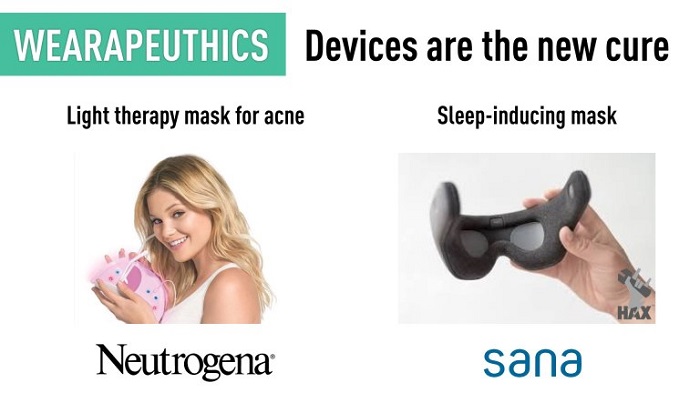 Therapeutic Wearables: Neutrogena’s Acne-Treating Light Therapy Device, Sana Sleep-Inducing Device (Image source: TechCrunch)
Maternal and Infant Medical Technology: Gerber, a well-known baby products brand, launched BabyNes, an “integrated maternal and infant nutrition and health system” featuring devices and a mobile app that support precision feeding. Its first flagship store in Hong Kong opened just last year. Meanwhile, a startup called BabyBe has developed a smart mat incorporating “soft robotics technology” to create an optimal care environment for infant development.
Metabolism-Related Technologies: Many companies in the market are engaged in blood and body fluid testing—such as diabetes screening and multi-parameter assays. The startup Aire has invented the first breath analyzer for patients with irritable bowel syndrome (IBS), capable of assessing food intolerances.
Proteus Health has taken diagnostics a step further by developing an ingestible sensor and smart sensing patch, which work in conjunction with its app to track patients’ conditions, activity levels, and more.
Neurological Medical Technology: EEG sensing technology can record sleep patterns and also enhance work efficiency. Berkeley Ultrasound has even developed an ultrasound device to stimulate the brain for treating depression, while certain emerging neurotechnologies hold potential for preventing and treating Alzheimer’s disease. In the future, such technologies are likely to compete with some pharmaceuticals used to treat neurological disorders.
Bionic Technology: In 2014, three exoskeleton research companies announced their initial public offerings. Two were U.S.-based companies—Ekso Bionics and ReWalk Robotics; the other was a Japanese technology company, Cyberdyne, with a total market capitalization exceeding $2 billion. Many other startup companies in the field of exoskeleton robotics are also following suit, such as SuitX and Japet.
Implantable Medical Devices: The dream of biotech geeks has come true: implantable medical devices that do not require radio-frequency chips have finally emerged. For example, Profusa is a subcutaneously implanted device that utilizes fluorescence to detect biomarkers such as oxygen levels, blood glucose, and lactate.
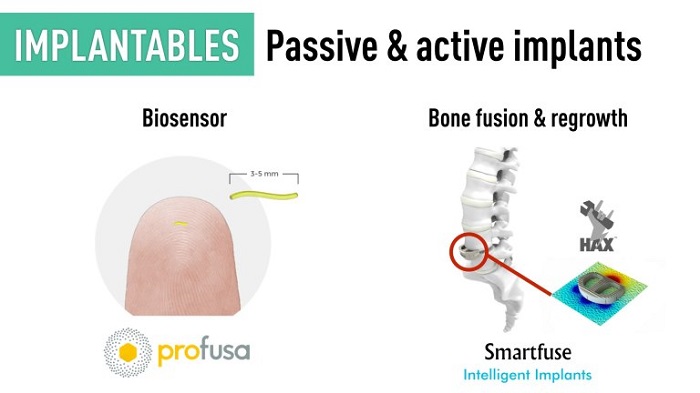 Implantable Medical Devices (Image Source: TechCrunch)
Redefining Healthcare
Future healthcare may be redefined: diseases with available treatments will not progress to severe stages, as sensors and artificial intelligence will help us identify early warning signs before onset and implement timely interventions. Human health could even reach a level where the most significant issues are merely fatigue or lack of concentration, free from pain and suffering. At this stage, while pursuing better medical outcomes, we must also rethink the future meaning of “healthcare.”