

SigTuple Raises $5.8M in Series A Funding, India's Largest AI-in-Medicine Round to Date
SigTuple is a company revolutionizing healthcare through artificial intelligence. It recently secured $5.8 million in Series A financing, marking the largest investment to date in India’s medical AI sector. The round was led by Accel Partners, with participation from IDG, Endiya Partners, pi Ventures, VH Capital, and Axilor Partners. Other notable investors include Sachin Bansal and Binny Bansal, senior executives of Indian e-commerce giant Flipkart, as well as Amit Singhal, Senior Vice President of Search at Google.
SigTuple is striving to achieve medical breakthroughs by leveraging the currently unprecedented boom in artificial intelligence and computer vision. Its research focuses on microscopic examination of blood smears, microscopic video analysis of sperm conditions, and identification of pathological features from retinal scan images—all of which represent the cutting-edge applications of AI in healthcare.
According to World Health Organization requirements, malaria screening for each blood smear takes an average of 20 minutes; however, physicians often fail to meet this standard due to fatigue, a challenge that SigTuple aims to address.
The company envisions a hub-and-spoke model, in which pharmaceutical experts based at a central laboratory extend AI-powered diagnostic capabilities to equipment across various healthcare institutions. This solution can be deployed in laboratories without requiring any hardware modifications and is relatively affordable.
However, due to the widely publicized “one-drop-of-blood” fraud scandal involving Theranos, and given that SigTuple’s first product, Shonit, is also a blood test, its launch immediately sparked questions about the reliability of its blood testing methods. In response, founder Rohit Kumar Pandey stated that SigTuple differs significantly from Theranos; the company did not deliberately reduce the volume of blood required for testing but instead adopted the same approach used in traditional pathological diagnosis.
A key focus for the company is “automated scanning of blood smears.” To achieve this in a simple and convenient manner, SigTuple has ingeniously integrated microscopes with smartphones. Through software on the smartphone, the company’s AI engine can classify and label image features within the microscope’s field of view. The most valuable feature is that the software not only identifies the presence of 200 neutrophils in the image but also marks their specific locations.
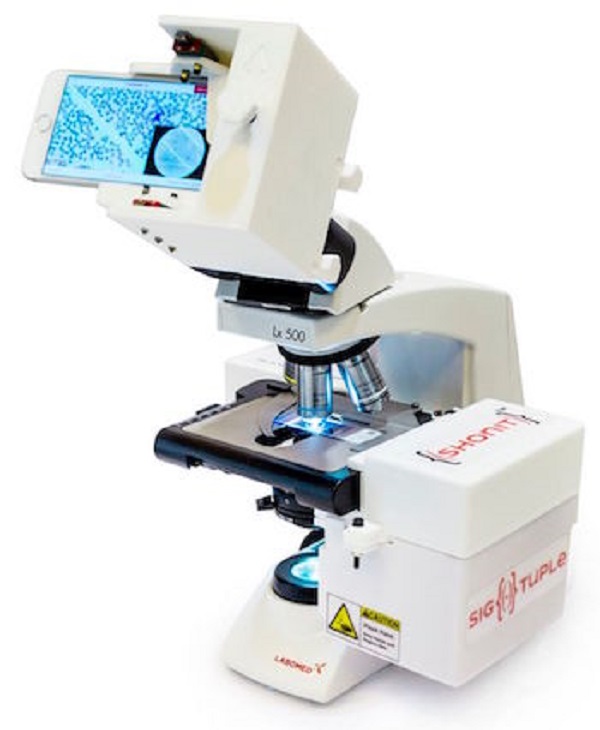
SigTuple Product: Microscopy Device Compatible with Smartphones
Founder Rohit and his two other founding team members previously worked at the Big Data Lab of American Express in Bangalore, India. It was while building the big data stack that they were first exposed to artificial intelligence technologies, which later became the focus of their entrepreneurial venture. However, instead of entering the more popular financial sector, the team chose to focus on healthcare.
At the outset of their research, they were excited by the vast amount of images and videos available for artificial intelligence engines in the healthcare industry. They ultimately chose to focus on pathology, as this field, unlike radiology, had not yet digitized its imaging data, and SigTuple aimed to improve this situation through enhanced microscopy techniques. Rohit added that both the quality and quantity of data are critical factors for artificial intelligence technologies to accurately distinguish features.
SigTuple has established pilot collaborations with 17 hospitals, leveraging them as sources of microscopic image data to train its medical AI engine.
Earlier, they collaborated with a group of pathologists on an experiment to test the company’s products. The conclusion was that cell counts, such as hemoglobin levels, measured by the software were nearly identical to those obtained through time-consuming and labor-intensive traditional methods, with the only difference being the mode of device operation.
The recently completed Series A financing will help the company further expand. Currently, SigTuple’s products are still manufactured in-house, but the company has partnered with a microscope equipment manufacturer to scale up production.
Furthermore, the company has even grander ambitions—to go global. To this end, SigTuple will apply for U.S. FDA clearance. The founder is highly optimistic about this prospect, given that Arterys, a U.S.-based company, recently received FDA approval for its AI-powered diagnostic technology for cardiac medical imaging.
“The healthcare challenges currently facing India require smarter solutions to address them,” said Kris Gopalakrishnan, former CEO of Infosys Technologies (the first Indian company to be listed in the United States). “SigTuple’s AI-powered medical software is an excellent example, capable of reducing the cost of similar tests to one-tenth of their previous level.”