

Leveraging Overseas Resources to Empower Primary Care: What Is This Cross-border Medical Institution Exploring?
As the New Year begins, everything takes on a fresh look. The end of the Spring Festival holiday marks our official entry into the busy schedule of 2017. Looking back on 2016, we witnessed frequent turbulence in the internet healthcare industry, the sustained boom in artificial intelligence, a rush of capital into the genomics sector, and tightening policies for pharmaceutical e-commerce...
Although the market we can observe is merely the tip of the iceberg of the entire healthcare and wellness industry, small signs can reveal major trends. VCBeat will identify benchmarks and leaders from these dynamic sectors, review their development over the past year, and offer reflections and forecasts on their 2017 strategies, with the hope of providing valuable insights for investors, observers, thinkers, and practitioners in the industry.
In recent years, cross-border medical consumption has gradually gained momentum in China. According to incomplete statistics, approximately 3,000 Chinese patients chose to seek medical treatment in the United States in 2015, and this number is projected to exceed 5,000 in 2016. Market analyses predict that the potential of China’s overseas healthcare market could surpass tens of billions of U.S. dollars over the next decade.
Cross-Border Healthcare at the Forefront
In June 2014, Sequoia Capital completed its Series A investment in Beijing Shengnuo Yijia Hospital Management Co., Ltd., entering the high-end cross-border healthcare market.
In April 2016, Yi'an Health, a cross-border medical service platform, announced that it had secured RMB 17 million in angel financing in April, led by Western Capital.
In August 2016, Shanxing Capital and Huayao Capital successively completed their Series A and Series A+ investments, totaling RMB 50 million, in Chunyu International, China’s first online platform for overseas medical services, thereby entering the field of internet-based cross-border healthcare.
With Shengnuo Yijia, Vodicon, and Chunyu International—three distinct types of cross-border healthcare institutions—securing successive rounds of investment, both the domestic industry and capital markets have demonstrated growing attention to the demand for high-end transnational medical services. All signs indicate that the cross-border healthcare industry is now at a pivotal point of rapid growth.
According to VCBeat’s annual review of cross-border healthcare, there are three types of cross-border healthcare service providers: traditional cross-border healthcare institutions, internet-based cross-border healthcare institutions, and China offices of overseas healthcare institutions.
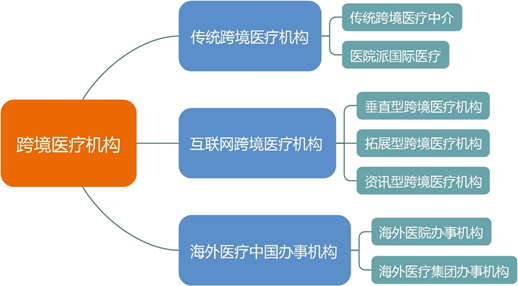
As the internet has gradually become a key channel for aggregating patient traffic, it is increasingly shaping the competitive landscape of the cross-border healthcare industry. In 2016, three types of institutions frequently engaged with online platforms, either by building their own digital platforms or by partnering with internet healthcare companies.
As the internet has become a critical battleground for cross-border healthcare institutions, we will analyze “Chunyu International,” a typical player in this space, to interpret development trends in cross-border healthcare and offer new insights for other companies in the industry.
Resources and Services Establish Industry Barriers
Chunyu International is positioned as an internet-based service platform that aggregates global healthcare industry resources. It currently primarily provides patients with international remote consultation services,International Referral, Assisted Reproduction, Overseas Medical Checkups、Community Health Managementand other services. As one of the strategic shareholders of Chunyu International, Chunyu Doctor provides strong support to Chunyu International in areas such as data, customer acquisition, and professionalism.
Although Chunyu International is an internet company, unlike other internet companies, its services are not limited to online platforms,Domestic Offline Partner Medical InstitutionsAlreadyNationwide12Provinces, municipalities, and autonomous regions.It has established offices in the United States, Europe, and Thailand. As a service-driven enterprise, the number and quality of partnered renowned hospitals often determine patients’ medical experience.
In September, when we reviewed the cross-border healthcare industry, we counted nearly 50 hospitals cooperating with Chunyu International. Data shows that in 2016, the average number of partner hospitals for cross-border medical institutions was less than 20. After one year of development, Chunyu International’s number of partner hospitals has risen to the forefront.
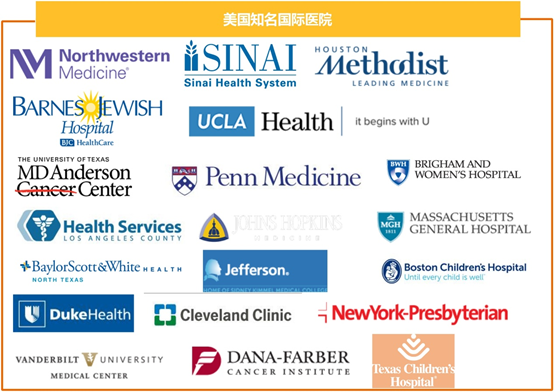
Map of Renowned Hospitals in the United States
According to VCBeat, Chunyu International has signed cooperation agreements with renowned hospitals across the United States, Japan, Singapore, Thailand, and other regions. In March 2016, it partnered with three major U.S. medical centers: City of Hope National Medical Center, Cedars-Sinai Medical Center in Los Angeles, and the Southern California Reproductive Center. In November 2016, it signed an agreement with the UK-based hospital group BMI Healthcare. In December 2016, it entered into an exclusive partnership with Cambridge Health Alliance, a well-known U.S. healthcare chain, to introduce an innovative primary care model and U.S.-based general practitioners.
On the other hand, remote consultation before seeking medical treatment abroad is also crucial for patients. Through such consultations, patients can make more rational decisions regarding whether to pursue overseas treatment. After reviewing the case, international experts will assess the patient’s condition and advise whether further treatment abroad is necessary. If overseas treatment is recommended, patients can gain a clearer understanding of the subsequent process through these remote consultations.
Furthermore, through international remote consultations, patients can also learn from experts about the treatment of similar cases abroad, as well as the latest treatment protocols, drug information, and clinical trials. In the technical domain of remote consultation services, Chunyu International has partnered with Agora.io, the global pioneer in real-time video communication cloud services, to achieve complementary advantages through resource integration.
A larger network of partner hospitals offers patients more options, enabling them to make choices better suited to their individual conditions. The quality of these hospitals directly determines patients’ medical experience and treatment outcomes. Both aspects are critical areas that cross-border healthcare companies continuously refine as they develop. Meanwhile, video technology for remote consultations addresses a key weakness in service-oriented companies, enhancing communication efficiency and the overall consultation experience through technical means. Overall, Chunyu International’s offline presence and resource-based services are fully competitive with those of traditional enterprises that have been established in the industry for many years.
Seizing the Primary Care Market
In reviewing Chunyu International’s 2016 performance, we found that two of its strategic moves pointed in one direction: primary healthcare services.
In December 2016, an exclusive partnership was established with the renowned U.S. healthcare chain Cambridge Health Alliance to introduce an innovative primary care model and American general practitioners.
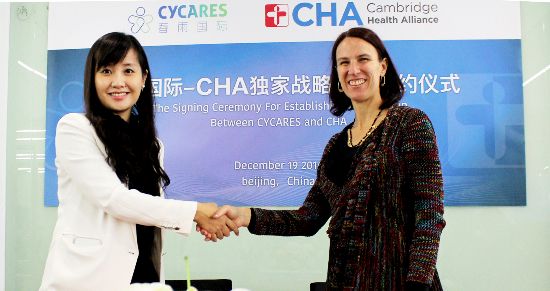
(Left) Xiong Juan, CEO of Chunyu International; (Right) Dr. Kirsten Masinge, Professor at Harvard Medical School and Head of the CHA International Division
Let us first clarify the background of this company. According to available information, CHA was founded in 1996 and operates 18 affiliated healthcare facilities in Massachusetts, USA, including three hospitals and 15 primary care community clinics. It provides a range of services such as primary care, specialty care, emergency care, inpatient care, pediatric behavioral health, and comprehensive geriatric care, serving over 140,000 patients annually. CHA’s Union Square Community Health Center has repeatedly received national awards in the United States and has been designated as a National Model Community Health Center by the Robert Wood Johnson Foundation.
In other words, this is a general practice chain group deeply rooted in the field of primary healthcare. The service details indicate that CHA will provide clinical pathway materials related to general practice, enhance Chinese physicians’ understanding of clinical pathways through remote methods, and conduct scheduled remote training and Q&A sessions for Chunyu International staff. This means that, with CHA’s assistance, Chunyu International will establish an International Community Health Management Center. Meanwhile, Chunyu International has stated that it will deliver a range of high-quality medical services, including international medical and health management services tailored for the elderly and children (“the elderly and the young”), through this new type of International Community Health Management Center.
Another move by Chunyu International further confirms its determination to establish a presence in primary healthcare. In December 2016, Chunyu International partnered with well-known Chinese real estate enterprises such as Jinmao to create a new ecosystem of internationalized health communities, providing high-standard, internationally aligned general practice (family doctor) medical services. In fact, these two initiatives in primary healthcare are interconnected; Chunyu International is linking advanced foreign concepts in primary care with domestic health needs.
Currently, there is a widespread tendency in China for patients to concentrate their medical visits at tertiary hospitals. In contrast, community health clinics are largely deserted. This significant imbalance in the distribution of medical resources has substantially undermined residents’ healthcare experiences.
The 2017 Investment Opportunities in Primary Healthcare Report, released by VCBeat, indicates that primary healthcare institutions account for an overwhelmingly high proportion—93.6%—of the total number of medical service providers in China’s healthcare system. However, their share of clinical consultations is disproportionately low relative to their numerical prevalence. For instance, in April 2016, primary healthcare institutions handled only 54.5% of total outpatient visits, whereas hospitals accounted for 40.9%. This implies that less than 3% of medical institutions (i.e., hospitals) served 40.9% of patients. The resulting concentration of patients at large hospitals has exacerbated the difficulty of accessing medical care.
Improving the community healthcare service system has always been a centerpiece of healthcare reform, making the reshaping of community clinics an urgent priority. Chunyu International appears to have recognized this opportunity, leveraging its strengths in international medical services to proactively establish a presence in primary care.
How to Break Through the Competition?
The internet is continuously transforming our lifestyles, harnessing the power of connectivity to drive change. At its core, China’s healthcare sector is characterized by a mismatch between supply and demand. By leveraging the connective nature of the internet to link China’s healthcare demands with global resources, cross-border healthcare emerges, at present, as an effective solution.
It will be highly anticipated to see how Chunyu International links global medical resources to primary care in the future. Cross-border healthcare also possesses consumer attributes, with a significant portion of its business overlapping with the medical aesthetics industry. As a pioneering sector within healthcare, the moves made by the medical aesthetics industry offer valuable references for the cross-border healthcare sector. According to VCBeat’s 2016 Review of the Online Medical Aesthetics Industry, the internet-based medical aesthetics market is currently dominated by three major players: So-Young, Gengmei, and Yuemei. These platforms initially operated as community-driven e-commerce sites for medical aesthetics but later transformed into cloud-based medical aesthetics clinics. They either partnered with offline medical aesthetics institutions or established their own clinics, and the establishment of offline medical services has become a widely favored direction in the market. Therefore, Chunyu International may follow the development path of consumer healthcare internet companies by making strategic layouts in the construction of offline physical entities for primary care.
On the other hand, since cross-border healthcare ultimately addresses the imbalance between medical supply and demand, seeking treatment abroad remains an inefficient solution. With the advancement of remote consultation technologies and Chunyu International’s deeper integration into community healthcare services, most medical issues will be managed domestically through collaboration with local physicians. Foreign medical resources will serve as an important supplementary option, and the proportion of Chunyu International’s remote consultation and advisory services is likely to increase significantly.
In September 2015, the Chunyu International Cross-Border Medical Platform was launched;
In December 2015, the Shanghai branch was established;
In July 2016, after one year of operation, it had partnered with nearly 50 authoritative overseas medical institutions, with its service teams present in multiple countries and regions including the United States, Japan, Thailand, and Taiwan;
In September 2016, it secured over RMB 50 million in Series A and A+ financing rounds;
In October 2016, we entered into a strategic partnership with Agora.io, the global pioneer and leader in real-time video service cloud solutions;
In November 2016, signed a contract with the UK hospital group BMI Healthcare;
In December 2016, an exclusive partnership was established with Cambridge Health Alliance, a renowned U.S. healthcare chain group, to introduce an innovative primary care model and American general practitioners.
In December 2016, we partnered with Jinmao and other renowned domestic real estate enterprises to create a new ecosystem of innovative, internationalized healthy communities.