

MobiDent Files IPO Prospectus: Revolutionizing Dental Care with 'Dental Clinic in a Suitcase'
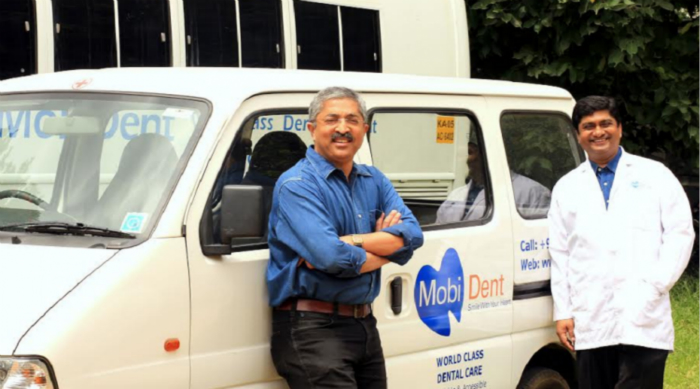
Co-founders Vivek Madappa (left) and Devaiah Mapangada (right)
The “Dental Clinic in a Suitcase” solution, developed by the Indian dental startup MobiDent, enables users to access dental care services from the comfort of their homes, significantly reducing the costs associated with oral hygiene and dental healthcare.
In India, 30,000 dentists graduate from dental colleges each year, facing significant challenges in finding employment. Most of them eventually end up working in elderly care and related practices, with monthly incomes as low as 5,000 rupees. In some cases, dental graduates even leave their profession to join Business Process Outsourcing (BPO) firms, as these jobs offer higher earnings to support their families.
Although the World Health Organization recommends that children receive dental check-ups every six months and adults undergo them annually, reports indicate that only 5% to 10% of India’s population visits a dentist for examinations. This low uptake is attributed to various factors, including lack of awareness about preventive care, painful treatment experiences, high costs, and time constraints. Furthermore, the dentist-to-population ratio in India stands at 1:9,000 in urban areas and 1:200,000 in rural regions. Annual expenditure on the dental equipment and laboratory market amounts to approximately $90 million, making dental treatment a highly expensive process in India.
On one hand, dentists face significant employment challenges; on the other, there is a widespread lack of patient education in the Indian market. Clearly, the dental sector lacks a strong aggregator to transform this awkward situation.Therefore, there is an urgent need for companies like MobiDent to enter the healthcare market, making medical care more affordable and the process more efficient.
In 2011, serial entrepreneur Vivek Madappa and Dr. Devaiah, a dentist, co-founded MobiDent, headquartered in Bangalore. MobiDent launched the “Dental Clinic in a Suitcase,” providing users with affordable at-home dental care services and pioneering a new model of oral healthcare delivery.
The concept of the “Dental Clinic in a Suitcase” was first proposed by Vivek. Reflecting on his initial entrepreneurial vision, he stated, “India is a land full of paradoxes. It boasts the world’s most densely concentrated young talent pool—individuals who are thoughtful, assertive, and execution-oriented. However, infrastructure and services in India remain underdeveloped, particularly in terms of healthcare quality. Although India has no shortage of doctors, only 10% of the population has access to dental care. To make dental services accessible to the general public, disruptive innovation is required.”
Another founder, Dr. Devaiah, has 25 years of private practice experience and has long advocated for “mobilizing dental services,” arguing that they should not be confined to traditional clinic settings but must break boundaries. Thus, from late 2011 to 2013, he built a fully equipped mobile van and brought it to IT campuses. After six months of operations, he sought to expand the business.
As early as 1991, Dr. Devaiah established a clinic on Brigade Road in the heart of Bengaluru. During home visits to conduct minor dental procedures in the residential area of Richmond Town, he observed a significant number of elderly individuals in need of care. In 2000, he completed a two-year specialized program in geriatric care in Switzerland. Upon completing the course, professors at the University of Zurich urged him to adapt the knowledge he had acquired to the Indian context.
It was not until 2007, when a patient spent four hours traveling to his clinic due to congested traffic—wasting a significant amount of time that could have been used for medical consultation—that Dr. Devaiah seriously considered whether dental care could be provided in patients’ homes or offices. A subsequent investigation revealed strong demand among the elderly, busy tech professionals, and parents with young children.
In 2011, he purchased the chassis of a six-wheeled bus, constructed a clinic using two traditional dental chairs, and brought it to schools, technology parks, and residential areas. He even obtained a heavy vehicle driver’s license so that he could drive the bus himself. On one occasion, when his “Dental Bus” was parked near a large office building, 600 people expressed interest, but ultimately only 12 individuals came aboard. He discovered that many people were unwilling to leave their office buildings and walk a considerable distance. Consequently, the development of a portable dental kit for home and office visits, rather than relying solely on a mobile clinic, was placed on the agenda.
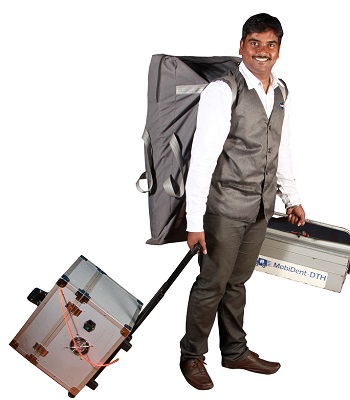
MobiDent’s Dental Kit, Priced as Low as 75,000 Rupees
In 2013, he reached out to entrepreneur Vivek, who had previously founded four companies.In addition to MobiDent, another company currently operated by Vivek is Humming Bird, which provides business travel services to large corporations.Upon hearing Dev’s suggestion, the two immediately hit it off. Vivek promptly proposed a sound strategy to expand the business: they needed to make their dental solutions portable, not merely mobile.
Now they have achieved it. The final solution is to design a portable dental clinic using a portable, foldable, lightweight dental chair weighing only 12 kilograms. The MobiDent kit can be carried and transported anywhere, including via Uber. According to Vivek, the kit costs as little as 75,000 rupees ($104), unlike traditional dental clinics, which cost nearly 120,000 rupees.
This dental kit is not only sturdy enough to accommodate a patient but also designed for easy portability of the compressor, drill, and other small tools. The initial version featured a foldable, tiltable frame made of lightweight steel, weighing approximately 25 kilograms. By replacing solid bars with hollow ones, the weight was reduced to 12 kilograms. The next iteration will halve the weight by substituting steel with carbon fiber.
Currently, MobiDent’s business model has been implemented across three vertical sectors: households, enterprises, and healthcare chains. These chain institutions are primarily concentrated in major cities such as Bangalore, Mysore, Pune, and Ahmedabad. By the end of 2016, MobiDent had provided dental care services to 44,000 users from over 400 enterprises, established partnerships with 19 hospitals, and served more than 250 household groups.
In July 2014, MobiDent officially embarked on an aggressive expansion journey. Initially operating with only four dentists and two clinic units, the company primarily targeted corporate clients, while its founders leveraged their personal networks to establish free dental screening camps.
Vivek stated that an average of 80 to 100 people walk into the screening camps each day for examinations, with nearly 70–80% of them found to have some form of dental issue they were previously unaware of. Forty percent of these individuals agreed to receive treatment. Over the past two years, MobiDent has claimed to have set up screening camps at nearly 400 companies. These include many large corporations such as GE, Infosys, Intel, TCS, and Cognizant.
Following the success of its collaboration with corporations, MobiDent launched its second strategy in February 2015: partnering with hospitals. Vivek, who is well-versed in the Indian hospital landscape, noted that dental consultation services are typically offered only in outpatient departments at most hospitals, which also lack the facilities necessary for practical clinical procedures. Consequently, the company’s value proposition of establishing mobile clinics within hospitals was well received, helping these institutions address practical operational challenges. Within the first month, the company generated revenue exceeding 300,000 Indian rupees (approximately RMB 30,787) at Columbia Asia Hospitals.
The specific model of collaboration with hospitals involves MobiDent assigning one to two dentists and deploying dental kits at each partner facility. Under the agreement, the hospital receives 20% of the revenue generated from patient treatment fees. Currently, the company has partnered with 19 hospitals in the West and South Indian markets, including the Sahyadri Hospitals chain in Maharashtra, Rainbow Children’s Hospital, and seven branches of Columbia Asia Hospitals. These 19 hospitals have collectively served 10,000 patients, accounting for one-quarter of MobiDent’s total patient base.
Building on the successful collaboration between enterprises and hospitals, Dev and Vivek did not halt their expansion efforts, aiming to uncover new opportunities in their business model. In August 2016, the company launched a family-oriented vertical service: MobiDent introduced the Family Dental Protection Plan, which provided at-home dental care services. Within just two months, the plan had served 250 households.
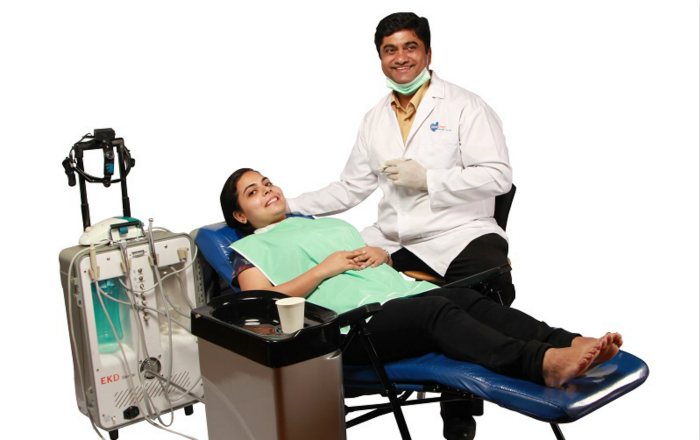
MobiDent: At-Home Dental Care Services
The company plans to offer a service called “oral spa” as part of its preventive dental care checkups, primarily providing deep cleaning, routine cleaning (plaque and tartar removal), and polishing. In terms of pricing, the annual fee for a family of four to five members is 2,750 rupees, which includes two preventive examinations. For couples without children, the same plan is priced at 1,750 rupees, while for individuals, the fee is fixed at 950 rupees. If patients have other serious dental issues, additional charges will apply for the dentist’s services.
How to Schedule a Doctor’s Appointment? Customers can book appointments online via the MobiDent website, call the helpline, or locate the nearest free dental camp. In terms of marketing, the two founders have consistently adhered to a conservative and restrained approach.
Regarding the selection of physicians, Vivek explained that only the most experienced doctors are permitted to provide in-home treatment. Physicians must complete certification for at least 2,500 procedures, encompassing various dental surgeries, before they are allowed to treat patients in their homes. This extensive experience enables rapid and accurate diagnosis of patients’ dental conditions. Furthermore, it ensures that physicians possess strong social communication and interpersonal skills, as they must assume the role of a trusted “family doctor” when entering patients’ private spaces. “Prevention is better than cure; most people require only basic preventive care rather than intensive treatment,” said Vivek Madappa, co-founder of Mobident.
Furthermore, all medical consultation outcomes are documented, and copies of the diagnosis are sent to clients via WhatsApp or email.
Why MobiDent Succeeded. Vivek cited several reasons. “Since its inception, we have formalized our service processes through our academy, recruitment efforts, and other initiatives. During this period, we have sought to make the intangible tangible.”
To address the challenge of hiring a large number of dentists, MobiDent has established the MobiDent Academy for Dental Excellence (M.A.D.E.), which provides trainees with essential clinical exposure and practical experience. Dentists with more than five years of experience undergo structured training focused on enhancing social and communication skills to build trust with patients and their families. Dentists with three to five years of experience receive training that enables each of them to perform nearly 50 dental examinations per day. The company pays monthly stipends to trainee dentists ranging from 30,000 to 35,000 rupees.
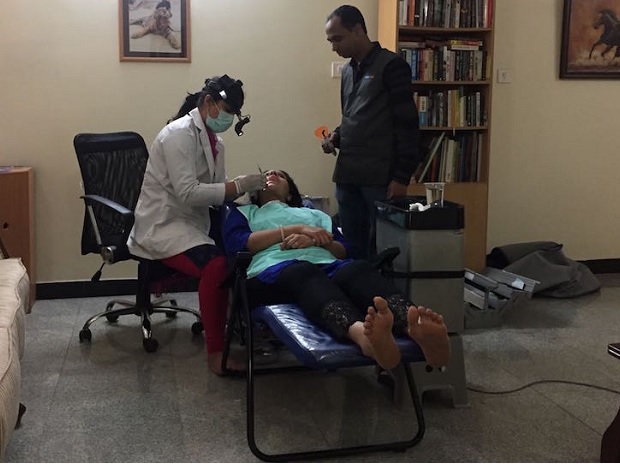
Doctor home visits can be scheduled.
“Home dental care is highly complex, so we have invested significant effort in recruiting and training dentists. Only dentists who pass psychological assessments, have more than three years of experience, have examined over 2,000 patients, and have completed certification for 2,500 procedures can serve as home dentists,” said Vivek.
MobiDent also has a proprietary digital platform at the backend, providing technical support for the company. It offers real-time analytics and controls processes ranging from CRM, patient medical history, and logistics management to billing, inventory cataloging, and finance. Although the company is managed by only three people (excluding doctors), it maintains high efficiency, primarily because its complete operations are supported by a robust technological backend.
As of November 2016, the number of dentists on the MobiDent platform offering home-visit services had reached 33. “The challenge in creating a new industry lies in finding talent capable of working within the new ecosystem. Physicians are accustomed to practicing in clinics or hospitals and are not yet familiar with providing home-based care.”
“When it comes to challenges and talent, Vivek stated, ‘To enable dentists on the platform to perform at their best, they must possess the necessary knowledge and skills; only in this way can they build trust with consumers receiving care at home. This is our top priority to address.’”
The company’s near-term goal is to hire 3,000 dentists and train 1,000 dental hygienists, covering 20 top-tier cities in 2017, and to launch MobiDent’s services in 200 cities across India by 2020.
When it comes to profitability, the figures are equally impressive. The facility conducts nearly 2,000 examinations per month, including approximately 1,000 dental surgical procedures. At launch, MobiDent’s monthly revenue stood at 150,000 rupees; today, its average monthly revenue has reached 2.1 million rupees. In terms of revenue composition, 40% is derived from corporate partners, while 50–55% comes from hospitals.
In 2015, MobiDent received funding and incubation support from the Entrepreneurship Cell at IIM Ahmedabad and was awarded by the Royal Academy of Engineering in London. In July 2016, MobiDent raised ₹12.5 million in angel financing from individual investors in New York, Dubai, and Mumbai. In 2017, based on the performance of its home-care services, the company planned to expand its offerings to the top 10 metropolitan and mini-metropolitan areas in India. In January 2017, MobiDent announced a Pre-A financing round involving DanGold Investment Corp from New York, although the specific amount raised was not disclosed. The company intends to use this round of funding to enhance its technology platform and strengthen its marketing and sales efforts. Currently, MobiDent serves only four regions: Bengaluru, Pune, Mysore, and Ahmedabad. Additionally, the company has global ambitions; it has already established its first clinic in Kenya and plans to expand into markets in Africa and South Asia.