

Nuance Communications: The World's Largest Speech Recognition Company with 50% of Revenue from Healthcare
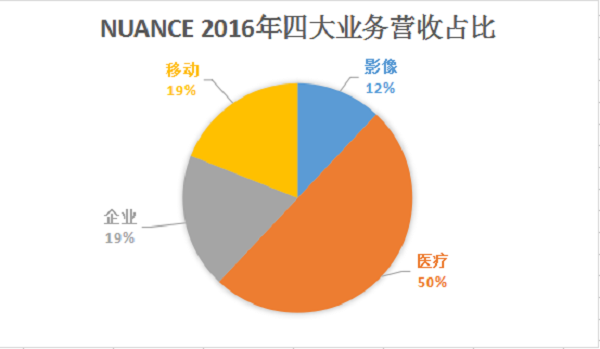
Nuance—the world’s largest speech recognition technology company—has provided voice technology solutions to tech giants such as Apple, Amazon, Samsung, and Nokia. Currently valued at $4.9 billion, Nuance’s core business is divided into four major segments: the Healthcare Division, which offers medical record management and dictation transcription services; the Enterprise Division; the Mobile Devices Division; and the Imaging Division. From Q1 to Q3 of 2016, the company generated $1.468 billion in revenue, with healthcare accounting for 50% of total revenue, making it Nuance’s most important division. VCBeat (WeChat ID: vcbeat) has outlined Nuance’s strategic expansion in the healthcare sector, hoping to provide valuable insights for Chinese intelligent voice companies seeking to establish a presence in the healthcare market.
>>>>
Seizing the Opportunity in Electronic Medical Record Development
Nuance was founded in 1992, initially focusing on optical character recognition (OCR) and document imaging. Following ScanSoft’s merger with Nuance, the company officially announced its renaming to Nuance Communications, Inc. on October 18, 2005. The newly formed entity retained the ScanSoft name solely for its home imaging applications and was listed on the NASDAQ in 2005.
Initially, Nuance’s healthcare products were dedicated to providing clinical professionals with voice-enabled file navigation systems and applications, aiming to revolutionize patient communication. The adoption of this technology significantly enhanced physicians’ diagnostic efficiency, enabling rapid, flexible, and accurate collection of patient clinical information.
To date, Nuance’s healthcare solutions have covered 72% of medical institutions across the United States, with clients in more than 30 countries worldwide. The company has accumulated over 300 million patient–provider interaction records and annually serves more than 500,000 physicians and 10,000 healthcare facilities. Its medical product portfolio has become increasingly diverse, including Clinical Documentation Improvement (CDI), clinical speech recognition, intelligent imaging diagnostics, real-time dictation, computer-assisted coding, healthcare quality management, mobile cloud computing, and precise radiology reporting, among others.
Nuance data shows that physicians using Nuance products in the United States can achieve an average efficiency improvement of 30%.
According to Nuance’s revenue data for the first three quarters of 2016, the proportions of its four major business segments—Healthcare, Mobile, Enterprise, and Imaging—are as follows:
Data Source:NuanceAnnual Report
Data source: Nuance Annual Report
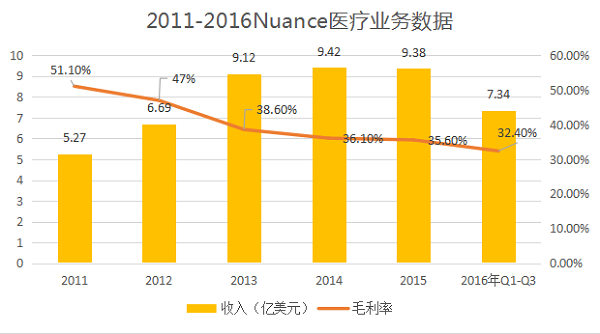
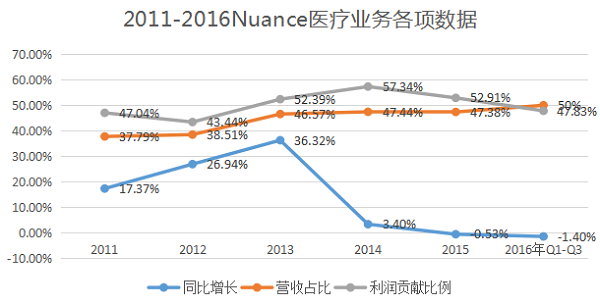
From the mutation, we can clearly see that Nuance’s healthcare business revenue grew rapidly from 2011 to 2013. The first reason behind this was its prior technological accumulation and the expansion of its medical product portfolio, which gained market recognition among users. The second reason was that, with the global popularity of Apple iPhones, Nuance became widely known worldwide through its collaboration with Apple on the Siri intelligent voice interaction system, leading to a rapid increase in brand value.
Third, during this period, the U.S. federal government introduced several tax and cash incentive policies to encourage hospitals and practicing physicians to adopt electronic health records (EHRs). Data from a 2010 survey indicated that only 12% of hospitals in the United States had implemented electronic physician notes across all clinical departments, and 17% of hospitals had achieved electronic medication ordering in all clinical departments.
For comparison, 75% of hospitals have adopted electronic reporting systems for laboratories and radiology departments. A significant number of hospitals have implemented certain key functions in one or more (but not all) departments, or have begun implementing such systems or already possess the resources to do so. These functions include physician order entry (44% of hospitals) and electronic medication ordering (38%).
However, by 2014, 61% of healthcare providers were using electronic health records (EHRs), and 34.8% of physicians were using comprehensive EHR systems (comprehensive functionality covering e-prescribing, electronic charting, and integration with laboratory and imaging centers). The medical specialties with the highest adoption rates were diagnostic specialties (80.6%), internal medicine/pediatrics (75.8%), nephrology (70.5%), and pathology (69.4%).
Over the past three years, Nuance seized opportunities to achieve rapid revenue growth.
>>>>
Medical business has not entered China
However, Nuance’s data has not been optimistic since 2014., the boom in electronic health record (EHR) development in the United States has passedFurthermore, from a technical perspective, Nuance’s speech technology is based on statistical inference methods, focusing on phonemes (the sounds of syllables) and context to recognize utterances. In terms of recognition capabilities, Nuance’s algorithms and patents are ahead of those of its competitors.
However, in recent years,Breakthroughs in Deep Learning Technology and Its Widespread Application in Speech Recognition and Natural Language Processing, eliminating many steps in voice model creation and significantly reducing difficulty, cost, and time. Apple, Samsung, and IBM have all entered this industry, competing with Nuance on the same level. Nuance’s technological advantages have gradually diminished, leading to a steady loss of customers.
Nuance has recently experienced a decline in revenue and missed another significant opportunity.VCBeat reviewed Nuance’s official Chinese website and found that its business in China mainly covers mobile, automotive, and enterprise services, with no involvement in healthcare services. This may be due to policy or technical reasons.However, as China is currently advancing the implementation of electronic medical records (EMR) and healthcare informatization, Nuance has failed to secure a share of this vast market, resulting in significant losses while simultaneously creating substantial opportunities for Chinese enterprises.
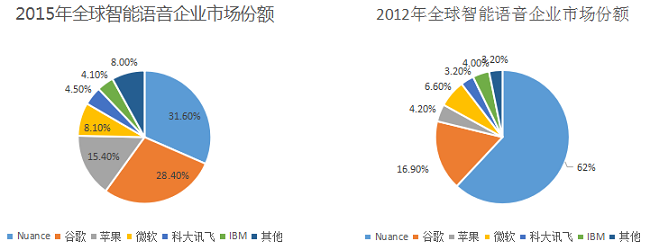
Although it remains the market leader, its market share has declined from a peak of 62% to 31.6% in 2016.
Having already reaped the benefits of its healthcare initiatives, Nuance is expanding its footprint in the medical sector beyond voice products to now focus on medical imaging. Nuance’s imaging business primarily provides enterprise-level document and imaging solutions. Its healthcare-related products include PowerScribe 360, mPower Clinical Analytics, and the PowerShare Network. In collaboration with radiology departments and healthcare institutions, these products deliver comprehensive, timely, and high-quality data and diagnostic reports, facilitate medical image exchange, and aim to extract greater value from radiology reports.
According to the official website, half of radiologists in the United States use Nuance’s solutions for documentation, more than 4,000 healthcare institutions are connected to the PowerShare network, and over 10,000 medical devices have been installed with Nuance’s clinical documentation solutions.
However, imaging services are not Nuance’s core product; their profit contribution has remained relatively stable at around 14%.
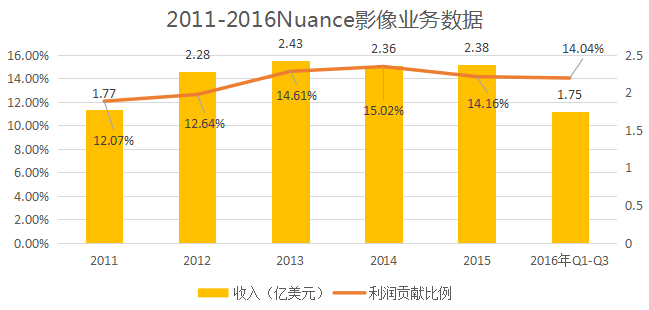
Data Source:NuanceAnnual Report
>>>>
# Competitors Abound
In addition to Google, Apple, Microsoft, and iFlytek, Nuance’s primary competitor in the healthcare sector is M*Modal. Currently, there is limited public information available about this company. In 2012, One Equity Partners, the private equity investment arm of JPMorgan Chase & Co. (JPM), acquired M*Modal, a technology services provider, for approximately $1.1 billion in cash. M*Modal provides clinical documentation and speech recognition technologies to healthcare professionals. The company employed 12,000 people across five countries and reported annual revenue of $450 million in 2011.
Many of the healthcare products launched by M-Modal are similar to those offered by Nuance. For instance, both companies have developed solutions that enable physicians to input patient information via voice, verify and highlight relevant medical records, review medical histories, and pose follow-up questions. Physicians can also edit the information to ensure its accuracy.
Both companies aim to leverage speech technology to enhance physicians’ work efficiency, with their target customers being healthcare institutions such as hospitals and clinics. Nuance’s greatest advantage lies in its longer market presence and established brand strength; however, M-Modal is closing the gap, as evidenced by its revenue performance.
Examining these data, it would be inaccurate to claim that Nuance has fallen from its pedestal. As the world’s largest voice technology company, it still holds the number one position in global market share. In today’s highly competitive landscape, Nuance’s greatest advantage lies in its years of experience serving healthcare institutions. Although the widespread adoption of deep learning technologies has diminished Nuance’s technological edge, the company has not suffered the same fate as Kodak or Nokia. Nuance is actively investing in deep learning and has not fallen behind. By retaining its B2B clients and aggressively expanding both domestically and internationally, Nuance is well-positioned for further growth. Should regulatory policies permit its entry into the Chinese market, Nuance’s performance could see even greater development.