

Tiantan Software Files IPO Prospectus After 8 Years of Pioneering Mobile Healthcare Solutions

After eight years in business, Tiantan Software has gradually emerged as a rising star in the healthcare IT industry, driven by its industry-leading mobile clinical care system and achieving 100% year-over-year revenue growth for three consecutive years.
Tiantan Software’s journey from 0 to 1 is closely tied to the medical background of its founder and CEO, Dong Jie. Dong Jie’s father serves as the president of a Grade II Class A hospital, while his mother and sister are also physicians, making theirs a typical family of doctors.
In 2009, Dong Jie was a junior at Beijing University of Posts and Telecommunications, majoring in computer science. At that time, his father’s hospital happened to beRequirementsRegarding the development of medical software, he asked him, “Can you assemble a team to take on this project?” Upon hearing this, Dong Jie was immediately intrigued and, with a try-it-out mindset, recruited several classmates still in school to form a development team.
Two years later, as Dong Jie was about to graduate from university, the Android operating system was gaining significant traction. Dong Jie and his development team began exploring how to introduce mobile healthcare products into hospitals via the Android platform, thereby creating a mobile office system. Seizing this opportunity, Dong Jie officially founded Tiantan Software in 2011.
Mobile Healthcare Management for Positioning
Positioning the product as a mobile clinical care tool, this persistence has kept Dong Jie and Tiantan Software committed for eight years. Beyond their optimism about mobile healthcare, there is also a telling anecdote: before Tiantan Software was founded, one of the co-founders received treatment for an eye condition at a Grade 3A hospital in Beijing. He had keratitis, but it was misdiagnosed as conjunctivitis. This misdiagnosis caused him to miss the critical window for timely treatment, leaving his eye with a permanent scar.
The founders’ experiences made Dong Jie and his team acutely aware that variations in the clinical proficiency of physicians and nurses inevitably lead to diagnostic errors. Mobile healthcare tools, supported by information technology, can leverage the fragmented time of medical staff and streamline bedside patient management.
Tiantan Software’s Mobile Healthcare System primarily encompasses two key functionalities: first, reducing diagnostic and treatment errors among physicians and nurses through measures such as IoT-enabled automatic verification; second, providing clinical decision support by delivering mobile-accessible clinical knowledge and diagnostic recommendations to doctors and nurses, thereby enhancing the efficiency of clinical diagnosis and treatment.
This product logic was not established from the very beginning of the startup, but rather evolved through step-by-step accumulation. In 2011, Tiantan Software facilitated the migration of hospital systems from PC to mobile platforms, after which its business gradually shifted toward mobile clinical decision support. The product was not truly launched into the market until late 2014.
Over a two- to three-year period, the core team of Tiantan Software was deeply embedded in hospitals, effectively assuming the roles of hospital information departments. Dong Jie, who grew up immersed in a medical environment, clearly understood that for clinical decision support systems to be truly effective, it is crucial for R&D personnel to possess solid medical knowledge. Even with professional product managers in place, if developers lack basic medical understanding—to the extent of being unfamiliar with hospital department structures—it would be difficult for the company to develop high-quality software.
Years of in-depth engagement within hospitals have made Tiantan Software’s clinical decision support system stand out from other third-party healthcare data companies. Their understanding of internal hospital management enables their products to integrate seamlessly into hospital workflows.
Mobile Nurses and Bianque Cloud Medicine
Mobile Nurse is a mobile solution developed by Tiantan Software, which utilizes QR code and RFID technologies to identify and track information such as medications, specimens, equipment, nursing staff, and patient identities. It is a customized system that integrates query, recording, verification, and management functionalities.
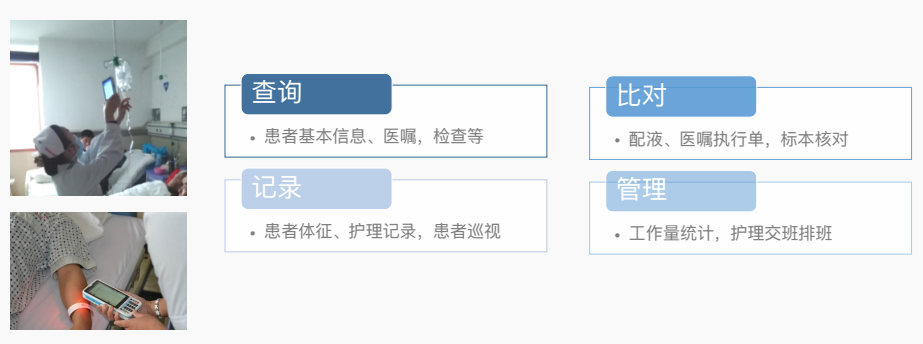
Key Functions of Mobile Nursing
Nurses in hospitals use mobile nursing devices to document every step of their daily workflows. This system introduces certain constraints to streamline documentation. For instance, while intravenous (IV) infusion information is typically verified manually at present, mobile nursing devices enable direct barcode scanning for verification. Furthermore, the system mandates a one-to-one correspondence between the IV bottle label and the patient’s wristband, thereby adding an automated identification and validation step that makes the replacement process both faster and more accurate.
Additionally, the backend system of the Mobile Nurse platform automatically calculates the infusion duration for each IV fluid bag, as certain medications require faster infusion rates while others necessitate slower administration. If a medication requires at least 40 minutes to achieve theoretical safety standards, the Mobile Nurse system will alert the nurse to adjust the infusion rate to an appropriate level. To prevent nurses from prematurely terminating infusions due to time constraints, the system implements restrictive measures to avoid such occurrences.
This type of clinical decision support has been fully integrated into Tiantan Software’s products, such as Mobile Nurse and Bianque Cloud Medicine. For instance, nursing care plans include internal medicine and surgical modules—such as trauma care and postoperative care—as well as care decision packages for specific single diseases. For physicians, Bianque Cloud Medicine offers intelligent decision support packages primarily focused on pulmonary diseases and cardiovascular and cerebrovascular disorders.
“Unlike many internet healthcare companies, Tiantan Software’s greatest advantage lies in its direct entry into the in-hospital segment from the outset. While many enterprises have transitioned from out-of-hospital to in-hospital services, Tiantan Software went straight to the core,” said Dong Jie.
After several years of development, the Tiantan team has gained an in-depth mastery of hospital business processes and internal information interfaces. This prolonged accumulation has also given rise to another core technology: data integration.
Currently, many hospitals’ Hospital Information Systems (HIS) still rely on traditional B/S or C/S architectures. Such systems typically do not provide application programming interfaces (APIs), making it difficult and costly for subsequent health IT vendors to integrate their products. To address this challenge, the Tiantan team has developed a set of interface data standards compatible with most mainstream HIS systems in China. By leveraging its proprietary ETL (Extract, Transform, Load) tools, Tiantan can directly establish data interface connections without requiring specialized cooperation from HIS vendors. This technology enables Tiantan Software to rapidly deploy its systems in hospitals.
The third advantage of Tiantan Software is cost. To implement a mobile healthcare system, hospitals must utilize mobile networks via smartphones. In this context, many hospitals opt to build their own Wi-Fi infrastructure. While this poses little problem for tertiary Grade A hospitals, the associated costs may be prohibitive for secondary Grade A hospitals or primary care institutions.
In response, Tiantan Software opted to partner with telecom operators. Traditional mobile workstations for doctors and nurses can cost tens or even hundreds of thousands of yuan per set. In contrast, Tiantan Software’s products are offered through monthly subscription packages, similar to topping up mobile phone credit, and can be installed and used via installment payments, thereby significantly lowering the barrier to deployment.
Furthermore, all products under Tiantan Software have been deeply optimized for telecom operators’ 4G networks and even 5G data standards, enabling Tiantan Software’s mobile healthcare solutions to operate rapidly and stably within hospital environments.
Cloud technology is also one of Tiantan Software’s key strengths. Large hospitals, particularly Grade 3A hospitals, have stringent requirements for the security of medical data. By partnering with national telecommunications carriers, Tiantan Software deploys its cloud platform on the carriers’ cloud servers.
Such cloud servers are typically designed to serve government agencies, public institutions, and enterprises, functioning similarly to private networks or dedicated lines. This architecture enables the secure transmission of diverse diagnostic and treatment data collected from hospital intranets to public cloud platforms. Furthermore, by integrating encryption technologies, medical professionals can conveniently access diagnostic and treatment information—previously available only on computers or within hospital intranets—via the Bianque Cloud Medicine mobile application.
Advancing Regional Healthcare Informatics
With these major technological advantages, Tiantan Software’s product strategy has gradually evolved into two primary directions. The first step is to deploy Bianque Cloud Medicine and mobile nursing tools for individual hospitals. In such single-hospital systems, data remains confined within the hospital premises, and the problem of information silos persists.
The true goal of Tiantan Software is to achieve interoperability of information between hospitals. Therefore, the second step is to connect individual hospitals to Tiantan Software’s public cloud platform, thereby establishing regional healthcare informatization.
In 2016, Tiantan Software completed three district- and county-level projects across China. In the regions covered by these three projects, all secondary hospitals adopted Tiantan Software’s mobile tools for doctors and nurses. After deployment, Tiantan Software integrated each hospital’s respective systems with a public cloud platform, thereby achieving interconnectivity and information exchange among the hospitals.
On this basis, hospitals can also implement two-way referral systems. Further extending this framework leads to the formation of a regional data integration platform, akin to a clinical diagnosis and treatment data center. Local health and family planning commissions and health administrative authorities can then leverage this regional data integration platform to rapidly consolidate and analyze information from different hospitals.
Expand the Primary Healthcare Market
Over the past two years, Tiantan Software has achieved a certain level of coverage in primary healthcare, particularly in regional electronic medical records.
Electronic medical records (EMRs) encompass all diagnostic and treatment data within hospitals. Currently, hospitals at Level II and above generally do not adopt EMRs on a large scale. However, primary healthcare institutions, such as township health centers and community health service centers, have a strong demand for SaaS-based EMR systems.
In 2015, Tiantan Software began deploying its products across China, with multiple districts and counties—including those in Beijing, Xinjiang, and Hebei—adopting the SaaS Regional Model Electronic Medical Record (EMR) system.
As Bianque Cloud Medicine possesses a wealth of diagnostic and treatment decision-making data from numerous experts, the platform further disseminates this information to physicians at township health centers. This enables these doctors to receive diagnostic and treatment decision support from Bianque Cloud Medicine while writing medical records or conducting clinical assessments on their computers.
According to Dong Jie, the mobile version of Bianque Cloud Medicine will be launched in mid-2026. At that time, township health centers and rural barefoot doctors will be able to access patient medical records and view expert recommendations for those cases through the mobile platform. Additionally, they will be able to connect with experts on the platform to facilitate remote collaboration.
Currently, nearly 100 primary care institutions have been integrated into the Bianque Cloud Medical platform, with the number continuing to grow.
CO-MEMR Alliance and Telecom Operator Channels
In 2016, Tiantan Software’s products achieved steady market growth, with channel development playing a pivotal role.。
Dong Jie told reporters that Tiantan Software’s customers primarily come from two major channels. The first is the CO-MEMR Alliance, a technical consortium for which Tiantan Software serves as the core initiator and developer of technical standards. Similar to Google’s Android system, Tiantan open-sources its mobile nurse station products to other health IT vendors within the alliance. These more than 20 vendors can leverage Tiantan Software’s technical architecture to rapidly deploy mobile nursing systems in hospitals.
Tiantan Software’s second user segment comes from telecom operators. In early 2016, Tiantan Software’s collaboration with telecom operators officially entered a golden period. According to Dong Jie, the growth rate of this user segment is expected to surpass that of the CO-MER Alliance in the future.
In terms of profitability, although Tiantan Software has not yet reached the break-even point, it has maintained a 100% year-over-year revenue growth for three consecutive years. Dong Jie believes that Tiantan Software is not a company that merely burns cash; it has a clear business model targeting the B2B sector. The fundraising is primarily driven by two factors: First, Tiantan Software’s current revenue is insufficient to support such rapid growth in its hospital client base.Over the past two years, Tiantan Software has added more than 300 secondary-and-above hospitals and over 300 primary healthcare institutions to its client base.
Furthermore, in the layout of regional medical informatization, migrating hospitals to public clouds represents a process of hospital decentralization. This implies that Tiantan Software cannot charge excessive fees to hospitals. Dong Jie believes that to deepen efforts in this direction, capital support is essential; only with such backing can they further integrate and unlock hospital data.
Data Analysis and Clinical Decision-Making Are the Next Steps
According to Dong Jie’s plan, in 2017, Tiantan Software would focus on Shandong, Hebei, and Beijing, radiating outward from these three provinces and municipalities. Within these regions, Tiantan Software would prioritize the deployment at county-level people’s hospitals, county-level traditional Chinese medicine hospitals, and county-level maternal and child health hospitals. By launching and integrating their information systems, the company aims to establish a regional clinical data exchange platform, thereby laying the groundwork for subsequent clinical decision support and data analytics.