

Jinyingjie Medical Files IPO Prospectus After $7.3M Series B Funding: Building a 'Big Education + Big Health + Big Medical' Ecosystem
Medical education was once a niche market in the healthcare sector that received little attention. However, driven by factors such as the growing number of healthcare professionals and the widespread adoption of online learning, the market size for medical education is gradually expanding. Many traditional educational institutions and internet-based education providers have begun to focus on this sector. Jinyingjie Medical, which transitioned from judicial examination training, is also accelerating its expansion in this market. By enhancing its competitiveness and market share through multiple internal and external dimensions—including technological upgrades, talent strategies, and resource sharing—the company has established a strategic goal of “Big Health, Big Education.” It aims to enter the upstream and downstream segments of the medical industry, starting with training for medical professional qualification exams, with the ambition of becoming a “fueling station” for the medical talent pool.
Small Steps Lead to Great Distances. Previously, Zhao Hongfeng, founder of Jin Yingjie, exclusively disclosed financing details to VCBeat. As time has passed, we are concerned about where Jin Yingjie has allocated its funds following the Series B financing round, what changes have occurred at the business level, how the market has responded, and whether it has moved closer to its goal of “Big Health, Big Education.”
On February 18, Li Zhongqi, General Manager of the Online Business Division and Vice President of Jin Yingjie, and Senior Consultant Zhang Bowen, were interviewed by VCBeat. They reviewed their business operations following the financing round and provided an in-depth analysis of their understanding of the medical education market.
Targeted Capital Investment
When the financing information was announced last year, Zhao Hongfeng stated that the RMB 50 million raised in Series B financing would be allocated to three areas: expanding the teaching faculty, ‚increasing investment in content development, and establishing an internet and big data center to upgrade technology.
“We were already profitable before raising funds. The purpose of bringing in investment is to leverage the power of capital to strengthen our investments in technology, talent, and resources,” said Zhao Hongfeng.
In terms of faculty, Jin Yingjie has signed exclusive agreements with multiple renowned instructors in the field of medical education and exam preparation training. This has enhanced the loyalty of star educators and the originality of content, helping the company rapidly establish a strong reputation for its high-quality teaching staff.
On one hand, there is high-quality content produced by renowned instructors; on the other, the challenge lies in making this premium content accessible to a wider audience, thereby benefiting more individuals with needs for medical education and examination training. To address this, Jin Yingjie has adopted a strategy of offering free online courses and providing learning packages upon registration.
“We offer free medical licensing exam courses taught by renowned instructors, along with preparatory books and live-streamed review sessions. To help medical professionals—including physicians, pharmacists, and nurses—obtain their credentials more efficiently and enhance their professional competencies, we are committed to fulfilling our responsibilities, contributing our share, guiding the direction of education, and promoting social progress,” said Li Zhongqi, Vice President of Jin Yingjie.
In fact, even before securing financing, Jin Yingjie had already adopted the strategy of offering free online courses, with estimated costs at around RMB 30 million. However, apart from the disruption and impact this “360-style approach” brought to the industry, these costs remained within expectations. From another perspective, Jin Yingjie’s slogan is “Medical Exam Training with Warmth.” Setting aside commercial strategic considerations, this move also helps more examinees access high-quality content.
User data also validates the effectiveness of Jin Yingjie’s free-content strategy. According to Li Zhongqi, prior to offering free online courses, Jin Yingjie had approximately 100,000 registered users. After implementing this strategy, the platform’s average daily new registrations reached around 3,000, with cumulative users exceeding 500,000.
From a business perspective, the strategy has also proven successful. From last October to this February, the overall conversion rate for Jinyingjie Medical Exam’s premium training products reached 15%, with enrollment in its premium courses accounting for 25%—a twofold increase compared to the previous period.
Furthermore, Jin Yingjie has established a comprehensive ecosystem encompassing “recorded courses, textbooks, live streaming, in-person instruction, and renowned instructors,” catering to the diverse learning needs of students. “Free recorded courses, supplementary textbooks, interactive live-streamed sessions, intensive in-person crash courses, and expert Q&A with distinguished faculty ensure a student-centric content framework. This approach yields high student satisfaction and pass rates, which in turn naturally bolster Jin Yingjie’s reputation.” Li Zhongqi, Head of the Online Business Division, possesses a deep understanding of this holistically designed content system.
From a technical perspective, online operations are the key focus. Li Zhongqi proposed the teaching objective of “360-degree visualization,” which involves using relevant technical tools to intuitively display the content taught by instructors, assess what students have learned, and systematically address any gaps or reinforce key topics.
“Creating 360-degree visualizations for student learning, instructor teaching, and institutional teaching management; integrating the stages of learning, practice, assessment, and evaluation to establish a closed-loop teaching system and achieve adaptive instruction.” This is how Li Zhongqi summarized the entire process.
Adhering to the principle of “open-door education,” Jinyingjie maintains a highly open stance toward its content and technological advantages, actively seeking online and offline partners. Partners can share in Jinyingjie’s achievements in both content and technology. To date, Jinyingjie operates more than 10 directly administered branch schools and nearly 150 franchised branch schools across China, along with over 500 partner institutions. It provides face-to-face instruction in more than 70% of large and medium-sized cities nationwide.
Li Zhongqi stated, “Our O2O teaching model—integrating high-quality resources with personalized instructional services, and leveraging PC platforms, mobile apps, and the ‘Jin Tiku’ question bank—enables visualization of teaching outcomes, adaptive responsiveness to instructional needs, comprehensive coverage in key regions, and resource sharing among partners. This ensures that learners across different regions, with varying needs and proficiency levels, can access the content they require in a timely manner, serving as a direct reflection of our student-oriented value system.”
On February 4, this year’s National Medical Licensing Examination plan was released. In response, Jin Yingjie immediately launched the “Rainbow Plan,” a premium training program for Traditional Chinese Medicine (TCM) and Integrated TCM-Western Medicine practitioners (including assistant physicians). Based on historical data, the average pass rate for this premium program in previous years has reached 95%. Numerous students have expressed their approval of Jin Yingjie’s training program in video testimonials, including many who had previously struggled for years with self-study or attended multiple other training institutions. They credited Jin Yingjie with helping them fulfill their “dream of becoming a licensed physician.”
In addition to the Rainbow Program, Jin Yingjie offers high-end in-person courses such as the Angel Program, Peak Program, Smile Program, Sunflower Program, and Medicine King Program, targeting examinations for nursing qualifications, licensed physicians, and licensed pharmacists. As most of its students come from primary healthcare institutions, the company emphasizes not only exam preparation but also the cultivation of practical skills to enhance the professional competence of grassroots medical personnel.
Addressing the most pressing public concern—where the funds were allocated—Li Zhongqi summarized: “The orderly advancement of technology, faculty development, and textbook R&D, combined with market sharing among partners and our unwavering commitment to a student-oriented value system, has ensured that funds are used in a targeted and effective manner.”
Backed by a RMB 10 billion medical education market
As a veteran in the vocational education market, Li Zhongqi previously worked at Huatu Education, where he secured tens of millions in financing for his projects, giving him deep familiarity with the operational strategies of the vocational education sector. He presented us with a series of figures: over 4 million candidates annually take the qualification exams for physicians, pharmacists, and nurses; approximately 250,000 individuals pursue postgraduate entrance examinations in medicine; and there is still a demand in the tens of millions for medical professional title evaluations. Overall, the visible scale of the medical education market represents only the tip of the iceberg. By starting with qualification exam training, the training system can be expanded horizontally. Furthermore, given that the educational journey for medical professionals is extensive and spans their entire careers, this approach ensures the completeness of the industry cycle.
It is precisely for this reason that traditional educational institutions and companies from other sectors have continuously crossed over into the field, making “Internet + Healthcare + Education” a major industry trend.
According to statistics from Yutouhui, there are currently nine listed (quoted) companies in the medical education market, including China Distance Education Holdings, New Oriental Online, Huatu Education, Intellimed Education, Huabo Education, Borui Health, Zhongchao Medical, Aimeidi, and Hongtao Shares. As the first-round investor in Jinyingjie, Hongtao Shares acquired a 20% stake for RMB 39 million. The company also owns other education-focused subsidiaries such as Kuakao Postgraduate Entrance Exam Preparation and Xue’ersen, making it a typical example of publicly traded companies actively expanding into the education market.
Like Jin Yingjie, many non-listed companies have also attracted capital interest. According to data from Yutouhui, since 2010, at least 12 companies involved in medical education have received investment, with eight companies securing funding last year alone, each raising amounts in the tens of millions.
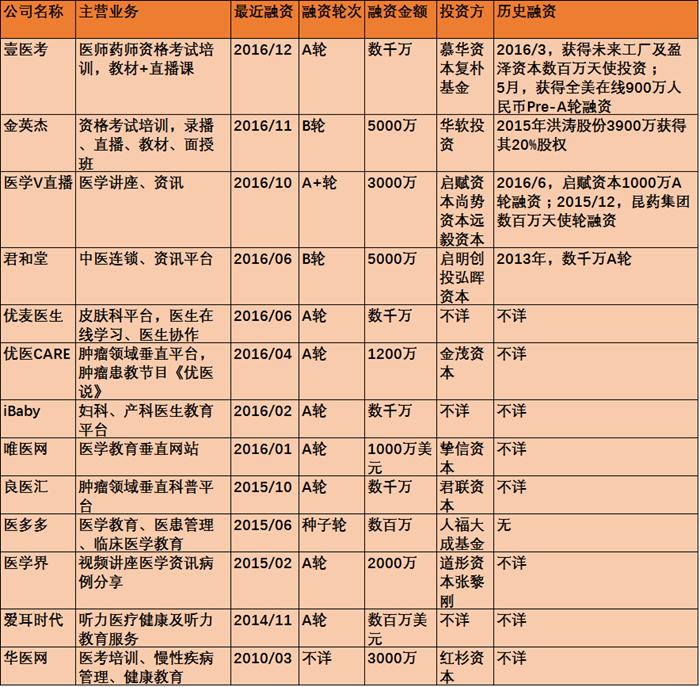
Source: VCBeat, compiled from data provided by Yutouhui
Zhang Bowen, Senior Consultant at Jin Yingjie and Deputy Dean of its Business School, has also been deeply engaged in the vocational education market for many years. According to him, capital inflow into the medical education market has occurred in distinct phases. Around 2010, investors began to take notice of the medical education sector (particularly online education). Between 2013 and 2015, cross-industry capital entered the market in an irrational manner. After 2015, investment sentiment cooled down, and the narrative of internet-based education disrupting traditional education faded. Instead, the integration and synergy between online and offline models have become the core competitiveness of medical education institutions. Jin Yingjie places significant emphasis on online-offline coordination and has proposed an O2O (Online-to-Offline) teaching model.
“The rise of internet-based education is inextricably linked to shifts in audience demographics. Many individuals born in the 1980s and 1990s grew up during the internet era, with digital technology deeply permeating their daily lives. When they seek learning opportunities, transitioning to online instruction is a natural progression. Therefore, internet education companies must accurately identify their needs and align with their learning habits,” said Zhang Bowen.
On the other hand, Zhang Bowen believes that it is impossible for internet education to completely overturn traditional educational models. Teaching is a comprehensive process integrating listening, speaking, reading, and writing; only offline training can fully stimulate students' enthusiasm. For students unable to participate in face-to-face instruction, live streaming serves as an effective teaching method, fostering a sense of participation and helping to mobilize student engagement.
“In the coming years, the Internet’s penetration into education will deepen, and the O2O (Online-to-Offline) teaching model is likely to see further development. Jinyingjie will vigorously expand its offline channels, particularly through company-owned branch campuses, while continuously strengthening its online presence based on students’ learning habits. Backed by a medical education market valued at tens of billions of yuan, Jinyingjie’s in-depth business cultivation and expansion enjoy sustained driving force,” said Zhang Bowen.
Internally, Jin Yingjie has also been actively responding to the changes facing traditional and online education by strengthening talent acquisition and reserves. According to Zhang Bowen, between 2016 and 2017, Jin Yingjie successively recruited four to five mid-to-senior-level managers, primarily from competitors. These hires included Vice President Li Zhongqi, as well as Xie Fei and Qin Qiuming, Directors of the Online Business Division. All of them had previously served as the primary leads for projects at Huatu, possessing both a solid foundation in traditional education and extensive experience in modern internet operations. Among the executives recruited, Li Zhongqi had secured tens of millions of yuan in investment for his previous project.
To cultivate and unlock the potential of internal employees, the company encourages staff growth within the organization by publishing a list of core positions, breaking away from traditional career development paths, and launching internal career planning initiatives. It has established a dual-track system that integrates an internal talent identification, training, and selection framework with individual employee career development plans, allowing for a degree of convergence between the two. This approach lays a solid practical foundation for the mutual growth of employees and the enterprise. In future talent development efforts, the company will continuously optimize its endogenous talent pipeline in alignment with corporate strategy to supply more core talent.
At the conclusion of the interview, Zhang Bowen summarized: “From a strategic perspective, capital flows beneath the surface of the education sector. On one hand, online education is surging; on the other, traditional education remains robust. It is an established fact that pure internet models cannot disrupt traditional educational paradigms, yet the growing market demand for online learning is undeniable. These dynamics have raised the bar for talent acquisition and development. Through internal upskilling and external recruitment, Jin Yingjie has maintained absolute vitality in its talent structure.”
Li Zhongqi stated that Jin Yingjie will continue to provide free educational services to medical professionals and will also serve users with health needs in the future. According to Jin Yingjie’s future plans, the company aims to build a medical service platform integrating “big education, big health, and big healthcare,” thereby creating a complete medical service industry chain.