

Founder Quits Million-Dollar Salary to Build Medical Equipment SaaS Platform Yumeng Healthcare, Files IPO Prospectus

In 2014, despite earning an annual salary of one million yuan, he resolutely gave up the opportunity to immigrate to the United States and founded Yumeng Medical.
Wang Yuanji, Founder and General Manager of YuMeng Medical, holds a master’s degree in information processing from Dalian University of Technology. After graduation, he was responsible for the R&D of CT equipment at Neusoft Philips. He subsequently spent six years at GE Healthcare in the United States, where, as project leader, he spearheaded the team that successfully developed GE’s first integrated SPECT/CT system. Prior to launching his own venture, he transitioned from technical roles to management, serving as Director of Operations at Mingfeng Medical.Over the years, Wang Yuanji has accumulated a decade of experience in medical imaging research and development and management.
Pain Points in Hospital Equipment Management
Given his extensive experience working with medical devices, Wang Yuanji is well aware that hospital equipment management represents a significant market opportunity. He has often considered whether an information-based management platform, leveraging the internet, could enhance the efficiency of hospital equipment management and reduce operational costs.
During his hospital research, he found that the increase in medical equipment has led to more frequent medical disputes, posing a severe challenge to the hospital's risk management and quality control.
In 2015, the Measures for the Use and Supervision of Medical Devices, reviewed and approved by the China Food and Drug Administration (CFDA), established new standards for equipment management in medical institutions. At present, logistical departments such as hospital equipment management divisions are no longer able to meet the demands for refined management due to insufficient staffing and inadequate tools.
In tertiary hospitals, the logistics staff responsible for medical equipment management typically number no more than 10. These individuals are often tasked with managing nearly 10,000 pieces of medical equipment, averaging close to 1,000 devices per person. They are responsible for the entire lifecycle of the equipment, from procurement and acceptance inspection to daily inventory checks, testing, preventive maintenance, repairs, and final decommissioning. The workload is undeniably substantial. Coupled with strict hospital controls on headcount for such roles, how to improve efficiency has become an urgent issue for hospitals to address.
Currently, most secondary and tertiary hospitals still rely on traditional ERP software for equipment management. Such software requires on-premise server deployment within the hospital, resulting in high usage costs—ranging from several hundred thousand yuan for basic solutions to over one million yuan for more advanced systems. This financial burden is often prohibitive for small and medium-sized healthcare institutions as well as primary care facilities.
Moreover, such systems typically rely on paper documents (e.g., inspection checklists and maintenance request forms) to record equipment information, which is then manually entered into the system by logistics personnel. This process is not only labor-intensive and time-consuming but also prone to delays and errors.
Challenges often come with opportunities. In July 2015, Yumeng Medical, having identified a market opportunity, began planning the YiYi project.
Yiyi Medical Equipment SaaS
Replacing traditional ERP with SaaS is the prevailing trend in the informatization industry. In the United States, over 70%–80% of traditional ERP systems have already been displaced by SaaS solutions. SaaS not only enhances operational efficiency but also significantly reduces hospital costs. By leveraging SaaS and cloud-based tools, business processes can be integrated into mobile devices, completely eliminating paper-based operations and enabling any workflow to be executed via smartphone.
Medical SaaS is primarily divided into two categories. The first category consists of relatively lightweight SaaS solutions that facilitate communication and collaboration among doctors, patients, and administrators in healthcare institutions, serving as tools for patient acquisition and referral. The second category comprises more robust solutions designed to replace traditional ERP management software, streamline workflows and business logic, and enable data sharing and interoperability through public or private clouds. Such SaaS tools can significantly enhance the operational efficiency of healthcare institutions through data analytics. Yuemeng Medical’s medical equipment management SaaS falls into the latter category.
Wang Yuanji told reporters that the biggest difference between Yimeng Medical’s Yiyi Device SaaS system and cloud-based Hospital Information Systems (HIS) is that it does not involve sensitive patient information. When hospitals collaborate with third-party HIS vendors, they often consider the risk of leakage of patients’ diagnostic and treatment information to avoid corresponding legal liabilities. Therefore, the credibility of health IT vendors is a key consideration for hospitals.
And Meng Medical has no such concerns. Since medical equipment management is essentially a form of hospital process management, streamlining originally cumbersome workflows to enhance operational efficiency is something they welcome. YiYi Equipment SaaS helps hospitals achieve refined management through data statistics, analysis, and organization. It meets their management needs without involving sensitive information, thereby making market expansion in this sector relatively easier.
Currently, Yuemeng Medical’s clients primarily fall into two categories: hospitals classified as Grade II or higher, and medical equipment suppliers. Among institutional healthcare clients, users are further divided into two groups: medical staff and hospital administrators. The needs of medical staff are rooted in their daily workflows and routine maintenance tasks, whereas administrators, such as hospital directors and department heads, focus primarily on workforce performance data and statistical reports.
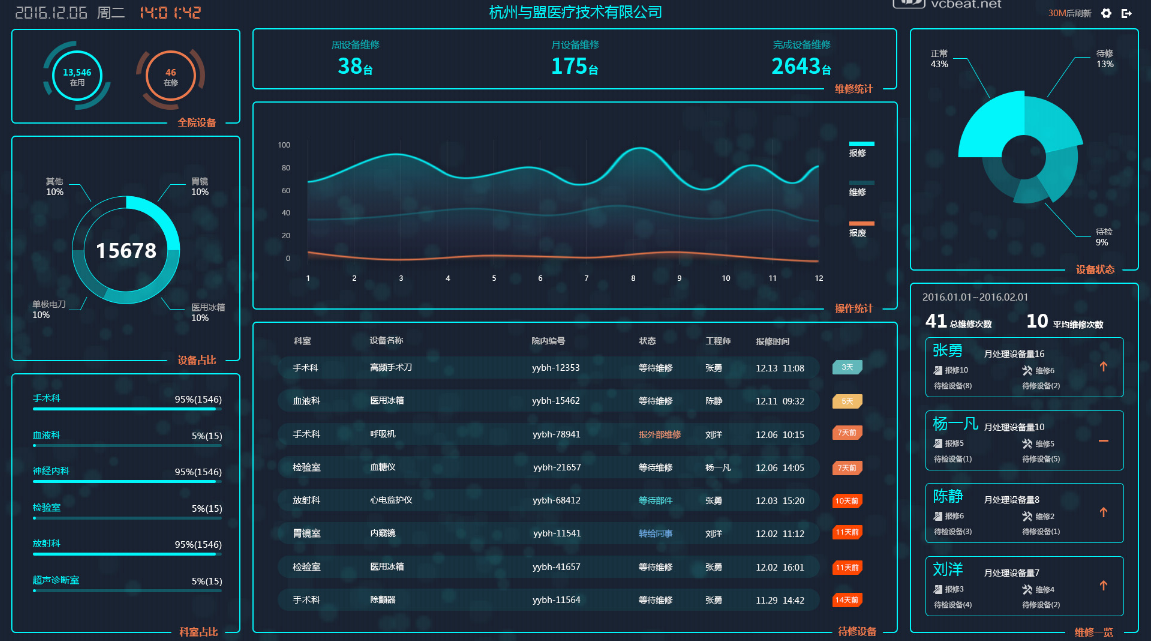
Yi Yi Medical Equipment SaaS Interface
For instance, regarding basic information on medical equipment, the Yiyi Medical Equipment SaaS platform establishes electronic asset profiles for all hospital medical and logistical equipment using barcodes and RFID (electronic tags). Logistics staff can simply scan the codes with their mobile phones to retrieve this information, completely eliminating manual data entry. Previously, logistics personnel often required one to two months to complete an asset inventory; now, the task can be accomplished in just one to two weeks.
For example, in the case of equipment repair requests, when a medical device malfunctions, users typically contact logistics staff by phone to describe their department, name, the device under warranty, manufacturer, model, and the issue encountered. During this process, equipment management personnel must manually record all information to generate a report, resulting in extremely low efficiency. With the YiYi Equipment SaaS platform, users can directly describe the fault and take photos via their mobile phones, completing the repair request in just two to three seconds—representing an exponential improvement in efficiency.
Yi Yi Medical Equipment SaaS provides a one-stop service, covering all logistical workflows from full lifecycle management of medical equipment to departmental management. It enhances efficiency in every operational area, freeing up more time for logistical and managerial staff to engage in data analysis, organization, and daily management tasks.
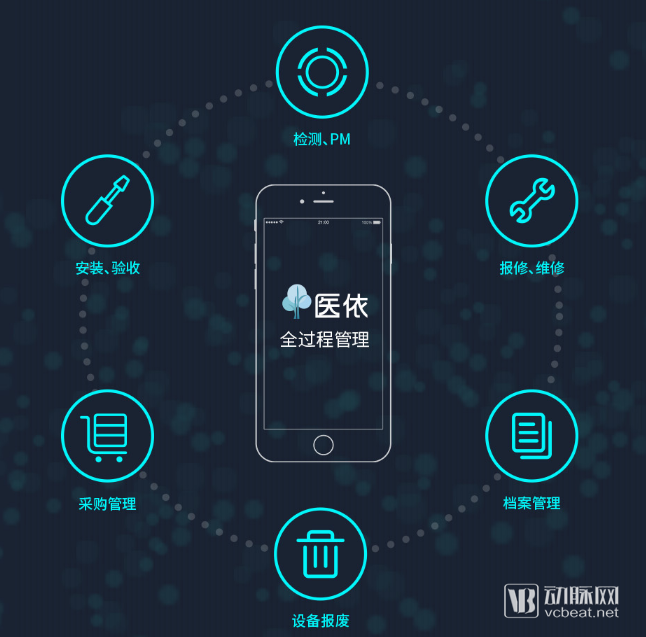
Medical Device SaaS Management Process
Logistics personnel analyze and compare equipment failure rates to identify issues within each department, organize targeted regular training sessions, and implement enhanced preventive and risk control measures. These efforts aim to reduce hospital equipment maintenance costs and failure rates, while preventing the reuse of faulty equipment.
Medical equipment suppliers can achieve information interoperability with hospitals through the Yiyi Equipment SaaS platform. In the past, communication between the two parties often relied on phone calls. With Yiyi, suppliers can submit progress updates directly within the system, enabling healthcare institutions to promptly track order status, including delivery and receipt details, as well as inspection and maintenance information. Furthermore, all orders are fully traceable.
In terms of safety and reliability, Yu Meng Medical has partnered with Alibaba Cloud, whose professional team provides customers with robust data security safeguards. Additionally, Alibaba Cloud’s data security insurance has been purchased to minimize the risk of data loss or leakage.
Equipment Management in Primary Healthcare
Among Yuemeng Medical’s clients, only a small number are primary-care hospitals. In fact, this large demographic has equally strong demands for equipment management; however, due to constraints such as funding, geographic location, and staffing, they have yet to establish robust operational systems.
Primary healthcare institutions typically have limited medical equipment and lack specialized personnel in equipment management departments. Consequently, when equipment malfunctions occur, it is often difficult to identify repair service providers. Compounded by their remote locations, which lead to prolonged repair times and higher maintenance costs, many manufacturers are reluctant to undertake such service contracts.
According to the latest statistical data from the National Health and Family Planning Commission, as of April 2016, there were approximately 34,000 urban community health centers and about 37,000 township health centers in China. Nationwide, privately operated clinics numbered around 198,000. Extending further down the hierarchy, including rural village clinics, the total reached approximately 600,000.
Given such a large base, the limited number of government regulators has led to significant risks in the quality control and safety of medical equipment at primary healthcare institutions. Wang Yuanji stated, “YiMeng Medical hopes to build a communication bridge between primary healthcare institutions and equipment manufacturers through its YiYi SaaS platform, thereby addressing the issue of information asymmetry.”
2017: Channels Are Paramount
East China is Yimeng Medical’s key expansion market at this stage, covering provinces such as Zhejiang and Anhui. To date, more than 60 secondary-and-above hospitals are using Yimeng Medical’s YiYi SaaS platform, with nearly 100 additional clients scheduled to go live in the near future.
Yumeng Medical employs two sales channels: one is a direct sales model, in which its in-house sales team establishes collaborations with hospitals; the other leverages distributor partners to assist Yumeng Medical in peripheral market expansion.
Over the past year, Yu Meng Medical has prioritized R&D, allocating substantial resources to this area. With continuous functional upgrades and iterations, its products have gradually matured. In the next phase, the company will focus on strengthening its distribution channels. Currently, the team comprises approximately 30 employees, with over 70% being developers, 10% in administrative support roles, and only 20% in sales—a segment that is currently undergoing rapid expansion.
According to Wang Yuanji, Yuemeng Medical is expected to experience rapid market growth this year, with a break-even point likely to be reached by mid-year.
New Business Model
For healthcare IT companies, innovating business models is no easy feat. Yumeng Medical aims to build a completely new business model through its YiYi Device SaaS platform. Under the traditional software sales model, vendors consider their goal achieved once the software is sold to a hospital. However, Yumeng Medical enjoys distinct advantages in both pricing and functionality compared to traditional software. Building on this foundation, it can cultivate substantial user engagement and high stickiness.
“By conducting in-depth analysis of data generated from user interactions, we provide comprehensive and detailed data analysis reports to healthcare institutions and medical device suppliers, thereby unlocking the potential value of the data,” said Wang Yuanji.
Currently, hospitals generally operate as information silos. While YiYi Equipment SaaS ensures the protection of hospital equipment data, it also generates highly valuable data reports based on the hospitals’ statistical information.
“The government invests heavily each year in the collection and compilation of such data. Equipment suppliers also conduct annual market research and analysis, with many companies paying to purchase reports. In reality, most of those reports are compiled through telephone inquiries, resulting in inaccurate information,” Wang Yuanji told reporters.
By leveraging the in-depth services of YiYi SaaS in hospital equipment management to unlock the latent value of data and generate anonymized industry data reports, thereby creating value for governments and medical device suppliers, Yumeng Medical envisions a novel business model.