

China's MOHRSS Releases 2017 National Reimbursement Drug List After 8-Year Gap
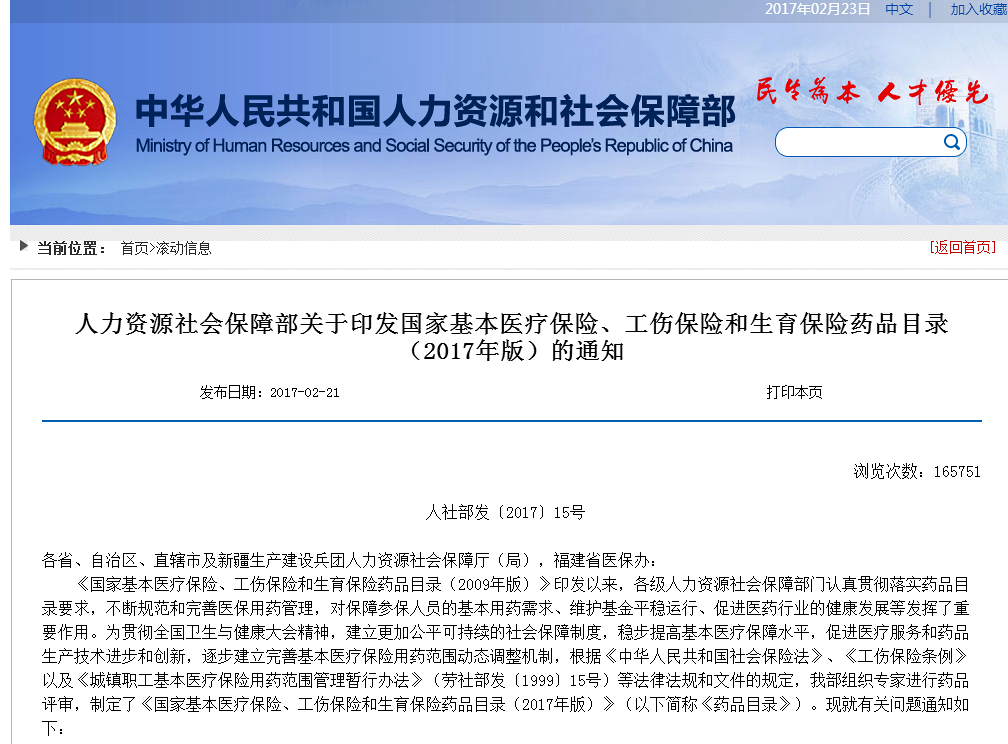
On February 23, the website of the Ministry of Human Resources and Social Security officially released the 2017 edition of the National Drug List for Basic Medical Insurance, Work-Related Injury Insurance, and Maternity Insurance. (Notice on Issuing the "National Drug List for Basic Medical Insurance, Work-Related Injury Insurance, and Maternity Insurance (2017 Edition)" (MOHRSS Document [2017] No. 15)). This drug list was developed through multiple rounds of review by nearly 4,000 clinical physicians, pharmacists, and medical insurance management experts from all provinces, autonomous regions, and municipalities across China.
The Western medicine section includes chemical drugs and biological products; the Chinese proprietary medicine section includes Chinese proprietary medicines and ethnic minority medicines; and the Chinese herbal decoction pieces section adopts an exclusion method to specify the pieces not covered by the fund. The Western medicine and Chinese proprietary medicine sections collectively list 2,535 drugs, an increase of 339 (approximately 15.4%) compared with the 2009 edition. Of these, 1,297 are in the Western medicine section and 1,238 in the Chinese proprietary medicine section (including 88 ethnic minority medicines). No adjustments were made to the Chinese herbal decoction pieces section, which continues to follow the provisions of the 2009 drug catalog.
The original text of the notice is as follows:
MOHRSS Document [2017] No. 15
Human Resources and Social Security Departments (Bureaus) of all provinces, autonomous regions, municipalities directly under the Central Government, and the Xinjiang Production and Construction Corps; Fujian Provincial Healthcare Security Administration:
Since the issuance of the National Reimbursement Drug List for Basic Medical Insurance, Work-Related Injury Insurance, and Maternity Insurance (2009 Edition), human resources and social security departments at all levels have conscientiously implemented the requirements of the drug list, continuously standardized and improved the management of medical insurance medications, and played a significant role in safeguarding the basic medication needs of insured persons, ensuring the stable operation of funds, and promoting the healthy development of the pharmaceutical industry. To implement the spirit of the National Health and Wellness Conference, establish a fairer and more sustainable social security system, steadily improve the level of basic medical security, promote technological progress and innovation in medical services and pharmaceutical production, and gradually establish and improve a dynamic adjustment mechanism for the scope of basic medical insurance medications, this Ministry has organized experts to conduct drug evaluations and formulated the National Reimbursement Drug List for Basic Medical Insurance, Work-Related Injury Insurance, and Maternity Insurance (2017 Edition) (hereinafter referred to as the "Drug List"), in accordance with the provisions of laws, regulations, and documents such as the Social Insurance Law of the People's Republic of China, the Regulations on Work-Related Injury Insurance, and the Interim Measures for the Administration of the Scope of Medications for Urban Employee Basic Medical Insurance (Lao She Bu Fa [1999] No. 15). Notice is hereby given on relevant matters as follows:
I. Strictly Adhere to Payment Regulations for the Drug Catalog. The "Drug Catalog" is divided into four parts: General Provisions, Western Medicines, Chinese Patent Medicines, and Traditional Chinese Medicine (TCM) Decoction Pieces. The General Provisions provide explanations and clarifications on the formatting, standardization of names and dosage forms, and restricted payment scopes within the "Drug Catalog." The Western Medicines section includes chemical drugs and biological products; the Chinese Patent Medicines section includes Chinese patent medicines and ethnic minority medicines; and the TCM Decoction Pieces section adopts an exclusion method to specify decoction pieces not covered by the fund. Expenses incurred by insured individuals for using Western medicines and Chinese patent medicines listed in the catalog, as well as TCM decoction pieces not listed in the catalog, shall be reimbursed in accordance with the relevant regulations of Basic Medical Insurance, Work-Related Injury Insurance, and Maternity Insurance. For anti-HIV drugs provided free of charge by the state, and anti-tuberculosis, anti-malaria, and anti-schistosomiasis drugs involved in national public health programs, the funds for Basic Medical Insurance, Work-Related Injury Insurance, and Maternity Insurance shall not provide reimbursement if these drugs are used by insured individuals and fall within the scope of public health coverage.
II. Standardize the Adjustment of Provincial Drug CatalogsThe social insurance authorities of all provinces (autonomous regions and municipalities) shall not make any adjustments to Class A drugs included in the "Drug Catalog" and shall strictly adjust Class B drugs in accordance with current laws, regulations, and relevant documents. The adjustment of the "Drug Catalog" must adhere to an expert review mechanism, uphold the principles of fairness, impartiality, and transparency, and effectively implement measures to prevent integrity risks. No fees shall be collected from enterprises under any pretext, nor shall any form of local protectionism be practiced. Administrative departments shall not interfere with the results of the expert review.
All provinces (autonomous regions, and municipalities directly under the Central Government) shall issue their local drug catalogs for basic medical insurance, work-related injury insurance, and maternity insurance by July 31, 2017. The number of adjustments (including additions, removals, and revisions to the scope of restricted payment) shall not exceed 15% of the number of Class B drugs in the national catalog. The adjustments to Class B drugs made by each province (autonomous region, and municipality directly under the Central Government) shall be reported to our Ministry for record in accordance with relevant regulations.
Each pooling region shall implement the new edition of the drug catalog within one month after the provincial (autonomous region or municipality) catalogs for basic medical insurance, work-related injury insurance, and maternity insurance drugs are released, and shall update the list of hospital preparations covered by fund payments in accordance with relevant regulations.
III. Improve the management of the use of the drug catalog. Each pooling region shall, based on the drug usage patterns of medical institutions and retail pharmacies within its jurisdiction, properly carry out the mapping of drugs included in the catalog and promptly update and improve the drug database in the information system. All provinces (autonomous regions, and municipalities directly under the Central Government) shall accelerate the adoption of the industry standard “Classification and Codes of Drugs for Social Insurance” in conjunction with initiatives such as direct settlement for cross-regional medical care, establish and improve a unified provincial drug database, and achieve unified management of Western medicines, Chinese proprietary medicines, hospital preparations, and traditional Chinese medicine decoction pieces within their respective administrative regions.
Localities shall, in accordance with the administrative provisions on the Drug Catalog and the prescription management measures, clinical technical operation standards, clinical diagnosis and treatment guidelines, and guiding principles for clinical drug application formulated by the health and family planning authorities and other relevant departments, incorporate the implementation of the Drug Catalog by designated medical and pharmaceutical institutions into the management and assessment scope of designated service agreements. Establish and improve an intelligent monitoring system for basic medical insurance services and a monitoring and analysis system for social insurance drug utilization, with a focus on drugs characterized by high volume, substantial expenditure, and potential irrational use; the monitoring results shall be disclosed to the public through appropriate channels. Leverage the role of pharmacists and incentivize medical institutions to adopt effective measures to promote rational clinical drug use.
All provinces (autonomous regions and municipalities) shall accelerate the establishment of medical insurance payment standards for drugs based on their generic names, in accordance with the requirements of pharmaceutical price reform. Each pooling region may further improve the classified payment management measures for drugs covered by medical insurance. For Class B drugs that primarily serve an adjuvant therapeutic role, the individual out-of-pocket share may be appropriately increased to widen the gap in payment ratios compared with other Class B drugs. For off-formulary drugs essential for emergency resuscitation and treatment of special diseases, a declaration system through designated medical institutions may be established, with clear review and management procedures reported to the higher-level human resources and social security authorities for record.
IV. Explore the establishment of a negotiation-based access mechanism for drugs covered by medical insurance. Our Ministry will conduct negotiations on the drugs proposed for negotiation, as determined through expert review, in accordance with relevant rules. Drugs that meet the eligibility criteria will be included in the scope of medical insurance reimbursement, and the list will be published separately.
All localities shall promptly report any major issues encountered during the adjustment and organizational implementation of the Drug Catalog. Upon the issuance of this document, the Notice on Issuing the National Basic Medical Insurance, Work-Related Injury Insurance, and Maternity Insurance Drug Catalog (Ren She Bu Fa [2009] No. 159) is hereby repealed.
Annex: National Catalogue of Drugs Covered by Basic Medical Insurance, Work-Related Injury Insurance and Maternity Insurance (2017 Edition)
3. Proprietary Chinese Medicines Section
4. Chinese Herbal Decoction Pieces Section
Ministry of Human Resources and Social Security
February 21, 2017