

The World's Top 20 Medical Tech Innovators: Pioneering the Future of Healthcare

Which healthcare technology companies were the most innovative in 2017? Which technologies or products were poised to attract investor favor? Insights can be gleaned from Fast Company’s list of the World’s Most Innovative Companies for 2017. Compiled by senior international journalists, this ranking screens companies based on their most impactful news stories of the year. After surveying thousands of enterprises worldwide, it identifies benchmark companies that excel in business agility and innovation impact, as well as emerging stars in the industry.
This year’s selection covers 36 sub-sectors or regions, spanning multiple fields such as artificial intelligence, healthcare, big data science, music, video, and biotechnology. From each sector or region, ten companies were evaluated, resulting in the final ranking of the top 50 firms. Clearly, this list has long been regarded as an annual barometer for business value and investment trends. In this year’s Global Most Innovative Companies list, Amazon of the United States claimed the top spot, with Google finishing in second place.
The top 10 are Amazon, Google, Uber, Apple, Snap, Facebook, Netflix, Twilio, Chobani, and Spotify, in that order. Among the top 50 companies, Chinese enterprises on the list include Alibaba (ranked 11th), Tencent (ranked 12th), Xiaomi (ranked 13th), BBK Electronics (ranked 14th), Huawei (ranked 15th), and Dalian Wanda (ranked 16th).
Notably, this year’s list also features Top 10 rankings for companies in three regions: China, India, and Israel. It is evident from the “Top 50 Most Innovative Companies” list that few healthcare companies were included. The selected companies comprise One Medical, a healthcare services provider; Medtronic, a medical device company; Thinx and Celmatix, both focused on women’s health; and Beyond Meat, a plant-based meat producer.
To this end, Fast Company also released its Top 10 lists of innovative companies in the biotechnology and healthcare sectors. Below is a detailed overview of these 20 companies, along with introductions to their innovative products and technologies, meticulously compiled by VCBeat (WeChat ID: vcbeat).
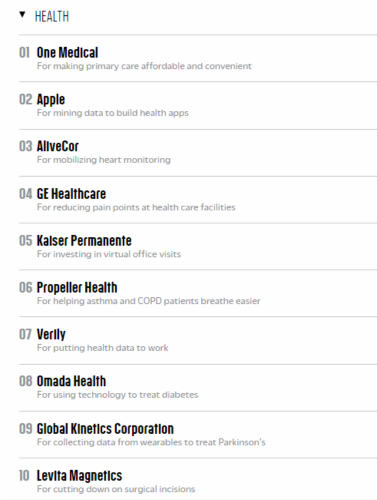
As listed, the most innovative companies in the healthcare sector include One Medical, Apple, AliveCor, GE Healthcare, Kaiser Permanente, Propeller Health, Verily, Omada Health, Global Kinetics Corporation, and Levita Magnetics.
One Medical made the list for making digital primary healthcare services more affordable and accessible. Founded in 2007 and headquartered in San Francisco, the company has raised a total of $182 million across seven rounds of financing. Last February, it acquired Rise, a nutrition coaching app developer, for $20 million. Tom X. Lee, founder of One Medical, believes that digitization and paperless processes not only enhance the patient experience but also improve hospital efficiency.
Through the One Medical website or app, patients can schedule online appointments, request prescription refills, access digital laboratory test results, and view their personal health summaries. Physicians can access electronic medical records (One Medical designed its electronic health records to meet the needs of doctors and patients, rather than healthcare administrators). To enjoy these services, patients pay an annual membership fee capped at $199 (with pricing varying based on the patient’s insurance coverage level). One Medical has reduced the administrative costs of traditional healthcare by two-thirds. It currently operates 54 offices in the United States, a 46% increase from 2015, and partners with 1,000 companies.
Apple’s inclusion is justified by its health data collection and app development. Its innovation goes beyond the surface; the company is currently committed to independent hardware and software development, venturing into artificial intelligence without fear of competitors like Google. For instance, it leverages AI technology to extend battery life while upholding strict privacy policies that limit the integration and analysis of cloud data.
However, Apple’s most significant contribution to the healthcare sector lies in its three data platforms. HealthKit establishes a data-sharing standard that enables the collection and analysis of users’ health data. By integrating with third-party devices, it provides insights into metrics such as heart rate, calorie expenditure, blood pressure, blood glucose, and cholesterol levels. Subsequently launched, ResearchKit allows researchers to leverage the iPhone’s built-in sensors to track, measure, and record patient data. This approach removes temporal and geographical constraints, enabling the real-time acquisition of objective patient-generated data for medical research purposes.
In March 2016, Apple released CareKit, a significant open-source framework for information sharing that enables healthcare providers to share patients’ medical data with their consent. Since its launch, CareKit has been used to develop applications helping patients manage diabetes (Drop), monitor depression (Iodine), track reproductive health (Glow), and record asthma attacks (Cleveland Clinic). In the healthcare sector, Apple works behind the scenes to assist researchers and developers in collecting patient health data via smartphones.
Reason for AliveCor’s Inclusion: Development of mobile cardiac solutions. Founded in 2011 and headquartered in San Francisco, USA, the company raised $13.5 million after two rounds of financing. AliveCor is a world-leading provider of FDA-cleared mobile cardiac solutions. Its products serve individuals with compromised cardiac function, helping physicians save lives, enabling patients to reduce costs, and advancing the modernization of medical technology.
AliveCor developed Kardia, the first smartphone capable of connecting to electrocardiogram (EKG) measurements. It can detect abnormal heart rhythms on a mobile device with accuracy comparable to hospital-grade EKG recordings. This enables patients to regularly monitor their cardiac health independently and determine within 30 seconds whether their results are normal or if medical attention is required. This capability is particularly critical for millions of Americans at risk of arrhythmias, who may be asymptomatic yet able to identify potentially life-threatening conditions such as heart failure and stroke through self-testing.
In 2016, the company announced a new version of its electrocardiogram (ECG) solution for the Apple Watch, called the KardiaBand. It was part of the first FDA-approved application to integrate blood pressure monitoring and ECG functionality. By November 2016, Kardia had recorded approximately 11 million ECGs, having reached 2 million by March 2015. Also in 2016, AliveCor announced a partnership with the Mayo Clinic to leverage machine learning technologies to better identify hidden health indicators within ECG readings.
GE Healthcare was recognized for addressing some of the most pressing challenges in the healthcare sector. GE currently operates across six business segments: Infrastructure, Industrial, Healthcare, Commercial Finance, Consumer Finance, and NBCUniversal. GE Healthcare holds a global leadership position in professional expertise spanning medical imaging, information technology, medical diagnostics, patient monitoring and life support systems, disease research, drug development, and biopharmaceutical manufacturing technologies. It is committed to enabling earlier disease detection and facilitating treatment.
GE Healthcare has partnered with the University of California, San Francisco (UCSF), Johns Hopkins University, and other institutions to jointly develop hardware and software technologies aimed at addressing some of the most pressing challenges in healthcare. Some of these challenges originate from health systems themselves; for instance, UCSF sought partners to develop machine learning algorithms for medical imaging, while Johns Hopkins required a NASA-style command center to better manage patient flow within and around the hospital. Early research results from Johns Hopkins University have been promising: the hospital reported a 60% increase in its capacity to treat patients with complex conditions compared to other hospitals in the region; its ambulances were able to pick up patients an average of 63 minutes earlier than those of other hospitals; and the emergency department improved its bed assignment speed by 30%.
Kaiser Permanente was recognized for its development of virtual access technologies, which enhance the potential benefits of digital health. Founded in 1945 and headquartered in Oakland, California, Kaiser Permanente offers nonprofit healthcare plans and is currently the largest integrated nonprofit healthcare organization in the United States. The company provides preventive care, well-baby and prenatal care, immunizations, emergency care, screening and diagnostics, hospital and medical services, and pharmaceutical services. In 2013, Kaiser Permanente served 9 million members across eight regions, nine states, and the District of Columbia, with a workforce of 170,000 employees (including nearly 50,000 nurses) and 17,000 physicians. Its annual operating revenue reached $53.1 billion, with a net profit of $2.7 billion.
To address the issue of patients waiting in long queues at healthcare facilities, Kaiser Permanente developed technology to enable virtual office visits for patients. While other physicians hesitated to adopt this new technology, Kaiser Permanente viewed it as a means to reduce costs and improve the quality of care. Over the past year, the health system has conducted 59 million telehealth visits using this technology, through which providers have delivered secure information and completed video consultations. By tapping into the potential benefits of digital health, Kaiser Permanente has become a model for other healthcare institutions. Furthermore, in 2016, it announced the establishment of a new medical school dedicated to teaching medical students how to leverage new technologies to care for an increasingly diverse patient population within local communities. The medical school was expected to begin instruction in 2019.
Propeller Health was listed for helping asthma and COPD patients breathe more easily. Founded in 2007 and based in Madison, Wisconsin, the company has raised a total of $28.4 million across four funding rounds. Propeller Health is a mobile platform that provides sensors, a mobile application, analytics, and services to support respiratory health management.
Asthma and chronic obstructive pulmonary disease (COPD) afflict millions of patients in the United States. To help patients and physicians better understand these conditions, Propeller Health has developed new technologies aimed at alleviating patient symptoms and reducing hospitalization rates and emergency room (ER) visits. The Propeller Health system comprises an inhaler or medication delivery device equipped with a sensor, along with a mobile application called Cards (launched in 2016). This system helps patients gain better control over their symptoms while serving as a tool for healthcare providers to proactively manage large patient populations. The system has received FDA clearance as a medical device, and to date, eight products in this category have been FDA-cleared.
Propeller Health’s technology has been deployed in more than 45 projects across the United States, including large health systems such as Dignity Health. Propeller Health recently completed an analysis of data from 330 patients, which showed a 100% reduction in asthma-related hospitalizations and a 60% decrease in asthma-related repeat visits within one year. Meanwhile, drawing on findings from peer-reviewed publications, the company launched the first predictive tool for environment-based asthma risk. By partnering with health plans, integrated health systems, and pharmaceutical companies seeking to improve medication adherence, Propeller Health aims to optimize resource utilization and reduce costs.
Verily’s inclusion is justified by its role as an incubator for various health initiatives. Founded in October 2015, it was formerly Google Life Sciences and is now an independent subsidiary under Alphabet. Verily conducts diverse life sciences research projects, having previously launched a bandage-sized glucose monitor and contact lenses capable of detecting blood glucose levels. Currently, it continues to advance life sciences research with a greater focus on understanding individuals’ health status and developing new technologies for disease prevention, detection, and treatment. Its key areas of interest include cardiovascular disease, diabetes, cancer, neurological disorders, and mental health. Its internal team comprises physicians, engineers, chemists, and data specialists. Its mission is to make the world’s health data useful.
In 2016, Verily announced various initiatives: Onduo, a data management platform for patients with diabetes developed in partnership with biotech giant Sanofi; Debug, aimed at reducing mosquito-borne diseases; Galvani Bioelectronics, created with GSK; and Verb Surgical, focused on robotic surgery in collaboration with Ethicon. One of Verily’s most advanced projects is Liftware, which unveiled its second product, The Level, following its tremor-stabilizing spoon. The Level is designed to help individuals with cerebral palsy and spinal cord injuries eat independently. Over the past year, Liftware’s devices have been used by more than 10,000 people.
Omada Health was recognized for its diabetes treatment technology. Founded in 2011 and headquartered in San Francisco, the company raised $48 million in Series C funding on September 16, 2015. After five rounds of financing, its total funding reached $76.5 million. Omada Health is a technology company dedicated to guiding and helping individuals modify their lifestyle behaviors to prevent chronic diseases and reduce disease incidence. As a pioneer in “digital therapeutics,” Omada is the first company to apply social networking principles to evidence-based clinical interventions, combining the most effective behavioral medicine treatments with advanced technology to deliver services directly to users. The company is currently developing a type 2 diabetes prevention program that integrates user communities, online education, and metrics tracking.
Omada Health is among the first digital health companies offering online diabetes prevention programs to receive reimbursement from the U.S. federal government. The target population comprises approximately 86 million Americans with prediabetes. Securing government support marks a significant advancement in chronic disease prevention; while the Centers for Medicare & Medicaid Services (CMS) reimburses treatment costs for patients with diabetes, no companies or healthcare institutions previously provided services aimed at preventing disease progression. The CMS decision also represents a major step forward for other digital therapeutics startups that have established offline program services, encouraging them to launch online offerings and reach a broader patient population.
Omada Health’s program currently engages over 85,000 participants, making it the largest diabetes prevention program in the United States. The company charges sponsors based on patients’ weight loss and clinical outcomes, adhering to a “no results, no fee” model. Sponsors are informed upfront that payment is contingent upon significant program outcomes. This unique approach ensures high-value, low-cost chronic disease prevention.
Global Kinetics was recognized for using wearable devices to collect data for the treatment of Parkinson’s disease. Founded in 2007 and headquartered in Melbourne, Victoria, the company raised $13.3 million in venture capital on June 4, 2015, bringing its total funding to $14.8 million across two financing rounds. It aims to commercialize innovative technologies developed by Dr. Rob Griffiths and Professor Malcolm Horne that precisely record, quantify, and report motor symptoms of neurological disorders.
Global Kinetics is the manufacturer of the personal KinetiGraph, a wearable device that tracks motor activity in Parkinson’s disease patients. It provides comprehensive, automated motor reports, enabling neurologists and other physicians to more easily identify changes in motor symptoms, thereby supporting clinical decision-making and optimizing treatment. The device reminds patients when to take their medication and even assists physicians in making accurate diagnoses. It has received FDA approval and is currently used in over 200 clinics worldwide, with 14,500 patients wearing the device.
With continuous wear over seven days, physicians can identify significant changes and trends in patients’ movement. In 2016, the company announced a randomized controlled trial conducted in collaboration with the Parkinson’s Foundation to evaluate the device’s impact on 400 patients and determine how the technology could be integrated into future clinical care. Global Kinetics states that its technology can be applied to other conditions, including Huntington’s disease, Alzheimer’s disease, and epilepsy. The company generates revenue by partnering with pharmaceutical companies to apply its technology in clinical trials for Parkinson’s drug development, while also developing a direct-to-consumer business model.
Levita Magnetics was recognized for reducing surgical trauma. Founded in January 2012 and headquartered in San Mateo, California, the company has completed three rounds of financing. Levita Magnetics is dedicated to developing an innovative magnetic surgical platform that enables simplified, cost-effective single-incision abdominal surgeries, while minimizing surgical trauma and pain during procedures, thereby advancing the field of minimally invasive surgery.
Rodriguez-Navarro, CEO of Levita Magnetics, invented a surgical system that requires only a single access point: the umbilicus. For common abdominal procedures such as cholecystectomy and appendectomy, Levita minimizes surgical incisions, thereby reducing surgical trauma and pain. Additionally, Levita Magnetics has developed a novel magnetic surgical system designed to enable surgeons to perform single-incision abdominal surgery.
In 2016, the U.S. FDA granted approval for this system under a novel category termed “Magnetic Surgery.” Also in 2016, the company reported results from a clinical trial involving 50 patients, which demonstrated no significant adverse reactions. The magnetic surgical system has been utilized for cholecystectomy procedures at Duke University, Stanford University, and the Cleveland Clinic. Homero Rivas, Director of Innovative Surgery at Stanford University, has employed the Levita system in gallbladder surgeries, stating, “It is both simple and novel.” The technology has also been introduced in Rodriguez-Navarro’s home country of Chile to perform a broader range of surgical procedures.
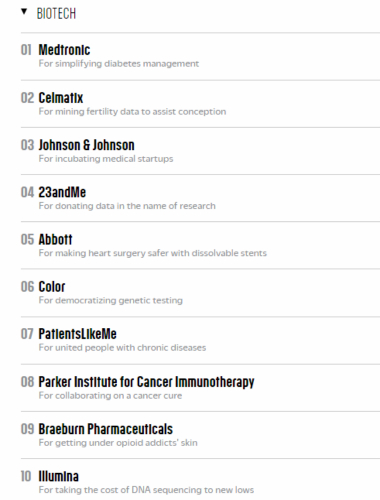
As stated in the ranking, the most innovative companies in the biotechnology sector are Medtronic, Celmatix, Johnson & Johnson, 23andMe, Abbott, Color, PatientsLikeMe, Parker Institute for Cancer Immunotherapy, Braeburn Pharmaceuticals, and Illumina.
Medtronic’s inclusion is justified by its simplification of diabetes management. Founded in 1949 and headquartered in Minneapolis, Minnesota, USA, Medtronic is a global leader in medical technology, dedicated to providing lifelong therapeutic solutions for patients with chronic diseases. Its product portfolio spans arrhythmias, heart failure, vascular diseases, heart valve replacement, extracorporeal cardiac support, minimally invasive cardiac surgery, malignant and non-malignant pain, movement disorders, diabetes, gastrointestinal diseases, urological conditions, spinal disorders, neurological diseases, and ENT surgical treatments.
Medtronic released a new diabetes management system, the MiniMed 670G, in September 2016, which has received FDA clearance. The MiniMed 670G is specifically developed for patients with Type 1 diabetes, a condition that predominantly affects children and adolescents. The system comprises a glucose monitor and an insulin reservoir. It measures blood glucose levels every five minutes, and if abnormal readings are detected, the system administers a calculated dose of insulin via an algorithm. Recalibration is required every 12 hours. Michael Hill, Medtronic’s Vice President of Global Marketing, stated, “We aim to do more work on behalf of patients.” The company worked closely with the FDA to design clinical trials, and following a 100-day approval process, the system was expected to become available in the spring of this year.
MiniMed 670G has launched a series of Medtronic diabetes care programs. In 2016, the company introduced an application to help users understand how food affects their blood glucose levels. The upcoming Fitbit device will enable researchers to collect patient data on blood glucose and physical activity, thereby gaining insights into the role of exercise in diabetes management.
Celmatix was listed for its ability to mine fertility data to support female reproduction. Founded in 2009 and headquartered in New York City, Celmatix has raised $35.11 million over nine financing rounds. As a healthcare company focused on women's health, Celmatix offers products that help women make informed decisions about fertility and provide physicians with data-collection tools to enhance patient care.
Fertilome leverages clinical blood tests to conduct genetic and big data analysis, providing five core services for women who are planning pregnancy, of advanced maternal age, or affected by non-hereditary reproductive disorders. These services include: identification of subclinical factors, formulation of diagnosis and treatment plans, analysis of female familial genetic history, recommendations on egg freezing timing (for those interested), and health management advice.
When providing services to patients, Fertilome leverages data from 32 genes and 49 variables obtained through Celmatix laboratories, a database of 5,200 fertility-related genetic markers provided by its partner 23andMe, and clinical data shared by collaborating clinics. Additionally, founder Beim stated that prior to launching the product, Fertilome completed a review of anthropological information—including age and ethnicity—in accordance with PRISMA guidelines, thereby establishing the contextual framework for its analyses.
Currently, the company’s product, Polaris, is used in top-tier fertility clinics across China and is the world’s first analytics platform optimized for improving fertility rates. Celmatix also has an active research initiative aimed at decoding the genetic determinants of fertility potential.
Polaris began clinical trials in mid-2015 and is currently being used in the 12 largest fertility clinics across the United States, serving approximately 7% of American patients with infertility. By comparing data from thousands of individuals, it calculates the likelihood of pregnancy for each patient. This enables physicians to develop more targeted treatment plans. To date, Polaris has been utilized in counseling approximately 30,000 women.
In January 2017, the company announced the Fertilome test. Based on clinical blood tests and leveraging genetic and big data analytics, Fertilome provides five key services to patients: identification of subclinical factors, development of diagnostic and treatment plans, analysis of female familial genetic history, recommendations for egg freezing timing (for those interested), and health management advice. This service is targeted at women who are planning pregnancy, are of advanced maternal age, or have non-genetic fertility disorders. After adding 45 employees in 2016 and doubling its workforce, Celmatix is collaborating with academic institutions, fertility centers, and companies such as 23andMe to continue researching and identifying new reproductive health biomarkers.
Johnson & Johnson’s inclusion is justified by its incubation of healthcare startups. Founded in 1886 and headquartered in New Brunswick, New Jersey, it is the world’s largest and most diversified company in medical health care products and consumer care products.
In 2016, Johnson & Johnson expanded its JLABS incubator/accelerator program to six locations across two countries. It doubled the laboratory space available for early-stage startups to 180,000 square feet and currently hosts 130 companies. Examples of companies incubated in the program include Epibiome, a startup working to develop selective antibiotics for treating infectious diseases in humans and livestock, and Applied Molecular Transport, a company developing novel therapies for autoimmune diseases such as inflammatory bowel disease. This accelerator model outperforms traditional pharmaceutical innovation practices. Notably, none of the companies selected for the Johnson & Johnson accelerator are subsidiaries of Johnson & Johnson or provide services exclusively to Johnson & Johnson.
23andMe was listed for contributing genetic data under the guise of research. Founded in April 2006 and headquartered in Mountain View, California, the company raised $240.92 million across seven rounds of financing. It provides genetic testing services to users. As a human genomics research company, 23andMe enables the study of users’ ancestry, family lineage, and genetic traits.
In the summer of 2016, researchers at Pfizer announced that they had identified several genetic markers associated with depression, sending ripples through the scientific community and bringing an end to years of frustrating efforts to identify genetic risks for mental illness. Equally significant was the fact that the study drew on data from more than 120,000 individuals with a diagnosis of depression sourced from 23andMe, as the genetic testing kit company has become a hotspot for individuals seeking to explore their personal histories through their DNA. “Studies of this scale were previously impossible,” said Anne Wojcicki, CEO of 23andMe. “We wanted to conduct research that had never been done before.”
On November 22, 2013, 23andMe received a warning letter from the U.S. Food and Drug Administration (FDA), prohibiting it from performing any analysis of users’ health data—a significant blow to the company. Previously, 23andMe offered services tailored to both businesses and individual consumers. Its business-to-business (B2B) offerings primarily focused on scientific research and providing genetic testing data to pharmaceutical companies, with customer consent obtained prior to data sharing. In response to the FDA’s injunction, reports for customers who purchased testing services thereafter included only ancestry analysis and raw health data, without any interpretive health-related analysis. Nevertheless, 23andMe did not abandon its efforts; it continued its research, educated users, and strengthened its subsequent service capabilities. Finally, in early 2015, the FDA acknowledged 23andMe’s efforts and approved its test for identifying carriers of Bloom syndrome.
Today, it is working closely with the U.S. Food and Drug Administration to directly share ancestral and selected genetically derived health reports with consumers—all without involving physicians. Among 23andMe’s 1.2 million customers who have registered for its at-home genetic testing kits, the majority have consented to having their data used for research and surveys. To date, they have answered more than 350 million survey questions. Other major research initiatives include a collaboration with Stanford University to investigate the genetic basis of skin cancer, as well as a new initiative called the “African Genetics Project,” aimed at bringing greater diversity to medical research.
Abbott Laboratories was recognized for making cardiac surgery safer and developing bioresorbable stents. Founded in 1888 and headquartered in Chicago, USA, Abbott Laboratories is a leading global healthcare company with a diverse product portfolio spanning nutritionals, pharmaceuticals, medical devices, diagnostics instruments, and reagents. The company operates in more than 130 countries and regions worldwide and employs 65,000 people.
Abbott Laboratories’ next-generation drug-eluting stent, Xience Xpedition, has received approval from U.S. medical regulatory authorities and will rapidly enter the U.S. market. Drug-eluting stents, also known as drug-releasing stents, are used to prop open diseased blood vessels following percutaneous coronary intervention (PCI). The drugs carried by the stent are then controllably released into the vascular wall tissue through elution, thereby exerting their biological effects.
The XIENCE Xpedition features a novel stent delivery system, particularly effective in challenging coronary anatomies. It has a broader range of indications, including use with dual antiplatelet therapy (DAPT) for a minimum duration of just three months. This next-generation XIENCE Xpedition drug-eluting stent from Abbott delivers everolimus to prevent vessel re-occlusion. Its superior deliverability enables interventional cardiologists to treat particularly complex coronary artery disease with ease and confidence.
Color’s inclusion is justified by its mission to democratize genetic testing. Founded in 2013 and headquartered in California, the company completed a $45 million Series B financing round in September 2016. After three rounds of investment, its total funding reached $98.55 million. Color (formerly Color Genomics) is a gene sequencing company co-founded by Othman Laraki and Elad Gil, former founders of Mixer Labs, along with Taylor Sittler and Nish Bhat.
Laraki stated, “In the modern process of disease treatment and prevention, we are increasingly reliant on data. Interestingly, auto mechanics obtain more information when changing a car’s oil than doctors do when diagnosing their patients.”
Color is currently dedicated to researching genetic variants associated with an increased risk of cancer, such as ovarian, breast, prostate, and colorectal cancers. If patients are aware that they carry certain mutations that may predispose them to cancer, they can take timely and optimal preventive measures—for example, undergoing regular colonoscopies if they are at risk for colorectal cancer. Patients provide a saliva sample for analysis by Color Genomics’ scientists and software engineers, who examine the data to determine whether the individual belongs to a high-risk population for cancer. This information is simultaneously stored in the cloud.
Currently, the price of this genetic test is $249 per session, making gene sequencing easier and more affordable than ever before. In 2016, Color added testing for eight additional types of cancer, enabling the analysis of 30 genes. Notably, the relatively low cost of $249 allows customers to pay out-of-pocket, thereby avoiding the complexities of health insurance coverage (as such tests are sometimes excluded from insurance plans, leaving patients with high out-of-pocket expenses). Color is also rapidly expanding its offerings to employers, including Visa, Slack, OpenTable, and Medium, which further help offset the cost of these tests.
PatientsLikeMe was listed for its in-depth exploration of the value of patient medical data. Founded in 2004 and headquartered in Cambridge, Massachusetts, it secured $100 million in venture capital funding on January 6, 2017.
PatientsLikeMe is a social networking site with over 400,000 users suffering from rare and chronic diseases. In 2016, it partnered with Duke’s ALS Clinic to study the efficacy of the soy peptide Lunasin in reversing symptoms in patients with amyotrophic lateral sclerosis (ALS). The trial design was innovative: it featured low inclusion criteria, did not use a placebo, and was largely conducted virtually, with patients completing monthly check-ins on the PatientsLikeMe platform. The participant enrollment rate for this trial was the fastest among ALS studies (averaging 9.5 patient check-ins per site per month, compared to an average of 1–2 patients enrolled per site per month in typical ALS trials). The company has also partnered with pharmacy giant Walgreens to include patient reviews of thousands of medications on its website, enabling patients to learn from one another.
The Parker Institute for Cancer Immunotherapy was recognized for its collaborative approach to cancer treatment. In April 2016, Sean Parker, a 36-year-old billionaire and co-founder of Facebook, invested $250 million to establish the institute. This initiative brought together more than 300 experts from over 40 laboratories across six leading U.S. research institutions: Memorial Sloan Kettering Cancer Center, Stanford University School of Medicine, University of California, Los Angeles (UCLA), University of California, San Francisco (UCSF), Perelman School of Medicine at the University of Pennsylvania, and The University of Texas MD Anderson Cancer Center. The institute is dedicated to pioneering breakthrough research in cancer immunotherapy.
Sean Parker, a technology entrepreneur who founded the music-sharing software Napster and served as an early investor and former president of the social networking site Facebook, established the Parker Foundation last year. He has now launched the Parker Institute for Cancer Immunotherapy, which collaborates with six leading U.S. cancer research centers to explore how the human immune system can be harnessed to combat cancer. “Cancer research has reached a turning point,” he said. “It is time to maximize the unique potential of immunotherapy to transform all cancers into controllable diseases, thereby saving millions of lives.”
Braeburn Pharmaceuticals was listed for its implantable medication for opioid addiction. Founded in 2012 and headquartered in New York, Braeburn Pharmaceuticals, an Apple Tree Partners company, is dedicated to the development and commercialization of innovative medical products.
Following FDA approval, the company’s first product will be Probuphine®, a buprenorphine implant for maintenance treatment of opioid dependence, which is currently undergoing FDA Priority Review. Braeburn’s executive team brings decades of experience in successfully bringing numerous drugs and medical devices to market, with in-depth expertise in the clinical development and quality assurance processes for pharmaceuticals and medical devices. Apple Tree Partners is a venture capital firm that primarily invests in pharmaceutical, medical device, and technology-enabled healthcare services companies.
Illumina’s inclusion is justified by its achievement in driving DNA sequencing costs to new lows. Founded in April 1998 and headquartered in San Diego, California, the company went public for the first time in July 2000. Illumina is a company dedicated to the research and commercialization of gene sequencing, improving human health by helping customers accelerate the acquisition, analysis, and application of biological information.
In 1999, Illumina was a startup with only 25 employees, primarily selling microarray chips used to detect significant changes at specific locations in the genome. In 2007, Illumina announced its acquisition of the gene sequencing company Solexa for $600 million, thereby entering the gene sequencing market. Solexa’s gene testing technology was hundreds of times faster than that of its competitors and offered lower costs. In 2013, it acquired Verinata Health, a non-invasive prenatal diagnostics company. Since 2005, Illumina has invested more than $1.2 billion in mergers and acquisitions. In January 2014, Illumina released a new high-end gene sequencer capable of accurately determining whole-genome sequences at a cost of less than $1,000, driving DNA sequencing costs to a new low.
The above provides an overview of these innovative enterprises. Admittedly, they have certain limitations; for instance, One Medical offers only basic diagnostic equipment without surgical facilities, primarily serving patients with stable conditions or those in a sub-health state. Celmatix, a company focused on predicting fertility, still needs to expand its big data sample size. Nevertheless, these imperfections do not overshadow their merits. It is precisely these enterprises—whether medical departments of large corporations or startups—that have overcome numerous technical challenges through product and technological innovation, combated diseases, and helped patients achieve better physical and mental health.