

Lenovo Star: The 'Oracle' of Early-Stage Healthcare Investing with Nearly 200 Bets Over a Decade
On February 27, Kintor Pharmaceutical was officially listed on the National Equities Exchange and Quotations (NEEQ). This development undoubtedly served as a major boost to entrepreneurs in the healthcare sector. For Legend Star, the investor, the company’s official listing on the NEEQ also marked a significant milestone.
As a leading angel investment firm, Legend Star focuses on early-stage investments in the TMT and healthcare sectors. In addition to Kintor Pharmaceutical, Legend Star has strategically positioned itself with precise, embedded investments across new medical technologies and services.
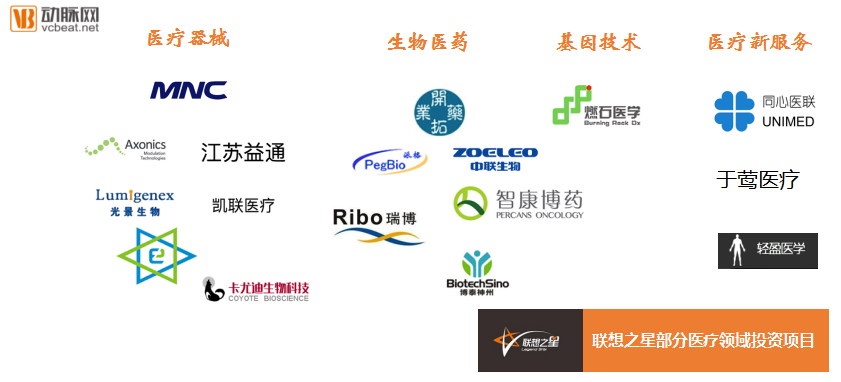
In its early stages, Legend Star’s investment theme in the healthcare sector focused more on new technologies, with medical devices and biopharmaceuticals as the primary areas of investment. Investment targets in the medical device field were mostly projects suitable for primary care settings, while those in biopharmaceuticals mainly involved small-molecule drugs. Representative companies from this period include Micro-Nano Core, a leading enterprise in the POCT (Point-of-Care Testing) sector; Cayudi, a genetic diagnostics company; and Kintor Pharmaceutical, which was listed on the NEEQ yesterday.
By 2014, the onset of the “Golden Decade” for healthcare, coupled with population aging and medical reforms, prompted new reflections within the medical services industry. Legend Star also incorporated new services into its investment themes, favoring diagnostic services and medical supply innovation projects capable of “reaching the grassroots level,” such as Yu Ying Medical and Qingying Medicine. In the realm of new technologies, Legend Star expanded its portfolio to include gene technologies. Its investment targets in medical devices grew from point-of-care testing (POCT) projects suitable for primary care settings to high-value consumables-oriented projects targeting tertiary hospitals. In the biopharmaceutical sector, the company broadened its investment scope from small-molecule R&D projects to large-molecule drug developers like Botai Shenzhou, and even included RNA therapeutics R&D initiatives such as those at Suzhou Ribo Life Science.
Since 2010, Legend Star’s investment portfolio has grown to nearly 200 companies, with strategic coverage spanning new technologies and services such as medical devices, biopharmaceuticals, gene technology, and innovative healthcare services.
With the listing of Kaituo Pharmaceutical on the NEEQ, a VCBeat (WeChat ID: vcbeat) reporter interviewed Lu Gang, Partner at Legend Star, to discuss Legend Star’s investment landscape and logic in the healthcare sector.
Nearly a Decade in the Pharmaceutical Sector, This Company Is Somewhat Willful
Legend Stars began its angel investing activities in 2009. Lu Gang recalls that at the time, there were few angel investment firms in China, and by 2010, “angel investment” was still an obscure term within the industry. How did angel investment develop in the United States, and what is the current state of China’s angel investment sector? Driven by these questions, Lu Gang conducted extensive research on angel investment institutions both domestically and internationally. After several rounds of study, he found that data on angel investment in China was scarce; compared to venture capital, the angel investment landscape was virtually a desert. “Despite this, we ultimately decided to move forward with it. It may be related to my personality—I enjoy doing things that others have not done before.” Perhaps it was precisely this trait that gave rise to this top-tier angel investment firm.
Based on its own understanding of the market, Legend Star primarily invested in projects driven by technological innovation between 2010 and 2013. Its earliest foray was into the pharmaceutical innovation sector, which has attracted significant capital attention in recent years.
Although the environment for pharmaceutical innovation has improved in recent years, with favorable policies and talent pools providing fertile ground for innovative pharmaceutical companies, investment firms have gradually recognized their future potential. Nevertheless, even today, due to the significant risks associated with new drug development, investors remain highly cautious when funding pharmaceutical innovation projects. They typically choose to invest at stages where Phase I clinical trials have already yielded certain results, or during Phase II clinical trials. In contrast, Legend Star began making angel investments in this industry many years ago, which can only be described as somewhat bold.
“At the time, some people called us foolish, saying that investing in generic drugs would be far safer, both in terms of risk profile and payback period. But we avoid projects with low barriers to entry,” said Lu Gang, emphasizing this as the steadfast principle of Legend Star as an angel investment firm.
The rationale for positioning biopharmaceuticals as a strategic direction lies in the significant gap between market demand development and innovation-driven growth in China. From a market perspective, domestic demand for new drugs is rising steadily; however, pharmaceutical innovation capabilities have failed to keep pace with this accelerating demand.
Lu Gang stated, “The market is currently dominated by generic drugs and high-priced imported medicines. In such a large market, companies focused on original innovative drugs are certain to survive and thrive.” Meanwhile, the launch of the national “Thousand Talents Plan” has attracted a substantial pool of talent to the domestic market, while increased investment in new drug R&D parks and infrastructure signals the future rise of this sector. “Improvements in the policy and talent landscapes have given us considerable confidence. It is only because the foundational conditions are improving that we dare to invest at such an early stage,” he explained. “Although the risks are significant, the overall profile still aligns with the return characteristics of angel investment.”
The first company to receive investment was PegBio. Lu Gang explained to VCBeat that the decision to invest in PegBio was driven both by its alignment with his firm’s investment thesis and by the company’s product advantages. However, what impressed him most was the rigor and solid foundation demonstrated by Xu Min, founder of PegBio, in drug development. “Impatient individuals cannot succeed in developing new drugs,” Lu Gang stated. “Xu Min also possesses a clear business acumen, with well-defined insights into competitive dynamics and the future market positioning of her drugs. This is a quality not shared by all those engaged in new drug R&D.”
Not only that, but PegBio’s PEG technology also served as a significant advantage for the project. This technology enables the company to continuously develop more promising new drug candidates in the future, ensuring that its subsequent R&D efforts are not limited to a single drug. Although our understanding of drug development was relatively limited at the time, based on market-oriented analysis and our confidence in the future market for innovative drugs in China, Legend Star invested firmly in Xu Min’s project.
Kintor Pharmaceutical is the second project invested by Legend Star in the biopharmaceutical sector, with the investment closed almost simultaneously with that in PegBio. In addition to providing growth capital, Legend Star leverages its market insights to help entrepreneurs focus their R&D efforts on promising directions and assists them in securing subsequent rounds of financing.
Currently, the most advanced drug candidates from both companies have entered Phase II clinical trials, and they have begun to reserve and advance their subsequent pipeline assets. Kintor Pharmaceutical has been officially listed on the National Equities Exchange and Quotations (NEEQ), while PegBio achieved in-depth collaboration with Pfizer last year, gaining recognition from this international pharmaceutical giant. Undoubtedly, the earliest two projects have both been successful.
Following its investments in PegBio and Kintor Pharmaceutical, Legend Star has successively invested in more than a dozen pharmaceutical R&D projects. These investments have evolved from initial small-molecule drugs to macromolecules and monoclonal antibodies, and now extend to gene-related therapeutic projects.
Lu Gang stated, “We hope this drug will not only capture the Chinese market but also achieve globalization, enabling Chinese enterprises to step onto the world stage.” During the period when companies primarily relied on channel operations, Legend Star identified a gap in the market. Today, amid the broader environment of healthcare and pharmaceutical reforms, many newly listed pharmaceutical companies are seeking innovative drug targets. As drug prices have been compressed, the market has shifted greater attention toward innovative drugs, validating Legend Star’s early predictions. “Over the next five to ten years, China is likely to see the emergence of more companies focused on innovative drugs. This is an irreversible trend, and we will remain steadfast in our commitment to this endeavor,” Lu Gang told reporters.
Medical Devices: Grassroots and Remote Care Will Be Key
Medical devices were established as a thematic focus earlier than biopharmaceuticals. Unlike the international perspective adopted for biopharmaceuticals, Legend Star tends to prioritize medical device projects that are grounded in the fundamental trends of the Chinese market. Due to the unique market dynamics and supply-demand structure, top-tier Grade A tertiary hospitals often absorb a significant share of high-quality resources, leading to severe overcrowding, while primary-care facilities remain largely underutilized.
Lu Gang believes that such a significant disparity signals market demand for primary-care medical devices and remote healthcare equipment, with cost-effective products being better suited to strengthening infrastructure in primary healthcare settings. As tertiary hospitals already possess well-established medical equipment systems, it is difficult for startups to gain a foothold there. Furthermore, Lu Gang contends that primary care and telemedicine will be key to transforming the service delivery aspect of China’s future healthcare system.
The first investment project was Micro-Nano Core. Sharing similarities with the investment logic in biomedicine, Legend Star continued to regard the team as the primary factor in corporate development. The Micro-Nano Core team originated from the Chinese Academy of Sciences, so their technical prowess goes without saying. Furthermore, Lu Gang recognized the team’s understanding of the market; this was not merely a group of scientists. Although microfluidics technology has gradually become a hot R&D focus today, it was still at a very early platform stage at that time. In 2010, the prototype for commercial applications of microfluidics-based POCT (Point-of-Care Testing) projects had begun to emerge, but the POCT market remained very small. It would take approximately two to three more years to productize the technology and obtain the necessary certifications. Based on dual recognition of both the technology and the team, Micro-Nano Core became Legend Star’s first angel investment project in the healthcare sector.
Since then, Legend Star has invested in multiple POCT projects, including Cayudi. From the current perspective, both national and social levels have greatly increased their efforts in primary healthcare. POCT projects based on primary care and remote services will achieve significant development, once again validating Legend Star’s foresight.
In addition to POCT projects, Legend Star has also made significant investments in high-value consumables. Given the market size, these high-value consumables are primarily applied in Grade 3A hospitals. Artificial nerves represent a typical project in this sector; by replacing damaged nerves with artificial ones, secondary harm to the body caused by traditional treatments can be avoided. During the clinical trial phase, even patients in the control group receiving traditional treatment expressed a strong preference for the new therapeutic approach. This indicates that the product’s future market potential is substantial. Within two years of investment, the artificial nerve project secured access to the CFDA’s Green Channel, further demonstrating the strong fit between the product and market needs.
Moreover, China has a high incidence of cerebral thrombosis, and traditional pharmacological thrombolysis carries certain risks. In light of this, Legend Star invested in a project developing a mechanical thrombectomy device for cerebral thrombosis, whose product can directly capture and remove thrombi from the brain. The device has currently submitted an application for CE certification and has attracted the attention of Medtronic.
Investment Strategies That Keep Pace with the Times: Gene Technology Cannot Thrive Without Services
For investment institutions, investment directions and strategies evolve with the market, and Legend Star is no exception. From 2010 to 2013, the firm adopted traditional technological innovation as its core investment strategy. In 2014, driven by population aging and the advancement of healthcare reforms, the “golden decade” of the healthcare sector commenced, bringing new perspectives to the medical services industry.
That year, Legend Star made strategic adjustments to focus more on the market. Starting in 2014, Legend Star expanded its investment theme in the life sciences sector from biopharmaceuticals to biotechnology, which included two sub-sectors: biopharmaceuticals and gene technology.
Lu Gang stated that Legend Star’s definition of gene technology leans more toward “technology + services.” “Why add services? Because the technology itself has strong service-oriented characteristics; one cannot focus solely on technological upgrades and cost reduction.” Gene technology projects should place greater emphasis on whether they align with China’s medical service scenarios and whether they can generate value within such contexts. This differs significantly from the pharmaceutical sector. “If gene technology lacks service attributes, its growth potential may be limited, and its market scope will consequently remain small.” In doing so, Lu Gang has assigned a new definition to gene technology.
This theme was largely finalized by the end of 2013, with Burning Rock Biotech being the earliest project. After leaving Northern Light Venture Capital, Han Yusheng founded Burning Rock Biotech. His former employer, Northern Light Venture Capital, held a highly favorable view of the venture; however, as per customary practice, endorsement from another investment firm was still required. Despite six months of diligent searching in the market, Han Yusheng failed to identify suitable investors. Meanwhile, Legend Star had been struggling to find promising projects. Fortunately, perseverance paid off: the two parties eventually crossed paths, and it took only one month from their initial meeting to reach an investment decision.
“Burning Rock’s selection as our inaugural project, coupled with the swift decision-making process, was driven not only by our deep understanding of the industry but, more importantly, by Han Yusheng’s entrepreneurial qualities that strongly appealed to us.” Across all sectors, Lu Gang places paramount importance on the founding team. Following the investment, Legend Star provided Burning Rock Medicine with substantial support in various other areas. In December 2016, Burning Rock Medicine completed its Series B financing round, in which Legend Star, together with Sequoia China, Ji Feng Capital, and CMB International, made a significant combined investment of RMB 300 million.
“We invested in Burning Rock Biotech in late 2013. By 2014, the gene market had begun to heat up, and by 2015 it had become a highly competitive ‘red ocean.’ Therefore, proactive market forecasting is crucial. When market enthusiasm reaches excessive levels, it tends to give rise to somewhat impetuous companies.” Lu Gang believes that, as an angel investment firm, the most critical capability lies in the ability to anticipate future trends.
New Healthcare Services: Pain Points in Medical Services Are Systemic Issues
Another theme adjusted and expanded during the same period was mobile health. Starting in 2013, Legend Star began its exploration in the field of mobile health. After more than a year of preliminary assessment, the company concluded that it is unlikely to address the numerous pain points in China’s current healthcare services solely through mobile health, as the mobile internet dimension is too narrow; many of these pain points are, in fact, symptomatic of systemic issues.Legend Star aims to improve the supply side by focusing on both volume and efficiency, either through new healthcare services or by investing in companies with innovative technologies and models.
In 2015, the company officially adjusted its investment strategy to focus on new medical services, incorporating deeper industry insights. Lu Gang stated that the siphon effect of tertiary hospitals in China’s healthcare sector is pronounced, leading to a severe lack of infrastructure at primary care institutions; thus, strengthening grassroots infrastructure is imperative. Coincidentally, this aligns precisely with the company’s prior strategic layout in POCT (Point-of-Care Testing).
“When we invested in MicroNano Core, we did not link the project to the theme of primary care; instead, we made our projections primarily based on commercial principles,” said Lu Gang. In light of the subsequent trends in mobile health and new healthcare services, Lu Gang’s prediction has once again proven accurate.
In the healthcare services sector, Legend Star has invested in grassroots clinic projects such as Yu Ying Medical. It has also made strategic investments in digital health and artificial intelligence. Furthermore, in the area of healthcare informatization, Legend Star invested in Qingying Medicine to promote transparency of medical information and alleviate clinical information asymmetry.
“Since 2014, we have identified biotechnology and new healthcare services as our primary strategic directions, with several sub-sectors defined within each of these two areas,” summarized Lu Gang.
Investment Logic: Positioning and Team
During a conversation lasting over an hour, “market forecasting” and “team” were the two terms Lu Gang repeatedly emphasized, which can be summarized as Legend Star’s investment logic in the healthcare sector.
Across all sectors, Legend Star consistently prioritizes the team as the primary criterion for evaluating projects. “When assessing technology and products, we are essentially evaluating the team. Whether an initiative stems from independent thinking, keen observation, or merely a fleeting idea will significantly influence the team’s agility in responding to future changes. It can be said that an exceptional team is the source of a company’s enduring vitality.”
Not only that, Legend Star demonstrates profound depth in team screening. There is a common saying in the investment community: firms avoid investing in companies whose founding teams have prior investment backgrounds. Yet Legend Star has deliberately invested in two projects led by teams with such investor pedigrees. Lu Gang explains that this saying stems from the perception that founders with investment backgrounds tend to consider more factors and lack the bold drive characteristic of pure entrepreneurs. However, he argues that such sayings are merely rumors; one should not simply label teams based on them but instead examine issues at a deeper level. Taking PacBio Biopharma as an example, Xu Min’s investment background serves as an added advantage, helping the company define a clearer market landscape. Moreover, his years of persistence in the field of pharmaceutical innovation reflect the character traits of an outstanding innovator in the industry.
As an angel investment firm, the ability to anticipate future trends and strategically position investments is an essential competency. Lu Gang revealed that Legend Star conducts over a dozen specialized research studies annually across various industry subsectors, identifying future opportunities by examining niche tracks and forecasting emerging trends and market tipping points. “We do not conduct research for its own sake; rather, we gain insights into industries through the process of evaluating investment opportunities,” Lu stated.
Starting from market demand, Legend Star makes forward-looking assessments of the future market and strategically positions itself in advance. On this basis, it further forecasts project development from the perspectives of team composition and talent acquisition. This is likely the core investment logic of Legend Star. The success of portfolio companies such as Kintor Pharmaceutical, PegBio, and Burning Rock Biotech, along with the accurate validation of its predictions in areas like pharmaceutical innovation, gene technology, and primary healthcare, demonstrates Legend Star’s capabilities as an angel investor in forecasting future trends and evaluating projects. It will be intriguing to see what strategic foresight this “oracle-like” angel investment firm will exercise next, and which outstanding enterprises it will incubate within the healthcare sector.