

Tai Health Butler: Redefining Family-Centric Healthcare Management – A Prospectus Summary
As healthy lifestyles become increasingly popular, the general public has gradually heightened its awareness of daily health maintenance. However, current practices in the medical and healthcare industry have yet to keep pace with people’s needs. First, while there is a growing emphasis on preventive care—maintaining health without the need for therapeutic intervention—the healthcare sector still relies primarily on disease treatment and pharmaceuticals as its main revenue sources. Second, the “user-friendliness” of the healthcare system requires improvement. Due to information asymmetry, most individuals rely on search engines or personal experience when addressing health needs such as medical check-ups, clinical consultations, and daily nutritional supplementation. This often leads to issues including excessive testing or treatment, missed diagnoses, indiscriminate health-related spending, and self-diagnosis.
A third-party platform called Tai Guanjia is dedicated to comprehensively addressing users’ health needs. VCBeat (WeChat ID: vcbeat) conducted an exclusive interview with its founder and CEO, Zeng Wen. This straightforward and down-to-earth entrepreneur remarked, “As an engineering graduate, I’m not very articulate,” yet he spoke about his company with remarkable clarity and logical coherence. One of Tai Guanjia’s major visions is to “ensure that every Chinese family has its own health manager.” So, how exactly is the company working to realize this goal?
Comprehensive Response to Personalized Health Needs
The challenge in achieving personalized health management lies in the acquisition and precise analysis of individual health data. Zeng Wen stated that Tai Guanjia has already establishedMedical-Grade Health Record Data System, it can directly interface with data from major medical institutions, enabling precise analysis of users' health conditions and long-term tracking and guidance once the data chain is integrated.
According to Zeng Wen, Tai Guanjia spent two years integrating a vast array of high-quality medical resources to create a comprehensive health service platform that combines “personalized health checkup appointments, health records, data analysis, health interventions, online consultations, and medical triage,” providing one-stop health services to a broad user base. Tai Guanjia assigns each user and family a dedicated health management team, comprising chief physicians, general practitioners, nutritionists, weight management specialists, medical care coordinators, and health checkup coordinators, who are ready to address users’ diverse health needs at any time. As full-time members of Tai Guanjia’s service team, these professionals provide long-term, continuous tracking of users’ health data and status.
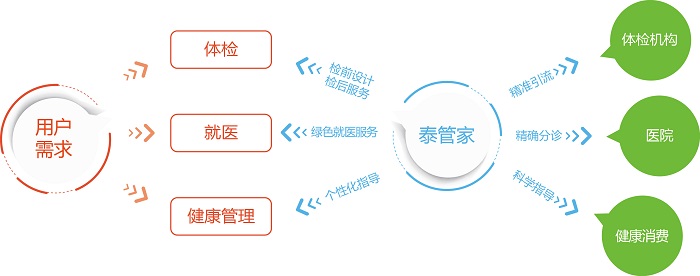
Tai Guanjia offers three types of services: First, health management services, through which users can consult experts on health issues, seek personalized health guidance, manage chronic diseases, and receive comprehensive assessments and risk alerts based on their health data via the Tai Guanjia app. Second, personalized physical examination services, which essentially handle the selection of examination institutions and price negotiations, followed by detailed interpretation of examination reports and timely intervention for any abnormal findings. Third, medical accompaniment services, which include pre-consultation health counseling, condition triage, and specialist recommendations; during-consultation support such as accompanying patients, answering questions, handling payments and medication pickup, delivering medications, and providing medication guidance; and post-consultation services including medical record establishment, nutritional dietary guidance, and rehabilitation instruction.
The most important label for Tai Guanjia is "Professional Third-Party Health Service Platform“—It provides only health guidance and humanizes the processes of physical examinations and medical consultations, without engaging in any medical practices or being affiliated with any clinic, hospital, or examination center. Thus, it serves as a communication bridge between users and hospitals or examination centers, creating mutual benefits for both parties. This approach closely resembles that of Accolade, the U.S.-based ‘medical concierge service’ unicorn previously covered by VCBeat: when users have health-related questions or feel lost and helpless in the face of impersonal medical institutions, professionals extend a helping hand through comprehensive and considerate services.”
Transforming into Healthcare, Building an Elite Team
Before embarking on his entrepreneurial journey, Zeng Wen was not involved in the healthcare industry; rather, he came from an internet background. He worked for three years at Yicha China, the first mobile search company in China, and later founded a startup focused on mobile games. In 2013, as his company sought transformation, the internet had already profoundly influenced various aspects of people’s daily lives, including clothing, food, housing, and transportation. However, the “Internet + Healthcare” sector remained largely untapped. Consequently, he chose to pivot into the healthcare field.
This decision also reflects the founder’s personal sentiments. In his early twenties, he watched his father pass away from lung cancer at the age of 50, leaving his family with lifelong regrets and profoundly impressing upon him the importance of health. After starting a family, Zeng Wen described himself as a typical user profile for Tai Guanjia (Tai Butler): juggling work responsibilities while caring for his elderly parents’ health and ensuring proper nutrition for his children. Faced with frequent household health needs, he largely relied on personal experience or online searches, which often led to imprecise decisions and consequent financial and health losses. This prompted him to ask: Why not entrust the planning and management of daily health needs—such as wellness care, medical check-ups, and clinical consultations—to professionals?
Upon the company’s establishment, Zeng Wen spent a year researching health management and medical service institutions in the Shenzhen area, engaging in in-depth discussions with several chief experts. He found that most entrepreneurial hotspots were concentrated in areas such as improving hospital efficiency and building platforms for doctor-patient communication,Platforms that are fully centered around users to respond to their health needs are virtually nonexistent.During the research process, he connected with a group of like-minded senior healthcare professionals, who subsequently formed the core team of Tai Guanjia. Among the core team members, some have built medical data platforms, while others are well-versed in the entire spectrum of medical services, including triage and health check-ups. One member is a chief physician of internal medicine with seven years of experience in health management. Regardless of whether their background is in technology or medical services, all team members possess over six years of industry experience. “Although none of the team members come from BAT (Baidu, Alibaba, Tencent) backgrounds, for the internet healthcare industry, which has been developing for less than a decade, the Tai Guanjia team can already be considered elite veterans in the field.”
Designed for Corporate Employees, Acclaimed by All Parties
Over the past year, Tai Guanjia has primarily promoted its health steward and customized physical examination services to enterprises. Zeng Wen stated, “In order to attract and retain talent, companies are placing greater emphasis on employee benefits across the board and continuously upgrading them. For instance, afternoon tea has become a standard offering at many companies in recent years. Simple physical examinations alone can no longer meet the demands of high-intensity work.” Tai Guanjia introduced the concept of further upgrading corporate health benefits, providing health steward services to enterprises without increasing their physical examination budgets. Before the examinations, they design personalized check-up plans for employees, negotiate prices with selected examination institutions, and organize the examinations for staff. This approach neither increases corporate costs nor compromises the quality of the original examinations, while also eliminating unnecessary administrative workload for enterprises. After the examinations, they establish mobile health records for employees and assign a dedicated steward team to each individual to address their health needs. Physical examinations are no longer a mere formality; employees genuinely benefit from the health perks provided by their companies. As a result, feedback indicates that Tai Guanjia’s services have been widely recognized and appreciated by many enterprises.
Corporate employees have responded even more positively to the novel health services provided by Tai Guanjia. Whether referred to as a “health concierge” or user-centric health services, these concepts are new to many people, seemingly offering ordinary citizens a healthcare experience akin to that of the elite. After installing the Tai Guanjia app, employees can now ask about health issues they previously searched for on Baidu, receiving responses within five minutes. Another advantage is the higher level of trust people place in explanations from this third-party platform. For instance, one user suspected that cardiac ultrasound and electrocardiogram (ECG) were redundant tests and specifically inquired with Tai Guanjia staff. The staff’s professional explanation alleviated the user’s concern about potentially undergoing unnecessary examinations.
For hospitals, Tai Guanjia’s services help attract more mid-to-high-end health checkup clients, making them highly receptive to collaboration. According to the Tai Guanjia team, many individuals seeking high-quality medical care actually prefer Grade A tertiary hospitals but are deterred by overcrowding, ultimately opting for private institutions with better environments and services. Tai Guanjia not only brings this demographic back to large hospitals but also fills gaps in hospital service offerings, facilitating smooth contract negotiations. Reportedly, Tai Guanjia has already partnered with the health checkup departments of nearly 10 Grade A tertiary hospitals in Shenzhen, and over 100 hospital department chiefs have become Tai Guanjia’s health consultants, assisting with users’ specialized medical issues when necessary. Similarly, Tai Guanjia has established strong partnerships with health checkup providers, covering almost all mainstream professional checkup institutions in Shenzhen, such as Ciming, Ruici, Meinian Onehealth, and CITIC Health. Additionally, it maintains more than 20 partner institutions in Shanghai, Guangzhou, and Dongguan.
Exploring Family Health Management at the Primary Care Level
Although the current focus is more on corporate partnerships, Tai Guanjia plans to collaborate with community property management firms in the coming years to extend its health stewardship services to more households, aiming to acquire 100,000 targeted family users.
Tai Guanjia positions itself as a “Family Health Steward.” With the exception of diagnosis and treatment, its capabilities extend beyond those of a conventional family physician. Typically, a family physician—usually a general practitioner—provides preliminary assessments of presenting symptoms. In contrast, the Tai Guanjia team includes general practitioners who offer health consultations, complemented by specialized services such as personalized nutrition planning and rehabilitation. This comprehensive health management team is committed to transforming the model of household healthcare.
As for deeper exploration of grassroots health management in the future, Zeng Wen stated that they would consider striving for clinic qualifications to better establish themselves in the community and deliver health services at the “last 500 meters.”Conduct diversified exploration in more areas such as community-based elderly care and community rehabilitation nursing。
“JD.com-Style” Health Management: A Long and Arduous Journey
Zeng Wen believes that health management should adopt the “JD.com self-operated model” rather than the “Taobao platform model,” which is why Tai Guanjia has chosen to provide self-operated health services instead of building a platform. The reason is that hospital doctors are too overwhelmed to cope with the large number of patients.Build a PlatformMerely connecting doctors and patients through the internet cannot truly deliver services with depth and stickiness.Tai Guanjia leverages professional third-party platforms to mediate and optimize services, filling the gaps in pre-consultation triage and pre-examination planning, as well as post-consultation and post-examination health management that hospitals and check-up institutions often fail to provide. Additionally, it enables a dedicated physician team to provide long-term, continuous care for individual users.
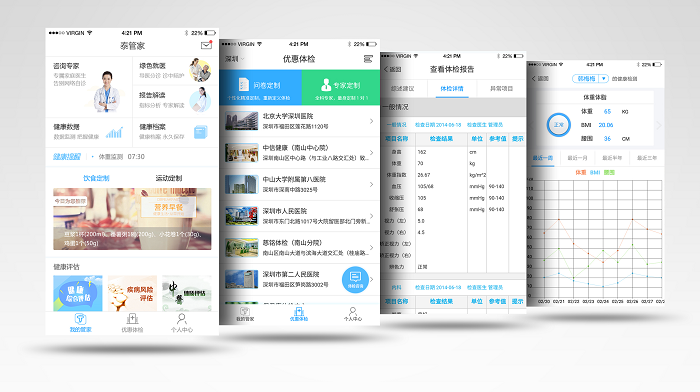
Tai Guanjia App Page
However, personalized health management has its drawbacks, namely relatively low efficiency. Zeng Wen introduced that over the next one to two years, Tai Guanjia aims to build a more intelligent platform while continuously optimizing user experience, so as to improve the efficiency of butler services and reach a larger population.
In terms of profitability, in addition to the commission revenue from corporate health checkup partnerships, Tai Guanjia offers a paid membership service tailored to high-end clients. This service provides year-round complimentary concierge consultations, personalized health guidance, sports rehabilitation, chronic disease management, and medical escort services. Once a substantial user base is established, Tai Guanjia plans to introduce additional value-added health services.
When recalling memorable experiences from the entrepreneurial journey, Zeng Wen highlighted two incidents that left the deepest impression on him. The first involved the Tai Guanjia team receiving a nutritional consultation request from a 17-year-old high school student. The second occurred after the public version of Tai Guanjia was launched, when users from provinces such as Hebei and Hunan began sending their medical examination reports via the app, seeking interpretation and health guidance. The first incident demonstrates that individuals across all age groups have health-related needs, while the second confirms that health management is not a pseudo-demand but a genuine and substantial need.
“The greatest takeaway is that entrepreneurship is a journey of inner cultivation. Tai Guanjia has forgone the model of making quick profits and has no counterparts to imitate. As pioneers in implementing this form of health service, we aim to create a transparent and precise consumption model for users in the healthcare industry, which is characterized by extreme information asymmetry, so that every Chinese family can have its own health steward.”