

GYENNO Secures Tens of Millions in Series A Funding to Advance Robotics-Based Solutions for Parkinson’s Disease
On February 18, GYENNO Science announced that it had secured tens of millions of RMB in Series A financing, led by Yinyue Medical Fund and participated by Wuhan Optics Valley Talent Fund. The funds will be allocated to product research and development as well as market promotion.
The Influence of Family Upbringing on Choices
Zhenluo Technology, whose name signifies “Striving for Perfection in Action, Building Extensive Connections,” is a provider of precision medical services based on rehabilitation robotics. The founder, Ren Kang, was born into a family with a strong medical atmosphere. Apart from his father, who is an electronic engineer, the professions of his other relatives are all related to medicine. Immersed in this environment from a young age, he developed an innate affinity for medical issues. However, after the college entrance examination, Ren Kang did not major in medicine; instead, he enrolled in the Automation Control program at Huazhong University of Science and Technology. Nevertheless, the influence of his family background has consistently shaped his life choices and entrepreneurial development.
Ren Kang did not start his entrepreneurial venture immediately after graduation. After graduating from university in 2008, he first joined Huawei as an R&D engineer. In 2010, Ren Kang moved to the United States to spearhead the expansion of the set-top box market. However, the North American set-top box market was already saturated and monopolized by a few major players, leaving virtually no room for new entrants.
During Ren Kang’s extensive client visits, one customer expressed a desire to add a graphical user interface (GUI) to their set-top boxes. Recognizing that large corporations would require considerable time to move from decision-making to mass production, Ren Kang independently completed the GUI design, securing Huawei’s first order in North America. The following year, he independently delivered an encryption project in Europe.
After spending three years at Huawei, Ren Kang felt it was time to take a bold leap. He resigned and embarked on his first entrepreneurial venture in the IC supply chain sector. Although he achieved a certain level of financial success, he found that it did not align with his personal values. Two years later, he transferred ownership of the trading company to his university classmate and co-founder, and in 2013, he established GYENNO Science.
When the company was first founded, its inaugural product was not an assistive robot for Parkinson’s syndrome, but a smart wristband. With limited funding and staff, the five founding team members worked nearly every weekend over a six-month period, handling everything from product design and technological R&D to supply chain management and marketing, as well as organizing the launch event and initiating a crowdfunding campaign. As the world’s first smart wristband supporting wireless charging, the product achieved remarkable success, topping its category in crowdfunding results and ultimately securing the company’s first round of financing.
Focus on the Field of Parkinson's Syndrome
Although the smart bracelet project was successful, it did not align with the medical field Ren Kang wished to enter. He hoped to leverage his engineering expertise to contribute to medicine. After conducting thorough research, he discovered that Parkinson’s disease is the third major category of diseases severely affecting the health of middle-aged and elderly individuals, following cancer and cardiovascular/cerebrovascular diseases. However, due to the non-universal nature of its cases and gaps in both the market and research, this patient population has received remarkably little attention.
However, this disease has a significant impact on patients’ lives. Sixty percent of individuals with Parkinson’s disease experience freezing of gait, which not only increases the risk of falls but can also cause sudden immobility while walking. As a result, most patients are reluctant to go out unaccompanied. Ren Kang told reporters, “Currently, neither medication nor surgery can truly resolve the problems faced by Parkinson’s patients; even experts are at a loss.”
Due to hand tremors, even enjoying a proper meal has become a luxury for Parkinson’s disease patients. Google once developed Liftware, an anti-tremor spoon for Parkinson’s patients. Equipped with built-in sensors, it detects arm tremors and actively counteracts them, thereby assisting patients with eating.
However, this approach was not suitable for patients with severe conditions. Drawing on his expertise, Ren Kang believed the initiative was feasible and thus launched the “GYENNO RuiCan + YiDongLi” project.
The GYENNO RuiCan+ Medical Dynamics project comprises two products: one designed for patients and the other for healthcare professionals.
For Patients
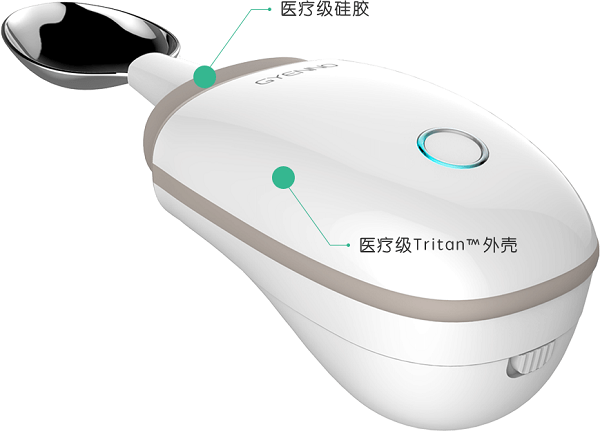
Let’s first talk about the GYENNO Ruican mini robot designed for patients.: It is specifically designed for patients with Parkinson’s disease and movement disorders. This closed-loop telemedicine solution integrates assistance, detection, and intervention, enabling both physicians and patients to monitor daily symptom data and long-term trends. It supports medication adjustments, helps prolong the “honeymoon period” of drug efficacy, assists patients with normal eating, and facilitates hand balance training to slow the decline of hand motor function. Its 360° comprehensive anti-tremor effect effectively counteracts 85% of hand tremors, thereby avoiding embarrassment during meals.

According to Ren Kang, the technical challenges of this system lie in its long technology chain; it is an interdisciplinary technology involving product design kinematics, programming algorithms, sensors, embedded hardware, and more. Compared with Liftware’s 75% tremor-cancellation efficacy, this system can serve a broader patient population. It has already achieved sales of several thousand units across China, the United Kingdom, and the United States. In particular, although priced higher than competing products in the U.S., its sales have been growing rapidly. The system also successfully won bids in Portugal and Switzerland.
Regarding the overcoming of technical challenges, Ren Kang stated that Zhenluo Technology is a market-oriented and academically driven company. Half of its 60 employees are R&D personnel.Additionally, expert professors from universities worldwide have been engaged as an R&D advisory board, all of whom are leading figures in their respective fields of research.
In addition, the Ruican+ Yidongli Chronic Disease Management System can record patient condition data and medication status, providing an objective reference for medication strategies and assisting physicians in evaluating disease progression and drug efficacy.Achieve precise medication to help extend the drug's honeymoon period.
For Experts
Zhenluo Technology also caters to expertsProvide Customized Research Platform Servicesservices.The Yidongli Chronic Disease Management System can be customized and expanded based on physicians’ needs, leveraging the Yidongli platform in conjunction with related medical robots or novel hardware to conduct research projects. On one hand, physicians can more effectively carry out routine clinical work and manage patients through Yidongli; on the other hand, they can utilize GYENNO’s robust expertise in ergonomics and mathematics to support large-sample, multicenter, customized research studies. Currently launched initiatives include “Screening for the Prodromal Stage of Parkinson’s Disease” (a key national R&D program under China’s 13th Five-Year Plan), with the “Research Project on Parkinson’s Disease and Essential Tremor” scheduled for imminent launch.
As a National Key R&D Program, the screening for the prodromal phase of Parkinson’s disease (PD) involves more than 40 top-tier tertiary hospitals across China. This initiative aims to extract clinical, laboratory, and imaging characteristics from patients with confirmed PD. Through a four-year follow-up of individuals in the prodromal stage, the study will validate the value of these markers for early diagnosis, dynamically update the indicators based on follow-up results, and ultimately establish a risk prediction and early diagnostic decision-making system for PD using intelligent computing models, thereby addressing the challenges associated with the early diagnosis of PD.
Four-Dimensional Industrial Closed Loop
When it comes to development plans, Ren Kang stated that GYENNO Science hopesProviding a complete service loop for Parkinson's patients across four dimensions: assistance, intervention, assessment, and rehabilitation.
Ruican has completed the development of its basic assistive features, while its gait-assist product, currently under R&D, has entered the intervention phase. This product aims to alleviate symptoms in Parkinson’s disease patients through various types of real-time interventions. Furthermore, by integrating Ruican’s hand movement data with gait analysis data, a comprehensive human body data model can be established to quantitatively assess patients’ motor symptoms and medication status, thereby providing rational medication recommendations. Zhenluo is also building technical reserves for motion-neuro rehabilitation applications, such as exoskeletons.
Currently, Zhenluo Technology’s revenue is primarily derived from hardware sales and follow-up consultations and video medical services offered through its mobile app. In the future, screening for the prodromal stage of Parkinson’s disease will also become one of the company’s revenue streams. Early screening enables early intervention; although it cannot cure the disease, mild interventions can improve patients’ quality of life.
Previously, Zhenluo Technology had separately secured RMB 10 million in angel funding from China Venture Capital and over RMB 10 million in Pre-A financing from Amoeba.