

Traditional Chinese Medicine Chain TaiKunTang Enters Internet Healthcare Arena with Major Strategic Push
On February 27, 2017, which marked the second day of the second lunar month—traditionally known as “Longtaitou” (Dragon Head-Raising Day)—the spring tea gathering of Taikuntang, a well-known chain of traditional Chinese medicine clinics, was held in Shanghai.
As one of the earliest TCM chain institutions in China, Tai Kun Tang has unveiled a new strategy dubbed “Tai Kun Tang 2.0.” In his speech, Chairman Wu Dasheng elaborated on how Tai Kun Tang integrates internet thinking and technology to comprehensively upgrade its diagnosis and treatment, services, and heritage preservation, thereby realizing its “cloud takeoff” plan.
This means that the booming internet-based traditional Chinese medicine (TCM) market of the past two years will welcome new heavyweight players, as traditional TCM healthcare institutions strive to transform into an “Internet Plus TCM” model. The online-offline integrated approach will inject new momentum into the existing internet-based TCM market, clearly posing a fresh challenge as well.
At the event, Taikuntang invited nearly 200 TCM experts from Shanghai to attend, including Professor Zhu Nansun, a nonagenarian luminary in TCM gynecology, and Professor Cheng Jiazheng, a renowned pediatrician, among other nationally and municipally recognized TCM masters. Professor Zhang Jianzhong, former Party Secretary of Shanghai University of Traditional Chinese Medicine, remarked that it has been quite rare in recent years to see so many prestigious Shanghai-based TCM physicians gather for such an intimate exchange.
Meanwhile, Liao Jieyuan, founder of WeDoctor, a “unicorn” in the internet healthcare sector, and Lv Songtao, Chairman of Green Valley Group, a leading enterprise in traditional Chinese medicine (TCM), also appeared at the venue, passionately discussing the integration of the internet with TCM. Whether this was an exercise in sharing experience or a joint call for collaboration inevitably sparked speculation.
In the TCM community, which has gradually become a hotspot in the past two years, Taikuntang has always remained low-key. However, this understated Taikuntang established Shanghai’s first TCM hospital after the reform and opening-up—Shanghai Taikuntang TCM Hospital—as early as ten years ago. Currently, in addition to its two hospitals/clinics in Shanghai being fully covered by medical insurance, three of the four independently established TCM hospitals (clinics) in other regions have also been designated as provincial or municipal medical insurance providers. It is reported that Taikuntang currently handles over 400,000 patient visits annually, with an annual growth rate of specialist outpatient services consistently exceeding 20% in recent years. Overseas patients account for nearly 15% of the total number of consultations. Taikuntang has secured a significant market share in the field of TCM specialties in Shanghai and across China. It has been successively included in the National Key TCM Specialty Collaboration Groups during the “11th Five-Year Plan” and “12th Five-Year Plan” periods. Currently, one of its specialties has been listed as a Shanghai Municipal Key Specialty, and four specific diseases have been recognized as Shanghai Municipal Advantageous Special Diseases.
Accumulating resources in traditional Chinese medicine (TCM) is exceptionally challenging. However, public information indicates that Taikuntang currently hosts the first “National TCM Academic Schools Collaborative Inheritance Studio” established by relevant departments of the National Administration of Traditional Chinese Medicine. It is home to nine renowned national academic schools and has established four studios for famous TCM practitioners at national, provincial, and municipal levels. In four key specialties—TCM gynecology, seasonal herbal paste prescriptions, TCM orthopedics and traumatology, and TCM dermatology—it has developed three characteristic therapies, eight exclusive formulas, and five specialized external treatment methods across ten specific disease areas. This forms the core connotation of its TCM practice model: “Nine Schools, Four Specialties, Ten Specific Diseases, Three Therapies, Eight Formulas, and Five External Treatments.” Notably, in its research on polycystic ovary syndrome (PCOS), Taikuntang pioneered a clear classification-based diagnosis and treatment protocol both domestically and internationally, achieving significantly better efficacy than either conventional Western medicine or traditional TCM alone. It has obtained five national invention patents and garnered attention and recognition from numerous experts in the fields of obstetrics, gynecology, and reproductive medicine worldwide. In 2015, ten gynecological academic schools listed among the first batch of National TCM Academic Schools Studios by the National Administration of Traditional Chinese Medicine jointly established an inheritance studio at Taikuntang—a distinction that is notably rare among private TCM clinics, which typically focus primarily on aggregating renowned physicians for clinical practice.
Actively Exploring the Path of “Internet + Traditional Chinese Medicine”
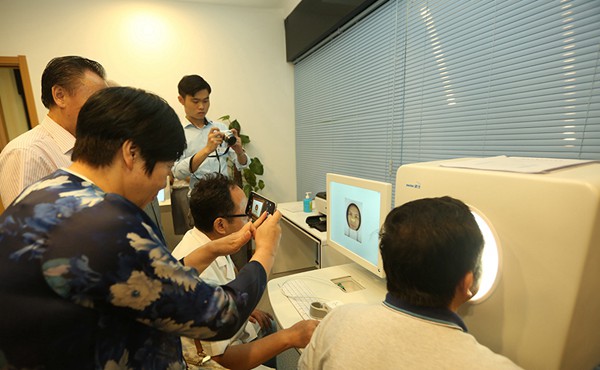
Visitors Experience the Remote TCM Consultation Room of the Wuzhen Internet Hospital, Constructed by Taikuntang
Interestingly, during the 2016 World Internet Conference, Ma Huateng, Chairman of the Board of Tencent, made a special trip to inspect the Wuzhen Internet Hospital. He took a keen interest in the Traditional Chinese Medicine (TCM) remote consultation room, capturing photos with his mobile phone and remarking, “It’s impressive that TCM consultations can be conducted remotely!” This remote TCM consultation room was built by Taikuntang. Its “TCM Remote Platform,” capable of collecting and transmitting TCM diagnostic information such as facial complexion, tongue appearance, and pulse conditions, attracted nearly 1,000 visitors to experience it.
To expand its internet healthcare business, Taikuntang has made significant upfront investments in technology. According to Wu Dasheng, Taikuntang has established a cloud-based TCM platform tailored to the characteristics of Traditional Chinese Medicine (TCM). All branch clinics are connected to the headquarters through a unified information management system and quality control system, enabling the interconnection and sharing of resources such as “specialized diseases, specialized medicines, and expert teams.” This integration facilitates synergistic application of products and services, including electronic medical record/clinical information databases, wearable devices, independent laboratories, objective data collection platforms for the four TCM diagnostic methods, patient communities, and management via disease-specific apps/micro-platforms, as well as pharmaceutical processing and distribution. The “National TCM Gynecology School Alliance,” jointly established by Taikuntang and the Gynecological Schools Branch of the China Association of Chinese Medicine Research and Promotion, has gone online. Currently, it has attracted more than 200 experts from 17 gynecological schools across China.
"Internet + Traditional Chinese Medicine (TCM)" Attracts Numerous Players: Four Dominant Models Have Emerged in the Mainstream MarketThe "Internet + Traditional Chinese Medicine (TCM)" sector has attracted numerous market participants. Currently, four dominant models have emerged in the mainstream market: O2O platforms providing diagnosis and treatment services, online consultation and diagnostic platforms, the digital transformation of traditional TCM clinics, and the integration of TCM pharmaceutical enterprises with internet technologies. These models demonstrate that business models combining TCM with the internet are easier to establish, as they enable both service delivery and online-to-offline sales of medicinal products. There is immense potential for collaboration between qualified TCM medical institutions and internet platforms.
What New Energy Can Rapidly Advancing Internet Technology Bring to Traditional Chinese Medicine? Lu Songtao, Chairman of Green Valley, believes that the internet and traditional Chinese medicine (TCM) are naturally compatible, and what the internet can bring to TCM is far more than just connectivity and collaboration.
Liao Jieyuan, Chairman and CEO of WeDoctor, believes that: first, the internet enables online patient referral, thereby expanding the user base for Traditional Chinese Medicine (TCM); second, it provides a technical platform for TCM practitioners to offer online consultations, remote pathological diagnosis, and treatment; third, it facilitates the accumulation of big data from a vast user base, aiding TCM diagnosis and the research and development of Chinese herbal medicines; fourth, it supports online training and the development of TCM disciplines, promoting the inheritance of TCM academia and schools of thought; and fifth, it leverages capital advantages to integrate the entire TCM industry chain.
“Once internet platforms achieve connectivity among TCM practitioners, TCM hospitals, clinics, patients, and the upstream and downstream industrial chains across China, a powerful cluster advantage will be formed. This will highlight the unique strengths of Traditional Chinese Medicine (TCM) in prevention, treatment, and rehabilitation, which is the primary reason we are actively integrating TCM with the internet.” Wu Dasheng expressed strong confidence in Taikuntang’s new strategy: “With the development and advancement of our internet-based TCM platform, we will connect and activate more distinctive and excellent expert teams, leverage a wider range of specialized products, and provide the public with more meticulous service experiences and better therapeutic outcomes. This will enable Taikuntang to emerge vigorously as a rising sun in the future landscape of TCM.”