

Grail, the U.S. Cancer Early Detection Startup Backed by Tencent, Files for IPO After Raising $1B Within a Year of Founding
On the evening of March 1, just as I was about to shut down my computer and turn in early, a major news release from foreign media completely dispelled my drowsiness: Grail, a U.S. company specializing in early cancer screening, announced the completion of the first closing of its Series B financing round, raising $900 million. The second closing of the Series B round is currently underway.
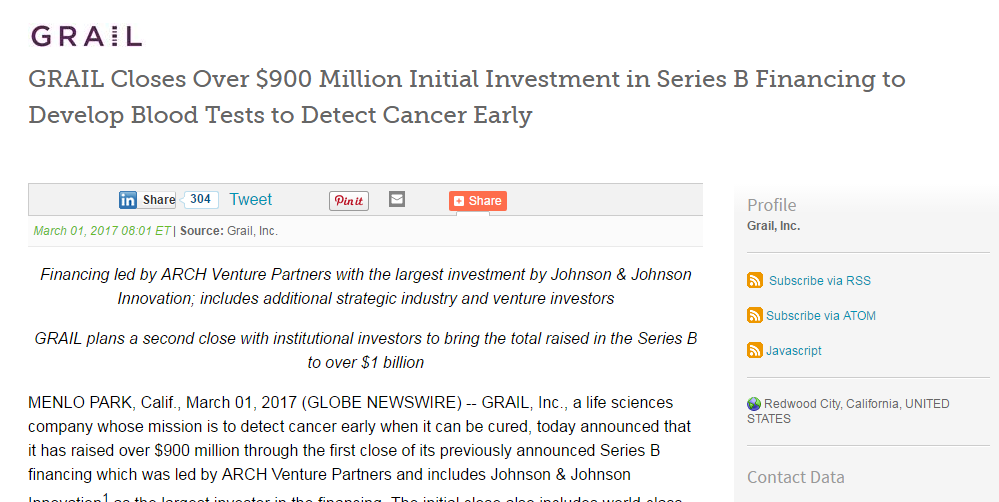
$900 million is a massive funding round, whether raised abroad or in China. And this figure represents only the initial tranche; Grail is currently undergoing the second closing of its Series B round. At that point, the total amount raised in Grail’s Series B is expected to exceed $1 billion. Why has this company, founded just one year ago with no products yet on the market, secured such an astronomical valuation? In fact, those familiar with the genomics market know that this young company has impressive backing.
Grail was established in January 2016 as a wholly-owned subsidiary of Illumina, the global sequencing giant. At the 2016 J.P. Morgan Healthcare Conference, Jay Flatley, then CEO of Illumina, announced the formation of Grail, a company dedicated to early cancer screening through simple blood tests. Leveraging Illumina’s sequencing technology, Grail conducts pan-cancer screening by directly measuring circulating cell-free DNA (cfDNA) in the blood. By analyzing high-resolution genetic fragments derived from dying tumor cells, Grail enables early cancer diagnosis, allowing patients to receive treatment before the disease progresses.
At its inception, GRAIL secured $100 million in Series A financing from what could be described as a “dream team” of investors. In addition to Illumina, the largest single investment came from the prominent U.S. venture capital firm ARCH Venture Partners. Other shareholders included Microsoft co-founder Bill Gates, Amazon founder Jeff Bezos, Google Ventures, and the Silicon Valley private equity firm Sutter Hill Ventures.
This time, ARCH Venture Partners continued its strong support by leading the Series B financing round. In addition to venture capital firms such as McKesson Ventures, investors from the pharmaceutical and technology sectors also participated, including Johnson & Johnson, Amazon, Bristol-Myers Squibb, Celgene, Merck & Co., Varian Medical Systems, and China-based Tencent Holdings. Among them, Johnson & Johnson was the largest investor aside from ARCH Venture Partners.
Ken Drazan, Chief Business Officer at Grail, stated, “Despite operating in different industries, these world-leading investors share our belief that early cancer screening can fundamentally reduce global cancer mortality rates.”
CEO Jeff Hube believes that Grail’s cancer detection technology is at the forefront globally, leveraging deep sequencing technologies, large-scale clinical trials, advanced computing capabilities, and data analytics. The company aims to maximize the value of its early cancer screening technology worldwide, helping more people mitigate the threat of cancer. He also revealed, “Grail has grown rapidly and achieved significant milestones in 2016. We are confident that the company will reach even more strategic and clinical milestones in the future.”
The funds raised in this round will be primarily allocated to three areas. First, the company will continue to invest in product research and development, specifically further validating its blood-based early cancer screening technology, including the previously announced Circulating Cell-free Genome Atlas (CCGA) study. Second, funds will be used to recruit volunteers for large-scale clinical trials. Despite technological support from Illumina, circulating cell-free DNA (cfDNA) detection technology has never before been applied to early cancer detection. At this stage, GRAIL requires substantial capital for clinical trials, particularly for the aforementioned CCGA project, which involves analyzing the genomic profiles of at least 7,000 cancer patients and comparing them with those of healthy individuals. Additionally, and most importantly, a portion of the raised funds will be used to repurchase shares held by Illumina, ultimately reducing Illumina’s stake to below 20%. It appears that GRAIL’s independence from Illumina is all but certain.To learn about the background, please clickGrail, an early-stage cancer screening company, sets $1 billion target for Series B funding and may spin off from Illumina.
It is not difficult to observe that the investor lineup in this round differs significantly from that of Series A. During Series A, most investors were from the venture capital sector, and the nature of the investment was more akin to traditional venture capital. In contrast, this round has attracted participation from world-class pharmaceutical companies such as Bristol-Myers Squibb, Merck & Co., and Johnson & Johnson. These companies have made substantial R&D investments in oncology therapeutics and may be seeking to leverage Grail’s research in cancer genomics to accelerate their own drug development efforts. Also participating is China’s Tencent Holdings, which appears to signal Grail’s global strategic ambitions. Overall, this round of financing is more strategic in nature.
It is understood that Grail plans to complete its Series B financing in the first quarter of 2017. In this second round of funding, Goldman Sachs and other global investors will participate. Ken Drazan also revealed that more pharmaceutical and technology companies will join as investors in this round.