

Dr. Wang Wei of Shanghai Jiao Tong University Affiliated Children's Hospital Discusses Clinical Applications and Future Prospects of Genetic Testing in Precision Medicine
Source: GeneInsight PPT
Introduction
As a major national project under China’s 13th Five-Year Plan, precision medicine has witnessed rapid iterations in upstream technologies such as gene sequencing, microarrays, and mass spectrometry. Large-scale cohort studies involving nearly one million participants have been launched. Downstream, the clinical application of genetic technologies is gradually expanding. New technologies—including microbiomics, immunotherapy, single-cell analysis, gene editing, and synthetic biology—are advancing by leaps and bounds, attracting cross-industry giants and sparking a wave of mergers and acquisitions. Meanwhile, the boundaries for the clinical application of genetic testing remain unclear, and industry standards urgently need improvement. The systems for genetic counseling and bioethics are still immature, and there is insufficient integration among scientific research, clinical practice, and industry. “Health is our concern; lives are entrusted to us.” In the course of this industrial transformation, how can we disseminate professional insights to foster mutual understanding, connection, and collaboration among all stakeholders?
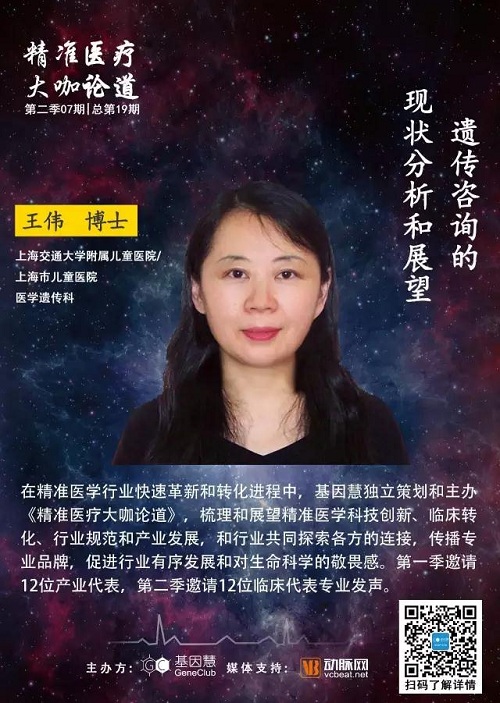
As a connector driving transformation in the precision medicine industry, GenePlanet has curated and hosted the series “Dialogues with Precision Medicine Leaders.” Season 1 featured 12 representatives from the precision medicine industry, while Season 2 invited 12 leading clinical experts to share their professional insights and establish industry brand authority. By creating value through connections and earning respect for knowledge, we aim to facilitate the orderly development of the industry. Special thanks to VCBeat for media support.
[Review]
Season 2, Episode 1: Professor Huang Shangzhi
Season 2, Episode 02: Dr. Gu Weihong
Season 2, Episode 3: Professor Yao Hong
Season 2, Episode 04: Professor Zhao Haitao
Season 2, Episode 5: Wang Yi, Deputy Dean
Season 2, Episode 6: Professor Qi Ming
[Editor's Note]
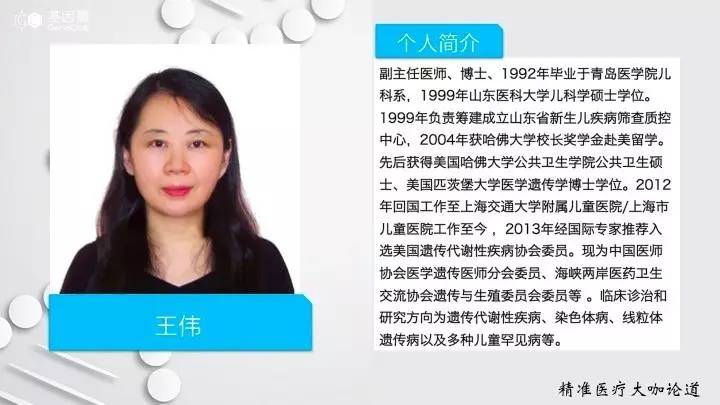
Shanghai Children’s Hospital, affiliated with Shanghai Jiao Tong University, is one of the first pilot institutions in China for the clinical application of high-throughput gene sequencing in the diagnosis of genetic disorders. As early as 2014, the hospital employed high-throughput genetic testing technologies to provide molecular diagnostics and personalized treatment for rare diseases and other conditions. Dr. Wang Wei has been engaged in clinical pediatric genetics in China for over a decade. She was awarded the Harvard University Presidential Scholarship to study in the United States, where she received specialized training in Western genetics. By integrating theoretical knowledge and practical experience from both Eastern and Western perspectives, she has developed profound insights into genetic diagnosis and genetic counseling in clinical pediatrics. Inviting Dr. Wang Wei was a challenging yet meaningful endeavor. Despite her demanding schedule and diligent work ethic, she graciously contributed her professional expertise to advance industry development amidst her busy commitments.
Author: Wang Wei
Shanghai Children's Hospital, Shanghai Jiao Tong University School of Medicine/
Department of Medical Genetics, Shanghai Children's Hospital
Key Points:
1. Prenatal diagnosis and preimplantation genetic diagnosis (PGD), in addition to clinical diagnosis, require 100% confirmation based on genetics;
2. The role definition and coordination among genetic counselors, clinical geneticists, and specialized clinical laboratory professionals need to be enhanced;
3. Genetic counselors play an indispensable role in the field of genetic testing, serving as a vital link between clinical geneticists and genetic diagnostic laboratories;
4. Clinical geneticists are bound to move toward greater specialization and subspecialization;
5. The characteristics of the clinical genetics specialty align precisely with the tiered diagnosis and treatment policy currently being promoted by the state.
When invited by GeneHui to discuss clinical implementation pathways for genetic testing, I hesitated for a long time, unsure of where to begin. On one hand, I can hardly be considered a leading authority in the field of genetic testing, and addressing this topic might seem presumptuous. On the other hand, I feel reluctant to prescribe definitive “solutions.” Within China’s unique healthcare system and cultural context, the industry has indeed developed in a distinctive and rapid manner. Yet paths are forged by those who walk them; I am confident that in the coming years, China will enter a phase of professionalization and standardization, ultimately standing at the forefront of the industry and leading the way. Having returned to China several years ago, I have been fortunate to immerse myself in this period of rapid industry growth. Perhaps, as a participant in this journey—a pediatrician with over a decade of clinical experience in China, later specialized through Western training in genetics—I can share my insights from an integrated perspective, offering food for thought to my colleagues.
At the time of writing this article, a pregnant woman at 16 weeks’ gestation, whose previous child suffered from methylmalonic acidemia (MMA), visited our clinic for prenatal diagnostic consultation. The proband had passed away several months earlier. Although we have encountered similar cases multiple times, such scenarios are becoming increasingly common due to the booming genetic testing market, particularly as more clinicians across healthcare institutions of all levels order genetic tests for patients. Therefore, via the GeneHui platform, we would like to kindly remind relevant clinicians and genetic testing agencies: please refer patients for consultation with a clinical geneticist. Even if you believe you can establish a definitive diagnosis independently, it is essential to provide preliminary genetic counseling first. Regarding future reproduction, determining whether a clear diagnosis can be made at the genetic level is a more critical issue than achieving a clinical diagnosis. Both prenatal diagnosis and preimplantation genetic diagnosis (PGD) rely on genetic diagnoses, which require 100% certainty. Diagnoses based on biochemical markers (a type of phenotype) constitute clinical diagnoses, not genetic diagnoses.
With the clinical adoption of high-throughput technologies such as next-generation sequencing (NGS) and chromosomal microarray analysis, incidents of this nature, including misdiagnoses, are becoming increasingly common. This trend compels us to deeply reflect on the challenges and bottlenecks associated with the clinical application of genetic testing. The root causes of these issues lie not only in the shortage of key professionals, such as certified genetic counselors, but more critically in the ill-defined roles of various stakeholders—including genetic counselors, clinical geneticists, and laboratory diagnostic specialists—under the current framework. Furthermore, there is a significant disconnect between clinicians and laboratory personnel, the latter of whom often lack the expertise required for professional clinical laboratory diagnostics. Consequently, in the absence of clearly defined roles, there is a mutual lack of understanding of each other’s professional domains. Clinicians and laboratory testers share no common ground; they lack a shared language in both clinical practice and genetics, resulting in severe communication barriers.
Genetic counselors play an indispensable role in the field of genetic testing, serving as a vital link between clinical geneticists and genetic diagnostic laboratories. However, careful consideration is needed regarding who is qualified to assume this role in China and what credentials they should possess. The process of genetic counseling is a cognitive journey that helps patients understand and adapt to the medical implications of genetic factors in disease. It involves not only interpreting and understanding genetic test results but also explaining family and medical histories, educating patients on therapeutic interventions, helping them grasp how inheritance patterns may impact their future and the reproductive risks for their offspring, and guiding patients and their families toward acceptance and a correct understanding of the condition. These responsibilities require qualified genetic counselors to communicate with and understand patients’ social, economic, educational, and religious backgrounds. During consultations, genetic counselors interact directly with patients or healthy individuals and their families; thus, the role extends beyond merely providing cold genetic data and reports. Therefore, as China develops a certification framework for genetic counselors, it should consider whether to adopt Western practices, such as conducting interviews prior to admission into training programs, to select candidates who demonstrate strong communication skills and a commitment to ethical principles, thereby ensuring these essential competencies. Currently, the profession of genetic counselor does not formally exist within China’s healthcare industry. In the future, it remains to be determined whether this profession will be regulated by existing clinical licensure bodies within the medical system or by a distinct regulatory framework. It is hoped that these competency requirements and future regulatory considerations will be integrated into the top-level design of the profession from the outset.
In the United States, clinical geneticists and clinical laboratory geneticists each have their own distinct specialties, with corresponding certification examinations and regulatory bodies. Both professions undergo rigorous genetics training, and the interface between them has been clearly defined historically. Most of the coordination and communication across this interface are handled by genetic counselors, thereby minimizing issues related to connectivity and communication. In contrast, China currently lacks professionals filling this intermediary role. This raises the question of whether every clinician should assume these responsibilities. In Europe and the United States, medical geneticists are specialists rather than general practitioners, nor do they fall under any conventional medical specialty; instead, they constitute a distinct specialized profession. Looking ahead, it is worth considering whether China should pursue a similar path of specialization or assign these duties as additional responsibilities to physicians in existing specialties. From my perspective, medical genetics should be established as a dedicated specialty practiced by specialized physicians, rather than being undertaken part-time by clinicians from other fields.
First, genetics is currently the most rapidly evolving specialty, with technological methods and diagnostic tools updating at an unprecedented pace. Since ancient times, there has been specialization in every field. The character “Shu” (skill/art) embodies mastery, focus, and respect. The numerous communication issues between clinicians and laboratories are not solely due to the absence of genetic counselors. The core issue lies in the lack of professional overlap in understanding genetics, or more specifically, genes, leading to disjointed conversations and a lack of shared language. This shared language refers to a fundamental understanding of genetics and genes. Consider a simple example: A physician encounters a patient with Down syndrome and requires chromosomal analysis. Is gene testing a more advanced diagnostic method? Regardless of potential medical disputes, when the laboratory receives such a request for gene testing, should it proceed or not? Furthermore, when high-throughput sequencing is used for gene testing, the clinical information collected by the laboratory relies heavily on clinicians. What type of information should be collected? Should negative clinical findings also be included and provided to the laboratory? If both parties lack common ground in their understanding of diseases and genetics, communication becomes extremely difficult. Similarly, a detected pathogenic variant does not necessarily equate to a pathogenic mutation, nor does it mean that a laboratory report based on current standards and databases can directly lead to a corresponding genetic diagnosis. The data screened by laboratory personnel from rows of genetic codes are based on our current limited understanding of genes. Medicine deals with living individuals, not rigid numbers. Therefore, it is essential to rapidly establish a professional team of clinical geneticists as well as a professional team of genetic laboratory diagnosticians.
Secondly, clinical genetics intersects with nearly every clinical specialty. Most genetic disorders involve multiple organ systems, meaning patients require care that extends beyond any single clinical discipline. Given the current scarcity of clinical resources and the excessive workloads shouldered by physicians daily, there is little spare time for continuous learning, such as mastering foundational genetics or keeping pace with rapidly evolving technologies and applications. Consequently, clinical geneticists are inevitably moving toward greater specialization. We urge physicians who are dedicated to or passionate about genetics to acquire the necessary knowledge and transition into specialized genetic roles as soon as possible; those who do so will surely find significant opportunities for professional achievement in the future.
Meanwhile, within a specific clinical specialty, the advantage of clinicians lies in their long-accumulated therapeutic experience. For diseases with clear genetic diagnoses, the majority of treatment should revert to clinicians in the relevant specialties. Take a simple example: a patient with mucopolysaccharidosis may require orthopedic correction for skeletal abnormalities, neurological intervention by a neurologist to manage epilepsy, and rehabilitation training provided by a physiatrist or rehabilitation specialist. More than 80% of rare diseases are genetic disorders. For any given genetic disease, without accumulated experience specific to that condition, the number of cases a clinician encounters throughout their career is limited, often meaning that treatment essentially begins with trial and error. The hallmark of diagnosing rare and genetic diseases is that it relies minimally on clinical experience; instead, it depends primarily on clinical laboratory tests and genetic testing results. This is particularly critical when patients’ families plan to have more children, where 100% accuracy in genetic testing—not just clinical diagnosis—is required. Therefore, if clinicians within a particular specialty wish to engage in therapeutic interventions for these conditions, they need to acquire knowledge in related fields and genetics, potentially pursuing this as a subspecialty for further study and training.
Finally, I would like to offer some suggestions regarding the clinical application of genetic testing under the current circumstances. It is highly encouraging that China is gradually implementing training programs for genetic counselors. This training lays a solid foundation for building a professionalized workforce of genetic counselors in the future. It is hoped that, on the basis of professional knowledge training, we can draw upon international experience to select talent suitable for careers in the healthcare sector. Medicine deals with human beings, not merely sets of experimental data. Humanities, ethics, and sociology play a significant role in medicine, particularly in the process of genetic counseling. Genetic counseling is far more than a paper-based genetic test report; its comprehensive scope is well reflected in the definition provided by the National Society of Genetic Counselors (NSGC). Furthermore, the characteristics of the clinical genetics specialty align closely with the tiered diagnosis and treatment policy currently being promoted by the state. In my view, it is extremely challenging to establish specialized genetic testing laboratories and medical teams in certain tertiary hospitals, and especially in secondary hospitals. Given that certain Grade A tertiary hospitals possess a strong foundation in both professional understanding of clinical genetics and specialized medical personnel, these institutions should be prioritized for post-diagnostic therapeutic interventions and follow-up care.
In genetic diagnosis, the specialization and standardization of genetic testing urgently need to be addressed. The interpretation of genetic data is currently a major pain point, and there is an even greater shortage of relatively professional genetic counselors. How to effectively concentrate limited talent resources in this field to meet the demands of the vast genetic testing market is something that institutions currently engaged in genetic testing should seriously consider. Based on my personal experience, I will speak frankly: the genetic test reports received by patients are highly inconsistent and varied. Many individuals transitioning from scientific research or lacking any diagnostic experience have moved into genetic diagnosis. There is an urgent need to strengthen their training in quality control of laboratory testing, basic requirements for clinical diagnosis, and especially in fundamental medical understanding. Regarding the genetic testing market, it is necessary to open up the sector to enhance competitiveness, rather than restricting it solely to public medical institutions. The institutional structure and personnel management mechanisms of public medical institutions result in many serious practical problems in genetic testing. Meanwhile, it is hoped that the state will strengthen regulatory oversight of third-party genetic testing laboratories and implement strict management and standardization of the market.
The above represents my humble views, intended solely for reference by industry experts and policymakers. I welcome any corrections or critiques.
Dr. Wang Wei's Clinic Information
Clinical Diagnosis, Treatment, and Research Focus: Various inherited metabolic disorders (particularly fatty acid oxidation disorders and lysosomal storage diseases), chromosomal disorders, mitochondrial genetic diseases, and a variety of rare pediatric conditions (including genetic disorders associated with intellectual disability and developmental delay, multiple congenital anomalies, etc.).
Outpatient Hours (Special Needs Clinic):
Every Tuesday morning (Shanghai Children's Hospital, Beijing West Road Campus)
Every Wednesday morning (Shanghai Children's Hospital, Luding Road Campus)