

FDA Powerless as Hyland's Homeopathic Teething Tablets Linked to Child Deaths
Homeopathy is an alternative therapy that has gained widespread popularity in the United States. It was founded in 1796 by Samuel Hahnemann based on his theory of "like cures like," which posits thatIf a substance can induce symptoms in healthy individuals that are characteristic of a particular disease, then diluting and succussing this substance enables it to treat those symptoms.. For example, onions can induce sneezing; however, highly diluted and succussed ultra-microscopic onion preparations can treat rhinitis characterized primarily by sneezing.
Clearly, this therapy is pseudoscience—a belief system mistakenly regarded as scientific. Homeopathy has no effect on any medical condition; large-scale studies have consistently found it no more effective than a placebo, indicating that any perceived benefits are merely the result of the placebo effect and the body’s natural healing processes.
In Case No. 7682299, on August 1, 2010, a mother administered three homeopathic teething tablets to her daughter to alleviate teething pain. However, within minutes, the poor infant stopped breathing.
“After I gave my daughter three Hyland’s teething pain relief tablets, she had a seizure and lost consciousness, then stopped breathing within about 30 minutes,” the mother later reported to the U.S. Food and Drug Administration (hereinafter referred to as the FDA). “I could only perform mouth-to-mouth CPR to restore my baby’s breathing, and then immediately rushed her to the hospital.”
The medication used by this mother was from Hyland’s, a company that promotes its “commitment to safe, effective, and natural remedies” to attract parents to try this alternative therapy. Following this incident, the FDA quickly obtained more information about the company’s pediatric teething products. FDA staff also regarded case number 7682299 as a relatively fortunate outcome.
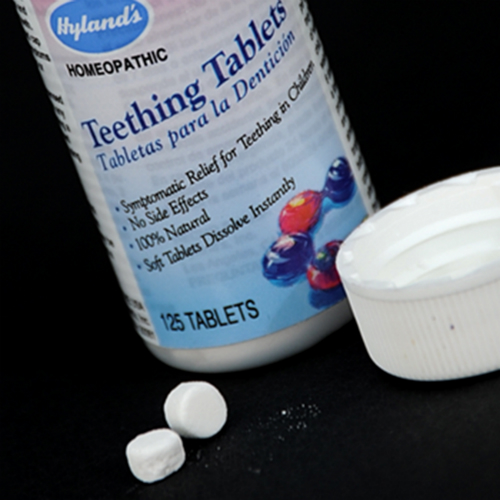
Hyland’s Homeopathic Teething Tablets Outer Packaging: Indicates Relief of Children’s Teething Pain Symptoms, No Side Effects, 100% Natural, and Rapid-Dissolving Tablets for Easy Administration
STAT News obtained investigative records from the FDA under the Freedom of Information Act, revealing that the severity of the situation exceeded that of the aforementioned cases. Children who had used Hyland’s teething products exhibited tendencies toward depression, with some fatalities reported. They also experienced recurrent seizures and manic symptoms. Many children were hospitalized as medical staff launched investigations to determine the cause of their limb convulsions.
Between 2006 and 2016, the FDA collected reports of adverse events involving more than 370 children who had used Hyland’s homeopathic teething tablets or teething gels. The teething gels are applied directly to the child’s gums and function similarly to the teething tablets.According to FDA records, eight children have died after taking Hyland’s products; however, the FDA is still investigating whether these products directly caused the deaths.
Additionally, the FDA is investigating two other deaths linked to teething medications but has not disclosed the manufacturers or provided case reports.
In September 2016, the FDA issued a warning stating that homeopathic teething tablets and gels may pose safety risks to children, advising consumers to stop purchasing and using these products. Subsequently, Hyland’s announced that it would discontinue its pediatric teething products. However, these products remained available on store shelves and online for several months thereafter, indicating that many households across the United States continued to use them.
Hyland’s, a privately held company based in Los Angeles with a 114-year history, is the leading player in the U.S. homeopathic market.The company insists that its products are highly safe and states that the FDA lacks conclusive scientific evidence to establish a direct link between its products and the epileptic symptoms and other complications observed in those children.
FDA spokesperson Mary Borneman stated, “Although there is no direct evidence, this does not mean that children are not sensitive to these products. Many parts of children’s bodies are highly sensitive, and we need to continue careful observation. Of course, this is not a condemnation of the company’s entire product line.”
Behind every FDA case number are angry and heartbroken parents. But it was only in this STAT News investigation that the public got its first clear look at these case reports, raising questions about how quickly relevant regulatory agencies responded to these incidents.
It took a full four years before the FDA issued a warning regarding teething tablets in 2010, ordering Hyland’s to rectify its products. In the seven years since then, adverse event reports linking Hyland’s pediatric teething products to safety concerns have continued to emerge.
“The FDA could well have kept its regulatory hammer firmly trained on this company,” said Sarah Sorscher, an attorney with a nonprofit public health research group, with clear reproach. “But it did not. It only took action after reports of infant deaths and hospitalizations emerged. Such delay and inaction are truly unacceptable.”
An FDA spokesperson defended the agency's handling of the matter.
“Although adverse event reports for these products provide us with some product information, as well as cases of serious injury and death caused to specific product users, we must point out that this information only indicates the need for further analysis and testing; it does not constitute conclusive evidence proving that there is a problem with the product,” said FDA spokesperson Ms. Lyndsay Meyer in a statement.
Although it is difficult for the FDA to prove that Hyland’s products have harmed children, some doctors do not question the dangers posed by these products.
In case No. 462749 dated September 15, 2011, a physician submitted handwritten notes regarding Hyland’s products, indicating that his five-month-old female infant patient fell into a coma lasting 45 minutes after taking Hyland’s teething tablets.
“I am certain this is not an allergic reaction,” the doctor wrote in his notes. “I urge you to report this incident and contact the FDA so that we can initiate an investigation and remove this dangerous, unregulated product from the market.”
In a lawsuit against Hyland’s, one mother wrote that her son’s pupils dilated to resemble “marbles with large black eyes” after taking their product. Another mother described how her daughter developed persistent seizure-like symptoms after using the teething tablets, bitterly telling Hyland’s, “I truly hate you from the bottom of my heart!”
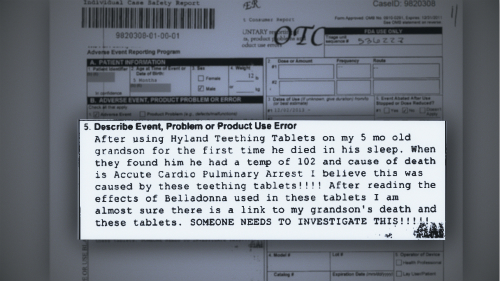
Adverse Drug Reactions, Issues, and Medication Errors
My five-month-old grandson passed away in his sleep after taking Hyland’s teething tablets for the first time. By the time we noticed, his body temperature had reached 102°F (38.9°C), and the cause of death was acute cardiopulmonary arrest. I firmly believe that these teething tablets were responsible. After learning about the role of belladonna in these tablets, I am almost certain that my grandson’s death is linked to them. Please, someone must investigate these medications!
Industry Titans of a Massive Sector
Hyland’s and its parent company are both standard homeopathic firms, considered to hold a major share of the homeopathy market. CEO John P. Borneman comes from a family that has been involved in this industry for generations, and he also serves as chairman of an industry association that published the Homeopathic Pharmacopoeia, regarded within the homeopathy sector as a bible-like guiding document.
Hyland’s manufactures and sells dozens of homeopathic products for the treatment and relief of headaches, excessive stress, sleep disorders, allergies, influenza, and other health conditions.
As with the principles employed by other homeopathic remedies, Hyland’s products also adhere to the theory that “if a natural substance in its original form can cause illness in healthy individuals, then highly diluting that substance can treat the condition.”
Despite the lack of scientific basis for the principles of homeopathy, this has not hindered its widespread popularity.
Homeopathy has now grown into a multi-billion-dollar annual industry. Its products enjoy substantial sales worldwide, with loyal adherents ranging from Hollywood legend Cher to Prince Charles. The industry also wields significant political influence, securing exemptions from many of the regulations issued by the U.S. Congress and the FDA in recent years.
Unlike pharmaceutical companies’ products, homeopathic products are not required to demonstrate their efficacy in treating a given condition, a distinction that is particularly evident during the pre-market phase.Since adverse event reports are generally regarded as merely the tip of the iceberg, reflecting only a fraction of actual occurrences, the information they provide may be far from sufficient for thorough investigations. This poses a significant challenge to the FDA’s drug regulatory authorities: how can they accurately determine whether these products pose safety risks in the post-marketing phase?
“If I were an emergency room physician and a family brought in a child exhibiting seizure symptoms, I might truly struggle to ascertain their history of homeopathic product use,” said Dr. Edward W. Boyer, a toxicologist at Harvard University, with resignation.
In some cases, parents believe that homeopathic products such as Hyland’s teething tablets and teething gels are unlikely to cause complications, so they do not disclose their use during medical consultations. Due to the lack of sufficient evidence demonstrating actual problems with these products, the FDA lacks the necessary enforcement authority.
Karinna Talbott, a 26-year-old mother from Colorado Springs, stated that Hyland’s teething products’ overt “all-natural” labeling largely alleviated her concerns.
“When our fourth child was born, he started teething at around three months of age. At that time, we were considering what we could do to alleviate his teething pain,” recalled Ms. Talbott. “Later, someone recommended these teething tablets to us, so we decided to give them a try.”
However, unfortunately, her son developed hand tremors shortly after taking the teething tablets.
“At first, we didn’t link our baby’s convulsions to the teething tablets,” Ms. Talbott admitted. “But his symptoms worsened, with jerking movements in his arms and legs, and at times, all four limbs would convulse simultaneously.”
Talbott said that doctors were initially unclear about the cause of the symptoms. However, after they stopped administering teething tablets to the child, the seizures subsided.
“A neurologist told us that our baby might be somewhat sensitive to this product.”
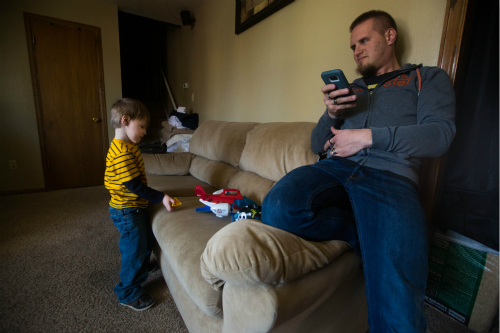
at his home in Colorado Springs with his father
"Deadly Nightshade"
During its investigation of Hyland’s teething products, the FDA focused on an ingredient derived from *Atropa belladonna*, a herb commonly known as “deadly nightshade.”
The ingredient in the product is diluted and should not pose any risk of toxicity or adverse effects. However, during a 2010 inspection, FDA investigators noted that Hyland’s manufacturing processes failed to meet relevant standards and further discovered inconsistent belladonna content across their products.
Consequently, the FDA issued a public warning disclosing “consistent reports of adverse events associated with the use of this teething product in children and its belladonna ingredients.”
The warning further notes that because infants’ bodies differ from adults in the rate at which toxins spread and elicit responses, they are “highly sensitive to the neurotoxins present in medications,” and that “their skin and oral mucosa absorb belladonna constituents particularly rapidly.”
Although Hyland’s continues to insist that its products are entirely safe, the company voluntarily withdrew the product from the market and implemented corrective measures in its manufacturing processes.
“Such an approach is entirely appropriate; parents no longer need to worry about the safety of this product,” said Ms. Borneman, FDA spokesperson.
In recent years, the number of serious adverse event reports for this product recorded by the FDA has been steadily rising. Some pediatricians and neurologists have begun to attribute these issues to teething tablets and gels. Many parents have written letters of complaint to the FDA, questioning why these problematic products have not yet been withdrawn from the market.
On February 13, 2012, a mother reported to the FDA that she suspected the product had triggered several epileptic seizures in her son. She stated, “My son also took three of those teething tablets. I am truly astonished by the ever-growing popularity of this product. Many of us parents lack adequate knowledge about it, and there are no warning labels on these products. If they must remain on the market, please take necessary measures, such as affixing warning labels, as many parents need such reminders.”
On September 30, 2016, while issuing a warning to Hyland’s, the FDA also announced that it was conducting further investigations into additional adverse event reports and advised consumers to discontinue the use of Hyland’s and other homeopathic teething products and to dispose of any such products already purchased. In response to this alert, several retailers that had previously sold Hyland’s and other homeopathic teething products, including Target and CVS, removed these products from their shelves.
The FDA once again requested that Hyland’s recall the relevant products, but this time the company firmly maintained its position and took no action, as the FDA lacks the authority to mandate recalls of homeopathic products.
FDA spokesperson Ms. Borneman stated that the company launched a product safety review system called the “Pharmacovigilance Plan” after 2010 to demonstrate the safety of its products.
“The safety margin of homeopathy is quite vague,” she said. “Our testing aims to ensure that no bottle of tablets contains excessive amounts of belladonna.”
Meanwhile, Hyland’s decided to discontinue production of its teething tablets. In an open letter to consumers, the company stated that the FDA’s safety alert had instead “caused confusion among parents.”
The company responded: “The FDA has forced consumers to confront such contradictory information, leaving you to decide whom to trust. This places an undue burden on you and undermines the FDA’s own credibility. We urge everyone to continue trusting Hyland’s and using our products, including those you have already purchased, as they are absolutely safe.”
On January 27, a few weeks ago, the FDA issued another warning after laboratory analyses revealed inconsistent belladonna levels in Hyland’s homeopathic teething tablets, with some batches containing amounts far exceeding those stated on the label. This poses unnecessary risks to children. The agency urged consumers not to use the product and advised seeking immediate medical attention if a child experiences seizures, difficulty breathing, lethargy, muscle weakness, flushing of the skin, difficulty urinating, or other adverse reactions after taking the medication.
The FDA also stated that there is no conclusive evidence to demonstrate the product’s efficacy.
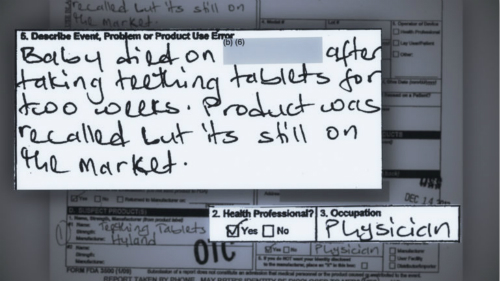
A child died after taking the teething tablets for two weeks; although the product had long been recalled, it remains available on the market.
The FDA: Willing but Unable
Out of concern over the toxicity of belladonna and the incessant reports of adverse events, some critics and parents have voiced strong criticism of the FDA, arguing that the agency should have taken more swift action in response to the incidents involving Hyland’s.
At the same time, they acknowledge that these incidents highlight regulatory blind spots when it comes to homeopathic products. There is no formula or official standard to determine how many case reports involving affected children are required before the FDA can investigate a company’s inventory, impose fines, or order a halt to production.
Critics point out that homeopathic products, which typically use highly diluted substances, are consistently sidelined by the FDA.
In an article on homeopathy published last year in The New England Journal of Medicine, Dr. Aaron S. Kesselheim noted: “Homeopathic products have long been a low regulatory priority for relevant agencies. Because these products often contain inert or highly diluted substances, the FDA has historically taken a less aggressive approach to their oversight. The primary harm to consumers is financial waste or the failure to use truly effective treatments.” However, regarding Hyland’s products, Dr. Kesselheim argued that it was the significant safety risks posed by the toxicity of belladonna ingredients that prompted the FDA’s regulatory action.
There are reasons for the FDA’s slow response to these incidents. The agency faces a staffing issue: it assigns health officers to review every report submitted by manufacturers, but it does not allocate personnel to regularly follow up with patients, their families, and physicians to obtain the reports that are currently missing yet necessary for enforcing mandatory regulatory actions.
“Isn’t it unfair to overly criticize the FDA for its slow action from 2010 to the present?” asked Patricia Zettler, an assistant professor of law at Georgia State University and former FDA counsel. “I believe the FDA itself is in a difficult position when dealing with these homeopathic products and their adverse event reports, as these do not constitute sufficient evidence that the adverse events are directly linked to the products.”
Professor Zettler added, “What I mean is, yes, these products do appear to warrant effective FDA oversight. But how many seizure case reports would be sufficient for the agency to take action—two or three, or ten? This is truly difficult to determine. The FDA needs to strike a delicate balance between acting swiftly when information is sufficiently clear and avoiding overreaction when the problem is not actually caused by the product.” Attorney Sorscher from the public health research group candidly stated that pursuing cases that escalate into criminal matters is time-consuming and labor-intensive; therefore, the FDA prefers that relevant companies comply with regulations voluntarily.
She pointed out, “There are no relevant regulations explicitly stating that this ingredient is unsafe and prohibiting its sale by all parties. Perhaps now is the right time for Congress to require the FDA to establish such regulations to completely ban the production and sale of this product.”
The standoff between the FDA and Hyland’s has infuriated Connecticut Democratic Representative Rosa DeLauro, who last week (on February 16) introduced the “Unsafe Drug Recall Act,” a bill that would reshape the FDA’s authority over homeopathic products. Currently, the FDA has mandatory recall authority only for medical devices, foods, and biological products.
Therefore, when drug safety issues arise, the FDA can only issue warnings and rely on manufacturers’ voluntary compliance to recall medications. While many companies do take FDA warnings seriously when their products pose safety risks, some refuse to recall their products even in the face of conclusive evidence that their products may cause illness or death among users.
Representative DeLauro angrily stated, “Hyland’s has blatantly ignored numerous FDA safety and health warnings and refused to recall its problematic products—a truly shameless act!” She further added, “This company has chosen to prioritize its own interests and reputation over the safety and health of our children.”
“Yet the current situation is that the FDA must resort to arduous and cumbersome legal proceedings to take action against companies such as Hyland’s. We find this time-consuming and labor-intensive process unacceptable, as it clearly poses hidden risks to the health and safety of the American public. I believe it is imperative to close the regulatory gap regarding mandatory recall authority; Congress should adopt my proposal to establish regulations that completely remove these products, which threaten consumer health and safety, from the market. We, as American citizens, have the right to know that the products we are using are safe.”
For the parents in Case No. 10723317, any measures would have been futile. The mother reported that on July 9, 2014, her nine-month-old daughter died after taking two crushed teething tablets for the first time. She had administered the tablets with a cup of water and then coaxed her baby to sleep. Forty-five minutes later, when the mother came to check on her daughter, she was met with the chilling sight of her child’s cold body in the crib, accompanied by a pool of vomit beside her. Five months after the incident, upon reading online reports about seizures triggered by belladonna ingestion in infants, she contacted Hyland’s.
An employee of Hyland’s stated in a report submitted to the FDA, “The customer did not request a refund or replacement.” Hyland’s also pointed out that, since the customer had already discarded the bottle of medication, it was no longer possible to conduct analytical testing on it.
Finally, Hyland’s concluded: “Due to the extremely limited information available from the reporter, no further investigation into this incident can be conducted.”
This article is sourced from STAT and translated by VCBeat; it does not represent the views of VCBeat.