

BOE Invests $50 Million in Israeli Medtech Firm Cnoga to Expand Mobile Health Ecosystem
VCBeat has learned that BOE announced today its plan to subscribe for 11.6931 million newly issued shares of Israel’s Cnoga Medical at $4.276 per share, with a total investment of $50 million, thereby acquiring approximately 23.81% equity stake in the company. The two parties will collaborate to launch two portable multi-parameter professional medical devices and have recently signed a conditional subscription agreement subject to certain effectiveness conditions.
This marks another move by BOE in the healthcare sector, following its RMB 250 million acquisition of Mingde Hospital, partnership with Dignity Health, the fifth-largest healthcare services group in the United States, collaboration with IBM to jointly develop a big data platform for health management, and the RMB 3.2 billion construction of the Hefei Digital General Hospital project.
Yu Lu, Vice President of BOE and General Manager of its Mobile Health Division, stated, “BOE’s mobile health initiatives are designed from the perspectives of disease prevention and management. By integrating artificial intelligence, big data, and professional support from offline hospitals, and leveraging intelligent health terminal devices for detection, we effectively provide health services to a broader population, including chronic disease management, health status monitoring, and risk warning and intervention. This represents one of the future directions of medical development.”
VCBeat has learned that Cnoga is an innovative developer of non-invasive medical devices. Headquartered in Israel, the company has subsidiaries in Shanghai and Changzhou, China, as well as in Brazil. It currently holds multiple international patents in the fields of non-invasive multi-vital-sign monitoring and non-invasive blood glucose testing. However, financial data show that Cnoga reported net losses for two consecutive years in 2015 and 2016, amounting to USD 3.87 million (approximately RMB 26.69 million) and USD 4.436 million (approximately RMB 30.60 million), respectively. During this period, Cnoga’s total assets and net assets both declined.
BOE’s official website stated that, following its investment in Cnoga, the two parties would collaborate to launch two portable, multi-parameter professional medical devices: the Non-Invasive Multi-Parameter Tester (MTX) and the Non-Invasive Combination Glucose Meter (COG). These are Cnoga’s two core products.
BOE stated that the company’s goal is to integrate high-quality mobile health products to form an industrial ecosystem chain. Upon completion of this investment, the company will be able to incorporate MTX and COG products into its mobile health ecosystem, thereby achieving a comprehensive development layout.
The MTX is a novel non-invasive fingerprint device that enables patients to undergo monitoring of a range of physiological parameters without the need for invasive blood tests (i.e., venipuncture). By analyzing tissue images of capillaries in the user’s fingertip, the device can detect more than 14 different physiological parameters—including pulse rate, stroke volume, cardiac electrical index, blood pH, hemoglobin concentration, and blood oxygen saturation—within seconds.
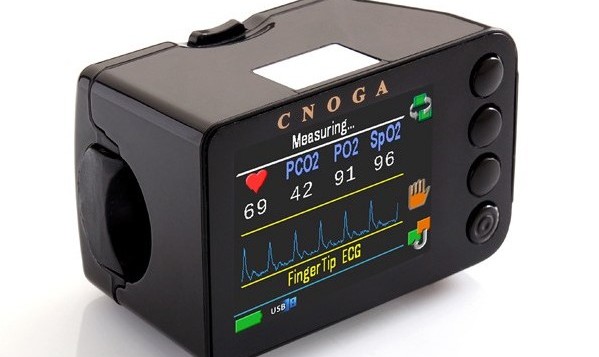
Cnoga's Non-Invasive Fingerprint Device MTX
When used in conjunction with the Cnoga app and cloud services, MTX enables experts and healthcare institutions to access medical data more easily and optimize disease management, thereby achieving true continuous remote monitoring.
Cnoga’s non-invasive combined glucose meter enables users to monitor blood glucose levels anytime and anywhere in a painless, simple, and convertible manner, facilitating the understanding, management, and control of diabetes over both short- and long-term periods. The device is lightweight and portable, with connectivity to computers and the internet. Additionally, the company offers VSM, a pocket-sized portable device capable of measuring blood pressure, pulse, and blood oxygen saturation.
BOE Technology Group Co., Ltd. was established in April 1993, asInternet of ThingsAs a provider of technologies, products, and services, its core businesses include display devices, smart systems, and health services. According to VCBeat, as of the fourth quarter of 2016, the company ranked first globally in market share for smartphone LCD panels, tablet displays, and laptop displays, while its monitor display panel business rose to second place worldwide, and its TV LCDThe display screen ranks third globally.
Citing Thomson Reuters’ “2016 Global Innovation Report,” BOE stated that it had become the second-most innovative company globally in the semiconductor sector. However, BOE currently faces certain challenges in enhancing the profitability of its core display panel business. At the 2013 shareholders’ meeting, Wang Dongsheng proposed identifying new profit growth drivers for the company.
Thus, in 2013, the company achieved its goal of completing the top-level architectural design and business segment planning for its healthcare division. A comparison of the financial reports from 2013 and 2014 reveals that its three core business segments shifted from “thin-film transistor liquid crystal displays (TFT-LCDs), display light sources, and display systems” to “display devices, smart system products, and health services.” Nevertheless, display devices remained the primary revenue source, accounting for nearly 90% of the company’s total revenue, while the health services segment contributed only between 1.5% and 1.9%.
At the 2016 BOE Global Innovation Partners Conference held last year, Chen Yanshun, CEO of BOE, announced that the company would invest RMB 100 billion in new fields over the next five years to establish a three-pillar business structure comprising Display Devices (D), Smart Systems Products (S), and Health Services (T). Within the health services sector, which encompasses five business areas—O2O medical services, mobile medicine, regenerative medicine, health parks, and health insurance—BOE is currently undertaking technological upgrades and exploring the development of fully intelligent healthcare systems.
In Wang Dongsheng’s plan, BOE’s focus is not on healthcare per se, but on leveraging its strengths in optoelectronic displays and artificial intelligence to provide smart health services.
This equity investment in a medical device company marks a significant step in BOE’s transformation into the smart healthcare services sector. As early as June 2015, BOE acquired 100% of the equity of Mingde Investment Co., Ltd. for RMB 250 million using its own funds, establishing it as BOE’s investment and development platform for its smart healthcare services business. The platform was primarily intended to support the operations of Beijing Mingde Hospital, under Mingde Investment, and to prepare for subsequent digital hospital initiatives. On the same day, BOE announced the signing of a strategic cooperation memorandum with Dignity Health, which would provide support to both BOE’s existing hospitals and its newly built facilities.
In December 2015, BOE invested RMB 3.2 billion through its wholly-owned subsidiary, Mingde Investment, to construct the Hefei Digital General Hospital project in Hefei. Simultaneously, it contributed RMB 1.19 billion to its wholly-owned subsidiary, Beijing Visionx, for the implementation of a smart manufacturing production line for complete units.
It is evident that BOE’s investments in the healthcare sector have expanded from hospitals to intelligent mobile medical terminals. BOE states that, compared with the traditional internet-based light consultation model and the medical device hardware model, the company possesses two core competencies: physical hospital resources and technological capabilities. By leveraging Cnoga’s non-invasive intelligent terminals, BOE can integrate human physiological data with its medical big data, cloud computing platforms, and hospital resources, thereby establishing a seamless channel between daily health data and clinical hospital data.
Wang Dongsheng also stated to the media that BOE’s smart healthcare services would integrate technologies such as the Internet, big data, information medicine, and sensing to disrupt traditional health concepts and medical models, thereby providing integrated smart healthcare services. In the future, leveraging technologies like the Internet, big data, and cloud computing, BOE may establish smart healthcare services as one of its core businesses.