

Puliy Pharmaceutical Files for GEM IPO, Reporting RMB 200 Million Annual Revenue from Three Key Drug Categories
VCBeat (WeChat: vcbeat) reports. Hainan Poly Pharmaceutical recently released its prospectus for the initial public offering and listing on the ChiNext Board. The company plans to publicly issue no more than 30.5294 million shares, with the offer price to be determined. The proceeds will be used for the construction of new production lines and research and development investments.
If Puli Pharmaceutical successfully lists on the ChiNext board, it will become the second pharmaceutical company to go public this year.
Official website information indicates that Poly Pharma is a high-tech enterprise engaged in the research and development, production, and sales of chemical pharmaceutical formulations, and has been certified as a pioneer in the internationalization of pharmaceutical formulations among Chinese pharmaceutical enterprises. Its main business areas include anti-allergy drugs, non-steroidal anti-inflammatory drugs (NSAIDs), antibiotics, and gastrointestinal medications.
VCBeat (WeChat ID: vcbeat) reviewed industrial and commercial records and found that Poly Pharma was established in 1992 as a Sino-foreign joint venture, with Linhai Huahai Synthetic Chemical Factory and Singapore Haizuan Industrial Co., Ltd. as its shareholders holding a 3:1 equity ratio. In July 2012, Poly Pharma underwent shareholding restructuring.
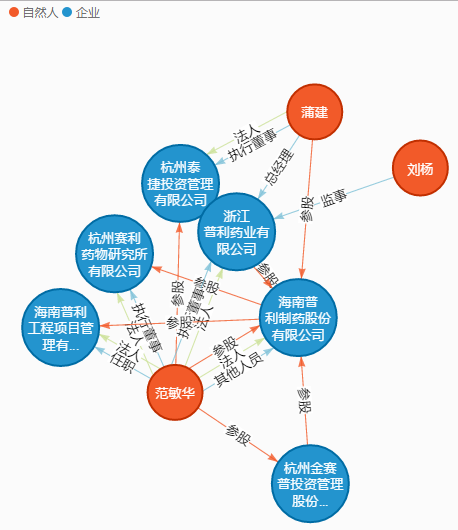
As disclosed in the Letter of Intent for Listing, the actual controllers of Puli Pharmaceutical are the married couple Fan Minhua and Zhu Xiaoping, who hold more than 50% of the shares in Puli Pharmaceutical either directly or through affiliated companies.
Puli Pharmaceutical owns two wholly-owned subsidiaries, Zhejiang Puli and Hangzhou Saili, as well as one controlled subsidiary, Puli Engineering. The former two are primarily engaged in drug research and development and pharmaceutical sales-related businesses, while Puli Engineering undertakes engineering construction, technology development, and other services.
Data source: Tianyancha
Other affiliated companies include Hangzhou Saili Drug Research Institute, Hangzhou Taijie Investment Management, and Hangzhou Jinseipu Investment Management.
Generating $200 Million Annually with Three Drug Categories
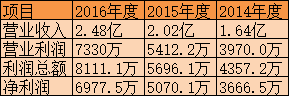
According to the prospectus, Poly Pharma achieved consecutive annual performance growth for two years. Its revenues for 2014–2016 were RMB 164 million, RMB 202 million, and RMB 248 million, respectively, while its net profits were RMB 36.665 million, RMB 50.701 million, and RMB 69.775 million, respectively.
The prospectus also disclosed that all of Poly Pharma’s production lines have passed certification under China’s new Good Manufacturing Practice (GMP) standards for pharmaceuticals. Its active pharmaceutical ingredient (API) and lyophilized powder injection production lines have successfully undergone audits by the U.S. Food and Drug Administration (FDA), the European Medicines Agency (EMA), and the World Health Organization (WHO) in accordance with relevant current Good Manufacturing Practice (cGMP/GMP) requirements. Additionally, its small-volume injection production line has passed the EMA’s GMP audit.
Puli Pharmaceutical holds 73 production approval numbers, including 60 for formulated drugs (48 for domestic chemical drugs and 5 for proprietary Chinese medicines), 10 for active pharmaceutical ingredients (APIs), and 3 for pharmaceutical excipients. Twenty-seven of its products are included in the National Reimbursement Drug List, with 14 classified as Category A and 13 as Category B.
Revenue data for Poly Pharmaceutical shows that three categories of drugs account for the vast majority of its revenue; the table below details its revenue composition.
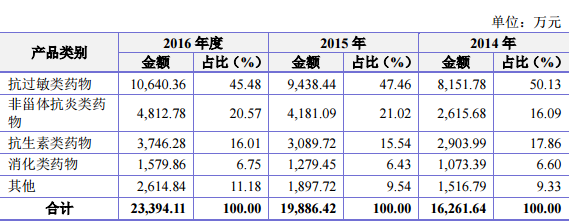
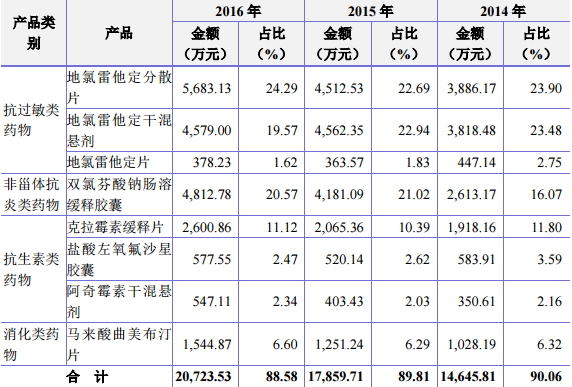
At the product level, desloratadine, diclofenac sodium, and clarithromycin sustained-release tablets are its flagship products. The following shows the revenue breakdown of Puli Pharmaceutical's main products.
Puli Pharmaceutical’s products reach the market through distributors and logistics providers. Domestic formulation sales utilize both channels, while active pharmaceutical ingredient (API) sales are conducted via direct sales. In international markets, sales are primarily carried out through distributors. The following table presents the revenue breakdown by sales model.
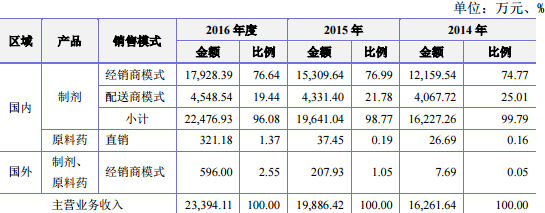
However, it is worth noting that small-scale distributors and delivery agents constitute a significant proportion of Poly Pharm’s business partners. Distributors and delivery agents with transaction volumes below RMB 200,000 account for 87.07% and 69.79% of the total number, respectively.
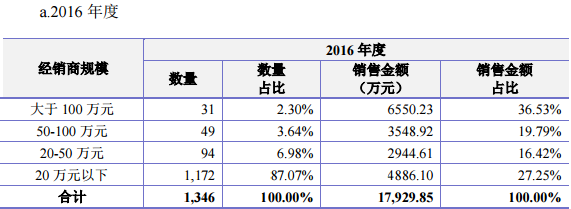
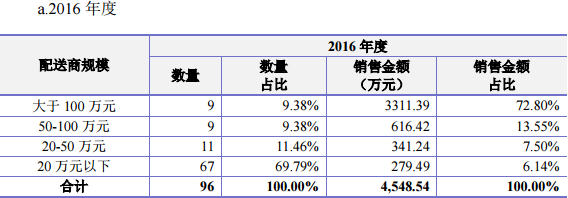
In light of this, Poly Pharma stated in its prospectus that in recent years, it has continuously strengthened its sales team to enhance control over the terminal market, and collaborated with large-scale distributors to leverage their regional distribution capabilities, thereby gradually expanding sales through the distributor model. As Fujian Province was the first to implement the “Two-Invoice System” reform, Poly Pharma’s pharmaceutical sales in Fujian during the reporting period complied with the “Two-Invoice System” requirements, adopting the distributor model for product sales. Meanwhile, due to Poly Pharma’s well-established marketing network in Zhejiang Province, which affords strong control over the terminal market and a sound distributor network, sales in this region were primarily conducted through the distributor model. In addition, during the reporting period, the company mainly adopted the dealer model for sales in other provinces and regions.
Proceeds from the IPO to be used for building new product lines
According to the prospectus, Poly Pharmaceutical plans to publicly issue 30.529405 million RMB-denominated ordinary shares (with the issue price to be determined). The funds raised will be used for the construction of two projects: a production line with an annual capacity of 1.5 billion tablets/pouches/capsules of finished dosage forms and a research and development center; and a production line for injectables meeting European and American standards. The specific investment amounts and implementation methods are as follows.
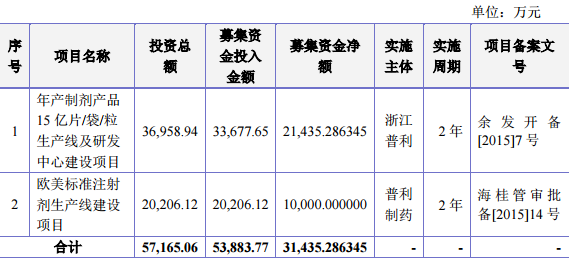
In its prospectus, Puli Pharmaceutical stated that the completion of the aforementioned projects would help it overcome bottlenecks caused by insufficient production capacity, fully leverage its competitive advantages and market potential, expand its business scope, and enhance profitability.
As previously mentioned, Puli Pharmaceutical also provided an explanation regarding these issues. The company stated that, constrained by production capacity bottlenecks, it primarily focused on manufacturing its leading products with relative competitive advantages during the reporting period, while other products were scheduled for limited production or had not yet been manufactured. Furthermore, as market demand for the company’s products continues to rise, its leading products are being continuously promoted, and reserve drugs and projects under development are progressively registered and approved for production, the company’s production capacity bottlenecks will become an obstacle to its further development.
In terms of R&D, Poly Pharmaceutical also aims to increase its investment. Currently, the company has more than 70 projects in development, covering therapeutic areas such as non-steroidal anti-inflammatory drugs (NSAIDs), gastrointestinal disorders, and cardiovascular and cerebrovascular diseases. Certain injectables, dry suspensions, and granule formulations will be simultaneously submitted for regulatory approval in the United States and the European Union. Poly Pharmaceutical expects that the construction of its new R&D center will improve both hardware and software infrastructure, enhance R&D capabilities and technical expertise, attract high-end R&D talent, and ensure that products under development obtain regulatory approval and are launched on the market as scheduled.
Overall, Poly Pharmaceutical aims to enhance its R&D and production capabilities through fundraising from its public listing, thereby expanding into a comprehensive pharmaceutical enterprise.
A-Share Pharmaceutical Company Storm
If Puli Pharmaceutical successfully completes its issuance and lists on the ChiNext board, it will become the second pharmaceutical company to enter the capital market this year. On January 11 this year, Nanjing Haichen Pharmaceutical listed on the ChiNext board, issuing 20 million new shares, bringing its total share capital to 80 million shares post-issuance. As of the market close on March 6, Haichen Pharmaceutical’s total market capitalization stood at RMB 3.826 billion, with a static price-to-earnings (P/E) ratio of 94.88.
Haichen Pharmaceutical and Poly Pharm share many similarities, such as their revenue reliance on a few blockbuster products, sales models, revenue levels, and equity structures.
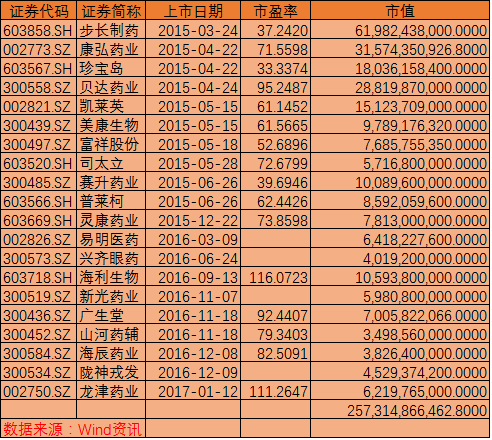
Expanding the scope to China’s A-share market, listed and pre-IPO pharmaceutical companies are stirring up a storm. According to Wind data, 20 pharmaceutical companies have gone public since 2015, with a combined total market capitalization of RMB 257.3 billion.
According to Wind statistics, as of March 6, there were still 35 pharmaceutical companies planning to enter the capital market.
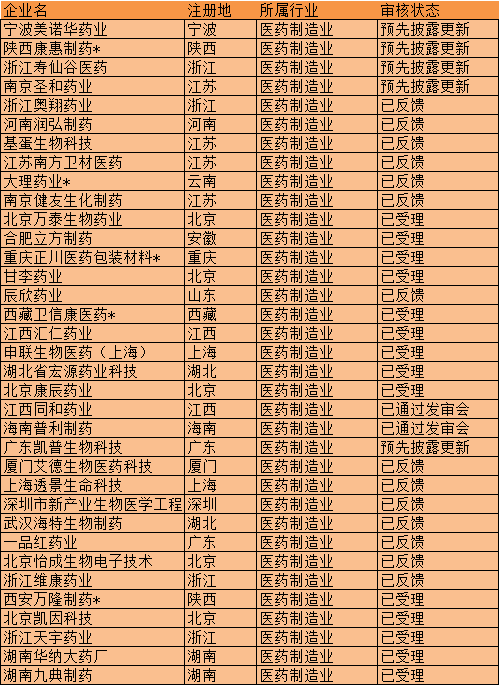
Data source: Wind
Should the aforementioned pharmaceutical companies complete their public offerings, it could trigger an investment frenzy in the capital markets for the pharmaceutical sector.