

Force Therapeutics Files for IPO: Revolutionizing Orthopedic Rehabilitation Through Remote Care
Telemedicine and tiered diagnosis and treatment are currently key drivers strongly promoted by the state to boost primary healthcare.With the rapid development of the internet and mobile devices in recent years, telemedicine has also entered a fast lane of growth, becoming accessible to ordinary households.Of course, the concept of “telemedicine” is not new; it was first proposed in the United States as early as the 1950s and has been developing abroad for over 40 years. Telemedicine offers advantages such as timeliness, portability, and ease of long-distance transmission, playing a significant role in the rational allocation of medical resources and the reduction of healthcare expenditures.
In the United States, patients who underwent joint replacement surgery in previous years might be surprised by the current treatment models in orthopedics.As fewer orthopedic patients are choosing inpatient rehabilitation therapy, they are increasingly opting for emerging telemedicine services at home.As an internet healthcare startup, Force Therapeutics is committed to driving this transformation in medical care models by enhancing patients’ rehabilitation experiences on web and mobile platforms.
Force Therapeutics, headquartered in New York, is a StartUp Health2009One of the incubated projects.Other companies in this category include Contessa Health, Jintronix, Reflexion Health, and Lumo Bodytech.
The company’s seed funding was raised from prominent CEO-investors, including Thomas Layton, former CEO of OpenTable; John Pleasants, former CEO of Revolution Health; and Randall Winn, an executive at FiveW Capital.They have completed two rounds of financing to date. The first round, closed in February 2015, raised a total of $2.2 million from six strategic and private equity investors, primarily led by FiveW. In addition to delivering rehabilitation guidance content via web and mobile platforms, their application also provides high-definition, evidence-based rehabilitation exercise videos.
Bronwyn Spira, the company’s founder and CEO, is a physiotherapist with over two decades of clinical and managerial experience across multiple healthcare institutions. She earned a Master’s degree in Physiotherapy from the University of the Witwatersrand in South Africa. Subsequently, she spent six years working in the inpatient rehabilitation department at the Rusk Institute of Rehabilitation Medicine at New York University, after which she successfully established a large, comprehensive clinical practice in New York.
Regarding her motivation for starting a business, Bronwyn stated, “As a former physical therapist, my responsibility was to help people achieve a higher quality of health. Every weekend, I would rigorously evaluate my professional performance by reflecting on how many patients had achieved better recovery during the week and to what extent their pain had been alleviated. It was this process of self-reflection that served as the catalyst for my entry into the digital health sector, as I sought to expand my impact: How could I help 2,000 patients rather than just 20?”
“Force Therapeutics’ mission is to maximize the positive impact of physical therapy and rehabilitation guidance on patients. Our greatest challenge lies in preserving the personalized, condition-specific approach inherent in doctor-patient interactions while striving to fulfill this mission. As I transitioned from clinical practice to internet-based medical technology, I continually reminded myself not to lose sight of this principle, nor to forget that my original intention was to provide the most professional medical care services.”
Driven by the vision of providing personalized rehabilitation services to more patients, Bronwyn Spira founded Force Therapeutics with the help of her husband, Mark Lieberman, who currently serves as the company’s president. Lieberman previously worked at Merck & Co. and ImClone Systems, making both spouses seasoned industry veterans. At the outset, many of her friends, family members, and most of her patients assumed she was treating the venture merely as a hobby and did not expect her to leave her clinical practice. After establishing the company, she built an information bridge between patients and physicians, discovering that this approach significantly enhanced clinical understanding for both parties.
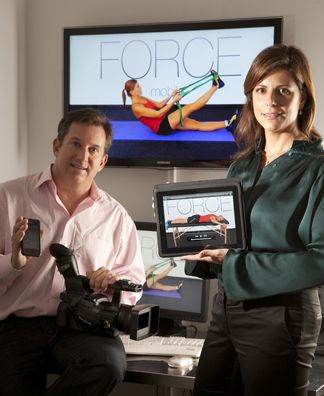
Founder Bronwyn Spira and her husband Mark Lieberman
“Over the years, having treated thousands of patients, I have observed that they commonly encounter challenges such as difficulty accessing timely care, difficulty understanding medical instructions, limited health literacy, and low engagement in the healthcare process,” Bronwyn explained, sharing the inspiration behind her startup. “I have also witnessed firsthand how significantly these barriers impact patient recovery.”
“With these insights, I felt it was my duty to establish a platform to improve patients’ healthcare experience. I also have a clear understanding of what healthcare providers truly need in terms of clinical problem-solving, data collection, and workflow optimization. Repeatedly witnessing the obstacles faced by both patients and physicians in my work was deeply frustrating, and this frustration, combined with advances in immersive technology, became the catalyst for my entry into the health tech industry.”
“I found that video is an excellent tool for communication and education, providing a bridge for remote interaction with patients. The fact that we can always offer video guidance to patients, whether they are at home or in the office, inspired me early on,” said Bronwyn, discussing the operational model of their software.
After developing Force Therapeutics’ application and operating it with patients as test subjects for a period, Bronwyn Spira left her familiar clinical healthcare world to devote herself fully to entrepreneurship. By that time, Force Therapeutics had already achieved modest success and earned a strong reputation among its users.
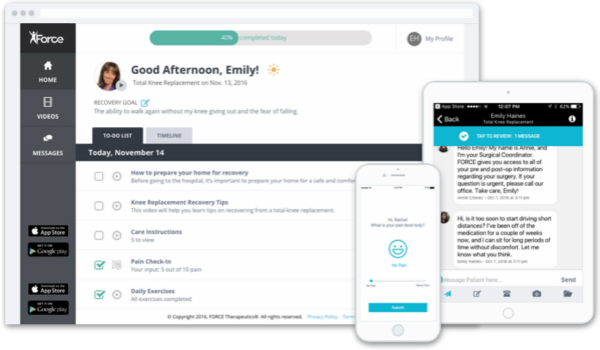
Force Therapeutics User Interface
The software provided by Force Therapeutics supports access via smartphones, tablets, and PCs. The program features numerous innovations: it not only facilitates communication between patients and physicians but also enables remote real-time patient monitoring, tracks pain levels, and customizes rehabilitation plans for individual patients. Additionally, it allows users to schedule appointments online and conduct video consultations.
The company leverages information technology to integrate clinical audio, interactive video education, and doctor-patient communication, building an information platform directly on top of the existing workflows of healthcare institutions.This application is primarily designed for patients undergoing out-of-hospital rehabilitation. By creating daily personalized rehabilitation plans, it enables them to actively participate in their own recovery process, thereby achieving more optimal outcomes.。
As the patient's recovery progresses,Their real-time physiological data and results will be collected by the software and promptly reported to physicians., enabling medical teams to gain unprecedented disease monitoring experiences and out-of-hospital treatment outcomes.
On iOS and Android devices, the software provided by Force Therapeutics for patients is called Force Patient,It helps patients watch home exercise videos, track their adherence to medical advice, read medical education materials, and receive recommendations for purchasing physical therapy equipment, while also obtaining real-time information from their primary care team.. The client designed for medical teams is called Force Provider, enabling physicians to conveniently monitor patients' exercise levels and recovery outcomes at any time.
VCBeat has learned that a patient named Michael Greco was pleased to try this new care model. He had undergone knee replacement surgery with an orthopedic surgeon at the Rothman Institute. However, after returning to his home in Egg Harbor Township, New Jersey, he found it difficult to access further professional care. He then turned to the Force Therapeutics app, using it daily to track his pain levels and correct his exercise techniques.
Greco stated that although costly in-home therapy should be the norm, and recovery might be better achieved using professional equipment at a specialist’s clinic, the rehabilitation model offered by Force is more convenient and cost-effective.
“I have a smartphone, and I’m willing to try any new technology,” Greco said as he demonstrated the exercises he performs three times daily. “I don’t need to worry about anything.” After one month of rehabilitative exercise, he expressed optimism, remarking, “I didn’t expect Force to make this process go so smoothly.”
Force Therapeutics believes that the healthcare industry is undergoing rapid transformation, requiring better patient outcomes with fewer resources. To achieve this, healthcare providers need to seek new approaches beyond traditional management methods.
In 2013, Force Therapeutics partnered with the Rothman Institute, at which time the platform had only 400 patients; by 2015, the patient count had surpassed 8,000. Currently, the Rothman Institute is also one of the investors in Force Therapeutics. Over the past five years, they have collected data and implemented continuous improvements involving tens of thousands of patients across multiple medical departments. Their clients’ end-to-end engagement in the treatment process has exceeded 80%, and patient satisfaction has increased by more than 20%.
In April 2016, the Centers for Medicare & Medicaid Services (CMS) launched the Comprehensive Care for Joint Replacement (CJR) program, in which approximately 800 hospitals across 67 major metropolitan areas in the United States participated. Under this program, hospitals performing joint replacement surgeries for Medicare beneficiaries are held accountable for medical expenditures and follow-up care during the 90-day postoperative recovery period. This approach, known as the “bundled payment system,” requires hospitals to provide end-to-end services for Medicare beneficiaries, ranging from surgery to rehabilitation.
This differs from the previous capitation-based health insurance payment model. It requires hospitals to be accountable for patient treatment outcomes. Hospitals will incur losses if they provide excessive treatment in unnecessary areas, and they will face penalties if patients require readmission for postoperative care. However, if hospitals can conserve medical resources while ensuring treatment efficacy, they will reap greater financial benefits from such savings.。
This means that hospitals must bear all costs associated with patient management, surgery, hospitalization, readmission, and post-discharge care; therefore, hospitals are compelled to strive for both improved treatment outcomes and reduced healthcare costs. In February of this year, VCBeat reported that Force Therapeutics had entered into a two-year contract with the Northwell Health (formerly known as North Shore Long Island Jewish Health System) medical network. This healthcare network comprises 21 hospitals and more than 550 outpatient facilities.
They will collaborate to build a video-based, customized medical service platform that enables effective monitoring by medical teams and real-time communication with physicians for patients during their recovery after orthopedic surgery. This technology seamlessly connects patients undergoing joint replacement and fracture surgeries with their doctors and care teams. The entire process is activated from the moment the patient begins surgery, aiming to improve treatment outcomes, reduce post-discharge readmission rates, increase the number of patients opting for home-based rehabilitation, and effectively lower healthcare costs.
Its overall approach is,Intervene during the early stages of patient rehabilitation and provide remote guidance; if rehabilitation outcomes are suboptimal, physicians can be promptly notified to conduct follow-up care and initiate timely subsequent treatment.. The bundled payment system in medical insurance directly incentivizes the healthcare system to prioritize patient recovery outcomes. Since telemedicine is already included within this bundled payment framework, it alleviates many concerns for both patients and hospitals, leading them to naturally embrace this new approach.
“We see tremendous potential in mobile applications. Our medical team can quickly identify the primary causes of many complications before, during, and after joint replacement surgery,” said Dr. Giles Scuderi, Vice President of Orthopedic Services at Northwell. “Force provides a convenient communication channel between patients and their care teams, aiming to improve treatment outcomes and reduce healthcare costs.”
 The doctor is using a tablet to discuss the patient's condition.
Last year, Northwell and Force Therapeutics collaborated on a nine-month pilot project, tracking the use of their new software by more than 200 patients and orthopedic surgeons at Lenox Hill Hospital in Manhattan and Jewish Valley Stream Hospital on Long Island.
Zenobia Brown, Medical Director at Northwell, candidly stated, “In-hospital management of orthopedic care is merely the tip of the iceberg in the entire treatment process.” She praised Force Therapeutics’ software, noting, “Under the new bundled payment policy, lower readmission rates are closely linked to overall patient satisfaction and hospital healthcare costs. This software enables patients after discharge and our medical team to collaborate and communicate in unprecedented ways.”
As of press time, seven hospitals within the Northwell Health network have begun using the software, with more than 1,300 patients enrolled in the program. The technology will also be deployed across other Northwell-affiliated hospitals and orthopedic outpatient clinics.
In a phone interview with Bronwyn Spira, CEO and founder of Force Therapeutics, she revealed that the signing of this contract has increased the number of hospitals participating in the Northwell Health network to 24. Although Northwell Health’s current operations are confined to the New York City area, Force Therapeutics also collaborates with other healthcare networks, including Geisinger, and is planning partnerships with hospitals in the U.S. Midwest following recent internal discussions.
As bundled payment models under Medicare gain widespread adoption across the U.S. healthcare system, it is foreseeable that more hospitals and a broader range of medical specialties will participate in this value-based payment model.
“Fortunately, given our market positioning, we will soon be able to make significant strides,” said Bronwyn. “We have greatly enhanced the patient user experience, improved the operational efficiency of healthcare networks, and also achieved better patient rehabilitation outcomes. These are major challenges for the vast majority of healthcare institutions.”
Bronwyn believes that the reason their program stands out in the fiercely competitive internet healthcare sector isIt is because they tailor personalized rehabilitation plans for patients.. For instance, physicians may use videos to explain to patients the various aspects of care from the preoperative phase through postoperative recovery. Moreover, these instructions are not provided by just any doctor; all guidance comes directly from the patient’s own primary surgeon.
However, VCBeat has learned that although Force Therapeutics’ business scope has primarily focused on orthopedics to date, Bronwyn stated that the company is actively working to incorporate cardiac care programs into this bundled payment system, including those for acute myocardial infarction and coronary artery bypass grafting (CABG) surgery.
On July 7, 2016, Force Therapeutics secured $2.5 million in financing. Mark Lieberman, Bronwyn’s husband and the company’s president, stated in an email that the funds would be used for product development, capital expansion, and entering overseas markets.
In addition to Force Therapeutics, many other internet healthcare companies are setting their sights on the telemedicine market. Although their target areas and operational models vary, they share a similar starting point: leveraging advanced mobile devices and information technology to enable real-time monitoring and remote guidance.
Reflexion Health is an internet healthcare startup with a business model similar to that of Force Therapeutics, focusing on leveraging bundled payment systems to provide remote rehabilitation support for patients undergoing hip and knee replacement surgeries.
Unlike the mobile app approach adopted by Force, Reflexion Health developed its own hardware and established a virtual rehabilitation platform called Vera, which leverages Microsoft Kinect technology to assist patients with rehabilitative exercises. By projecting an avatar onto the screen to serve as a rehabilitation coach, the system guides and motivates patients to actively engage in their home-based recovery routines. Furthermore, Reflexion Health’s device functions as a remote monitoring tool, enabling physicians to collect data on patients’ recovery progress, schedule virtual consultations, monitor adherence to medical advice, and optimize treatment plans in real time.
In June last year, Reflexion Health completed a $18 million Series B financing round to help its first batch of devices gain approval from the U.S. Food and Drug Administration (FDA). Companies such as reponddesign and ewell are also competing with Reflexion Health and Force Therapeutics in this field. It remains to be seen how much the FDA’s approval of Reflexion’s devices will reshape the market landscape.
Trinity Health, based in Michigan, has also begun adopting remote monitoring technology from telehealth provider Vivify Health. The vendor offers a home kit called “Pathways+,” which pairs customized 4G tablets with wireless vital signs monitors. Targeting high-risk patients and the elderly, the solution aims to safeguard patients through continuous remote monitoring and education, thereby reducing hospital admission rates. Trinity also expects to integrate predictive analytics into this remote monitoring system, enabling the accurate identification of potential health risks before patients develop clinical issues.
Medical device developer Cohero Health also attempted, three years ago, to develop remotely connected devices capable of real-time monitoring of patients’ lung function and medication adherence. Initially, their target population primarily consisted of patients with asthma, chronic obstructive pulmonary disease (COPD), and cystic fibrosis who required inhalation therapy. Today, however, their customer base has expanded far beyond this group to include not only healthcare systems and pharmaceutical companies but also life insurance providers.
In an interview, Melissa Manice, Co-Founder and CEO of Cohero Health, stated that the company made significant strides in 2016 and had already established strong user stickiness. She also revealed that several pharmaceutical companies had expressed keen interest in the potential of their remote monitoring devices for tracking patients’ clinical manifestations, although she did not disclose the names of these companies.
The companies listed above represent only a small fraction of those involved in the telemedicine sector; the competition for this emerging market has already quietly begun.