

Rehab Community: Building China's First Full-Process Rehabilitation Ecosystem in a Trillion-Yuan Blue Ocean Market
In 2017, VCBeat launched a case study solicitation campaign themed “The Power of Grassroots: Seeking Best Practices in China’s Primary Healthcare.” Starting on February 15, the call for submissions targeted primary healthcare service practice cases across the entire industry. We will explore development trends in the primary healthcare sector from dimensions including industrial policy, technological evolution, business models, and industry collaboration, and select and report on innovative medical enterprises that truly represent and are deeply rooted in grassroots communities. Stay tuned.
ClickRegistration Address, enter the event introduction page.
Through the registration portal for VCBeat’s (WeChat: vcbeat) initiative, “The Downward Force—Seeking Best Practices in China’s Primary Healthcare,” we connected with Kangfushe, a national rehabilitation platform currently taking shape. It has enshrined the following statement in its mission: “To build a large-scale platform serving primary care and to establish China’s premier rehabilitation ecosystem.”
Platforms with such grand vision and confidence are rare, sparking our curiosity about Kangfu She.
In an interview with founder Wang Jun, VCBeat learned that the rehabilitation industry only began to gain significant attention after the 2008 Wenchuan earthquake. Currently, there are approximately 20,000 to 30,000 certified rehabilitation therapists in China, resulting in a ratio of just 0.4 therapists per 100,000 people. The shortage of rehabilitation therapists is projected to reach 300,000 within the next few years. What has caught hospitals and rehabilitation institutions off guard is that, as population aging intensifies, integrated medical and elderly care projects and private hospitals are proliferating. Meanwhile, public awareness of rehabilitation is awakening, further widening the gap between supply and demand.
And the Rehabilitation Society can be described asOne of the few platforms in China that encompasses resources across the entire rehabilitation industryFrom rehabilitation therapist training, communication and liaison between rehabilitation medical institutions and therapists, and sales of rehabilitation products, to patient education, doctor-patient communication, and referral services, all these functions are interconnected into a network on the platform. It is worth mentioning that Hongkang Weiye, the company behind Kangfu She, was the pioneer in introducing and promoting internationally advanced sports rehabilitation centers for bone and joint conditions, as well as neurological rehabilitation medical programs.
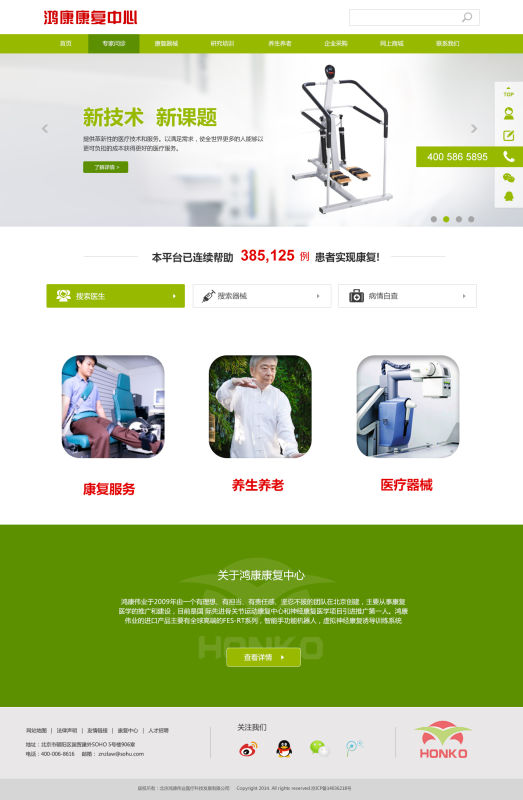
Rehab Society Website: Encompassing Nearly All Resources Across the Rehabilitation Industry
Cultivating Talent and Introducing Equipment to Address Two Critical Needs in Rehabilitation
Mr. Wang told us that modern medicine integrates prevention, clinical treatment, and rehabilitation into a tripartite framework. The rehabilitation industry is primarily responsible for the downstream and upstream segments of the healthcare sector; however, public awareness of medical care remains largely confined to inpatient treatment—the middle segment. It is considered downstream because rehabilitation often assumes responsibility for post-discharge recovery. It is also regarded as upstream because rehabilitation facilities serve a referral function when medical intervention is required during physical therapy. Despite its critical importance, the rehabilitation sector has yet to establish comprehensive, standardized protocols. Mr. Wang believes that two essential needs must be met to strengthen the rehabilitation industry.
The primary essential need is for rehabilitation professionals.. The field of formal rehabilitation therapy is, in fact, very broad. Rehabilitation programs in neurology, orthopedics, pediatrics, cardiopulmonary medicine, psychology, and oncology all require specialized rehabilitation therapists.
“China’s rehabilitation sector developed relatively late, resulting in a severe shortage of specialized professionals. In the early stages, rehabilitation services were primarily provided by practitioners with backgrounds in traditional Chinese medicine (TCM) and nursing. Today, however, university graduates majoring in rehabilitation are unable to assume clinical roles directly due to a lack of practical experience.” To address the critical scarcity of rehabilitation talent, Kangfu She has identified an inevitable path forward: investing heavily in training.
Thus, the Rehabilitation Society introducedContinuing Education for Rehabilitation TherapistsSection. The platform integrates resources from renowned rehabilitation experts across more than thirty provinces in China, allowing all practitioners to receive expert training and guidance, as well as purchase training videos and courseware. For rehabilitation therapists seeking certification, both online and offline training courses are available. Currently, the training section of Kangfu She (Rehabilitation Community) receives at least 2,000 unique visits per day.
The second major essential need is rehabilitation equipmentDue to staffing shortages and the specific nature of certain medical conditions, rehabilitation equipment has become an indispensable tool in rehabilitation departments. Rehabilitation devices are categorized into various types based on their therapeutic objectives, such as assessment equipment, occupational therapy, kinesiotherapy, physical therapy, swallowing therapy, and traditional therapies. Currently, a wide array of imported and domestically produced rehabilitation robots have also entered the market. Consequently, faced with a vast variety of devices with numerous models and uneven quality, many rehabilitation institutions struggle due to limited information. They find it difficult to determine which manufacturer’s products to purchase, unable to aggregate and compare all product information to identify the most cost-effective options.
To address this need, the Rehabilitation Society has established“Rehabilitation Equipment Park”section, presenting a wide range of imported and domestically produced rehabilitation equipment on the platform for users to choose from. Whether it is the simply constructed “Finger Ladder,” complex rehabilitation robots, or novel VR scenario-based interactive rehabilitation training systems, all can be viewed and purchased on the Kangfushe website.
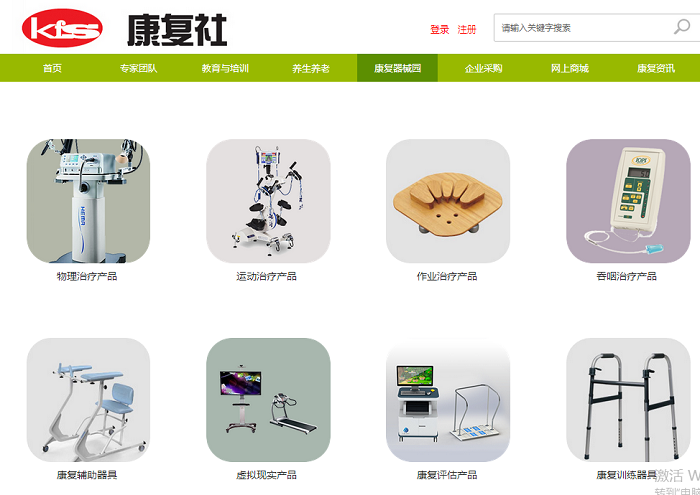
“Rehabilitation Equipment Park” Section
Born with a natural affinity for the grassroots, bringing rehabilitation back to ordinary households
The inherent nature of the rehabilitation industry dictates that it maintains close ties with primary care. However, a paradox exists:Rehabilitation resources are not most concentrated at the primary care level., but rather in major cities such as Beijing, Shanghai, Guangzhou, and Shenzhen, and in regions with abundant medical resources.
However, in recent years, national policies have increasingly focused on primary-level rehabilitation medicine. Starting from June 30, 2016, the number of rehabilitation services covered by medical insurance increased from 9 to 29, which is undoubtedly a significant positive development for the rehabilitation medical industry.
Kangfushe has also capitalized on the new momentum in primary healthcare and tiered diagnosis and treatment. It collaborates closely with both grassroots family doctors and higher-level hospitals, while providing residents with standardized establishment and maintenance of electronic health records. When residents require medical care, they can log into the Kangfushe platform to consult their family doctors. If a family doctor is unable to provide the necessary treatment, they will issue a referral through the platform, directing the patient to the rehabilitation department of a higher-level hospital.
In the tiered diagnosis and treatment system, downward referral remains a major pain point due to public distrust in the quality of primary care. In fact, patients referred downward are precisely those entering the optimal phase for rehabilitation. Kangfu She serves as a platform connecting rehabilitation resources across China, enabling primary care institutions to directly access rehabilitation experts from tertiary hospitals, including those in Beijing, Shanghai, and Guangzhou.
In addition, Kangfu She’s online and offline rehabilitation therapist training programs are themselves bringing the expertise of rehabilitation specialists from renowned hospitals across China to the grassroots level, providing the industry with “the shoulders of giants.” When there is a demand for rehabilitation services in a particular locality, the platform can also push nearby rehabilitation therapist resources.
Fear No Hardships, Stay True to the Original Mission
"Reflecting on his entrepreneurial journey, Wang Jun was quite emotional."
Hailing from a family of medical practitioners, Wang Jun served as Regional Manager at Novartis Pharmaceuticals for four years and as Sales Director at Gan & Lee Pharmaceuticals for another four years, where he was one of the founding members of the sales team. Throughout his career, he has maintained close engagement with clinical practice, witnessing the profound suffering endured by countless patients and their families. He recognizes that rehabilitation medicine can significantly alleviate post-acute sequelae, thereby enhancing the quality of life and dignity of patient populations.
In 2008, Wang Jun entered the field of rehabilitative medicine, founded his own rehabilitation equipment company, and vigorously promoted both rehabilitation devices and the concept of rehabilitative care. During this process, he observed that medical institutions suffered from a shortage of qualified professionals and equipment; in some cases, even available equipment remained idle. Among patients, those who embraced the concept of rehabilitation often lacked proper guidance, while many others were deceived by products with exaggerated efficacy claims found in residential communities and advertisements, resulting in unnecessary financial losses and detriment to their health.
In 2014, he reached a consensus with a colleague specializing in IT infrastructure development that the company urgently needed to establish a platform to integrate its rehabilitation resources and maximize their impact. Together with an MD with whom he had previously worked at Novartis, they formed a core team with complementary expertise and access to valuable medical resources.
To date, the Kangfushe team has primarily facilitated multi-party coordination of rehabilitation resources in Beijing and Inner Mongolia. However, Wang Jun emphasizes that Kangfushe is a nationwide platform, allowing all doctors and rehabilitation therapists across China to register on the platform, thereby bringing offline patients online to facilitate communication and management. “We aim to establish a viable model based on our operations in Beijing and Inner Mongolia, and then gradually deploy a comprehensive rehabilitation ecosystem in other regions across the country.”
To make the Kangfushe website align as closely as possible with user habits, the team invested considerable effort in its design and navigated many detours. One particularly memorable instance was when, to address the inconveniences in registration and bookmarking, the team made the decisive move to overhaul the entire website framework within four to five days, thereby streamlining the user operations"Three-Step Precision", meaning that the process of finding experts, information, and products takes no more than three steps.
In terms of finer details, the Kangfushe website has also undergone meticulous design and refinement. For instance, since many individuals undergoing rehabilitation therapy are elderly and lack proficiency in using computers and smartphones, the team designed the user’s personal center to beOne Person Manages the Whole Family's Health Recordsmodel, all family members' medical records, medical images, and other data can be archived under a single account, organized by each individual's name and specific medical conditions.Moreover, to ensure data accuracy and security, the uploaded materials must be images of the original medical records.。
Throughout the entrepreneurial journey, Wang Jun has maintained ongoing communication with rehabilitation medicine experts across China. He told VCBeat (WeChat ID: vcbeat) that the experts’ views can be summarized into two main points: First, the initiative he is undertaking holds significant importance for the rehabilitation industry. With the full arrival of the internet era, rehabilitation care requires heightened attention from all rehabilitation professionals, as well as support and guidance from national policies. Second, they express their support for Kangfu She (Rehabilitation Community) and will do their best to provide assistance.
Last year, Xie Yuxiao, a renowned expert at China-Japan Friendship Hospital, invited Kangfushe to join the Chinese Tele-Rehabilitation Expert Alliance and told Wang Jun that they greatly appreciated Kangfushe’s mission-driven ethos, offering all their rehabilitation medical resources to the platform. “This gave our team the greatest affirmation and confidence.” In addition, Kangfushe is alsoInaugural Member of the Rehabilitation Professional Committee of Non-Public Medical Institutions。
To date, Kangfushe has helped tens of thousands of patients achieve recovery. Wang Jun stated that the greater the challenges in the rehabilitation industry, the greater the opportunities. Most importantly, it is essential to remain true to the original mission and attract and assist more people in jointly building China’s rehabilitation medical ecosystem.