

Another Theranos? Proove Biosciences Accused of Forcing Dubious Genetic Tests and Falsifying Data
This article is sourced from STAT News and translated by VCBeat, which does not represent the views of VCBeat.
Silicon Valley blood-testing company Theranos has collapsed due to exaggerated claims,Once Valued at $9 BillionWill Proove Biosciences become the next Theranos?
Genetic testing is all the rage. Proove Biosciences, a genetic testing company based in Irvine, California, bills itself as “the leader in personalized pain medication.” Its claim that its tests can help address the nation’s opioid crisis has garnered extensive coverage from media outlets eager to praise it.
The company claimed it “could use precise predictions to keep patients away from opioids.” However, when STAT reported this in an article last December, leading experts in the field strongly disputed the company’s assertions, dismissing them as “nonsense.” Following the publication of the report, both current and former employees of Proove immediately contacted the journalist, revealing deeper insights into the company’s business practices.

Proove’s California Headquarters
They say,Proove manipulates patients into undergoing unnecessary and unreliable tests, turning guided clinical research largely into a means of increasing revenue., and pay for physicians’ non-core services, which legal experts argue runs counter to anti-kickback regulations. Below is STAT’s investigative article on Proove Biosciences.
Proove is, in fact, just one among many companies that sellDNA-Based Personalized “Lab Maturity” Test”, with almost no credible scientific basis. These companies represent a profitable segment of the multi-trillion-dollar genetic testing industry, and their operations are largely unregulated.
Former scientists and managers of the company stated,CEO Brian Meshkin is a charismatic entrepreneur, but he lacks formal scientific training, thus turning Proove’s research into a marketing tool.. In an investigative article, the reporter detailed how the company earns millions of dollars each month by leveraging diagnostic tests that are not endorsed by scientists at leading firms.
Other major findings include:Employee Falsifies Research Data on the Validity of the Company’s Genetic Testing. Opioid sensitivity testing, along with outcomes from many other drug delivery methods, contradicts the company’s regular treatment recommendations.
This report draws on extensive interviews with current and former Proove physicians, scientists, executives, sales staff, and research assistants. It also includes a review of thousands of pages of leaked documents. VCBeat will reveal the findings in detail.
A California-based medical laboratory issued a brochure that made the content sound like an easy way for physicians to make money.Each participant in the genetic testing study is required to pay a $30 fee, which is used to help select the most effective analgesic medication for each patient.An ordinary physician can earn $144,000 annually in “research funds.”
However, the clinical trials were largely designed to boost Proove Biosciences’ revenue, with many contracted physicians not actually participating in the trials, according to current and former employees of the company.
Amid growing public concern over opioid addiction, Proove has rapidly advanced thanks to extensive research in this area. Proove is one of many companies offering personal DNA testing services to consumers.There is a scarcity of credible scientific data to support the reliability of the test.. The proliferation of DNA testing services is due to the lack of government oversight in the genetic testing industry, which has given rise to a market worth tens of billions of dollars.
STAT Investigation Finds Proove Employees Stationed in Physicians’ Offices Drove Unnecessary Patient TestingThis was a “mandatory” practice implemented by a former manager, whereby employees would sometimes complete research assessment forms on behalf of physicians and rate the interventions as highly effective even when the observed outcomes were only moderate.。Proove’s DNA testing, which obtains samples by swabbing patients’ cheeks, is in fact highly unreliable, and many physicians disregard the test results.. The company’s former chief scientist stated that the test claims to improve patient recovery outcomes but lacks supporting evidence.
The company is housed in two modern buildings in Irvine, California, situated within a thriving life sciences corridor. The company also misled insurers into making payments to boost its revenue by submitting copies of insurance policies for both current and former employees.
Proove claims to be “the personalized leader in pain treatment,” stating that its test predicts patients’ responses to analgesics and identifies those at risk of developing opioid dependence.
Television news reports stated that the company has profited significantly from its role in helping to combat the opioid crisis.Employees and physicians who have worked with Proove stated that this characterization of the product was hyped by the company’s Chief Executive Officer (CEO), Brian Meshkin, who lacks a scientific background and is known for his exceptional salesmanship and self-promotion skills.。
“Meshkin disregards medical needs, ‘thinking only about money. He wants as many people as possible to undergo testing; he even hopes that individuals with a common cold will come in for facial swabbing to assess their risk related to opioid use,’ said Beth Stevens, former manager at Proove, who left the company last year following a conflict with its CEO.”
Meshkin declined interview requests and responded to only one of the numerous written questions. In an email, he stated, “Proove operates in accordance with the law and (intends to) comply with both the letter and the spirit of legal provisions.”
But legal experts told STAT that the company’s methods of funding physicians may have violated anti-kickback laws, as these doctors were involved in trials for two Proove products currently under development—products that are critical to the company’s approximately $2 million in monthly revenue.
STAT began its review of Proove at the end of last year, following engagements with current and former employees of the company. These employees had read an article highlighting the lack of evidence supporting the company’s flagship opioid risk test. The investigation included interviews with 12 current and former employees, as well as four physicians who collaborated with Proove. STAT also obtained thousands of pages of internal company memoranda, billing and insurance records, and test reports.
On the other hand, the Federal Bureau of Investigation (FBI) and the Office of Inspector General at the Department of Health and Human Services are investigating Proove for potential misconduct, according to a former employee and a current employee of Proove, who stated that they were recently visited by federal agents. They indicated that the agents were focused on possible kickbacks, including payments made to physicians. The FBI and the Department of Health and Human Services (HHS) declined to comment.
For several years, the government has been scrutinizing testing services offered by companies under the guise of research. In 2014, the U.S. Department of Health and Human Services (HHS) issued a fraud alert warning laboratories that certain payment arrangements made to physicians in the name of funding “research” could violate anti-kickback laws applicable to laboratory testing. This alert was issued in the wake of a series of cases involving improper payments from laboratory companies to physicians.
In response to the HHS alert, Proove’s legal counsel drafted a memorandum for managers and sales personnel mandating compliance with applicable laws. Regarding other controversies, Proove stated that it would only provide compensation to physicians who personally conducted the research. However, both current and former employees of Proove, as well as physicians who have collaborated with the company, have disputed this claim.
In an interview, Dr. Titus Taube stated that when he signed on as a researcher at Proove, it “sounded like the wave of the future.”
He stated that he quickly became disillusioned and concluded that the payments were directed toward patients undergoing testing at Proove, as the research tasks—including questionnaire completion and assessment of test efficacy—were carried out by Proove employees in the office.
“If physicians are induced by improper benefits to conduct DNA sequencing tests through research projects, both the companies and the physicians may violate federal and state anti-kickback or other anti-fraud laws,” said Dr. R. Gregory Cochran, a physician and attorney specializing in relevant legal matters. He further stated that misleading advertising or unreliable tests could also expose companies to claims of fraud and abuse.
Proove’s “laboratory-developed tests” can be sold as long as they are ordered by a physician. These tests are designed and used by independent companies or hospital laboratories.Last year, Silicon Valley blood-testing company Theranos became a cautionary tale for errors in such testing, as its claim to rapidly diagnose dozens of diseases from minute blood samples was overly exaggerated. Theranos is currently under federal criminal investigation.。
In 2015, the FDA warned that certain laboratory-developed tests (LDTs) could harm patients by leading to misdiagnosis and inappropriate treatment. However, last year, the FDA withdrew its proposed regulatory guidance for these tests, leaving it to the newly appointed FDA Commissioner under President Trump and Congress to determine what regulations should be approved.
“The current regulatory gaps pose challenges to the sustained development of precision medicine, undermine the confidence of patients and physicians, and may slow the adoption of effective tests.“Andrew Fish stated. He is the head of AdvaMedDx, a trade group primarily serving developers of diagnostic tests.”
At least for now,Proove and similar companies can sell testing services without having to prove the results are true and valid.. Proove conducted genetic testing on six patients, and STAT obtained the trial report, which included multiple conflicting clinical recommendations.
A typical example cited by both former and current Proove employees is that, despite reports warning that patients are highly susceptible to respiratory issues when administered high doses of the synthetic opioid fentanyl, Proove still recommended standard dosing. The reports did not specify how physicians should proceed when prescribing fentanyl or what recourse would be available if their recommendations caused patient harm.
Christopher Coston stated, “Many doctors reviewed the report and said, ‘I don’t think so; this doesn’t make sense.’” He was previously responsible for managing Proove’s research assistants in the western United States and was dismissed by Proove in March of last year.
Dr. Oleg Gavrilyuk, a physiatry expert in San Diego, defended Proove. He stated that, in most cases, pharmacogenetic testing for his patients confirmed his clinical judgments; when it did not, he disregarded the results.
“Ford created the first automobile,” he said. “It was certainly not perfect. Today, Tesla is the most advanced. We should not restrict its development due to imperfections. This is the first step.”
Proove’s first clinical study underwent peer review, was based on data from 134 patients, and was not published in the Journal of Psychiatric Research until late January. In the study, physicians reported that most patients showed improvement after undergoing Proove’s pain perception assessment and receiving treatment decisions derived from its results.
Dr. Eric Fung is the General Manager of a biotechnology company. He temporarily served as the company’s Chief Scientific Officer in 2015 and co-completed this research study. In an interview, he stated that the study mined tens of thousands of patient records from the Proove database, yielding evidence to validate the efficacy of a certain test. He acknowledged that the findings were weakened by the absence of a control group, which would have consisted of patients who did not undergo the test.
Fung added that he left the company with skepticism about the efficacy of the tests. “I could not identify any statistical or clinical benefits from these tests,” he stated. “I was uncomfortable with the scientific research conducted by Proove.”
The dubious science did not stop Meshkin from building Proove, a private company described by Deloitte Consulting and Inc. magazine as one of the fastest-growing companies in the United States.
His method is simple:Recruit physicians as salaried “researchers” and provide them with financial support to conduct testing services for patients.
According to current and former employees of Proove, its operational model is as follows:Proove has conducted several large-scale pilots, requiring clinicians to assess the areas in which Proove can benefit patients. Currently, two ongoing pilots aim to screen 150,000 patients.。
Company sales representatives market research contracts to physicians, often targeting those facing financial hardship and seeking to supplement their income. They promise physicians easy work and stable earnings.
Last year, Meshkin stated that 400 physicians had ordered the Proove test service, with 150 of them signing contracts. However, physician turnover remained high due to withdrawals by dissatisfied physicians.
Proove stationed its 300 employees in physicians’ offices to instruct them on collecting buccal swab DNA samples from as many patients as possible and to recruit patients for clinical trials. Proove employees stated that patients were informed the testing was free. Employees were also required by the company to tell patients that their physicians had insisted they undergo the testing.
Even pain-free patients seen in family medicine and obstetrics-gynecology (OB-GYN) practices were recruited for pain and addiction-related testing. Coston, Proove’s former regional manager, stated that this seemed illogical, but if research assistants failed to do so, Meshkin would fly into a rage.
“Many doctors ‘test every patient who comes in for a visit,’” Coston said, “but they do not conduct research. Their incomes have been steadily rising, even though they are essentially doing nothing more than ‘renting space’ to Proove.”
Research assistants must devote at least half of their time to completing all research tasks, according to Stevens and other managers who supervise the assistants. When asked whether physicians profit from this work, she remarked, “If it quacks like a duck and walks like a duck, then it is undoubtedly a duck.”
Stevens stated that each research assistant was required to collect at least five buccal swab samples per day, a mandatory quota. Documents obtained by STAT indicate that assistants who exceeded this target received tiered cash bonuses.
Stevens claimed that Meshkin’s strategy was to “force” patients who did not need testing to undergo tests.
To maintain a steady number of patients undergoing testing, research assistants conducted surveys and obtained consent forms from patients. This made some patients feel threatened, according to several former and current employees.

Brian Meshkin (Howard County Library System/Creative Commons)
Some research assistants grew increasingly uncomfortable with the high-pressure tactics and ultimately chose to withdraw. “The assistants were tired of the attempts to persuade patients who did not want testing to undergo it,” said Stevens.
Fearing retaliation, a current employee anonymously stated that patient recruitment has become increasingly scripted and sales-driven. The employee noted that research assistants were instructed to avoid using the word “study” when enrolling patients, as some individuals object to being treated like “guinea pigs.”
“A former Proove manager, who requested anonymity, stated that assistants’ titles were changed from ‘Research Assistants’ to ‘Patient Engagement Representatives,’ while Meshkin instructed managers to recruit capable young professionals to fill the vacancies. These details were cited from a company non-disclosure agreement.”
It is of paramount importance that,Proove urges all physicians, regardless of their participation in clinical trials, to obtain a signed “consent form” from each patient to access Proove’s full suite of genetic testing services, including assessments for opioid misuse risk, pain sensitivity, and patient responses to opioids and other medications.。
Many physicians were reluctant to sign the “authorization forms.” However, by 2015, approximately 70% of doctors had signed them under pressure from Meshkin, the former manager stated. STAT has obtained instructions issued by Proove to its research assistants, authorizing them to collect DNA from any patient receiving care from participating physicians.
Meshkin emphasized that the decision regarding participation in testing, as outlined in the consent form, “is not up to the patient but is determined by the physician.” Stevens stated that patients “have no choice.”
Long-term prescriptions are common in medical practice, but this is not the case here. When patients undergo routine testing or treatment for known chronic conditions, physicians typically issue long-term prescriptions to streamline the care process. However, across different clinical practices, such prescriptions are difficult to apply universally to all patients’ genetic testing.
“Long-term prescriptions are usually a red flag, especially when patients have different diagnoses and needs, as in the above case,” said Cochran. He is the Associate Director of the Health Policy and Law Degree Program at the University of California, San Francisco, and also serves as an Associate Dean at UC Hastings College of the Law. “If physicians know they will be examining patients who have signed up and agreed to testing, kickbacks are inevitably involved.”
In his written statement, Meshkin stated that “Proove strives to ensure that each participating clinician independently determines whether testing is necessary for the patient,” and that “each patient must sign a consent form before undergoing the test.”
Meshkin fabricated a perfect story
Meshkin, the mastermind behind Proove, has launched a meticulously crafted personal website featuring photos that boast about himself and his family. The site is replete with praise for his character, business acumen, and personal achievements as a former member of the school’s board of directors. It also lists his honors, including the “Entrepreneur of the Year” award presented by the Orange County Business Journal in Southern California.
“Volunteer, civil servant, entrepreneur, coach—Brian Meshkin has worn many hats. But if you ask Brian who he is, he says he is simply the dream-driven, hardworking, and helpful Brian,” his unsigned personal biography on the website begins with these words.
Although he lacks any formal scientific training, he claims to be a “published researcher,” and he has not addressed the legal issues arising from previous genetic testing risks.
“Nutrigenomics” company Salugen sells gene-customized health supplements to customers through Las Vegas spas, and also directly to customers. In an interview last year, Meshkin stated that California authorities issued him a cease-and-desist letter for improper marketing in 2009, and shortly thereafter, he sold the company.
Both current and former physicians and employees at Proove have stated that the website effectively crafted a persona of an overly confident individual prone to fabricating stories.
Meshkin’s name appears as a co-author in the research abstract and in the recently published research report. Proove’s data was also presented at scientific conferences. One of the reasons Meshkin personally participated in the research was that Dr. Daniel A. Schwarz, Proove’s former Director of Research and Development, had announced his resignation.
Schwarz, a pain management specialist in Michigan, stated that he left Proove in 2015 due to concerns about the company’s scientific ethics. “A company’s research efforts cannot be directed by a CEO lacking a scientific background,” he said. “This is marketing, not science, and I cannot be part of it.”
Schwarz stated that scientific control became a critical issue when he began to doubt the validity of Proove’s work and sought to repair the company’s R&D system. Meshkin “would not listen to me,” he said. “He did not accept my advice; I felt he simply wanted to do things his own way.”
When a colleague stated that the patient’s research records had not been securely stored, Schwarz was horrified.Another former executive at Proove stated that data sheets piled up at the company’s headquarters, where they remained unused for an extended period.Due to the signing of a non-disclosure agreement, the former executive requested anonymity during the interview.
“Patients come first. If your product does not benefit patients, I cannot be part of this company,” said Schwarz.
According to Stevens, the company’s current head of biotechnology is Fung, a respected figure who holds an M.D. and a Ph.D. from Johns Hopkins University and was hired by Proove with great fanfare in 2015. Insiders at the company hope that Fung will bring about a significant transformation.
“I recall a clinical researcher under Fung telling me, ‘If Fung leaves the company, we will all leave,’” Steven stated.
Three months later, Fung left Proove.
Georgia family physician Dr. Taube stated that he has directly witnessed how unreliable Proove’s testing and research are. Sales representatives initially approached him, and four months later, he signed a contract with Proove. Dr. Taube expressed interest in Proove’s vision of advancing precision medicine, and he was also impressed by the support Proove received from Medicare and other insurance companies, which Proove refers to as “sponsors” of its research.
Initially, he was required to complete the research forms himself, which included a “Researcher Intervention Assessment” designed to evaluate whether Proove’s testing benefited patients or influenced their recovery. However, he stated that a Proove manager told him, “You don’t need to fill it out; (our staff) will take care of it.”
Under a non-disclosure agreement, a former Proove executive stated anonymously that some physicians received compensation even after submitting study forms that were partially completed or left entirely blank, a practice that was subsequently widely adopted.
Subsequently, Taube would sign the assessments prepared by Proove’s research assistants without reviewing them in detail. However, as he began to realize that these clinical trials were primarily marketing tools, he examined the assessments he had signed more carefully. To his surprise, he found that Proove’s tests consistently received the highest ratings, despite demonstrating minimal therapeutic benefit for his patients.
"The test results often contradict patients' personal experiences," he stated. For instance, the results indicated that several of his patients should not be taking losartan, as it is an antihypertensive medication that is difficult to metabolize. However, these patients had been taking this drug for many years without experiencing any adverse effects.
Taube has recently stopped signing new patients for Proove, stating that he wants to know, “Are these data credible enough for me to trust?”
According to current and former employees of Proove, his experience was typical. They stated that Proove managers instructed representatives to always assign scores of 4 or 5 (on a 5-point scale) when rating tests, even if the tests had no impact on patients’ clinical recovery.
Another former Proove executive who signed a non-disclosure agreement stated that even Dr. Daniel R. Kendall did not trust the test results. Dr. Daniel R. Kendall is an orthopedic surgeon at the National Spine Rehabilitation and Pain Relief Center and served as the principal investigator for Proove’s clinical trial program involving 50,000 patients.
A former executive at Proove stated that a review of data from 1,500 patients revealed that Proove’s testing did not improve patient recovery outcomes.
Kendall had previously conducted tests on these patients. In an email, Kendall disputed this conclusion. He did not provide any materials for the audit and shifted all questions to Proove. In the email, he stated that Meshkin had indicated that patients at the National Center for Spinal Rehabilitation and Pain Management showed “significant therapeutic improvement,” but he provided no detailed explanation.
Clinical trials can help improve testing effectiveness, but insurers often refuse to cover the costs, prompting Proove to devise another revenue-generating approach: creative billing.
Insurance companies consider many Proove tests to be experimental because they lack evidence demonstrating their utility in patient diagnosis and treatment.. Some former employees stated that the consequence of denial was that Proove would periodically withhold salaries from sales representatives and even terminate their employment.
Proove also failed to pay salaries to the many physicians who supported its research, including Taube; even those doctors who were directly involved did not receive their compensation. Coston stated that this was “the main issue my physician colleagues were vocally upset about.” Taube noted that the company faced criticism for its slow insurance reimbursement processes.
By 2014, Proove was able to perform multiple tests using a single buccal swab. However, current and former employees of Proove stated that if insurance reimbursement rates were based on the type of specimen collected, the reimbursed amount would be lower than the cost of alternative tests that the company believed could yield equivalent results.
Consequently, Proove adopted a new billing strategy in 2015. Documents show that Proove no longer consolidated charges for multiple genetic tests performed on the same service date onto a single invoice; instead, it “split” the charges across several invoices based on the publication dates of the laboratory reports. Both current and former employees stated that this was a common practice.
The company may submit the bill for the “Opioid Risk Test” to insurance companies on Monday, followed by the bill for the “Pain Perception” test the following Monday, and so on, thereby demonstrating that the patient has undergone multiple tests. Combined bills typically range from $7,000 to $10,000.
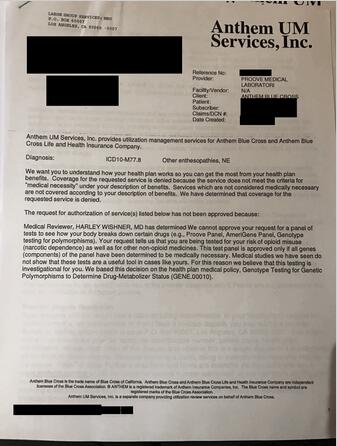
STAT’s investigative documents on Proove are on page 19 (provided to DocumentCloud by STAT’s Charles Pillar)
“A Southern California physician, who requested anonymity, stated that he has abandoned Proove’s testing.”
“The bills they submitted to insurance companies were four times the amount they initially told me they would charge. Several of my patients became very distressed because the fees charged to their insurers were unreasonable,” the physician stated in an email. This reaction is common among physicians, according to current and former employees of the company.
Michelle Cavanaugh stated that tiered pricing “can address systemic issues.” He is an expert at Kareo, a medical billing company based in California.
“Is there a legitimate rationale in clinical trials for assigning participants based on different dates?” asked P. Thomas Hirsch, Director of the Laboratory Billing Resolution Center at Plymouth State University in New Hampshire. After hearing the description of the Proove trial, he stated, “If they cannot provide a justification, it is deceptive.”