

Chinese Medical Enterprises Invest Over $5.8 Billion Overseas in One Year: Where Did the Money Go?
Since the beginning of 2016, spanning more than a year, “overseas medical asset allocation” has become a hot topic for Chinese enterprises. With transaction records being broken repeatedly and patented medical technologies being acquired one after another, Chinese companies are nearly scrambling to enter the international healthcare market. Public data compiled by VCBeat (WeChat ID: vcbeat) shows that the total amount involved in all cases exceeds $5.8 billion (over RMB 40 billion), with the value of individual M&A transactions also hitting new highs.
Regarding the overseas medical capital investments made by these enterprises, we must ask several questions: Which countries have received the funding? Which medical sectors have been targeted? What is the nature of the investing entities? Which specific events and companies warrant attention? What insights can be drawn from these trends? We will provide answers to each of these questions through data-driven and phenomenological analysis.
(Note: The data mentioned in this article is derived from partial public information on overseas medical investments and mergers and acquisitions.)
Data source: VCBeat, VCBeat Research Institute database
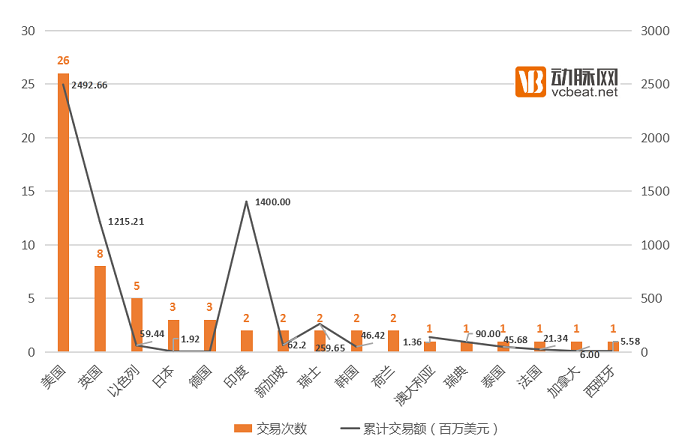
From early 2016 to the present, the region with the most concentrated overseas healthcare M&A investments from China isUnited States, for a total of 26 times. The United Kingdom ranks second with 8 occurrences, followed by Israel, Japan, Germany, and others.
According to publicly available transaction data, Chinese enterprises recorded the highest total investment and M&A value in the U.S. healthcare sector, reaching $2.492 billion; India, with only two reported deals, ranked second at $1.4 billion.The known transaction amounts in the United States, India, and the United Kingdom have exceeded the $1 billion mark.。
Data Source: VCBeat, VCBeat Database
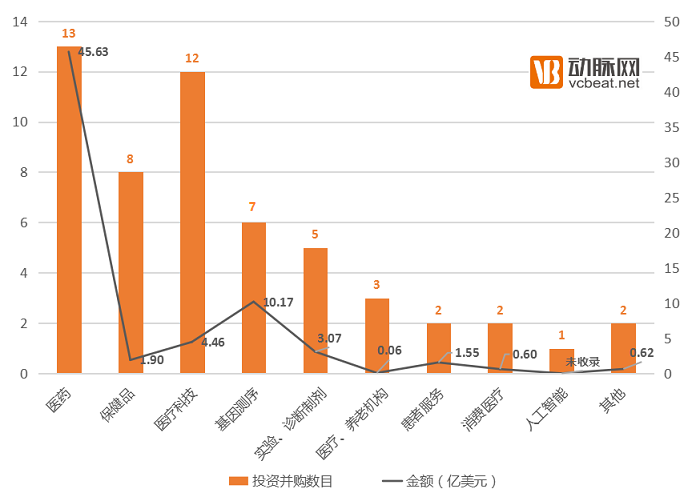
Based on public data collected and compiled by VCBeat (WeChat ID: vcbeat) and VBInsight, we have categorized all overseas healthcare investment and M&A activities from the beginning of 2016 to the present into nine major sectors.
In the pharmaceutical and healthcare sector, there were 13 overseas investment and M&A deals, with a total transaction value exceeding USD 4.5 billion, ranking first in both number and amount. Among all the cases included,The top three transactions by value all stemmed from investments in the pharmaceutical sector.。
Investment in the health supplements sector ranked second in terms of deal count, yet the total disclosed transaction value remained modest; in recent years, this field has witnessed repeated breakthroughs in both technology and pricing.Genetics Field, the overall number of overseas investment and M&A transactions (7) and the total amount (over US$1 billion) were both substantial.
The pharmaceutical and gene sectors command higher valuations due to factors such as R&D risks, leading to elevated total investment and M&A volumes. In addition, overseas transaction values are also substantial in the fields of medical technology, medical devices and equipment, and laboratory diagnostic reagents.
Data Source: VCBeat, VBInsight Database
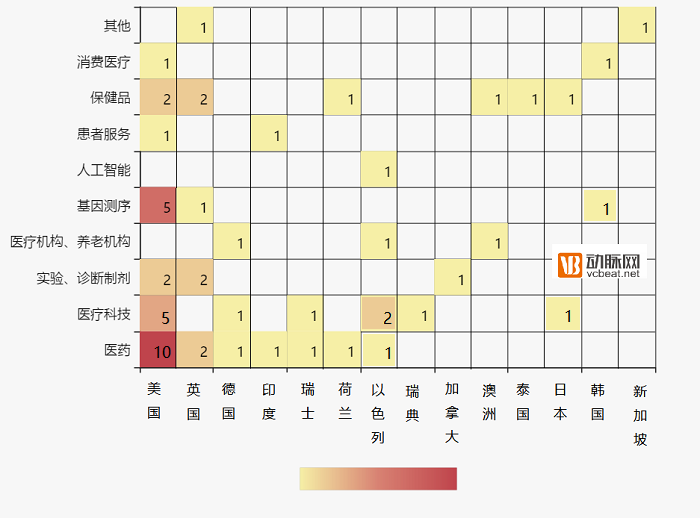
A review of transaction data across various sectors in different countries yields the following key insights:
1. Major Overseas Healthcare Investment and M&A Activities from Early 2016 to PresentUnited StatesIt covers the widest range of investment sectors, including pharmaceuticals, medical technology, in vitro diagnostic reagents, gene sequencing, patient services, health supplements, and consumer healthcare. There were seven transactions in the genomics sector, five of which took place in the United States. The pharmaceutical sector saw ten transactions, far exceeding those in any other country.
2. Pharmaceuticals, MedTech, and Health SupplementsDeals are flourishing across the board. Investment and acquisition cases in these three major sectors have the widest geographic distribution, spanning 7, 6, and 6 countries, respectively.
3. Chinese investors seem inclined to believe that,Germany, Switzerland, Israel, SwedenIn countries that lean more toward “scientific research,” funding is increasingly directed towardPharmaceuticals, Medical Technology Equipment, and Pharmaceutical Reagentsand other “serious” medical fields; whereasAsia-Pacific Regioninvestments that are somewhat removed from the healthcare sector, focusing more onNutritional Supplements, Consumer Healthcareetc.
Data source: VCBeat, Eggshell Research Institute database
Data Source: VCBeat, VCBeat Database
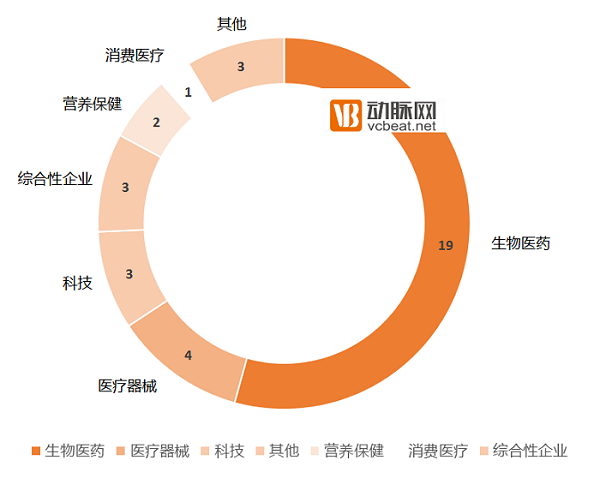
Among all the investors cataloged by VCBeat (WeChat: vcbeat) and VBInsight, there are companies in fields such as biopharmaceuticals, medical devices, technology, nutrition and health, and consumer healthcare, as well as diversified conglomerates with multiple business lines. Many of these enterprises are cross-industry players for whom healthcare is not their core business.
Among investors primarily focused on healthcare, biopharmaceutical companies are the most numerous, accounting for more than half of the total. In the fiercely competitive healthcare market,Many healthcare companies are seeking new investment opportunities overseas., to expand areas of business growth. Diversified investment cases are frequently emerging, with pharmaceutical companies targeting genes, medical devices, health supplements, and healthcare institution projects; medical device companies targeting genes and healthcare institution projects; and digital health technology companies targeting gene projects.
In addition, three diversified conglomerates have healthcare operations. Notably, several companies from non-healthcare sectors, such as environmental protection and agriculture, have also identified potential synergies with healthcare businesses.
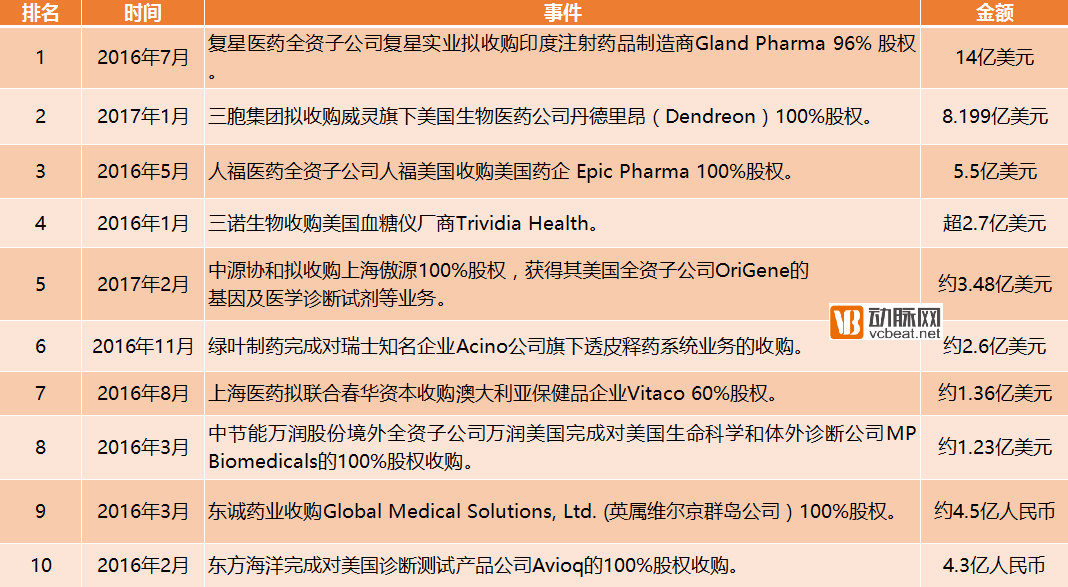
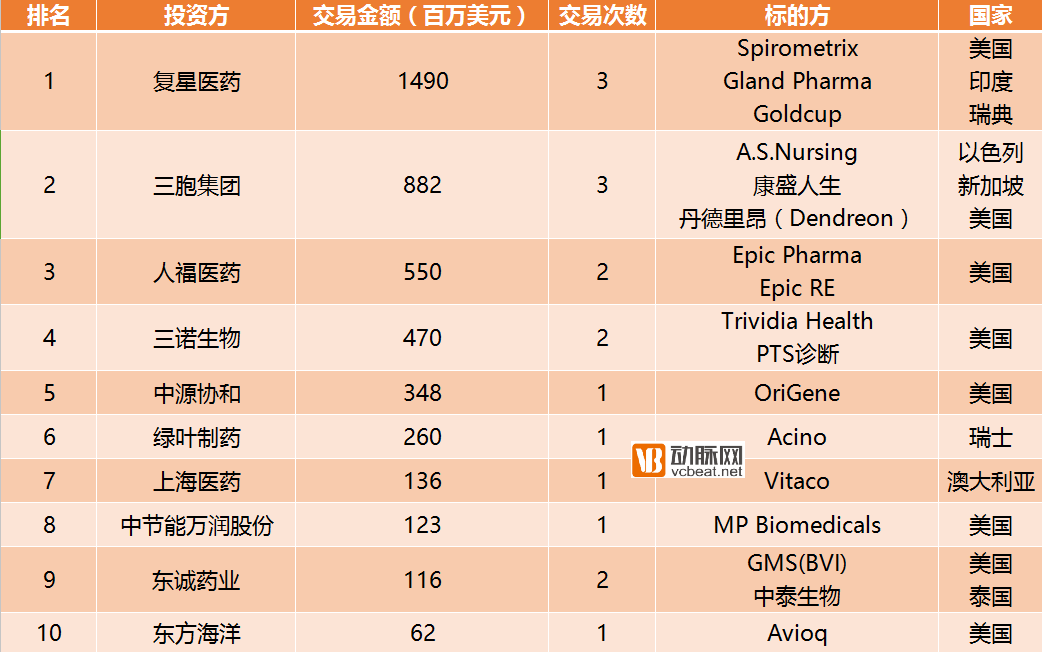
Among the companies that disclosed their investment and M&A amounts, Fosun Pharma topped the list with three transactions totaling over $1.4 billion. Among the top ten “big spenders,” two non-healthcare companies—CEC Wanrun Co., Ltd. and Dongfang Ocean—made the list, demonstrating that these cross-industry players have the strength to strategically position themselves in the healthcare sector and are willing to invest heavily in promising overseas healthcare projects.
Data Source: VCBeat, VCBeat Research Institute Database
· Record High Value of Overseas Mergers and Acquisitions
On July 28, 2016, Fosun Pharma announced that it intended to acquire a 96% stake in Gland Pharma, an Indian injectable drug manufacturer, for $1.4 billion (approximately RMB 9.3 billion) through its wholly-owned subsidiary, Fosun Industrial. This deal set a record as the largest overseas acquisition by a Chinese pharmaceutical company to date.
· "Most Cost-Effective" Deal
On April 1, 2016, Xiamen Kingdomway Group signed a joint venture agreement with Maikon Kohgen Co., Ltd. and Japan ARVIS Co., Ltd. to jointly invest in and establish the joint venture company Maikon Health Foods Co., Ltd. Kingdomway planned to contribute JPY 3.6 million (approximately RMB 216,000) and hold a 40% equity stake in the joint venture.
· Chinese Company Acquires Sole Original Drug in the U.S.
In January 2017, Sanpower Group proposed to acquire 100% equity of Dendreon, a U.S. biopharmaceutical company under Valeant, for $819.9 million in cash, becoming the global owner of Provenge, the world’s first cellular immunotherapy drug for prostate cancer. This marked the only original drug acquired by a Chinese enterprise in the United States.
· Achieving business “upgrading” through acquisition
In January 2016, Sinocare completed the acquisition of U.S. blood glucose meter manufacturer Trividia Health, thereby becoming the sixth-largest blood glucose meter company globally. This $270 million transaction was one of the largest overseas acquisitions by a Chinese medical device company in recent years.
· A Company Acquires Four Overseas Health Supplement Businesses in Succession
Chinese nutritional health brand Ailand acquired four overseas health supplement businesses in 2016: the Dutch heritage brand Bloem Health, Perrigo’s U.S. nutritional products division, and the UK-based health supplement companies Brunel Healthcare and Biocare.
· Both Digital Health Projects Were Led by Chinese Tech Companies
Tencent led the $55 million Series D financing round for Practo, India’s leading healthcare platform, while iCarbonX led the $100 million financing round for PatientsLikeMe, a well-known patient social network. Both tech companies have strategically positioned themselves in the “asset-light” segment of digital health. Moreover, Practo and PatientsLikeMe are both star projects, with impressive business models and strong backing from prominent investors.
Currently, industries across the board have been transformed and redefined by the internet wave. However, due to various factors, the healthcare sector has seen a slower pace of transformation, leaving significant room and opportunities for growth. Guided by the notion that “the next tech giant will emerge from the healthcare sector,” companies of all kinds are considering strategic moves into healthcare. Yet, there is an indisputable fact:There is still a certain gap between China and some other countries in medical technology and products.。
In the pharmaceutical sector, the United States continues to see a steady emergence of new technologies and discoveries, maintaining its global leadership in new drug research and development. The genomics industry, which has evolved from the Human Genome Project, is naturally most vibrant in the U.S. In the field of medical technology, other notable players include Germany, as well as Israel and Switzerland, both rising hubs of innovation. In the nutritional and health supplement sector, products from Australia, the Netherlands, and other regions have gained considerable recognition among Chinese consumers. When it comes to the rapidly growing medical aesthetics industry in recent years, the “cosmetic surgery economy” of countries such as South Korea and Japan often comes to mind first.
For Chinese enterprises investing in and acquiring overseas healthcare projects, the primary objective can be described asIntroduce technologies, brands, and concepts, and localize them according to the specific conditions of the Chinese market.. Yuan Yafei, Chairman of Sanpower Group, once stated that his company’s intention behind overseas healthcare M&A was “very simple: to serve the Chinese market,” by acquiring Western brands and technologies lacking among Chinese enterprises.
Additionally, beyond the Chinese healthcare market, many companies also planSecuring a Foothold in the International MarketAs mentioned above, the acquisition of major brands in blood glucose meters and ventilators exemplifies a strategy to capture international market share by introducing advanced products. Fosun Pharma, which created the largest overseas transaction by value, has articulated its perspective on globalization: First, the observation of market development in the healthcare industry must adopt a global perspective; second, resource allocation must also be considered from a global standpoint to continuously enhance corporate competitiveness and achieve global standards.
However, Chinese enterprises must now consider whether target acquisition assets align with their own circumstances and how to overcome the “acclimatization challenges” associated with overseas operations. Our business success cannot be achieved merely by “benchmarking” against foreign counterparts; acquiring cutting-edge technology only demonstrates financial capability, not that China can rapidly catch up with overseas pharmaceutical development in a short period. Overseas healthcare investments that deliver sustained benefits require seamless integration with a company’s existing operations, active learning from the introduced technologies and business models, and their incorporation into the firm’s own R&D and strategic planning. Ultimately, this approach may even enable companies to surpass their foreign counterparts with new technologies and models, thereby propelling the healthcare industry into the ranks of global leaders.
(Correction: In the case of Fosun Industrial, a wholly-owned subsidiary of Fosun Pharma, acquiring the Indian injectable drug manufacturer Gland Pharma, “$1.4 billion” has been corrected to “no more than $1.26137 billion,” and “96% equity interest” has been corrected to “86% equity interest”; in the table summarizing total overseas investment and M&A transactions by each company, Fosun Pharma’s transaction amount has been corrected from “$1.49 billion” to “$1.35 billion.”)
Copyright Statement
This report is produced by VCBeat. All text, images, and tables contained herein are protected by applicable trademark and copyright laws. Some of the text and data have been collected from publicly available sources, with ownership retained by the original authors. No organization or individual may reproduce or distribute this report in any form without prior written permission from our company. Any unauthorized commercial use of this report shall constitute a violation of the Copyright Law of the People's Republic of China, other relevant laws and regulations, and applicable international conventions.
Disclaimer
This research report is based on information that VCBeat considers reliable and currently publicly available. VCBeat strives to, but does not guarantee, the accuracy and completeness of such information. Due to limitations in research methodologies, sample sizes, and the scope of data collection, the data presented herein only reflects the basic conditions of the surveyed population during the survey period. It serves solely for the current research purposes and provides basic reference for the market and clients. Furthermore, VCBeat does not guarantee that the views or statements contained herein will remain unchanged. At different times, VCBeat may issue reports with information, opinions, and estimates inconsistent with those contained in this report.
VCBeat does not consider recipients of this report as clients merely by virtue of their receipt thereof. This report is distributed only where permitted by applicable laws and regulations, solely for informational purposes, and shall not constitute any form of advertising. Under no circumstances shall the information contained herein or the opinions expressed be construed as investment advice to any person. Where permitted by law, VCBeat and its affiliates may hold equity interests in companies mentioned in this report and may provide or seek to provide fundraising, financial advisory, or other related services to such companies.