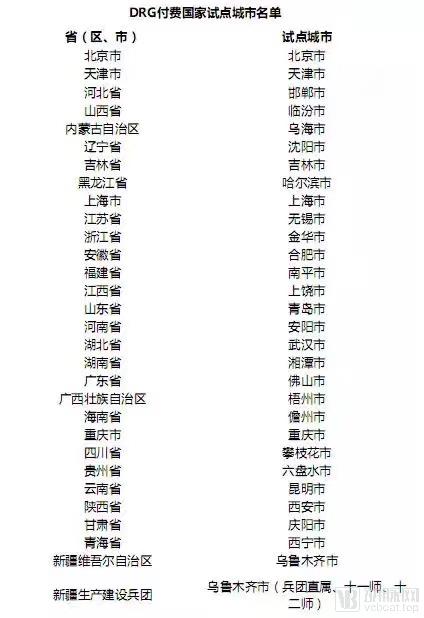
China's National DRG Payment Pilot Program: List of 30 Cities and Implementation Timeline Announced
Notice of the National Healthcare Security Administration, the Ministry of Finance, the National Health Commission, and the National Administration of Traditional Chinese Medicine on Issuing the List of National Pilot Cities for Diagnosis-Related Group (DRG) Payment
National Healthcare Security Administration, Ministry of Finance
National Health Commission, National Administration of Traditional Chinese Medicine
Notice on Issuing the Payment by Diagnosis-Related Groups
Notice on the List of National Pilot Cities
Yi Bao Fa [2019] No. 34
To the healthcare security administrations, finance departments (bureaus), health commissions, and administrations of traditional Chinese medicine of the relevant provinces, autonomous regions, and municipalities directly under the Central Government; and to the healthcare security administration, finance bureau, and health commission of the Xinjiang Production and Construction Corps:
To deepen the reform of healthcare insurance payment methods and accelerate the national pilot program for Diagnosis-Related Group (DRG) payment, the National DRG Payment Pilot Working Group has designated 30 cities as national pilot cities for DRG payment, based on the applications submitted by various provinces, autonomous regions, and municipalities in the earlier phase. The relevant matters are hereby notified as follows:
I. Elevate Political Stance and Clarify Task Objectives
Reform of Healthcare Security Payment Methods is a major initiative guided by Xi Jinping Thought on Socialism with Chinese Characteristics for a New Era, fully implementing the spirit of the 19th National Congress of the Communist Party of China and its Second and Third Plenary Sessions, and serves as an important lever for improving the healthcare security payment mechanism and the benefit regulation mechanism.
"Taking the exploration and establishment of a DRG payment system as a breakthrough point, implementing a diversified and composite payment method primarily based on diagnosis-related group (DRG) payments helps to deepen the reform of medical insurance payment methods."
All pilot regions’ healthcare security, finance, health, and traditional Chinese medicine administrative departments must further elevate their political stance, consistently adhere to the people-centered development philosophy, and take the protection of insured individuals’ rights and interests as the starting point. They shall further improve policies, standardize medical service practices, enhance the efficiency of healthcare security fund utilization, and aim to advance the scientific, refined, and information-based management and service levels of healthcare security. These departments are required to carefully organize pilot initiatives to ensure tangible results.
II. Strengthen Organizational Leadership and Form a Synergistic Force to Advance Work
DRG-based payment is a systematic project. Pilot cities and their respective provinces must strengthen leadership, establish and improve working mechanisms to promote the national pilot program for DRG-based payment, foster collaborative efforts, and ensure the steady and effective advancement of the pilot work.
Provincial-level healthcare security administrations shall collaborate with finance, health, and traditional Chinese medicine administrative departments to establish steering groups for the pilot initiatives, concurrently form expert panels, strengthen inter-departmental coordination, clarify division of responsibilities, and forge a cohesive force to guide pilot cities in carrying out their work.
Under the unified leadership of the government, each pilot city shall establish a pilot steering committee composed of departments including healthcare security, finance, health, and traditional Chinese medicine administration, as well as a technical team comprising representatives from healthcare security agencies, medical institutions, and experts, to fully implement pilot tasks and requirements, ensure the orderly conduct of pilot work, and achieve tangible results.
All pilot cities must fully mobilize the enthusiasm of medical institutions, guide participating institutions to establish sound working mechanisms, clarify pilot tasks, and ensure the effective implementation of all related work.
Healthcare institutions implementing DRG in Shenzhen, Sanming, Karamay, and all other provinces (autonomous regions, and municipalities) served as observational units.
III. Clarify Key Tasks to Ensure Timely Completion of the Pilot Program
Under the unified leadership of the National DRG Payment Reform Pilot Working Group, all pilot cities and their respective provinces shall adhere to the three-step approach of “top-level design, simulation testing, and actual payment” to ensure the completion of tasks at each stage, with simulated operations in 2020 and the implementation of actual payments in 2021.
First, improve the information system for DRG-based payment. All pilot cities must refine their medical insurance payment information systems in accordance with DRG payment requirements, based on the unified adoption of nationally standardized codes for disease diagnoses, surgical procedures, pharmaceuticals, medical consumables, and medical service items. They must also properly manage data interfaces with pilot healthcare institutions to ensure seamless integration between these institutions and the medical insurance payment system.
Second, establish DRG groupings for medical insurance payment. Pilot cities shall, in accordance with the national technical specifications for DRG grouping, develop local technical standards—such as local DRG grouping systems and methodologies for calculating fee weights—based on the Core DRGs (A-DRGs) and local conditions, thereby achieving a basically unified national framework for DRG groupings used in medical insurance payment.
Third, standardize the collection of DRG health insurance information. All pilot cities shall organize health insurance handling agencies and medical institutions to submit basic data from the previous three years in accordance with the requirements of the National Pilot Working Group and the standards for health insurance information collection. During the simulation testing phase, relevant data from medical institutions shall be collected in accordance with the nationally unified standards for health insurance information collection and submitted through a centralized reporting mechanism.
Fourth, continuously improve health insurance payment policies and operational management processes. Pilot cities and their respective provinces shall, in accordance with the requirements of the National DRG Payment Working Group, participate in and support the formulation of health insurance payment policies and operational management processes. They shall further refine health insurance payment policies, operational management processes, and agreements for designated institution management based on actual conditions at the time, thereby continuously strengthening the DRG payment system.
Fifth, strengthen the management of medical institutions designated for health insurance. Guide medical institutions participating in the DRG pilot to improve their internal medical management systems, enhance supervision over medical practices, medical record coding, and service quality, and establish a sound management mechanism centered on ensuring quality, controlling costs, standardizing diagnosis and treatment, and motivating medical staff, thereby fully leveraging the incentive and constraint roles of health insurance payment.
While implementing DRG pilots, each pilot city shall further improve the global budget management system for medical insurance. For cases not suitable for DRG settlement, it shall further advance big data-based payment by disease type, per diem payment, and capitation, thereby establishing a diversified and composite medical insurance payment system.
IV. Improve the Working Mechanism for Pilot Programs to Ensure Effective Results
The implementation of the national pilot program for Diagnosis-Related Group (DRG)-based payment involves multiple departments, requires extensive participation from pilot medical institutions, and demands close collaboration among experts. Under the unified leadership of the National Working Group on the DRG Payment Pilot Program, it is essential to establish and improve robust operational mechanisms to ensure the effectiveness of the pilot initiatives.
First, establish a tiered training mechanism. The national authorities will organize training for key personnel and core experts from provincial-level medical insurance departments and pilot cities. Each province (autonomous region, municipality) and pilot city shall be responsible for training other relevant department staff, healthcare institution personnel, and local experts. It is essential to ensure that all individuals involved in the national DRG payment pilot program receive comprehensive training.
Second, establish a mechanism for regular evaluation. In accordance with the national pilot program arrangements and timelines for DRG-based payment, evaluate the implementation of pilot initiatives across various regions. Regularly produce reports on the effectiveness of DRG implementation, providing recommendations and suggestions for subsequent steps. Conduct phased assessments of simulated operations and actual payment processes, ensuring strict oversight and steady progress. Local authorities shall carry out routine quality control, perform big data statistical analysis on DRG grouping and related metrics, and implement dynamic maintenance.
Third, establish a mechanism for regular reporting. Timely summarize and exchange the experiences and practices of pilot cities, and submit reports through each administrative level. Implement a system for submitting important policy documents and technical specifications. Implement a briefing system for the national DRG payment pilots. Each year, promote best practices and successful experiences through experience-sharing conferences, on-site meetings, and specialized training courses.
Fourth, establish a communication and coordination mechanism. Healthcare security, finance, health, and traditional Chinese medicine administration departments in pilot cities and their respective provinces shall strengthen communication and coordination, promptly study and address issues arising during the pilot program, and implement targeted measures; they shall also establish close exchange mechanisms with the National Pilot Working Group on DRG Payment to form synergy and jointly plan and advance the work.