

Ningxia Internet Hospital Launches as an Integrated Online-Offline Medical Consortium to Serve Northwest China

Ningxia Internet Hospital Event Site
On March 12, under sunny skies, the Ningxia Internet Hospital, covering an area of over 1,400 square meters at the intersection of Helan Mountain Road and Hongqiao Road in Helan County, Yinchuan City, Ningxia Hui Autonomous Region, officially opened.
Distinguished leaders attending the opening ceremony included Zhang Leqin, Vice Chairperson of the Ningxia Hui Autonomous Region Committee of the Chinese People’s Political Consultative Conference (CPPCC); Song Chenyang, Deputy Director of the Ningxia Health and Family Planning Commission; Li Yuhua, Member of the Standing Committee of the Yinchuan Municipal Party Committee and Secretary of the Helan County Party Committee; Song Zhilin, Member of the Standing Committee of the Yinchuan Municipal Party Committee and Secretary of the Commission for Discipline Inspection; Wang Yong, Deputy Director of the Municipal Standing Committee of the National People’s Congress; Li Hongru, Deputy Mayor of Yinchuan; Gou Zhuanhui, Vice Chairperson of the Municipal CPPCC Committee; and Tian Yonghua, Director of the Municipal Health and Family Planning Commission. Also in attendance were guests such as Liao Jieyuan, Chairman and CEO of WeDoctor; Yang Yinxue, President of the General Hospital of Ningxia Medical University; and Zhang Qunhua, Dean of Wuzhen Internet Hospital. During the opening ceremony, Vice Chairperson Zhang Leqin, on behalf of the Autonomous Region, presented President Yang Yinxue of the General Hospital of Ningxia Medical University with his appointment letter as the Dean of the Ningxia Internet Hospital.
This internet hospital was jointly established by WeDoctor and the General Hospital of Ningxia Medical University, under the guidance and support of government authorities at all levels in the Ningxia Hui Autonomous Region, Yinchuan City, and Helan County.
VCBeat has witnessed the entire process of the Ningxia Internet Hospital’s inception, from contract signing, approval, renovation, implementation, acceptance testing, and commissioning to its official opening. The entire process took only 50 working days, fully demonstrating the “Helan Speed” and “Helan Efficiency.” Leveraging WeDoctor’s mature internet technology and connectivity capabilities, the Ningxia Internet Hospital is a truly integrated online-offline medical consortium. In accordance with the requirements of Li Jianhua, Secretary of the Party Committee of the Ningxia Hui Autonomous Region, the Ningxia Internet Hospital will be “based in Ningxia and serve the entire Northwest region.”
What, then, are the distinctive features of Ningxia Internet Hospital? What constitutes an online-offline medical consortium? And how can Ningxia Internet Hospital serve as a lever to elevate healthcare services across the entire Northwest region?
Upon entering the Ningxia Internet Hospital, one is immediately struck by the sight of numerous small booths partitioned into distinct functional areas, such as Primary Care Studios, Academic Research Rooms, and Remote Consultation Suites. Each room is equipped with a large television screen, a work desk, and at least two computers. Through microphones and screens, physicians and healthcare professionals can conduct diagnoses, treatments, and consultations for patients remotely.
At the event, Liao Jieyuan, Chairman and CEO of WeDoctor, gave an exclusive interview to VCBeat, stating, “We have established 19 internet hospitals across China, with the basic platform alone costing RMB 280 million. Building a regional medical consortium internet hospital in Ningxia cost between RMB 120 million and RMB 150 million.”
Subsequently, Liao Jieyuan also informed VCBeat that the Ningxia Internet Hospital established this time will undertake the following five levels of services and platform composition: The first level is a convenient medical treatment platform for the entire autonomous region. Entrusted by the National Health and Family Planning Commission, Ningxia Internet Hospital will gradually migrate the service windows of hospitals in Yinchuan and Ningxia to the internet, providing residents in Ningxia and the northwest region with services such as appointment registration, online payment, sharing of examination and test reports, and health cloud card services, thereby significantly reducing waiting times for patients and improving the medical environment.
One week later, residents across the entire autonomous region will be able to register and book appointments at various hospitals without leaving home, via the WeDoctor app or ningxia.guahao.com.
The second layer is the tiered diagnosis and treatment platform for Northwest China. Relying on central hospitals in the Northwest region, such as the General Hospital of Ningxia Medical University, Ningxia Internet Hospital will fully leverage the connectivity capabilities of the internet to build a tiered diagnosis and treatment platform for Northwest China.
The third layer is a physician collaboration platform based in Ningxia, covering the entire region, and connecting Beijing and international networks. As the world’s largest physician collaboration platform, WeDoctor’s main platform enables the Ningxia Internet Hospital to extend the expertise of top-tier specialists to grassroots levels, effectively enhancing the professional capabilities of primary care physicians.
The fourth layer is the Internet-based multidisciplinary consultation center. Wuzhen Internet Hospital has successfully established ten interdisciplinary consultation centers led by academicians, which have been directly replicated at Ningxia Internet Hospital to provide efficient consultation services for complex and rare diseases to residents across the region and Northwest China.
Level 5: Gradually driving the agglomeration of the pharmaceutical, healthcare, and insurance industry chain. This afternoon, “Ningxia Health Valley” will be unveiled in Helan. Ningxia Internet Hospital, along with upstream and downstream enterprises in its industry chain, will relocate to “Ningxia Health Valley” in phases. Leveraging Ningxia’s policy advantages, it aims to cultivate a thriving healthcare industry ecosystem in Northwest China.

Unlike other purely online internet hospitals, Ningxia Internet Hospital also has a physical offline presence. Located at the Tianyuan Caihui Center, at the intersection of Helanshan Road and Hongqiao Road in Yinchuan City, it covers an area of over 1,400 square meters and features a high-tech interior design. Its functional layout and equipment investment are similar to those of the Wuzhen Internet Hospital. Furthermore, through collaboration with the General Hospital of Ningxia Medical University, it leverages their robust offline medical service capabilities, which complement WeDoctor’s online services, creating an optimal synergy.
Why is close collaboration with offline physical medical institutions essential? First, it is a legal requirement. According to the Administrative Measures for Medical Institutions, healthcare providers offering online diagnosis and treatment services must possess appropriate medical qualifications and be equipped with necessary facilities, beds, equipment, and medical personnel in accordance with relevant regulations. The integrated online-offline model also facilitates standardized daily oversight by regulatory authorities. Relevant administrative measures issued by Yinchuan City explicitly mandate that such services must be supported by an offline physical hospital.
Second, medical quality and safety. Medical services encompass diagnosis, examinations, treatment, surgery, and more. No matter how advanced online capabilities become, certain medical services—such as initial consultations, imaging examinations, and surgical procedures—must be conducted offline. Third, patient service and experience. Fragmented online and offline medical services fail to meet patients’ demands for convenience, efficiency, and affordability, making it difficult to gain user acceptance.
At the opening press conference, a representative of the Ningxia Hui Autonomous Regional People’s Government presented Yang Yinxue, President of Ningxia Medical University General Hospital, with the appointment letter for the position of President of the Ningxia Internet Hospital. Yang Yinxue has officially assumed the role of President of the Ningxia Internet Hospital. To ensure service quality and medical safety, WeDoctor Internet Hospital not only relies on offline physical hospitals but also invites renowned medical experts or administrators from top-tier (Grade A Tertiary) hospitals to serve as presidents. For instance, Professor Zhang Qunhua, formerly of Huashan Hospital Affiliated to Fudan University, serves as the President of Wuzhen Internet Hospital; Mi Denghai, President of the Second People’s Hospital of Gansu Province, serves as the President of Gansu Internet Hospital; and Lin Hui, Executive Vice President of the People’s Hospital of Guangxi Zhuang Autonomous Region, serves as the President of Guangxi Internet Hospital.
A true internet hospital must possess not only “upward” capabilities—online connectivity and services—but also “downward” capabilities—offline patient reception and support for primary care institutions. Family physician health service platforms, remote consultations, general practice centers, health centers, and cloud-based health cards are key vehicles through which internet hospitals deliver both online medical care and offline services.
Meanwhile, medical resources within the same region are integrated to form a healthcare consortium, typically comprising tertiary hospitals, secondary hospitals, community health centers, and village clinics in that area. The aim is to alleviate the difficulty patients face in accessing medical care; for instance, common ailments such as fever and cold can be managed at primary care facilities rather than overcrowding tertiary hospitals. This approach has achieved the intended goals of satisfying the public, the government, and healthcare workers.
For instance, Ningxia Internet Hospital has established remote consultation links with a community in Helan County to assist local residents with health management. According to Dr. Yang Caixia, the primary focus is on chronic disease management for conditions such as hypertension and diabetes, as well as providing guidance on precautions for families planning a second child. In her view, patients with such needs often only require brief consultations or prescription refills; therefore, it is unnecessary for them to travel to large hospitals, where they would waste time queuing for outpatient services and medication.
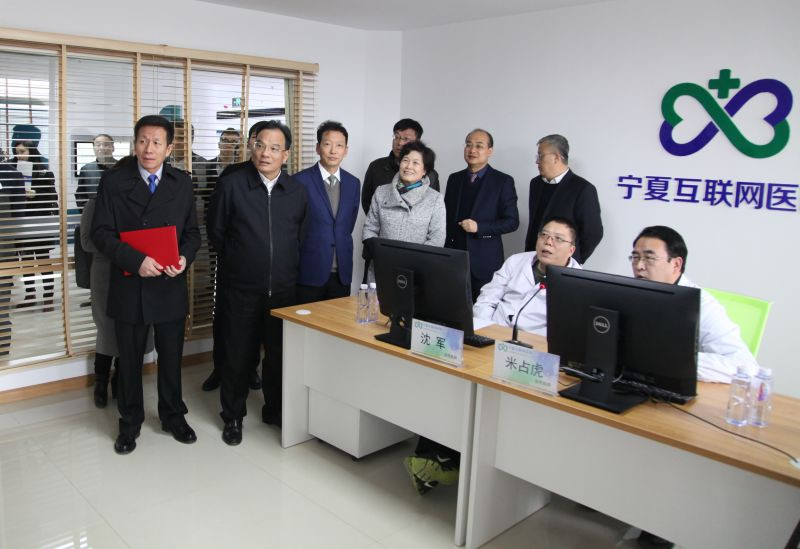
Ningxia Internet Hospital Doctors Conducting Remote Consultations
Ningxia, located in the inland northwest of China, has a relatively insufficient supply of high-quality medical resources. In regions such as Xihaigu, poverty caused or exacerbated by illness remains a persistent issue. Taking Helan County as an example, among its population of 260,000, there are only slightly more than 1,100 medical personnel, with fewer than 30 holding the title of associate chief physician or higher. Wang Shengping, Director of the Helan County Health and Family Planning Bureau, stated that by leveraging the platform of internet hospitals, patients can access expert medical resources from across Ningxia and throughout China. Meanwhile, local medical professionals benefit significantly from learning alongside these experts on the platform, which greatly contributes to discipline development and skill enhancement.
Furthermore, Ningxia is a pilot province for national telemedicine policies, boasting a solid policy foundation. On January 15, 2015, the National Development and Reform Commission (NDRC) and the National Health and Family Planning Commission (NHFPC) jointly issued the Notice on Approving Pilot Telemedicine Policy Programs in Five Provinces and Autonomous Regions Including Ningxia and Yunnan, mandating the establishment of a five-tier hierarchical telemedicine service system covering the entire region, structured as “National–Autonomous Region–City–County–Township.” During the 13th Five-Year Plan period, Ningxia vigorously implemented the Healthy Ningxia Construction Project, explicitly aiming to build a regional population health information platform, achieve open sharing of healthcare service information, and improve the telemedicine network system.
Therefore, WeDoctor and General Hospital of Ningxia Medical University, a leading Grade A tertiary hospital in Northwest China, jointly established the Ningxia Internet Hospital. By integrating the online and offline strengths of both WeDoctor and General Hospital of Ningxia Medical University, and prioritizing its launch in Helan, this initiative enables residents of Ningxia to access high-quality medical services from across China without leaving their homes.
“In my view, healthcare is like a horse, and the internet is like wings. The integration of internet and healthcare creates a Pegasus, enhancing the efficiency of medical services and improving patients’ healthcare experience,” Yang Yinxue told VCBeat.
The General Hospital of Ningxia Medical University is the largest comprehensive Grade 3A hospital in the Ningxia Hui Autonomous Region, boasting robust medical service capabilities, with over 3,700 open beds and more than 2 million patient visits in 2015. At the signing ceremony, Yang Yinxue from the General Hospital of Ningxia Medical University stated that the Ningxia Internet Hospital, leveraging the General Hospital of Ningxia Medical University as a hub, integrates WeDoctor’s online network of 260,000 physicians and 7,200 expert teams, thereby introducing high-quality medical resources from across China to Ningxia and the Northwest region, and enhancing the level of medical services.