Dr. Junbiao Dai of Tsinghua University Discusses Synthetic Genomics and Its Industrial Applications in Precision Medicine Forum
Source: GeneInsight PPT
【Previous Reviews】
Season 2, Episode 1: Professor Huang Shangzhi
Season 2, Episode 02: Dr. Gu Weihong
Season 2, Episode 03: Professor Yao Hong
Season 2, Episode 4: Professor Zhao Haitao
Season 2, Episode 5: Vice President Wang Yi
Season 2, Episode 6: Professor Qi Ming
Season 2, Episode 07: Dr. Wang Wei
Season 2, Episode 8: Professor Ding Jie
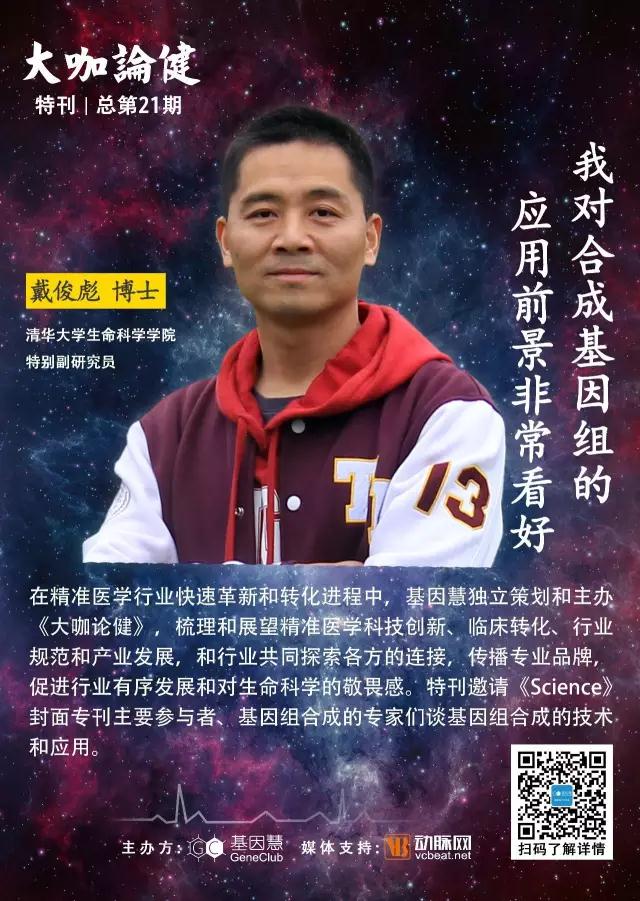
Season 2, Episode 09 | Issue No. 21: Dr. Dai Junbiao
[Editor's Note]From “reading” to “writing,” from understanding to construction, the gene industry has gradually formed a closed loop, spanning from the Human Genome Project (HGP) in 1999 to the Human Genome Synthesis Project (HGP) in 2016. In the field of synthetic biology, since 189 years agoFrom the synthesis of the organic compound urea, to the synthesis of the protein bovine insulin 52 years ago, to J. Craig Venter’s synthesis of a prokaryotic genome nine years ago, and now to the synthesis of a eukaryotic genome—yeast—the pace of technological advancement has caught up with public imagination. RecentlyRecently, the prestigious international scientific journal *Science* featured a series of advances in synthetic genomics and seven related papers in its cover story and special issue. Below, we have invitedDr. Junbiao Dai, Corresponding Author of the Paper: A Decade-Long Dedication to Yeast and Synthetic Genomics, to hear him discuss the technical roadmap and industrial applications of synthetic genomics.
I am very optimistic about the application prospects of synthetic genomics.
Author: Dr. Dai Junbiao
School of Life Sciences, Tsinghua University
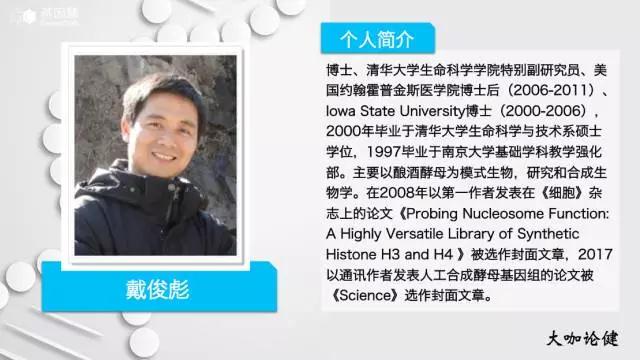
[GeneWisdom]Professor Dai, greetings! Thank you for accepting this exclusive interview with GeneHub. Congratulations on the publication of the “Synthetic Yeast Genome Project (Sc2.0 Project)” as a cover story and special issue in Science [1,2]. Your own paper published in Cell in 2008 was also selected as a cover article [3]. As a scientist in the field of synthetic biology, please introduce yourself to GeneHub’s readers and discuss the background of the Sc2.0 project.
[Dai Junbiao]Let me begin by briefly introducing my background. I entered the Honors Program in Basic Sciences at Nanjing University in 1993 and graduated in 1997, after which I pursued a master’s degree in the Department of Biological Science and Technology at Tsinghua University. In 2000, I went to Iowa State University in the United States to pursue my Ph.D. under the supervision of Dr. Daniel F. Voytas, a renowned expert in the field of genome editing, particularly in plant genome editing. Dr. Voytas has since moved to the University of Minnesota. After completing my doctoral studies, I joined the laboratory of Dr. Jef D. Boeke at Johns Hopkins University School of Medicine in 2006. Dr. Boeke was the original proposer and primary leader of the Sc2.0 project (the Synthetic Yeast Genome Project). In Dr. Boeke’s laboratory, I worked on two projects simultaneously. One resulted in our paper published in Cell in 2008. The other involved my participation in the initial phase of the Sc2.0 project. The first paper on Sc2.0 was published in Nature [4] in 2011, although the name “Sc2.0” had not yet been adopted at that time. This article described our design work for the entire synthetic chromosome.
In 2011, I completed my postdoctoral fellowship at Johns Hopkins University, returned to China, and established my own laboratory at Tsinghua University. During my doctoral studies, I investigated the mechanism of action of a retrotransposon in yeast. My postdoctoral research focused on protein-related studies. Upon establishing my independent laboratory, I resumed work on the Synthetic Yeast Genome Project (Sc2.0). Driven by Yizhi Patrick Cai, a postdoctoral fellow at the University of Edinburgh, we organized the first Sc2.0 project coordination meeting near Tsinghua University in early 2012. We invited scientists and funding agencies from the United Kingdom, Australia, Singapore, Hong Kong, and India. At this meeting, we discussed how to conduct this international collaboration, which marked the inception of the Sc2.0 Plan. Consequently, starting in 2012, three research groups in China formally joined the Sc2.0 Plan.
【GeneWise】: Noting that you began studying the control of retroviral elements in yeast as early as 2003, and have now achieved the total synthesis of the yeast genome this year, could you discuss the research objectives behind synthetic genomics? Over the past 14 years, what changes and advancements have occurred in the field of synthetic genomics? Please share your insights with us.
[Dai Junbiao]: Let me first discuss the objectives of the Sc2.0 project research. If we liken our cells to a room, our existing genome determines the layout within that room. For instance, there is a window here, a television set placed over there, and an electrical outlet installed on this side. Through sequencing technologies, we obtain the genomic sequence and identify the determinants encoding such a layout. The primary purpose of synthesizing the genome is to understand how the genome dictates this layout. How can we achieve this understanding? To use a simple analogy, it is like opening up a wall to examine its interior structure, or excavating another section to inspect how the wiring is arranged, and then replicating it accordingly. Thus, through this construction process, we can gain insights into how genes determine these features.This is one of the core concepts in synthetic biology, known as “build to understand,” which means facilitating understanding through construction.
The second objective of synthetic biology is to determine how we can design genomes after gaining understanding through construction.? Using the analogy of a house, the genome determines the current interior design style, such as the placement of windows and the television within the house. Can we then alter this design style by sealing a window on one side and opening a new one on the other? With technological advancements, this has become possible. Since 2000, we have been able to construct small genetic circuits to perform specific functions, such as enabling cells to exhibit periodic fluorescence—alternating between fluorescent and non-fluorescent states. By 2016, we had already designed more complex genetic circuits capable of multi-step regulation, indicating substantial progress in this field. In another direction, starting from the synthesis of the smallest viral genomes, progressing to the synthesis of the Mycoplasma genome by Craig Venter and his team in 2010, and extending to the current synthesis of the yeast genome, these developments represent significant milestones. Meanwhile, the cost of gene synthesis has dropped from several dollars per base to just a few cents per base—a nearly hundredfold decrease, marking a tremendous change.
[GeneHui]: In the Sc2.0 project, your team was primarily responsible for synthesizing chromosome XII, the longest and most functionally unique among the 16 chromosomes, employing a strategy of hierarchical assembly followed by subsequent engineering. Could you explain in relatively accessible language the technical roadmap for genome synthesis and engineering, and highlight the key challenges and difficulties involved?
[Dai Junbiao]: We have a predefined strategy for chromosome assembly. Rather than synthesizing chromosomes by adding bases one by one, we divide them into several fragments, synthesize each fragment separately, and then assemble all the fragments together. For each fragment, we use chemical synthesis to obtain nucleotide chains approximately 80 to 100 bases (or characters) in length, which are then ligated to form the fragment. This process creates the individual “bricks” used to build the chromosome. The chromosome assembly strategy is akin to constructing a wall by piecing together these bricks. The first brick is joined to the second, the second to the third, and so on, ultimately forming a complete chromosome. We replace the original bricks at their corresponding positions on the chromosome with our newly synthesized ones, proceeding from left to right, brick by brick, until all replacements are completed.
This strategy is relatively easy to implement for short chromosomes that can be assembled from just a few DNA fragments. However, it proves more challenging for the long chromosomes in the yeast genome, which are approximately one million base pairs in length and require assembly from roughly thirty-three such fragments. Since each fragment is synthetically designed, there is uncertainty regarding whether it can perform its intended function—specifically, whether it can successfully replace the corresponding native segment. For instance, certain modifications introduced into the designed fragments might render them structurally unstable, causing them to “break” under stress. To address this, we developed a “hierarchical assembly” approach. To use a simple analogy, we initially distributed these thirty-three fragments across thirty-three yeast strains, integrating each fragment individually as a test. This allowed us to generate thirty-three chromosomal variants, each containing only one synthetic fragment replacing its native counterpart rather than having the entire chromosome replaced. Based on this setup, we could identify which fragments were problematic. Indeed, we discovered that many fragments did exhibit issues. After testing, we corrected these defects and used the newly optimized fragments to replace the original ones. Subsequently, we assembled these thirty-three fragments in six different yeast strains, with each strain harboring five fragments. We then crossed these six strains to produce diploids, followed by meiosis to generate haploids, thereby consolidating all synthetic fragments onto a single chromosome.
[Dai Junbiao]: Identifying issues within individual DNA bricks was the most significant challenge we encountered. We were stalled for nearly a year when integrating a specific brick. The previous design involved assembling bricks sequentially from left to right; consequently, a bottleneck at any single step halted all subsequent progress. As a result, our entire project was effectively suspended for about a year. We eventually devoted substantial efforts to resolving this issue. Currently, we employ a hierarchical assembly strategy combined with downstream modifications to achieve whole-chromosome concatenation, enabling continuous strain construction while simultaneously addressing technical challenges.
【GeneWise】: It is claimed that Sc2.0 can serve as a tool to introduce exogenous genes, thereby enabling the production of carotenoids and other compounds. Some even suggest that synthetic genomes could potentially trigger a species explosion akin to the Cambrian explosion. As a scientist, could you share with the readers of GeneHui how this technology might impact biopharmaceuticals, medical diagnosis and treatment, bioenergy, and information storage? What are the challenges in translating this technology into industrial production, and what is its outlook?
[Dai Junbiao]: I believe that synthetic genomics technology will have significant applications in the present and near future. For instance, within the next couple of years, we can leverage synthetically engineered strains to replace or improve upon existing yeast strains for fermentation-based production, such as producing beta-carotene, artemisinin, or using yeast fermentation to produce bioethanol. Furthermore, by utilizing our synthetically engineered yeast, we can further enhance the yield and productivity of these applications, thereby realizing greater economic value. This technology holds promise in both the bioenergy and information sectors.
Of course, there are still many challenges. For instance, how can we rationally design our genomes? Currently, our understanding of the phenotypes determined by the genome, or the biological functions it governs, remains very limited, and there is still much that is scientifically unknown. If we do not even know what these elements are or how they function, attempting to design them poses a significant challenge. Therefore, what we can currently achieve technically is to construct genomes, and then identify new issues through continuous subsequent phenotypic analysis and high-throughput sequencing. We then investigate the underlying biological mechanisms behind the identified problems, and based on these insights, proceed with further design and application. Thus, the entire process of genome design and synthesis in the Sc2.0 project can deepen our understanding of the overall information contained in biological genetic material, while also paving the way for advances in both basic scientific research and practical applications. I am very optimistic about the prospects of genome synthesis applications. Synthetic biology involves many fields and will significantly promote the entire biotechnology industry.
Every time I teach at Tsinghua University, I have this feeling: now is an excellent time, because we have pushed sequencing technology to its limits. We can now sequence a wide variety of organisms, and perhaps in the future, all living beings on Earth will be sequenced and analyzed, thereby unlocking a vast treasure trove of resources—the genetic repository. So, how do we leverage this genetic information obtained through sequencing? The answer lies in the process from sequencing to synthesis. I believe we can use “writing” as a method to design numerous organisms, enabling them to perform various functions required for diverse applications.
We also hope that our readers and the broader public will pay attention to the development of synthetic biology, while allowing us the time and space needed for growth. This will enable scientists to further refine and advance various technologies, ensuring their practical application for the benefit of society and contributing to its overall progress. In doing so, synthetic biology can make significant contributions across multiple domains, including healthcare, public health, environmental remediation, and the resolution of energy crises.
These are my personal thoughts and insights regarding our work in this field. I hope that China’s synthetic biology sector will continue to improve, become globally competitive, and seize first-mover advantages in the industry. Please forgive any inaccuracies. Thank you all!
References and Literature:
1. http://scitech.people.com.cn/n1/2017/0310/c1007-29135176.html
2. Engineering the ribosomal DNA in a megabase synthetic chromosome
3. Junbiao Dai*, Edel M. Hyland*,Daniel S. Yuan, Hailiang Huang, Joel S. Bader and Jef D. Boeke, ProbingNucleosome Function: A Highly Versatile Library of Synthetic Histone H3 and H4Mutants, Cell, 2008, 134: 1066-1078 (Featured cover story).
4. Synthetic chromosome arms function in yeast and generate phenotypic diversity by design
Author's Homepage:
http://life.tsinghua.edu.cn/faculty/faculty/1594.html