

Watson for Oncology Practice Survey: Over 10,000 Patients Served and Dozens of Hospital Partnerships Established with Three Key Clinical Applications
Artificial intelligence was extremely hot in 2017, with more than 30 AI companies securing funding within just three months. In the healthcare sector, good news kept coming:
People are expected to be able to diagnose skin cancer via mobile phones, with an accuracy rate exceeding 91%;
The FDA has approved an AI-powered software for cardiac MRI analysis for the first time;
“Nature” (Hazlett et al. 2017) Major Breakthrough: AI Outperforms Doctors in Early Diagnosis of Autism in Children;
Humans Completely Defeated... Breast Cancer Diagnosis: 30-Hour Pathological Analysis Proves Less Accurate Than Google AI;
Google Uses Deep Learning to Assist Pathologists in Detecting Cancer, with an Accuracy Rate of 89%;
Impressive! The Third Military Medical University Uses AI to Identify Blood Types Within 30 Seconds, with Over 99.9% Accuracy;
Amidst the hype, should we not take a step back to examine how artificial intelligence is actually being implemented in healthcare institutions?
Currently, Watson for Oncology is the fastest-developing AI application in the healthcare sector. To this end, a reporter from VCBeat (WeChat ID: vcbeat) interviewed Dennis Lin, Head of Marketing at Hangzhou Renzhi, the operator of Watson for Oncology in China, to gain a detailed understanding of its clinical implementation data in the Chinese market.
Served Over 10,000 Patients Globally, with Surging Case Volume in China
Watson has currently been deployed in seven countries worldwide: China, the United States, South Korea, Thailand, Singapore, India, and the Netherlands. In these seven countries, it has officially entered the commercialization phase, providing patient-facing services., the national service coverage will continue to expand this year.
Additionally,Watson for Oncology may have served tens of thousands of patients across seven countries worldwide, while its case volume in China continues to surge. Since January this year, it has provided services to hundreds of cancer patients through existing partner hospitals.
In the future, China's service fee model will mainly rely onServices provided to patients by hospitals or medical institutions, while in the United States, there are organizations such as Best Doctors. After receiving a diagnosis from their attending physician, patients can consult Best Doctors for a second opinion. Best Doctors collaborates with Watson to provide recommended treatment plans for patients to choose from.
Dozens of Chinese Hospitals Sign Strategic Cooperation Agreement
Currently, Hangzhou Cognitive is the sole operator of Watson for Oncology.Has established strategic partnerships with dozens of hospitals in China, and will increase the number of partner hospitals to hundreds this year.,and extend the influence of Watson for Oncology to all medical consortiums affiliated with Hangzhou Cognitive Collaboration Hospital。
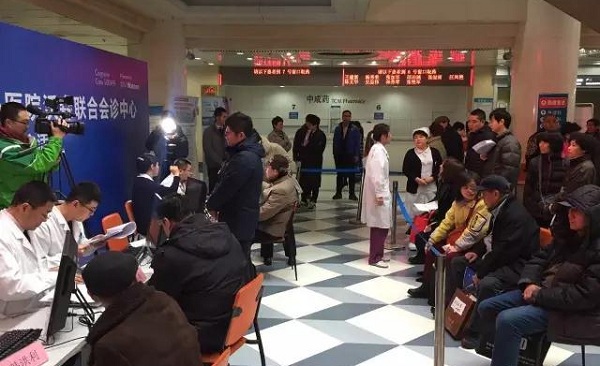
Promoting Watson Through Free Clinic Services
To achieve this goal, Hangzhou Cognitive and Yihui Health have jointly developed a Multidisciplinary Team (MDT) consultation platform to facilitate multidisciplinary consultations within hospitals and among hospitals in the medical consortium.
In China, Watson for Oncology currently provides consultation services to patients with six types of cancer—lung cancer, breast cancer, rectal cancer, colon cancer, gastric cancer, and cervical cancer—at implementing hospitals.The scope of services will continue to expand this year, with an expected coverage of 80% of cancer types.
Dennis told VCBeat that, based on the applications in various hospitals across China, each collaborative hospital serves different types of cancer. Overall,Serves the Largest Number of Lung Cancer and Breast Cancer Patients, and there are also many patients seeking consultations, which is mainly related to the high incidence of this cancer in China.
Three Practical Applications Identified Post-Implementation
Watson has been deployed globally in top-tier hospitals comparable to China’s Grade 3A hospitals. In China, physicians at these Grade 3A hospitals generally affirm the capabilities of Watson for Oncology. Based on currently collected physician feedback, its clinical decision support functions are primarily reflected in three aspects.
The First OnePropose a new plan,Assist physicians in diagnosis and treatment. For many cancer cases, doctors and hospitals have established treatment protocols and systems. However, when a patient’s pathological indicators change slightly, the treatment plan must be adjusted accordingly. In such instances, Watson builds upon the standard treatment protocols,Propose New Treatment Options for Physicians to Discuss and Select。
The second oneAssist in Final Diagnosis for Patients and Facilitate Doctor-Patient Communication. The initial treatment following a tumor diagnosis is a critical and pivotal stage; Watson for Oncology can serve to validate and endorse the final treatment plan, thereby enhancing patients’ confidence in their medical care.
In a previous case, a son sought medical advice from various sources for his father, who was in the late stages of lung cancer. After consulting with the attending physician, he learned that no effective treatment options remained. Nevertheless, to avoid any future regrets, he continued to seek further opinions. Eventually, he turned to Watson for Oncology, which also recommended palliative care, indicating that there were no effective treatment protocols supported by current global clinical evidence.
At this point, the son has done his best and found peace, while the father feels comforted by recognizing his son’s efforts. For physicians, upholding the mission to treat patients yet being unable to provide effective treatment plans inevitably leads to a sense of disappointment. Watson for Oncology can deliver globally validated clinical evidence, serving as robust support for clinicians’ diagnostic and therapeutic decision-making, thereby strengthening confidence in the physician–patient relationship.
The third oneSupporting Young Physicians and Subspecialists, young physicians often have limited experience, while subspecialists—such as thoracic surgeons—may be highly experienced in managing pneumonia or other conditions but less familiar with the diagnosis and treatment of tumors. During interactions with Watson, physicians need to input key clinical indicators from patient cases, receive prompts on important details to address during patient interviews, and thereby leverage its supportive role in diagnosis and treatment.
Additionally, during interactions with patients, the Hangzhou Cognitive Watson for Oncology operations team discovered thatThe vast majority of patients are not resistant to this new development., patients view Watson merely as a tool to assist physicians, offering more treatment options for patients,However, the final decision-making authority still rests with the physician., Watson for Oncology can enhance patients' confidence in their physicians.
During its investigation, VCBeat also found that patients can use Watson to learn about detailed drug side effects and drug-drug interactions, which is highly beneficial for caregivers in reminding patients and supporting daily care.
In the interview,Dennis emphasized that Watson for Oncology can only assist patients who have already been diagnosed with cancer.Here is an interesting case: a cancer patient underwent surgical resection five years ago and currently shows no signs of recurrence or metastasis. Although physicians initially determined that the patient had been cured, the patient remained concerned and sought further evaluation at the Joint Consultation Center. When the patient’s data were entered into the Watson for Oncology system, the system classified the individual as a non-cancer patient and provided no relevant treatment recommendations.
Hangzhou Cognition is committed to building a closed-loop system for physician services.
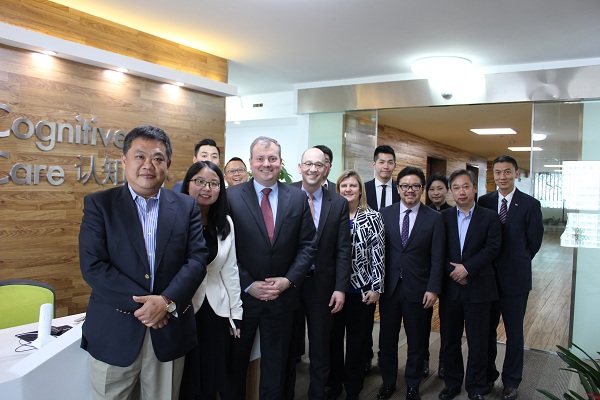
Group photo of the IBM Watson team and the Cognitive Care core management team (Robert Merkel, third from left)
A few days ago, Robert Merkel, General Manager of IBM Watson Oncology & Genomics, visited China to assess the implementation of Watson for Oncology in the country.It was announced that Watson will further deepen its collaboration with hospitals and academic institutions in the fields of scientific research, as well as teaching and educational research.
Additionally, throughout the implementation process across China, Hangzhou CognitiveWe will strive to assist in the localization of Watson for Oncology in China, while strengthening physician training and follow-up patient services to create a comprehensive service loop.。
InResearch Section: When conducting any scientific research, physicians must gather extensive data that exhibit case-matching relevance. For instance, in lung cancer cases involving metastasis or other extended pathological conditions, identifying relevant empirical studies is a complex and time-consuming task for clinicians.
By leveraging Watson for Oncology, physicians can directly locate relevant clinical evidence-based literature for specific cases and input case details into the system to receive recommended treatment plans.
Teaching and Research Section: When interns or medical students enter hospitals and engage in clinical practice, Watson for Oncology can assist them in learning from relevant cases by providing recommended and non-recommended treatment options, along with supporting literature for each. For novice physicians, lack of experience may impair their judgment in patient interviews and diagnostic decision-making, and they may not be as familiar with drug side effects as seasoned clinicians. In such situations, Watson for Oncology can offer valuable support to these early-career doctors.
Dennis stated that Watson for Oncology has been launched in China,Hangzhou Cognitive Operations Team creates a closed-loop medical service system for hospitals and teaching institutions, spanning from physician education and clinical consultations to related scientific research.。
Watson's Oncology Industry Ecosystem
Cancer is a chronic disease, and its treatment efficacy is evaluated by 5-year and 3-year survival rates, reflecting the long-term nature of therapy. Moreover, cancer management extends beyond mere medication; the rehabilitation process also encompasses psychological support, lifestyle interventions, and even palliative care in advanced stages.
Hangzhou Cognitive introduces Watson for OncologyPositioning is not merely an AI-powered smart healthcare product, but rather a strategic implementation in China from the perspective of operating the entire oncology treatment ecosystem., from determining the treatment plan at the time of diagnosis, to precautions for home recovery after treatment, as well as subsequent cancer metastasis and palliative care. Hangzhou Cognitive will provide relevant recommendations from a patient-care perspective.
Finally, the greatest challenge in the implementation of Watson for Oncology lies in the changes it brings about.. Artificial intelligence is an entirely new entity; it is not a new drug that physicians can simply add to a prescription. Smart healthcare will adjust or reshape the diagnosis and treatment workflow, a process that may involve collaboration among multiple entities and intersect with hospitals’ existing consultation procedures, as well as issues related to payment, insurance, and liability.
As artificial intelligence (AI) becomes more widely adopted in the future, a host of new issues will warrant discussion. Should the additional costs incurred by AI be covered by medical insurance? Who bears liability in the event of AI-related incidents? How should de-identification and management of patient data generated by AI systems be handled? And how many people are willing to abandon established habits and embrace change? These challenges hinder the practical implementation of AI. We look forward to the issuance of specific governmental guidelines to enable AI, as a tool, to better assist physicians and serve patients.