

Dr. Yue Shen of BGI Genomics Featured in 'Precision Medicine Leaders Forum' Season 2 Episode 10
Source: GeneHui PPT
[Previous Reviews]
Season 2, Episode 01: Professor Huang Shangzhi
Season 2, Episode 02: Dr. Gu Weihong
Season 2, Episode 3: Professor Yao Hong
Season 2, Episode 04: Professor Zhao Haitao
Season 2, Episode 5: Wang Yi, Vice President
Season 2, Episode 6: Professor Qi Ming
Season 2, Episode 07: Dr. Wang Wei
Season 2, Episode 8: Professor Ding Jie
Season 2, Episode 09: Dr. Dai Junbiao
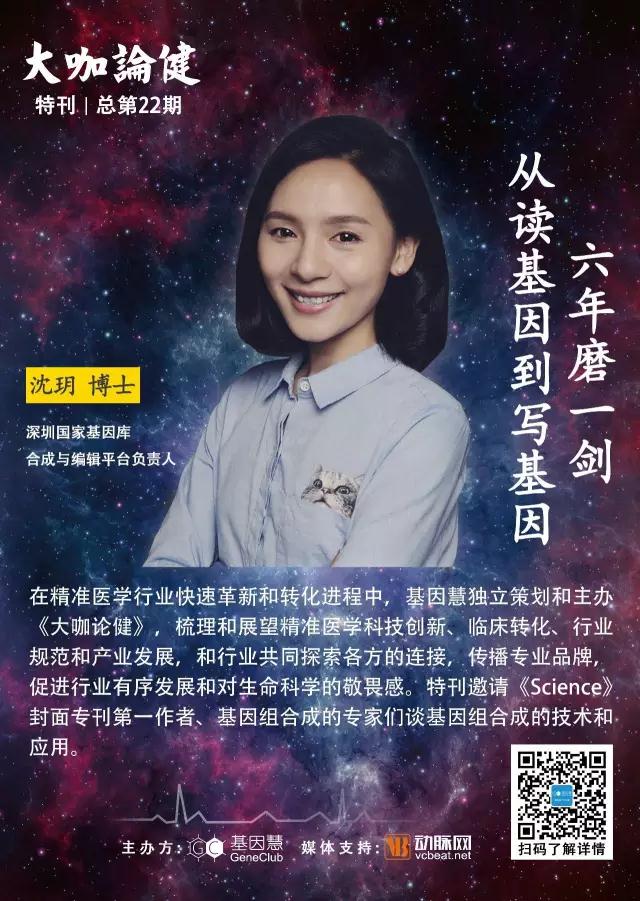
Season 2, Issue 10 | Total Issue No. 22 | Dr. Shen Yue
[Editor's Note]From the synthesis of organic compounds such as urea, amino acids, the protein bovine insulin, and nucleotides, to Venter’s synthesis of a prokaryotic organism, and now to the synthesis of eukaryotic genomes, humanity’s understanding and modification of life have progressively deepened, evolving from comprehension to construction. On this path of technological innovation, there is no shortage of young, brilliant pioneers leading the charge.。NearRecently, the international core scientific journal *Science* reported on a series of advances in synthetic genomics and seven associated papers in a cover story and special issue. Below, we have invitedDr. Shen Yue, the first author of the paper, has dedicated six years to gene synthesis.Hear her share the backstory, along with the application prospects and challenges involved.
Six Years of Honing a Sword: From Reading Genes to Writing Genes
Author: Dr. Shen Yue
Head of the Synthesis and Editing Platform, Shenzhen National GeneBank
[GeneWisdom]: Hello, Shen Yue! Thank you for accepting GenHui’s exclusive interview. Congratulations on the publication of seven papers simultaneously as cover stories and in a special issue of the prestigious international journal Science on March 10, 2017, detailing the Synthetic Yeast Genome Project (Sc2.0 Project). As a key participant and the first author of these papers, could you share with GenHui’s readers some background on this project?
【Shen Yue】“The Sc2.0 Project” was established with the initial goal of synthesizing all 16 chromosomes of the eukaryotic organism Saccharomyces cerevisiae (baker’s yeast), comprising 14 million base pairs—approximately 0.5% the size of the human genome—thereby achieving complete artificial writing and synthesis of the yeast’s life source code. This project represents another major landmark international collaborative effort in the field of synthetic genomics, following the Mycoplasma genome synthesis project. Initiated by the United States, the project involves collaborative efforts from multiple research institutions across China, the United Kingdom, France, Australia, Singapore, and other countries. In 2014, the first chromosome—chromosome III—was fully synthesized. Now, through the collaboration and efforts of the international team, five additional chromosomes have been designed and synthesized.
【GeneHui】: As the head of the Synthesis and Editing Platform at the China National GeneBank in Shenzhen and the first author of the paper, your team jointly completed the design and synthesis of chromosome 2 with the University of Edinburgh. There must be many stories behind this endeavor. Could you share how you became involved in this project, as well as any interesting and meaningful experiences during its course?
[Shen Yue]: The project underwent feasibility studies starting in 2011, with the results published in 2017. Over these six years, our team encountered setbacks in technological research and development, experienced lows, and faced periods of uncertainty inherent to long-term R&D efforts. To stay on schedule, our team members took turns working on duty during the Spring Festival holiday for three consecutive years. Every team member listed as an author of the paper has endured such trials, persevering through solitude and navigating this challenging process. Looking back today, we feel fortunate to have had this experience; it served as a valuable trial that clarified our future direction and bolstered our confidence to continue moving forward along this path.
【GeneWisdom】: I noticed that People’s Daily Online provided immediate coverage of this scientific breakthrough. In your remarks, you mentioned that the project integrates five levels: phenomics, genomics, transcriptomics, proteomics, and metabolomics. In the past, when we discussed trans-omics, it often referred to profiling different omics features across large sample sets and then examining their associations. With regard to genome synthesis, particularly in synthetic eukaryotes, could you elaborate on how it effectively incorporates trans-omics technologies across these five levels? Additionally, are there significant technical barriers to genome synthesis?
[Shen Yue]: Multi-omics analysis is one of the key focuses of our published article. It is crucial to emphasize that the yeast we synthesized was not a “de novo innovation,” but rather a “re-optimization” based on existing maps. Our understanding of life has not yet reached the stage where de novo innovation is feasible. Every modification requires in-depth validation to determine whether it affects the viability of the yeast itself. After incorporating numerous design elements, the primary requirement for the synthesized yeast is to exhibit physiological activity highly similar to that of wild-type yeast. This explains why we conducted in-depth validation from an omics perspective to assess the rationality of our design. Subtle differences may not be directly reflected in the phenotype, making cross-omics validation a powerful supplement. In the article, we reported a specific finding: both transcriptomic and proteomic results revealed nearly a 10% fluctuation in ribosome-related regulatory pathways. However, no phenotypic differences were observed. Ultimately, this fluctuation was proven to be caused by the tRNA we removed. This result directly demonstrates the necessity of omics analysis.
The technical barriers in genome synthesis are mainly reflected in two aspects: First, addressing the synthesis challenges caused by sequence complexity. This is not merely due to high repetitiveness or GC content; we have even encountered cases where conventional synthetic cloning failed because of inherent coding issues within the gene itself. Such cases are often case-by-case and require the gradual accumulation of extensive experience to resolve similar problems. Second, as genome sizes increase, further improving efficiency and reducing costs remain the key challenges we are currently focused on solving.
[GeneHui]: After watching your speech titled “We Are Overturning Darwin’s Theory of Evolution” at the “BGI x Zaojiu” event, you mentioned that the difference between the “Synthetic Yeast Genome Project (Sc2.0 Project)” and Sc1.0 is that this synthetic genome can serve as a tool, enabling exogenous gene introduction without relying on carrots, through gene synthesis methodsSynthesizing carotene through chemical methods is quite intriguing. Regarding the fascinating concept of “creation,” when we first conducted the actual experiment...How did the successful experiment feel? What insights did it provide, and what are its application-related, commercial, and ethical implications for the life sciences industry and humanity?
【Shen Yue】: Many may assume that our team is most excited at this moment, as the article is being published. In fact, that is not the case. Our level of excitement was no less when we obtained validation results confirming the accuracy of our chromosome synthesis, and when we received mass spectrometry data confirming that we had successfully synthesized a series of products.
From a theoretical scientific perspective, the artificial design and synthesis of the yeast genome, along with subsequent research on rapid genomic evolution, not only enable comprehensive functional studies of the entire yeast genome—such as elucidating the functions of unknown genes—but also provide abundant materials for investigating yeast evolutionary history through yeast libraries generated by random genomic variations.
Furthermore, as a microorganism closely linked to human life, yeast is an essential ingredient in winemaking and bread baking. Industrially, yeast enables the production of numerous substances. For instance, by introducing genes related to artemisinin biosynthesis into yeast, large-scale production of artemisinin can be achieved. Similarly, insulin, used by diabetic patients for treatment via injection, is produced using genetically engineered yeast. More intriguingly, one company is leveraging engineered yeast to synthesize novel small-molecule compounds for creating new types of fragrances. We can also harness engineered yeast to produce substances originally synthesized by other microorganisms, such as antibiotics, monosodium glutamate (MSG), and even hyaluronic acid. In short, engineered yeast holds significant application potential closely tied to our daily lives, with broad utility in the production of pharmaceuticals, bioenergy, food, and biomaterials.
References and Literature:
1. http://scitech.people.com.cn/n1/2017/0310/c1007-29135176.html
2. http://science.sciencemag.org/content/355/6329/eaaf4791
3. Building on nature's design
4. 3D organization of synthetic and scrambled chromosomes
5. “Perfect” designer chromosome V and behavior of a ring derivative
6. Bug mapping and fitness testing of chemically synthesized chromosome X
7. Design of a synthetic yeast genome