

Lian Technology Files IPO Prospectus: Pioneering Cloud-Based Health Management Services Across 12 Provinces as the Guardian of Family Health
In 2017, VCBeat launched a case study collection campaign themed “The Power of Downward Reach—Seeking Best Practices in China’s Primary Healthcare.” Starting from February 15, we invited submissions of primary healthcare service practice cases from across the industry. We will explore development trends in the primary healthcare sector from dimensions such as industrial policy, technological evolution, business models, and industry collaboration, and select innovative healthcare enterprises that truly represent and are deeply rooted in primary care for coverage. Stay tuned.
ClickRegistration Address, enter the event introduction page.
More than a month ago, Lian Technology signed a strategic cooperation agreement with the China Smart City Forum. As part of the 2017 National Smart City Tour lecture series, Feng Nanhai, founder of Lian Technology and a think-tank expert for the China Smart City Forum, will share case studies on cloud-based population health management services across 12 provinces. With so many enterprises engaged in grassroots smart healthcare throughout China, what sets Lian Technology apart as a model example? To find out, VCBeat conducted an exclusive interview with Feng Nanhai to learn more about his entrepreneurial journey.
Family Health Gatekeeper
Community residents throughPurchase or LeaseLian Tech Multi-Parameter Intelligent Wearable Health Self-Check Device: Measure your health data at home, and patients and family members can access the information online.
The information backend system of the Community Health Service Center enables general practitioners to analyze these data and generate patient assessment reports, thereby providing users with immediate, science-based health guidance. This helps residents reasonably plan their fitness activities and dietary intake, while also facilitating online consultation and communication with specialists.
The integration of home health informatization with medical informatization aims to jointly address the current shortage of community healthcare professionals and ensure effective health management at the household level. This is Lian Technology’s goal: to serve as the gatekeeper of family health.
# Transformation Helps Enterprises Survive Crises

Feng Nanhai
Feng Nanhai, born in 1957 at the Navy General Hospital in Beijing, was immersed from childhood in the culture of military compounds, which instilled in him the decisive and vigorous work style characteristic of a soldier. As part of the first cohort of university students admitted in 1977 after the Cultural Revolution, he studied at Beijing University of Posts and Telecommunications. This academic foundation gave him the resolve to resign from his stable position and venture into business, where he leveraged his expertise to establish a company that pioneered mobile phone electronic top-up card payment services across China. After graduation, he was assigned to conduct scientific research in the aerospace industry. This professional experience equipped him with the innovative spirit and cross-disciplinary resilience needed to boldly enter the smart healthcare sector. This serves as a brief summary of key chapters in his life.
In 2002, Feng Nanhai founded a company that leveraged internet-based concepts to address the inconvenience of paying telecommunications carriers. Using this as a breakthrough point, he transformed mobile phone bill payments into electronic recharge card transactions. Encrypted value-bearing cards were transmitted via the network to sales terminals, where they were decrypted to complete customer payment processes. As the business expanded continuously, it launched China’s first mobile virtual network operator (MVNO) services, with operations established in Beijing, Guangzhou, Hebei, Shandong, and other regions.
In 2005, Feng Nanhai came to Ningxia to expand his business and participated in the bidding for China Mobile Ningxia Branch to become a service operator for mobile electronic recharge vouchers. After winning the bid based on his strengths, Feng Nanhai established more than 4,000 Lian Digital Community service outlets in Ningxia within three to five years.
In 2008, the Department of Commerce of Ningxia Hui Autonomous Region implemented the “Three Conveniences and One Promotion Project” (establishing a service network platform for public convenience, deploying digital community network terminals for public convenience, creating convenient employment channels, and promoting the development of modern service industries). Li’an Technology seized this opportunity and became the implementing enterprise for the government’s public convenience project. After more than ten years of development in Ningxia, its service outlets have basically covered all five prefecture-level cities in the Ningxia Hui Autonomous Region and gained public recognition, which also laid an important foundation for its subsequent development of convenient smart healthcare services.
With the widespread adoption of Alipay and WeChat, mobile payments began to gain popularity. In 2013, Feng Nanhai recognized the emerging crisis and decided to pivot his business. He told VCBeat that the direction of this transformation was linked to his own family life.
Feng Nanhai, now in middle age, often accompanies his elderly family members to the hospital. During these visits, he has observed that although doctors are already overwhelmed with work, they still need to answer patients’ phone calls during consultations, addressing issues such as abnormal blood pressure readings and changes in medication regimens.
In general, households with elderly members tend to purchase blood pressure monitors. However, patients often struggle to interpret the measurements themselves and still need to consult doctors at hospitals. Feng Nanhai wondered whether it would be possible to develop a device and system that allows both doctors and family members to access the measurement data once recorded, enabling physicians to provide guidance and recommendations as needed. Consequently, Feng Nanhai decided to pivot and venture into cross-disciplinary research on the Internet of Things (IoT) and big data to deliver remote medical services over the internet.
The company began its journey by developing remote blood pressure monitors, launching its first-generation product in 2014. During the promotion phase, it became evident that a single-parameter device was too limited. From the perspective of home healthcare, there was no multi-parameter self-testing device available for households in China. Consequently, the company shifted its strategic focus from the broader domain of online telemedicine to the development of intelligent multi-parameter home health self-testing devices, thereby advancing the digitalization of home health information.
2016 Lian Health Self-Testing Devices and National Health Management Cloud Platform Services, from home health data collection to health intervention services, forming a complete closed loop. Multi-parameter intelligent health self-test device,It can measure 21 physical indicators, including blood pressure, blood glucose, blood oxygen, heart rate, body temperature, respiratory rate, body mass index (BMI), basal metabolic rate (BMR), and body fat percentage, within minutes, while also completing the “One Cloud, Three Terminals” service system.(National Health Management Cloud Service, Doctor PC Client, Customer PC Client, WeChat Push Notification Server).
Doctors at primary healthcare service stations can access residents' home self-monitoring health data directly through the platform without leaving their stations, providing an effective reference basis for delivering health interventions and guidance to patients with chronic diseases.. Meanwhile, by leveraging the analysis of home-based health self-testing data, a smart public health service system has been established for primary healthcare institutions. This enables primary care physicians to conduct follow-up services via WeChat using artificial intelligence technology, significantly reducing their workload and providing practical, appropriate technologies for tiered diagnosis and treatment as well as family doctor contract services.
During the market promotion phase, the rollout of the National Health Management Cloud Project was not without its challenges., Feng Nanhai told VCBeat that during the initial promotional phase, their product attracted only one user per day. It was through door-to-door visits, collaborating with physicians to conduct community-based chronic disease management education, and partnering with the government that they eventually broke into the market.
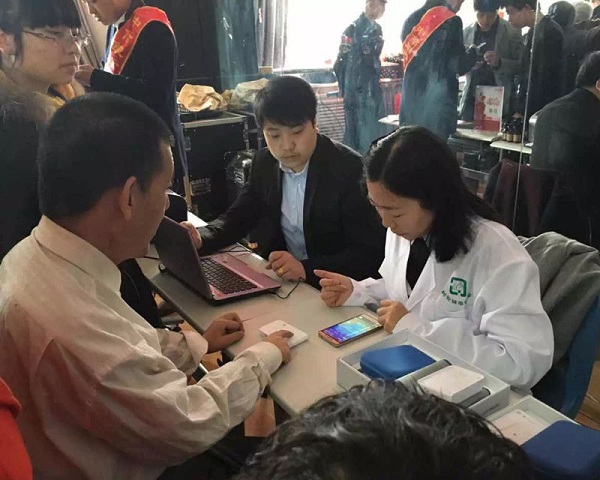
Additionally, to enhance user stickiness, they have established WeChat and QQ groups for the community, where elderly users actively engage in discussions with positive results.
Li'an Technology is currently providing health management services to residents in 100 communities in Yinchuan. By the end of this year, it will expand its services to 500 communities, with each resident required to undergo measurements two to three times per week. The resulting big data will be available to support government decision-making.
Any company that doesn’t aim to make money is acting like a rogue.
Many mobile health companies currently boast large user bases and impressive user metrics, yet their profitability models remain unsatisfactory. In an interview with VCBeat, Feng Nanhai stated that he has never engaged in deceptive practices since founding his company, emphasizing that businesses without profitability cannot sustain themselves in the long run.
Tiered diagnosis and treatment and family doctor contracting are unfeasible without the collection of household health data and the interoperability of medical informatization.. Lian Technology focuses on appropriate technologies for primary care settings. By integrating local medical institutions with internet-based solutions, facilitating doctor-to-doctor collaboration (between specialists and primary care physicians), and enhancing doctor-patient communication, it aims to increase patients’ sense of benefit, thereby establishing a solid foundation for sustainable development.
Lian Technology’s current profitability relies primarily on its services: for an annual service fee of RMB 300 per user—less than RMB 1 per day—individuals can access personal health data collection and guidance and intervention services provided by community physicians. This constitutes the first tier of the five-tier medical service system within the Smart Healthcare framework of the “Smart Yinchuan” model.
This year, Li'an Technology is expected to serve 500,000 residents in Yinchuan, with revenue reaching RMB 150 million., with the costs shared by users and the government. The government gains access to user health data for decision-making, which not only enhances health management but also alleviates pressure on the medical insurance system—this is part of the reason why the government is willing to contribute financially.
VCBeat has learned that in the Yinchuan model of smart healthcare,It embodies the concept that prevention is proactive treatment. Healthy individuals who are not yet ill can use intelligent self-check devices to monitor various health indicators at home, thereby achieving the goal of self-managed health.When physical health indicators fall below standard, adopting lifestyle modifications through non-medical means can help prevent disease onset. For patients already diagnosed with a specific condition, various preventive measures should be taken based on home-based self-monitoring health data to reduce the risk of disease progression and the development of comorbidities.
Feng Nanhai told VCBeat that, in terms of marketing, the company plans to promote the Yinchuan model of smart healthcare in Beijing, Qinghai, Zhejiang, Yunnan, Xinjiang, Guangzhou, and other provinces and cities in 2017, with related efforts already underway. To date, Li’an Technology has not undergone any financing rounds. Feng Nanhai stated that a financing plan will be launched in the near future to support the development of its future marketing team and the promotion of its projects.