

Baiyunshan Reports Record Revenue of Over RMB 20 Billion in 2016, with Jin Ge Sales Surpassing RMB 4 Billion
VCBeat (WeChat: vcbeat), March 16 – Guangzhou Baiyunshan Pharmaceutical Holdings Co., Ltd. (600332.SH) today announced its 2016 annual report. During the reporting period, the company reported revenue of RMB 20.035 billion, a year-on-year increase of 4.76%; total profit of RMB 1.945 billion, up 19.47% year on year; and net profit of RMB 1.508 billion, representing a 15.97% year-on-year increase. Historical data show that this marks the first time Baiyunshan’s annual revenue has exceeded RMB 20 billion, with net profit surpassing RMB 1 billion for three consecutive years.
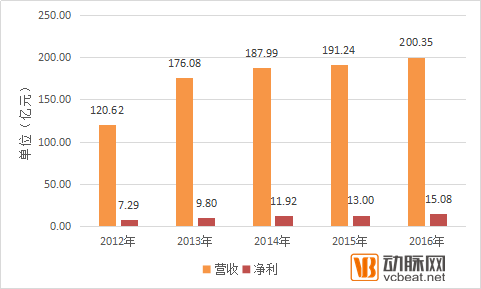
Baiyunshan Historical Revenue Data
Baiyunshan is the sole listed company (Hong Kong H-shares and Shanghai A-shares) under Guangzhou Pharmaceutical Holdings Limited. The Group’s business primarily comprises four segments: (1) research and development, manufacturing, and sales of Chinese and Western proprietary medicines, active pharmaceutical ingredients (APIs), natural medicines, biopharmaceuticals, and API intermediates; (2) wholesale, retail, and import/export of Western medicines, traditional Chinese medicines, and medical devices; (3) research and development, production, and sales of big health products; and (4) investments in the health industry, including medical services, health management, and wellness and elderly care.
The revenues from these business segments were RMB 690.6 million, RMB 776.9 million, RMB 514.8 million, and RMB 5.1 million, respectively, with corresponding costs of RMB 389.3 million, RMB 460.1 million, RMB 483.9 million, and RMB 3.8 million. The profit margins for the first two segments both exceeded 40%.
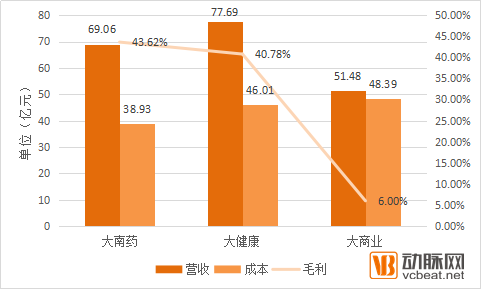
“Jinge” Delivers Impressive Performance
“Big Southern Medicine” is the core business and foundational industry of GPC Baiyunshan. During the reporting period, GPC Baiyunshan prioritized the “Big Southern Medicine Revitalization Project” as its top agenda. By implementing measures such as establishing a top-level design for technological innovation, integrating sales operations, strengthening core competencies while addressing weaknesses, developing a list of growth projects, attracting distributors for dormant product lines, and introducing compensation incentives, the company drove significant high-speed growth in its key products. Notably, Zishen Yutai Pills from Zhongyi Pharmaceutical, Shujin Jianyao Pills from Chen Liji Pharmaceutical Factory, and Sildenafil Citrate (“Jinge”) from Baiyunshan General Pharmaceutical Factory all achieved rapid growth, with year-on-year increases exceeding 60%.
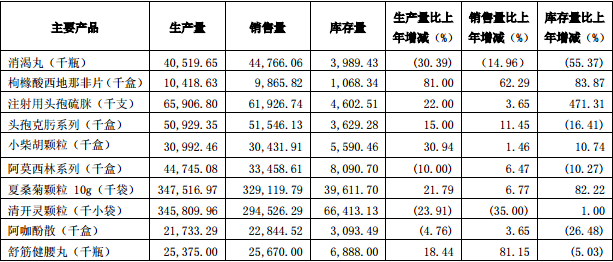
Jinge (Sildenafil Citrate Tablets) is the first domestic generic version of Viagra. Baiyunshan obtained the production approval (National Medical Products Administration Approval No. H20143255) in July 2014, officially launched the product in October 2014, and basically completed pharmacy distribution by early 2015. In 2015, it generated RMB 234 million in revenue for Baiyunshan, and by 2016, with a growth rate of 62.29%, it had become Baiyunshan’s second-largest core product.
According to the annual report data, Baiyunshan Pharmaceutical General Factory produced 10.41 million boxes of Jinge in 2016, sold 9.865 million boxes, and held an inventory of 1.068 million boxes. Baiyunshan stated that the year-on-year increase of 81.00% in Jinge’s production volume was primarily due to increased sales demand and expanded mass production; the year-on-year increase of 62.29% in sales volume was mainly attributed to market expansion and the implementation of promotional strategies, which drove growth in end-user sales; the year-on-year increase of 83.87% in ending inventory was primarily caused by rising market demand, leading to a corresponding increase in inventory levels.
According to a research report by Soochow Securities, Jinge is the largest growth driver in the Southern Pharmaceutical segment. Data from China's National Bureau of Statistics indicates that approximately 127 million people in China suffer from erectile dysfunction, with a noticeable trend toward younger patients, suggesting a potential market size worth tens of billions of yuan. Viagra’s terminal sales reached RMB 1 billion. Following the expiration of patent protection, Jinge, as the first generic version, achieved sales of approximately RMB 400 million in 2016, with terminal sales nearing RMB 1 billion—close to Viagra’s level—and its compound annual growth rate doubled between 2014 and 2016. Jinge enjoys significant advantages in distribution channels and pricing, with a gross profit margin exceeding 90%. Although additional generic drug applications are expected, Jinge has already secured a first-mover advantage. Sales are projected to reach RMB 800 million in 2018, with a net profit margin of 20% and net profit of RMB 160 million. Applying a price-to-earnings (P/E) ratio of 30x implies a market capitalization of RMB 4.8 billion.
Leveraging Star Products to Expand into the Greater Health Sector
As a typical example of pharmaceutical companies actively transforming toward the “big health” sector, Baiyunshan has proactively expanded into the production, R&D, and sales of beverages, food, health supplements, and cosmeceuticals, launching flagship products such as Wang Lao Ji herbal tea, Ganoderma lucidum spore oil capsules, throat lozenges, and Guilinggao (turtle jelly).
In its annual report, Baiyunshan stated that the revenue of its big health segment is primarily derived from Wanglaoji herbal tea. Regarding the sales of Wanglaoji herbal tea, Wanglaoji Big Health Company mainly adopts a distribution model with a three-tier distributor structure. Tier-1 distributors are accountable to Wanglaoji Big Health Company and are specifically responsible for regional channel development in accordance with the sales targets assigned by the company. Tier-2 distributors purchase products from Tier-1 distributors and handle product delivery. Wanglaoji Big Health Company directly manages advertising expenditures and participates in terminal expansion, promotional activities, and customer retention.
To further elevate Wang Lao Ji herbal tea’s market position, Wang Lao Ji Health Industry Company undertook numerous initiatives last year. These included initiating the establishment of the China Time-Honored Brand Alliance, promoting campus football, establishing the Wang Lao Ji Scholarship in partnership with Tsinghua University, launching the “Bring Love Home in Time” campaign, collaborating with Zhejiang Satellite TV’s flagship program Challenger League, tying in with the popular IP Report for Boss Season 2, and engaging in cross-industry marketing collaborations with Taobao and mobile games.
Moreover, new products are continuously being launched, including low-sugar and sugar-free variants of Wanglaoji herbal tea. The company is also collaborating with domestic groups and institutions to explore and develop the walnut milk beverage market and to jointly operate large-scale health and wellness chain experience stores, placing high hopes on the diversified development of its health and wellness product portfolio.
The herbal tea market has currently formed a duopoly, with Wang Lao Ji and Jia Duo Bao holding a combined market share of 80%. According to a research report by Soochow Securities, the herbal tea market is valued at approximately RMB 40 billion, with sales growth having declined to a low of 4%. Increased market concentration may lead to reduced expenses, resulting in a turning point for net profit. The net profit margin is projected to reach 8%, 10%, and 14% in 2017, 2018, and 2019, respectively. Wang Lao Ji’s revenue is expected to maintain a growth rate of over 10% in 2017–2018, reaching RMB 10 billion and RMB 11 billion, respectively, with annual net profit exceeding RMB 1 billion.
Top 10 Development Highlights This Year
From the broader perspective of the pharmaceutical sector, China has implemented numerous reforms in recent years targeting pharmaceutical manufacturing, distribution, medical insurance reimbursement, and terminal healthcare services. The release of the “Outline of the ‘Healthy China 2030’ Plan” has further provided programmatic guidance for the development of the pharmaceutical industry, with the elimination of outdated production capacity and mergers and acquisitions becoming long-term trends.
As regulatory standards in China’s pharmaceutical and healthcare industry continue to rise, the previous extensive growth model is no longer sustainable. It is being replaced by a moderation in the industry’s overall growth rate, along with divergent development and structural adjustments across various sub-sectors. These trends signal the advent of an era characterized by healthy, standardized, and differentiated development. In the future, only enterprises that proactively embrace change and align their transformation strategies with industrial trends will achieve long-term growth.
In its annual report, Baiyunshan stated that in 2017, the pharmaceutical industry would not only be affected by the continued downturn of the macroeconomic environment but also, more significantly, by national policies. The year 2017 was a critical period for the implementation of policies such as the Consistency Evaluation and the “Two-Invoice System.” Meanwhile, stricter controls on medical insurance expenditures would further curb growth at the hospital terminal level, accelerating industry consolidation and intensifying mergers and acquisitions among enterprises. The focus of drug research and development would gradually shift from generic drugs to innovative drugs. Supported by national policies, the market share of the big health industry and Traditional Chinese Medicine (TCM) was expected to grow, presenting development opportunities for major TCM proprietary medicine products. In the future, macro-level supporting policies for online pharmaceutical trading would remain favorable, further promoting the development of pharmaceutical e-commerce. From a long-term perspective, the policy environment for the pharmaceutical and healthcare industry would become increasingly favorable, the industrial environment would become more standardized, and the market environment would become more complex.
Based on this, Baiyunshan outlined 10 key points for its 2017 plan. Key focuses include brand strategy, logistics network expansion, Baiyunshan Hospital, and investment and mergers and acquisitions.
Boosted by the annual report’s performance results, Baiyunshan’s stock price rose 2.5% in early trading, closing at 28.14 today with a gain of 0.68%.