

Third Military Medical University's AI-Powered Blood Typing Platform Achieves >99.9% Accuracy in Under 30 Seconds
Blood type can be identified within 30 seconds using artificial intelligence, with an accuracy rate exceeding 99.9%. This was reported on March 15 in the authoritative journal “Science Translational Medicine》published an article on the latest research findings by Luo Yang’s team at the Third Military Medical University of China,This is of significant importance for patients requiring urgent blood transfusions, as it can save 3–15 minutes, thereby increasing their chances of survival. It is also applicable in situations demanding rapid blood testing, such as disaster relief and battlefield emergency care.
Traditional hospital-based blood typing requires 3–20 minutes.
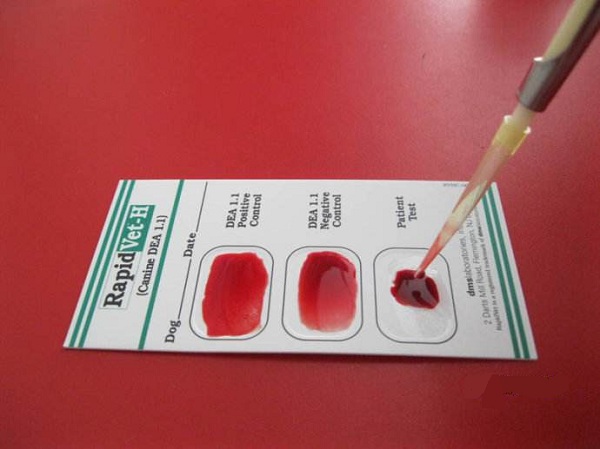
According to VCBeat, blood type refers to the specific types of antigens present on red blood cells. In the ABO blood group system, individuals are classified into types A, B, AB, and O based on the presence or absence of A and B antigens on the red blood cell membrane. The blood group system is of critical importance in blood transfusion; transfusing incompatible blood can trigger hemolytic reactions, leading to hemolytic anemia, renal failure, shock, and even death.
Currently, there are two methods for blood type identification in hospitals.Slide Method and Tube Method,Among these, the slide method is the most widely used., here is a brief overview of the steps:
(1) The nurse places one drop each of anti-A and anti-B sera on opposite sides of a glass slide, labeling them A and B, respectively.
(2) Disinfect the tip of the left ring finger with a 75% alcohol cotton ball, and puncture the skin with a sterile lancet. Place one drop of blood into a small test tube containing 1 mL of normal saline, and mix well to prepare a red blood cell suspension (approximately 5% concentration).
(3) Use a dropper to draw up the red blood cell suspension, and place one drop onto the serum on each side of the glass slide. Mix separately using two toothpicks (take care to strictly prevent contact between the two types of serum).
(4) After 15 minutes, visually inspect for agglutination to determine blood type.
VCBeat learned from online feedback provided by physicians that blood typing typically takes approximately 3 to 20 minutes, depending on the specific circumstances. During this testing phase, patients must simply wait for the results—a brief interval that can feel interminably long for those in urgent need of life-saving transfusions.
Establish an Automated Blood Typing Platform
The technology developed by Luo Yang’s team at the Third Military Medical University,Can be30Detected within secondsABOBlood Type andRhBlood Type,With just a drop of blood2Complete simultaneous forward and reverse typing, including rare blood types, within minutes(To minimize errors, physicians typically perform both forward and reverse typing as well as crossmatching tests prior to blood transfusion.) Meanwhile, the team has also developed an intelligent algorithm capable of determining blood type based on color changes in test strips, achieving a typing accuracy rate exceeding99.9%。
Luo Yang’s team employs antigen-antibody reactions and pH test strip color changes for identification.. Researchers impregnated special paper materials with pH indicator dyes to create paper strips of specific shapes. Different serum antibodies were then immobilized at distinct locations on each strip, allowing blood types to be determined based on the color changes resulting from the reaction between blood and the antibodies.
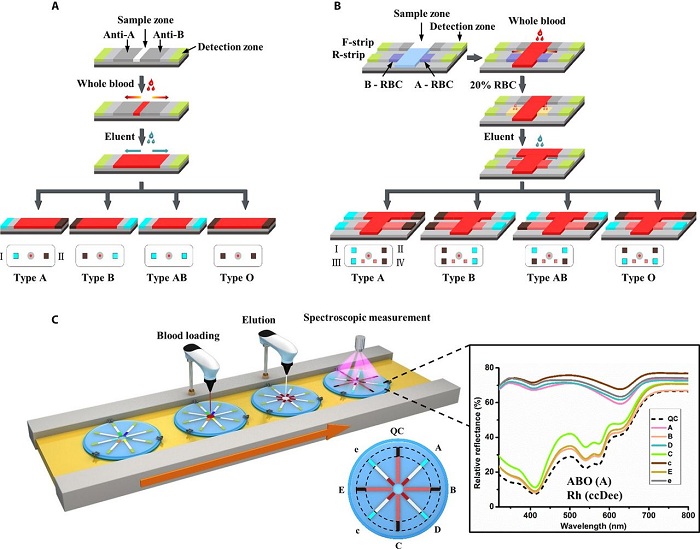
(A) ABO forward typing strip, (B) simultaneous ABO reverse typing, and (C) design of multiplex antigen detection for ABO and Rh blood groups, enabling automated blood type identification. I and II represent the forward blood typing observation windows; III and IV represent the reverse blood grouping observation windows. The observation zone is located between the two dashed lines, as shown in the platform for ABO and Rh group testing (C). Strips without antibodies (containing only BCG) are used for quality control (QC).
It is worth noting that the recognition of post-reaction color changes is not performed manually, but rather automatically identified by the machine.To minimize errors associated with manual interpretation, the R&D team developed a machine learning algorithm for the automated identification of color changes. To validate the algorithm's accuracy, researchers first identified the blood types of 3,550 blood samples using the classical gel card method. Subsequently, through parameter optimization, the algorithmic model accurately determined the blood types of these 3,550 samples.
Meanwhile, in another trial, researchers collected 600 blood samples, including 15 invalid samples (such as those containing red ink),The machine learning model identified 15 invalid samples with 100% accuracy.。
Furthermore, the paper mentions that this approach not onlyConvenient, rapid, and low-cost, this method is well-suited for widespread adoption. With minor modifications, it can be developed into a cost-effective and robust universal blood typing platform for industrial-scale application.VCBeat looks forward to seeing such technology enter the market as soon as possible.
Original paper: http://stm.sciencemag.org/content/9/381/eaaf9209.full